Why USB Ports Matter More Than You Think in a Tesla
Search for "USB for Tesla" and you'll find thousands of owners trying to figure out which cables work, where the ports are, and how to get dashcam and Sentry Mode running reliably. In the refreshed 2026 Tesla Model Y, USB-C isn't just about charging your phone — it's the backbone of the car's data recording, media playback, and device integration. This review covers the full Model Y lineup while giving you the definitive USB setup guide Tesla never published.
The 2026 Model Y continues to dominate the electric crossover segment with up to 320 miles of EPA range, 250 kW DC fast charging, and a cabin that's as much a rolling computer as it is a family hauler. Let's break down every spec that matters — and exactly how to use those USB-C ports.
2026 Tesla Model Y: Full Spec Sheet
| Spec | Long Range RWD | Long Range AWD | Performance |
|---|---|---|---|
| EPA Range | 320 mi | 308 mi | 285 mi |
| Battery (usable) | ~75 kWh, LFP | ~75 kWh, NMC | ~75 kWh, NMC |
| Drivetrain | Rear-Wheel Drive | Dual-Motor AWD | Dual-Motor AWD |
| Horsepower | 346 hp | 384 hp | 510 hp |
| 0–60 mph | 5.8 sec | 4.8 sec | 3.5 sec |
| DC Fast Charge (peak) | 250 kW | 250 kW | 250 kW |
| 10–80% DC Time | ~25 min | ~25 min | ~25 min |
| Level 2 Home Rate | 11.5 kW (44 mi/hr) | 11.5 kW (44 mi/hr) | 11.5 kW (44 mi/hr) |
| MPGe (combined) | 122 MPGe | 116 MPGe | 110 MPGe |
| Base MSRP | $44,990 | $47,990 | $52,990 |
| Battery Warranty | 8 yr / 120,000 mi | 8 yr / 120,000 mi | 8 yr / 120,000 mi |
Source: EPA fueleconomy.gov and Tesla Model Y design page.
Real-World Range: What the EPA Sticker Doesn't Tell You
Long Range RWD: EPA 320 mi — expect 270–290 mi on highway road trips at 70+ mph, and roughly 220–250 mi in sub-30°F winter conditions.
Long Range AWD: EPA 308 mi — expect 255–280 mi highway, 210–240 mi in deep cold.
Performance: EPA 285 mi — expect 235–260 mi highway with aggressive driving reducing that further.
The Model Y's efficiency is genuinely class-leading among electric crossovers, but physics is physics. Highway speeds above 70 mph push aerodynamic drag up significantly, and cold weather reduces battery chemical efficiency while drawing energy for cabin heating. The Model Y uses a heat pump (standard on all trims), which mitigates winter losses compared to resistive heating, but you'll still see a 15–25% range reduction in sustained freezing temperatures.
For city commuting with regenerative braking engaged, hitting or slightly exceeding the EPA number is realistic in mild weather. The LFP battery in the RWD trim also tolerates regular 100% charging without degradation concerns, meaning you actually get to use all 320 miles of rated range daily — unlike NMC owners who are advised to cap at 80% for longevity.
USB-C Ports in the Model Y: Complete Guide
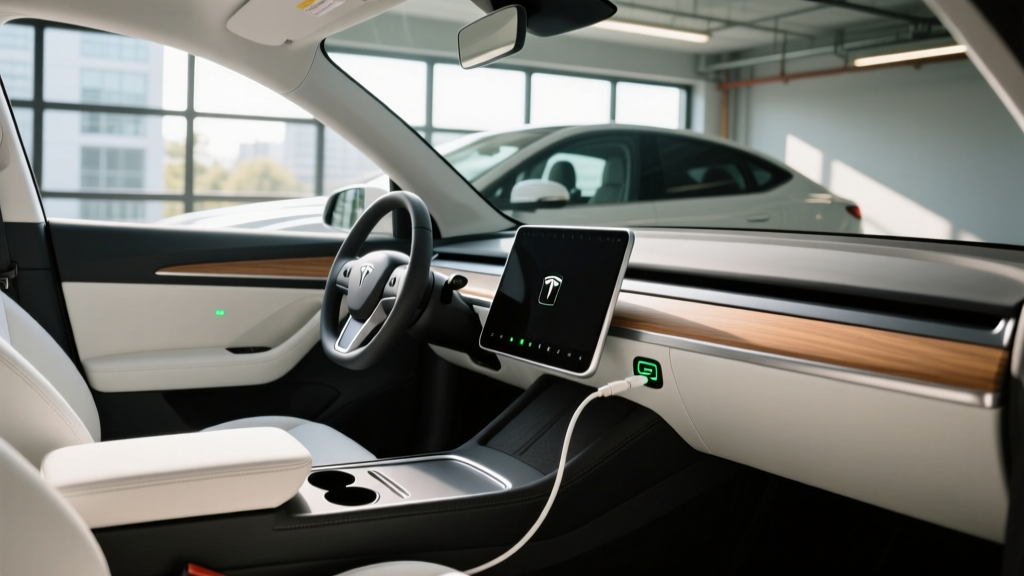
The 2026 Model Y features five USB-C ports distributed across the cabin, plus a wireless charging pad. Here's what each one does and how to set them up properly:
Port Locations and Power Output
- Front center console (2× USB-C): Up to 65W each — supports fast phone charging, laptop charging, and data transfer for dashcam/Sentry Mode USB drives.
- Rear seat (2× USB-C): Up to 27W each — phone and tablet charging for rear passengers.
- Glovebox (1× USB-C): Data port for Sentry Mode and dashcam recording — this is the secure port Tesla recommends for your recording drive.
Setting Up Dashcam and Sentry Mode via USB
To use the Model Y's built-in cameras for dashcam and Sentry Mode recording, you need a properly formatted USB drive plugged into the glovebox USB-C port. Here's the setup:
- Use a USB-C flash drive (64 GB minimum, 128 GB+ recommended) or a USB-C SSD for better thermal performance.
- Format the drive as exFAT on your computer.
- Create a folder named TeslaCam at the root of the drive.
- Plug it into the glovebox USB-C port.
- The car will recognize it automatically — enable Sentry Mode and Dashcam in Controls > Safety.
Pro tip: USB-C SSDs (like the Samsung T7) handle sustained heat far better than thumb drives, which can throttle or fail during long Sentry Mode sessions in hot parked cars. This is the single most common "USB for Tesla" problem owners encounter — drive overheating and corrupted footage.
USB-C Cable Recommendations
Not all USB-C cables support data transfer. For dashcam connectivity, you need a cable rated for USB 3.1+ data (not charge-only cables). For phone charging alone, any quality USB-C cable with 60W+ rating works. For Apple CarPlay-style integration, note that Tesla does not support CarPlay or Android Auto natively — phone integration is limited to Bluetooth audio and the Tesla app.
Charging Speed: DC Fast, Level 2, and Level 1
| Charging Level | Power | Speed (mi/hr added) | Notes |
|---|---|---|---|
| Level 1 (120V outlet) | ~1.4 kW | ~5 mi/hr | Emergency/trickle only |
| Level 2 (240V, 48A) | 11.5 kW | ~44 mi/hr | Full overnight charge in ~7 hr |
| Level 2 (240V, 32A) | 7.7 kW | ~30 mi/hr | Common with Mobile Connector |
| DC Fast (Tesla Supercharger V3) | 250 kW peak | ~1,000 mi/hr at peak | 10–80% in ~25 min |
| DC Fast (CCS adapter, non-Tesla) | Up to 250 kW | Varies by station | CCS adapter included since 2024 |
The Model Y's charging curve peaks at 250 kW up to roughly 50% state of charge, then tapers progressively. Expect 10–80% in about 25 minutes at a V3 Supercharger, but 80–100% adds another 20+ minutes due to cell-balancing taper. For road trips, the practical strategy is charging to 80% and moving on — the navigation system's preconditioning feature warms the battery en route to your next Supercharger, which is critical for achieving peak charge rates in cold weather.
At home, a Wall Connector on a 60A circuit delivers the full 48A / 11.5 kW, adding roughly 44 miles of range per hour. Most owners charging overnight from 20% to 80% need only 4–5 hours. Installation typically runs $500–$1,500 depending on panel proximity and local permitting — consult a licensed electrician for your specific setup.
Pricing, Trims, and Federal Tax Credit Eligibility
| Trim | Base MSRP | As-Tested (typical config) | §30D Credit Potential | Effective Price |
|---|---|---|---|---|
| Long Range RWD | $44,990 | $46,490 (with color + wheels) | Up to $7,500* | ~$38,990* |
| Long Range AWD | $47,990 | $49,990 | Up to $7,500* | ~$42,490* |
| Performance | $52,990 | $55,490 | Up to $7,500* | ~$47,990* |
*Federal §30D credit eligibility depends on multiple requirements. Always verify current rules.
§30D Tax Credit Eligibility Checklist
- MSRP cap: SUVs/crossovers must be ≤ $80,000 — all Model Y trims qualify.
- Buyer income cap: AGI ≤ $150,000 (single), $225,000 (head of household), $300,000 (joint).
- Battery sourcing: Critical minerals and battery components must meet phased-in domestic/free-trade sourcing thresholds — check IRS §30D guidance for current-year percentages.
- Point-of-sale transfer: Since 2024, you can transfer the credit to the dealer at purchase, reducing your out-of-pocket cost immediately rather than waiting for tax filing.
- Final assembly: Must occur in North America — the Fremont, CA and Austin, TX factories qualify.
The battery-sourcing requirements tighten annually, and specific Model Y configurations may qualify for the full $7,500, a partial $3,750, or nothing depending on the battery pack supplier at time of manufacture. Always confirm the specific VIN's eligibility with your Tesla advisor and a tax professional before relying on the credit in your budget.
Interior, Cargo, and Daily Livability
The refreshed Model Y interior is sparser than competitors but functionally excellent. The 15.4-inch center touchscreen handles all vehicle controls — no physical buttons for climate, mirrors, or glovebox. This takes adaptation but becomes intuitive within a week.
Dimensions and Space
- Cargo (rear seats up): 30.2 cu ft
- Cargo (rear seats folded): 72.1 cu ft
- Front trunk (frunk): 4.1 cu ft — fits a soft duffel or charging cables
- Rear legroom: 41.6 inches — genuinely comfortable for adults on long trips
- Front headroom: 40.8 inches (glass roof creates an airy feel despite low roofline)
The flat floor and absence of a transmission tunnel give the rear seat a spacious, limousine-like feel. Two adults on a 400-mile road trip will arrive comfortable; three across is tight for anyone over 5'8" due to shoulder width.
Standout Tech
- Autopilot (standard): SAE Level 2 adaptive cruise + lane centering — driver must remain engaged at all times.
- FSD Supervised (optional, ~$8,000 or $99/mo): Still Level 2 — adds automatic lane changes, traffic light recognition, and city street navigation. Not autonomous driving.
- Sentry Mode: Cameras record when parked and motion/impact detected — requires USB drive in glovebox.
- Over-the-air updates: Tesla regularly adds features; the 2026 model year received improved adaptive suspension tuning and UI refinements.
- HEPA air filtration: Bioweapon Defense Mode remains class-leading for air quality in wildfire or pollution-heavy regions.
Pros, Cons, and How It Stacks Up
Pros
- Best-in-class efficiency (kWh/100mi) among electric crossovers
- Supercharger network access — still the most reliable DC fast-charging ecosystem
- Strong real-world range, especially RWD with LFP battery (daily 100% charging OK)
- Over-the-air updates add features over time
- Excellent cargo versatility with flat floor + frunk
- Five USB-C ports with 65W front charging
Cons
- No Apple CarPlay or Android Auto
- Minimalist interior feels cheap relative to Hyundai Ioniq 5 or BMW iX
- Ride quality on Performance trim is firm over rough pavement
- All controls via touchscreen — no physical climate or volume knobs
- FSD Supervised is expensive and remains Level 2 (not self-driving)
- Insurance premiums run 15–30% higher than comparable ICE crossovers
Model Y vs. Key Competitors
The Hyundai Ioniq 5 offers 800V architecture (10–80% in ~18 min on 350 kW chargers), CarPlay, and a more comfortable ride — but less range (305 mi max) and no frunk on AWD trims. The Ford Mustang Mach-E brings a more engaging drive and BlueCruise hands-free highway driving, but trails on range and Supercharger access. The BMW iX delivers a luxury interior and quieter cabin, but starts ~$20,000 higher. For total cost of ownership, charging infrastructure, and software, the Model Y remains the default rational choice — just not the most emotionally compelling one.
Who the 2026 Model Y Suits Best
Choose the Model Y Long Range RWD if: You commute 30–60 miles daily, want maximum range, don't need AWD, and prefer the LFP battery's longevity and 100% charging tolerance. Best value in the lineup.
Choose the Model Y Long Range AWD if: You live in a region with snow/ice, take regular road trips, and need the traction and acceleration security of dual motors. The sweet spot for most families.
Choose the Model Y Performance if: You want sports-car acceleration (3.5 sec 0–60) in a practical crossover and accept the range and ride-quality trade-offs. Enthusiast pick.
Look elsewhere if: You need CarPlay/Android Auto, prefer physical buttons, want a luxury-grade interior, or need three-row seating (consider the Kia EV9).
Frequently Asked Questions
What is the real-world range of the 2026 Tesla Model Y?
The EPA rates the Long Range RWD at 320 miles, the AWD at 308 miles, and the Performance at 285 miles. In real-world highway driving at 70–80 mph, expect 250–290 miles depending on trim. In freezing weather, reduce those figures by 15–25%. City driving with regenerative braking can match or slightly exceed EPA estimates in mild temperatures.
How fast does the Model Y charge at home and on the road?
At a Tesla V3 Supercharger, the Model Y peaks at 250 kW and charges from 10–80% in approximately 25 minutes. At home on a 48A Level 2 Wall Connector (240V), it charges at 11.5 kW, adding about 44 miles of range per hour — a full overnight charge takes roughly 7 hours from near-empty. On a standard 120V outlet (Level 1), expect about 5 miles per hour — adequate only for overnight top-ups.
How much does the Model Y cost after the federal tax credit?
Base MSRPs range from $44,990 (Long Range RWD) to $52,990 (Performance). If you qualify for the full §30D credit of $7,500 — meeting income caps, MSRP limits, and battery-sourcing requirements — the effective starting price drops to roughly $37,490. However, the credit phases based on battery component and critical-mineral sourcing rules that change annually. Verify your specific VIN's eligibility on IRS.gov and consult a tax professional.
Does the Tesla Model Y qualify for the federal EV tax credit?
Yes, the Model Y is eligible under §30D as a North American–assembled SUV under the $80,000 MSRP cap. However, the actual credit amount ($3,750 or $7,500) depends on battery-sourcing compliance at time of manufacture, and buyer eligibility depends on adjusted gross income limits. The credit can be transferred to the dealer at point of sale since 2024, reducing your purchase price directly.
Is the Model Y worth buying vs. competitors in 2026?
For most buyers prioritizing range, charging infrastructure, software, and total cost of ownership, the Model Y remains the segment benchmark. Its Supercharger access, efficiency, and cargo versatility are difficult to match. However, if interior quality, CarPlay support, or ride comfort are higher priorities, the Hyundai Ioniq 5, Kia EV6, or Ford Mustang Mach-E are strong alternatives worth cross-shopping.
Which USB drive works best for Tesla dashcam and Sentry Mode?
A USB-C SSD (64 GB minimum, 128 GB+ recommended) formatted as exFAT with a "TeslaCam" folder at the root. USB-C SSDs handle sustained heat far better than thumb drives, which are prone to thermal throttling and failure in hot parked cars. Plug the drive into the glovebox USB-C port — not the front console ports. Samsung T7 and SanDisk Extreme Portable SSDs are proven, reliable choices.
What's the battery warranty on the 2026 Model Y?
Tesla covers the battery and drive unit for 8 years or 120,000 miles (whichever comes first) with a minimum 70% capacity retention guarantee. If your battery degrades below 70% State of Health within that window, Tesla will repair or replace it. The LFP battery in the RWD trim generally shows slower degradation than NMC, and tolerating daily 100% charges without accelerated wear.