Quick Verdict: The Tesla Model Y in 2026
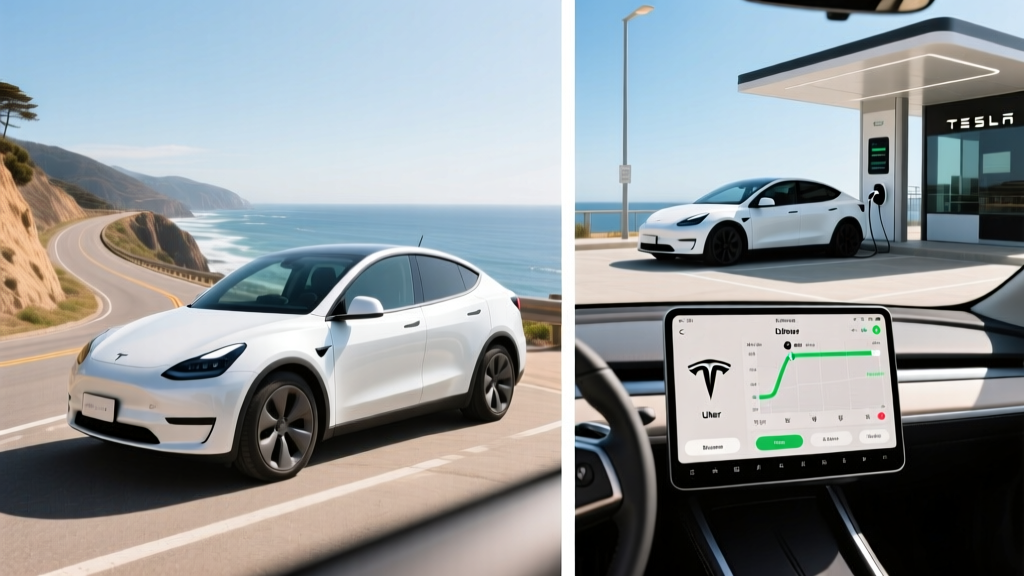
The 2026 Tesla Model Y remains the default electric crossover for a reason: strong real-world range, access to the most reliable DC fast-charging network in North America, and low operating costs that make it one of the few EVs that genuinely pencils out for rideshare duty. For drivers searching for information on the Tesla Uber app experience — whether that means using a Tesla on Uber's platform, understanding Uber's EV incentives, or evaluating Tesla's own rideshare ambitions — this review covers the ownership math, the vehicle specs, and what you need to know before committing a Model Y to full-time or part-time ride-hailing.
Tesla does not currently offer a standalone driver-facing rideshare app that replaces Uber or Lyft. The phrase "Tesla Uber app" typically refers to one of three things: (1) driving a Tesla vehicle on the Uber platform using the standard Uber Driver app, (2) Uber's EV-specific incentives and programs for Tesla owners, or (3) Tesla's long-discussed but not-yet-launched Robotaxi network. As of early 2026, Tesla's Full Self-Driving (Supervised) remains a SAE Level 2 driver-assistance system — the driver must remain engaged at all times. It is not a driverless robotaxi service.
| Spec | Long Range AWD | Performance |
|---|---|---|
| EPA Range | 320 miles | 295 miles |
| Battery (usable) | ~75 kWh, NMC | ~75 kWh, NMC |
| Drivetrain | Dual-motor AWD | Dual-motor AWD |
| Horsepower | ~384 hp | ~456 hp |
| 0–60 mph | 4.8 sec | 3.5 sec |
| Max DC Fast Charge | 250 kW (peak) | 250 kW (peak) |
| 10–80% DCFC Time | ~25 min | ~25 min |
| Level 2 Home Charge | 11.5 kW (~44 mi/hr) | 11.5 kW (~44 mi/hr) |
| MPGe (combined) | 117 MPGe | 111 MPGe |
| Efficiency | 28 kWh/100 mi | 30 kWh/100 mi |
| Cargo (rear seats up) | 30.2 cu ft | 30.2 cu ft |
| Cargo (rear seats folded) | 72.1 cu ft | 72.1 cu ft |
| Rear Legroom | 37.0 in | 37.0 in |
| Base MSRP | $44,990 | $48,990 |
| Battery Warranty | 8 yr / 120,000 mi | 8 yr / 120,000 mi |
Real-World Range: What the EPA Number Doesn't Tell You
The 2026 Model Y Long Range AWD carries an EPA-estimated 320 miles of range. That figure is measured under controlled laboratory conditions and represents a blended city/highway cycle. Real-world results depend heavily on speed, temperature, and terrain.
EPA Range: 320 miles (Long Range AWD)
Real-World Expectations:
- City driving (65°F): 300–330 mi — regenerative braking recovers energy in stop-and-go traffic, sometimes exceeding the EPA estimate.
- Highway driving (70–75 mph, 65°F): 250–280 mi — sustained high speed increases aerodynamic drag significantly.
- Cold weather (30°F, highway): 200–230 mi — battery chemistry loses efficiency and cabin heating draws power. Expect 25–35% range reduction in freezing conditions.
- Rideshare duty (mixed city, moderate climate): 270–310 mi — frequent stops and regen favor the Model Y's efficiency profile.
For rideshare drivers, the city-heavy driving profile actually works in the Model Y's favor. Regenerative braking recaptures kinetic energy that a gasoline car would waste as heat, and the Model Y's ~28 kWh/100 mi efficiency (per EPA fueleconomy.gov) is among the best in the crossover segment. A typical 150-mile shift in mixed city driving will consume roughly 42–46 kWh, leaving enough buffer to finish most shifts without a mid-day charge in temperate climates.
Charging Speed: DC Fast Charge and Home Level 2
Charging infrastructure access is the single biggest factor in whether an EV works for rideshare. The Model Y's NACS (North American Charging Standard) connector gives it native access to the Tesla Supercharger network — over 6,000 stations and 65,000+ connectors in North America as of 2026 — which consistently outperforms third-party networks in uptime and reliability.
| Charging Level | Power (kW) | Miles Added per Hour | Typical Use Case |
|---|---|---|---|
| Level 1 (120V outlet) | ~1.4 kW | ~3–5 mi/hr | Emergency / overnight trickle |
| Level 2 (240V, 48A home) | 11.5 kW | ~44 mi/hr | Daily home charging |
| DC Fast Charge (V3 Supercharger) | Up to 250 kW peak | ~1,000+ mi/hr (peak) | Road trips, mid-shift top-ups |
Understanding the charge curve: The Model Y peaks at 250 kW only when the battery is between roughly 10–30% State of Charge (SoC) and the battery is preconditioned (warmed to optimal temperature via the car's navigation-routed preconditioning). Above 50% SoC, the rate tapers to ~100–120 kW. Above 80%, it drops further to ~40–60 kW. This is why the industry standard metric is 10–80% time: roughly 25 minutes at a V3 Supercharger.
For rideshare drivers, this means a 20–25 minute break at a Supercharger adds approximately 180–200 miles of range — enough to cover most remaining shift hours. Home Level 2 charging at 11.5 kW fully replenishes the battery in about 7–8 hours, ideal for overnight charging between shifts.
Home charging installation: A 48-amp Level 2 circuit requires a 60-amp dedicated breaker. Installation costs typically range from $800–$2,500 depending on panel proximity and local permitting. If your electrical panel is at capacity (common in older homes), a panel upgrade can add $1,500–$3,000. Always consult a licensed electrician for final specifications.
Pricing, Trims, and Federal Tax Credit Eligibility
The 2026 Model Y is offered in two primary trims. Both are assembled at Tesla's Fremont, California and Austin, Texas factories, which affects federal tax credit eligibility under current battery-sourcing rules.
| Trim | Base MSRP | Destination | Total Before Incentives | Est. After §30D Credit |
|---|---|---|---|---|
| Long Range AWD | $44,990 | $1,390 | $46,380 | ~$38,880* |
| Performance | $48,990 | $1,390 | $50,380 | ~$42,880* |
*Assumes full $7,500 federal tax credit eligibility. Actual credit varies based on income, battery sourcing, and point-of-sale transfer rules. Verify at irs.gov.
The IRS §30D Clean Vehicle Credit offers up to $7,500, but eligibility is not automatic. Key requirements for 2026:
- MSRP cap: SUVs/crossovers must be priced at or below $80,000. Both Model Y trims qualify.
- Buyer income cap: Modified adjusted gross income (MAGI) must not exceed $150,000 (single), $225,000 (head of household), or $300,000 (joint). Exceed these thresholds and the credit phases out.
- Battery sourcing: A percentage of critical minerals and battery components must be sourced from the U.S. or free-trade-agreement countries. Tesla's U.S.-built Model Y has generally qualified for the full $7,500, but sourcing requirements tighten annually. Confirm current eligibility on the IRS clean vehicle credit page before purchasing.
- Point-of-sale transfer: As of 2024, buyers can transfer the credit to the dealer at purchase, reducing the upfront price rather than waiting for a tax refund. This applies to the Model Y when purchased new from Tesla.
For rideshare drivers, the point-of-sale transfer is significant — it effectively lowers your monthly payment from day one rather than providing a lump-sum refund at tax time. Consult a tax professional to confirm your individual eligibility.
Performance, Efficiency, and Interior Space
The Model Y Long Range AWD produces approximately 384 horsepower from its dual-motor setup, reaching 60 mph in 4.8 seconds. The Performance trim bumps output to ~456 hp and cuts the 0–60 time to 3.5 seconds. Both trims use Tesla's permanent-magnet synchronous motors with regenerative braking that enables near-one-pedal driving in city conditions.
Efficiency is where the Model Y distinguishes itself for rideshare economics. At 117 MPGe combined (28 kWh/100 mi), the Long Range AWD costs roughly $0.04–$0.06 per mile to charge at home (at $0.13–$0.18/kWh, the U.S. residential average), compared to $0.12–$0.16 per mile for a 28 MPG gasoline crossover at $3.50/gallon. Over 40,000 miles of annual rideshare driving, that translates to $2,400–$4,000 in annual fuel savings.
Interior space is competitive for the compact luxury crossover segment. Rear legroom measures 37.0 inches — adequate for adult passengers and a common Uber Comfort/Uber XL consideration. Cargo volume behind the second row is 30.2 cu ft, expanding to 72.1 cu ft with seats folded. The front trunk (frunk) adds 4.1 cu ft for luggage or gear storage.
The 15.4-inch center touchscreen handles all infotainment, navigation, and vehicle settings. Wireless phone charging, a 17-speaker audio system, and a HEPA air filtration system are standard. Notable drawbacks include the absence of physical buttons for climate or volume (everything routes through the touchscreen), no Apple CarPlay or Android Auto integration, and a minimalist interior that some passengers find spartan compared to luxury competitors.
Driver Assistance: Autopilot, FSD, and Rideshare Reality
SAE Automation Level: Level 2
Tesla's Autopilot and Full Self-Driving (Supervised) are Level 2 driver-assistance systems, not self-driving. The driver must keep hands on the wheel (or demonstrate attentiveness via the cabin camera) and remain fully responsible for vehicle operation at all times. No consumer Tesla vehicle is capable of unsupervised autonomous driving as of 2026.
Standard Autopilot includes Traffic-Aware Cruise Control and Autosteer (lane centering on marked highways). The optional FSD (Supervised) package ($8,000 or $99/month in 2026) adds Navigate on Autopilot, Auto Lane Change, Autopark, and traffic light/stop sign recognition. For rideshare drivers, Autopilot can reduce fatigue on highway segments between pickups, but it does not eliminate the need for constant attention — and passengers expect a fully engaged driver.
What Autopilot and FSD (Supervised) Do NOT Do:
- Drive the vehicle without an attentive, licensed driver present
- Navigate unmapped construction zones or temporary lane shifts reliably
- Replace driver judgment in severe weather (heavy rain, snow, fog)
- Qualify as a "robotaxi" service — Tesla's proposed Robotaxi network remains unlaunched as of 2026
Tesla's long-promised Robotaxi platform — which would theoretically allow owners to earn income from their vehicles autonomously — has not launched in any market. Any references to a "Tesla Uber app" in the context of autonomous ride-hailing are speculative. For now, the practical rideshare path is driving the Model Y yourself on the Uber or Lyft platform.
Using the Tesla Model Y on Uber: What Drivers Should Know
The Uber Driver app works on any smartphone, regardless of what vehicle you drive. There is no Tesla-specific version of the Uber app. However, there are practical considerations for running a Model Y on Uber:
- Uber Comfort eligibility: The Model Y qualifies for Uber Comfort in most markets, which pays a premium over UberX for newer, roomier vehicles with rated drivers. Requirements vary by city but generally include a vehicle model year within the last 5–7 years and a minimum driver rating.
- Uber Green: Uber's zero-emission ride category is available in select cities and may offer per-trip bonuses or rider surcharges passed to the driver. Check your local Uber market for availability.
- Uber Zero Emissions incentive: In partnership with various programs, Uber has offered $1/ride incentives (up to $4,000/year) for drivers using battery-electric vehicles in participating U.S. markets. Availability and terms change — check the Uber Driver app promotions tab for your region.
- Charging strategy for full-time drivers: Plan shifts around Supercharger locations. A 20-minute charge break every 4–5 hours maintains range without significantly impacting earnings. Avoid charging above 80% during shifts — the taper makes it time-inefficient.
- Depreciation and mileage: High-mileage rideshare use accelerates depreciation. The Model Y's battery warranty covers 8 years or 120,000 miles (whichever comes first) with a minimum 70% capacity retention threshold. Drivers covering 40,000+ miles/year may hit the mileage cap in 3 years.
Pros, Cons, and Competitor Comparison
Pros
- Best-in-class Supercharger network access with native NACS connector
- Low per-mile energy cost (~$0.04–0.06/mi at home)
- Strong real-world city range benefits rideshare duty cycles
- OTA software updates add features over time
- Qualifies for Uber Comfort and Uber Green in most markets
- Spacious rear seat and cargo area for a compact crossover
Cons
- No physical buttons — all controls via touchscreen
- No Apple CarPlay or Android Auto
- Cold-weather range loss (25–35%) impacts winter earnings
- FSD (Supervised) is expensive ($8,000) and remains Level 2
- Ride quality can be firm on rough pavement
- Insurance premiums tend to be higher than comparable non-Tesla EVs
Key competitors include the Hyundai Ioniq 5 (EPA 310 mi, 800V architecture enabling ~18 min 10–80% charges, but requires a NACS adapter for Supercharger access), the Ford Mustang Mach-E (EPA 320 mi Extended Range, NACS-equipped for 2026), and the Kia EV6 (EPA 310 mi, similar 800V fast-charging capability). The Model Y's primary advantage remains the Supercharger ecosystem — for rideshare drivers who can't afford charging downtime, network reliability matters more than peak specs.
Who Should Buy the 2026 Tesla Model Y?
Choose the Model Y Long Range AWD if:
- You drive for Uber/Lyft and want the lowest per-mile operating cost with reliable DC fast charging
- Your daily driving is 100–200 miles of mixed city/highway with overnight home charging
- You value over-the-air updates and a proven charging ecosystem over luxury interior materials
- You live in a region with cold winters and need AWD capability
Look elsewhere if:
- You need three-row seating (consider the Model X, Kia EV9, or a PHEV minivan)
- You prioritize physical controls and smartphone integration (Hyundai Ioniq 5 offers both CarPlay and buttons)
- You cannot install a Level 2 home charger and lack reliable public charging access
- You want a hands-free highway driving system (GM's Super Cruise offers hands-off on mapped highways, still Level 2)
Frequently Asked Questions
What is the real-world range of the 2026 Tesla Model Y?
The EPA estimates 320 miles for the Long Range AWD. In real-world city driving at moderate temperatures, expect 300–330 miles thanks to regenerative braking. Highway driving at 70+ mph drops this to 250–280 miles. In freezing conditions, expect 200–230 miles on the highway — a 25–35% reduction from the EPA figure.
How fast does the Model Y charge at home and on DC fast chargers?
At home on a 240V Level 2 charger (48A), the Model Y charges at 11.5 kW, adding roughly 44 miles of range per hour — a full charge takes about 7–8 hours. On a Tesla V3 Supercharger, peak rate is 250 kW, with a 10–80% charge in approximately 25 minutes. The rate tapers significantly above 80% SoC.
How much does the 2026 Model Y cost after tax credits?
The Long Range AWD starts at $46,380 (including destination). If you qualify for the full $7,500 §30D federal tax credit — subject to income caps ($150K single / $300K joint), MSRP limits ($80K for SUVs), and battery-sourcing requirements — the effective price drops to approximately $38,880. The credit can be transferred at point of sale to reduce your upfront cost. Always verify current eligibility at irs.gov.
Is there a Tesla-specific Uber app?
No. Tesla does not offer a rideshare driver app. Tesla owners who drive for Uber use the standard Uber Driver app on their smartphone. Tesla's proposed autonomous Robotaxi platform has not launched as of 2026. References to a "Tesla Uber app" typically refer to using a Tesla vehicle on the Uber platform or Uber's EV incentive programs for drivers.
Is the Model Y worth buying vs. competitors for rideshare?
For rideshare drivers, the Model Y's Supercharger network advantage is significant — reliable fast charging means less downtime and more earning hours. Competitors like the Hyundai Ioniq 5 and Kia EV6 offer faster peak charging speeds on paper (800V architecture), but third-party charging networks (Electrify America, EVgo) have lower uptime than Superchargers. If charging reliability is your priority, the Model Y remains the strongest choice.
Does the 2026 Model Y qualify for the federal EV tax credit?
Yes, the U.S.-built Model Y generally qualifies for up to $7,500 under IRS §30D, subject to buyer income limits, MSRP caps, and annual battery-sourcing requirements that tighten each year. Both trims are well under the $80,000 SUV MSRP cap. Confirm your personal eligibility and current sourcing compliance at irs.gov/clean-vehicle-tax-credits before purchasing.
What is the battery warranty on the Model Y?
Tesla covers the Model Y battery and drive unit for 8 years or 120,000 miles (whichever comes first), with a guaranteed minimum 70% capacity retention during the warranty period. For rideshare drivers covering 40,000+ miles annually, the mileage limit will be reached in approximately 3 years. Battery replacement outside warranty currently costs approximately $12,000–$16,000 depending on the pack.