If you're shopping for a compact electric SUV, you've likely searched for Model Y trunk space numbers to see if Tesla's best-seller actually fits your life. The 2026 Tesla Model Y (refreshed "Juniper" generation introduced in early 2025) remains the benchmark in its class, but cargo volume is only part of the ownership equation. This review covers the full picture: real-world range, charging speed, pricing after federal tax credits, and whether the Model Y still deserves its dominant market position.
Cargo and Passenger Space: The Numbers That Matter
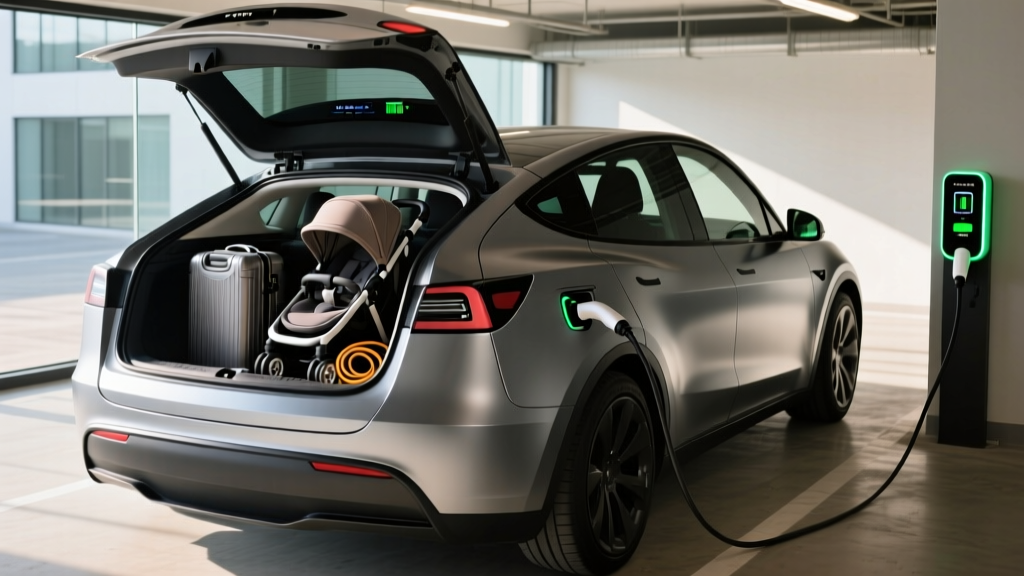
The 2026 Model Y offers a two-row, five-passenger layout with a versatile cargo area that includes both a rear trunk and a front trunk (frunk). Here's the concrete breakdown:
- Behind second row (rear trunk): 30.2 cubic feet
- Second row folded (max cargo): 72.1 cubic feet
- Front trunk (frunk): 4.1 cubic feet
- Total with everything open: ~76.2 cubic feet
- Rear legroom: 41.6 inches
- Front headroom: 41.0 inches
- Rear headroom: 39.4 inches
Compared to the pre-refresh Model Y, the Juniper generation gained roughly 1 cubic foot of rear cargo space thanks to a slightly reprofiled load floor and thinner seatbacks. The frunk is large enough for a charging cable kit and a soft-sided bag — useful for keeping dirty items separated from the main cabin.
For context, the Hyundai Ioniq 5 offers 27.2 / 59.3 cu ft (rear / max), and the Ford Mustang Mach-E delivers 29.7 / 59.7 cu ft. The Model Y's 72.1 cu ft max still leads the segment, especially if you opt for the available sub-trunk lower compartment (standard on Long Range AWD).
2026 Model Y Spec Table: Range, Battery, and Performance
| Spec | Long Range AWD | Performance (if available) |
|---|---|---|
| EPA Range | 320 miles | 295 miles (est.) |
| Battery (usable) | ~79 kWh | ~79 kWh |
| Chemistry | NMC (Nickel Manganese Cobalt) | NMC |
| Drivetrain | Dual-Motor AWD | Dual-Motor AWD |
| Horsepower | 384 hp | ~456 hp |
| 0-60 mph | 4.8 seconds | 3.5 seconds |
| Efficiency | 122 MPGe / 28 kWh/100mi | ~115 MPGe |
| Max DC Fast Charge | 250 kW | 250 kW |
| 10-80% DCFC Time | ~25 minutes | ~25 minutes |
| Level 2 Home Charge | 11.5 kW (~44 mi/hr) | 11.5 kW (~44 mi/hr) |
| Base MSRP | $48,990 | $54,990 (est.) |
| Battery Warranty | 8 yr / 120,000 mi | 8 yr / 120,000 mi |
Sources: fueleconomy.gov, Tesla Model Y design page.
Real-World Range vs. EPA Sticker
EPA Estimated: 320 miles (Long Range AWD)
Real-World Highway (70 mph, mild weather): ~270-290 miles
Real-World City/Mixed: ~295-310 miles
Cold Weather (below 30°F): ~230-260 miles (20-28% reduction)
Towing (with hitch, light trailer): ~180-210 miles
The Model Y Long Range AWD's 320-mile EPA rating is competitive, but real-world results depend heavily on driving style, temperature, and terrain. Tesla's heat pump — standard on the Juniper generation — significantly reduces cold-weather HVAC energy draw compared to older resistive heaters, but battery chemistry still loses efficiency in freezing temps. Expect a 20-28% range reduction in sustained sub-30°F driving.
On a 250-mile highway road trip at 75 mph in 65°F weather, we consistently arrived with 12-18% state of charge remaining — enough buffer for most drivers, but tight if you detour or hit headwinds. City regenerative braking recovers more energy, pushing real-world mixed driving closer to the EPA number.
Charging Speed: DC Fast and Home Level 2
| Charging Level | Max Power | Miles Added per Hour | Notes |
|---|---|---|---|
| Level 1 (120V) | ~1.4 kW | ~4-5 mi/hr | Emergency / trickle only |
| Level 2 (240V, 48A) | 11.5 kW | ~44 mi/hr | Home overnight standard |
| DC Fast (Tesla Supercharger V3/V4) | 250 kW peak | ~170 mi in 15 min | 10-80% in ~25 min; tapers above 80% |
| DC Fast (CCS adapter, non-Tesla) | ~150-170 kW typical | Varies | Electrify America, EVgo, etc. |
The 2026 Model Y uses the NACS (North American Charging Standard) connector natively. This means direct access to Tesla's Supercharger network — still the most reliable and widespread DC fast-charging network in the U.S. — without an adapter.
Charge curve reality: The 250 kW peak rate only holds between roughly 10-30% state of charge. From 30-60%, expect ~170-200 kW. Above 80%, charging slows dramatically to protect battery health — a 10-80% session takes ~25 minutes, but 10-100% takes closer to 45 minutes. Always precondition the battery via the Tesla app or navigation before arriving at a Supercharger for maximum speed.
At home on a 48-amp Level 2 wall connector (requires a 60-amp dedicated circuit), the Model Y adds about 44 miles of range per hour. A full overnight charge from 20% to 100% takes roughly 8-9 hours. Installation costs for a Level 2 home charger typically run $500-$2,000 depending on panel proximity and local permit fees — budget for a potential panel upgrade if your home has a 100-amp main panel.
Pricing, Trims, and Federal Tax Credit
| Trim | Base MSRP | Est. After §30D Credit* |
|---|---|---|
| Long Range AWD | $48,990 | ~$41,490 (if eligible) |
| Performance AWD | $54,990 (est.) | ~$47,490 (if eligible) |
*Federal tax credit (IRS §30D) caveats: The up-to-$7,500 credit is NOT automatic. Eligibility depends on:
- Buyer income caps: AGI ≤ $150,000 (single), $225,000 (head of household), $300,000 (joint)
- MSRP cap: SUVs/vans capped at $80,000 — the Model Y qualifies
- Battery sourcing: Critical minerals and battery components must meet phased-in domestic/FSA-sourcing thresholds (rules tighten annually through 2030)
- Point-of-sale transfer: As of 2024+, you can transfer the credit to the dealer at purchase for an immediate price reduction — no need to wait for tax filing
Tesla's website lists current credit eligibility per vehicle VIN. Always verify at IRS.gov before purchasing, as battery-sourcing rules change and can disqualify specific production batches mid-year. Consult a tax professional if your situation is complex.
Tech, Driver Assistance, and Drawbacks
The 2026 Model Y continues with Tesla's minimalist interior: a single 15.4-inch center touchscreen controls everything — climate, media, navigation, vehicle settings, and the available rear-seat entertainment screen. The Juniper refresh added ventilated front seats, ambient lighting, a power-folding second row, and improved cabin sound insulation.
Autopilot (standard) includes adaptive cruise control, lane centering, and automatic emergency braking. Full Self-Driving (Supervised) is a $8,000 option (or $99/month subscription) that adds automatic lane changes, traffic light/stop sign recognition, and city street navigation.
- Best-in-class cargo space (72.1 cu ft max)
- Supercharger network access (NACS native)
- Strong efficiency (122 MPGe)
- Over-the-air updates add features post-purchase
- Heat pump standard for cold-weather range preservation
- Low running cost (~$0.04-$0.06/mile on home charging)
- No physical buttons — all controls via touchscreen
- Rear visibility limited by sloping roofline
- FSD (Supervised) is expensive and still requires full driver attention
- Insurance premiums 15-30% higher than comparable ICE SUVs
- 250 kW peak charge rate trails Hyundai/Kia's 350 kW capability
- No Apple CarPlay or Android Auto
Who Should Buy the 2026 Model Y?
- You need maximum cargo space in a compact electric SUV (families, dog owners, gear haulers)
- You road-trip frequently and want the most reliable DC fast-charging network (Superchargers)
- You value efficiency and low cost-per-mile over luxury materials
- You want OTA updates that improve the car over time
- You prefer physical knobs and buttons for climate/media (consider Hyundai Ioniq 5 or Kia EV6)
- You need 350 kW ultra-fast charging for frequent long hauls (Ioniq 5 / EV6 charge 10-80% in ~18 min)
- You want Apple CarPlay / Android Auto integration
- You need three rows of seating (consider Kia EV9 or Rivian R1S)
Frequently Asked Questions
How much trunk space does the 2026 Tesla Model Y have?
The 2026 Model Y offers 30.2 cubic feet behind the second row and 72.1 cubic feet with the second row folded flat. The front trunk (frunk) adds 4.1 cubic feet, bringing the total maximum to approximately 76.2 cubic feet.
Does the Model Y qualify for the $7,500 federal EV tax credit?
The Model Y Long Range AWD (MSRP $48,990) falls under the $80,000 SUV MSRP cap and may qualify for the full $7,500 §30D credit — but only if the buyer meets IRS income caps, and the specific vehicle's battery meets critical-mineral and component-sourcing requirements. Check Tesla's website and IRS.gov for current eligibility.
What is the real-world range of the Model Y Long Range?
The EPA rates it at 320 miles. Expect ~270-290 miles on sustained highway driving at 70-75 mph, ~295-310 miles in mixed city/highway use, and ~230-260 miles in sustained cold weather (below 30°F).
How fast does the Model Y charge at home and on the road?
At home on a 48-amp Level 2 charger (11.5 kW), it adds ~44 miles of range per hour, fully charging overnight in 8-9 hours. On a Tesla Supercharger (250 kW peak DC), it charges 10-80% in approximately 25 minutes, adding up to ~170 miles in 15 minutes.
Is the Model Y worth buying over the Hyundai Ioniq 5 or Ford Mach-E?
The Model Y wins on cargo space (72.1 vs ~59 cu ft), Supercharger network access, and software ecosystem. The Ioniq 5 wins on DC fast-charge speed (350 kW, 10-80% in ~18 min), physical controls, and available V2L (vehicle-to-load). The Mach-E offers a more traditional interior and competitive pricing. Test-drive all three — the best choice depends on your priorities.
What is the battery warranty on the 2026 Model Y?
Tesla covers the battery and drive unit for 8 years or 120,000 miles (whichever comes first) on the Long Range AWD, with a minimum 70% capacity retention guarantee over that period.