Tesla Model Y Cargo Capacity: The Numbers That Matter
The Tesla Model Y remains one of the best-selling electric vehicles in the U.S. for a reason that goes beyond its badge: it delivers crossover utility in a package that actually fits a family's life. But if you've landed here searching for Tesla Model Y trunk size, you want concrete measurements — not marketing copy. Let's start with exactly what you get before covering the full ownership picture for the 2026 model year.
Tesla Model Y Cargo Dimensions (2026)
- Behind second row (seats up): 30.2 cubic feet
- Second row folded flat: 72.1 cubic feet
- Front trunk (frunk): 4.1 cubic feet
- Total maximum cargo volume: 76.2 cubic feet
- Rear cargo opening width: ~42 inches
- Cargo floor length (seats up): ~37 inches
- Cargo floor length (seats folded): ~72 inches
- Rear legroom: 41.6 inches
- Front legroom: 41.8 inches
- Optional third row: Available on select trims; reduces behind-rear cargo to ~12.8 cu ft when all rows up
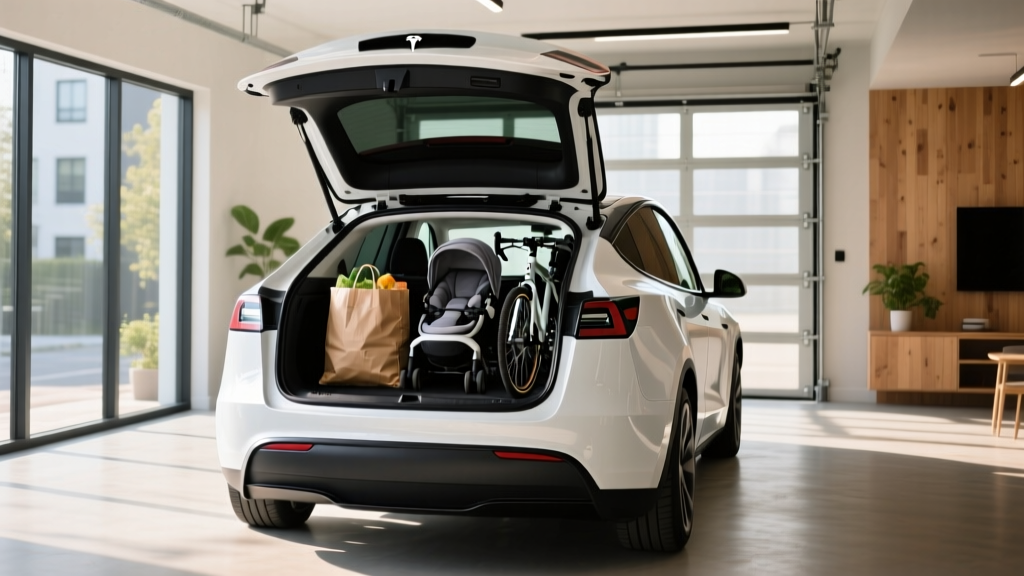
The hatchback design is the Model Y's secret weapon over the Model 3 sedan. The wide, tall opening swallows items a traditional trunk simply can't — think a full-size dog crate, a folded wheelchair, or two large suitcases stacked vertically. The load floor sits relatively low, and the 60/40 split-folding rear seats create a nearly flat surface when dropped. The frunk adds a useful 4.1 cubic feet for charging cables, groceries, or a small carry-on — and keeps them isolated from the cabin.
Compared to key rivals, the Model Y's 30.2 cu ft (seats up) edges out the Ford Mustang Mach-E (29.7 cu ft) and the Hyundai Ioniq 5 (27.2 cu ft), though the Kia EV9 three-row SUV offers substantially more if you regularly need maximum volume. The optional third row in the Model Y is best suited for small children on short trips; adults will find it cramped, and deploying it significantly cuts cargo space.
2026 Tesla Model Y: Full Spec Breakdown
Cargo is only part of the equation. Here's how the 2026 Tesla Model Y lineup stacks up across the metrics that define daily EV ownership.
| Spec | Long Range RWD | Long Range AWD | Performance |
|---|---|---|---|
| EPA Range | 320 mi | 303 mi | 277 mi |
| Battery (usable) | ~75 kWh, NMC | ~75 kWh, NMC | ~75 kWh, NMC |
| Drivetrain | RWD (single motor) | AWD (dual motor) | AWD (dual motor) |
| Horsepower | ~295 hp | ~384 hp | ~456 hp |
| 0–60 mph | 6.5 sec | 4.8 sec | 3.5 sec |
| MPGe (combined) | 123 MPGe | 117 MPGe | 111 MPGe |
| Efficiency | 27 kWh/100mi | 29 kWh/100mi | 30 kWh/100mi |
| Max DC Fast Charge | 250 kW | 250 kW | 250 kW |
| 10–80% DCFC Time | ~25 min | ~25 min | ~25 min |
| Level 2 Home Rate | 11.5 kW (~44 mi/hr) | 11.5 kW (~44 mi/hr) | 11.5 kW (~44 mi/hr) |
| Base MSRP | $44,990 | $47,990 | $52,490 |
Source: EPA fueleconomy.gov and Tesla.com. Specs reflect 2026 model year. Real-world results vary by driving style, temperature, and terrain.
Real-World Range: What the EPA Sticker Doesn't Tell You
EPA vs. Real-World Range (Long Range AWD)
EPA sticker: 303 miles
Real-world highway (70–75 mph, mild weather): ~255–275 miles
Real-world mixed city/highway (moderate climate): ~280–295 miles
Cold-weather highway (below 32°F / 0°C): ~210–240 miles
The Model Y Long Range AWD carries an EPA-estimated 303 miles, but real-world highway driving consistently shaves 10–15% off that figure. At sustained speeds above 70 mph, aerodynamic drag dominates energy consumption — a reality every EV faces, but one that catches new owners off guard on their first road trip.
Cold weather compounds the effect. In sub-freezing temperatures, expect a 20–30% range reduction, particularly on short trips where the cabin and battery must be heated from cold. The Model Y's standard heat pump significantly mitigates this compared to older resistive-heater EVs, but physics is physics. If you live in the northern U.S. and regularly drive highway distances in winter, budget your trips around ~220 usable miles between charges.
Pro tip: Always precondition the battery before arriving at a DC fast charger. The Model Y does this automatically when a Supercharger is set as your navigation destination — it warms the battery to the optimal temperature for peak charge acceptance. Skipping preconditioning (e.g., navigating to a non-Tesla charger without the feature) can slow your initial charge rate substantially, adding 5–10 minutes to your stop.
Charging Speed: Home, Supercharger, and the Curve Reality
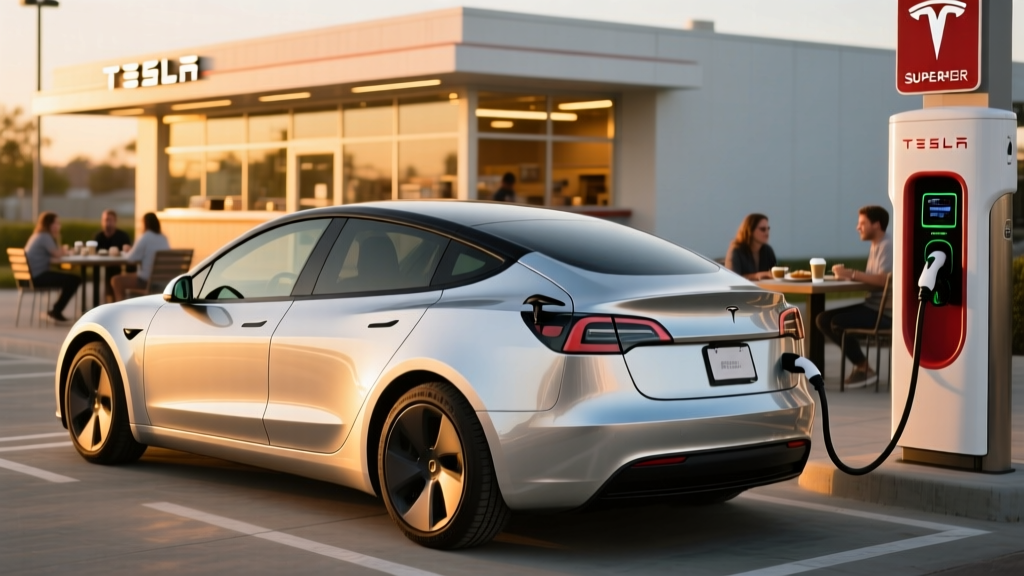
The 2026 Model Y uses the NACS (North American Charging Standard) connector natively — the same plug used across the Tesla Supercharger network. This remains one of the Model Y's strongest practical advantages: access to 20,000+ Superchargers in North America with plug-and-charge simplicity, no app fumbling or adapter required.
| Charging Level | Power | Miles Added/Hour | Best For |
|---|---|---|---|
| Level 1 (120V household) | ~1.4 kW | ~3–5 mi/hr | Emergency / overnight trickle |
| Level 2 (240V home, 48A Wall Connector) | 11.5 kW | ~44 mi/hr | Daily home charging |
| DC Fast Charge (Supercharger V3/V4) | Peak 250 kW | ~1,000 mi/hr at peak | Road trips, 10–80% in ~25 min |
The charge curve matters more than peak kW. The Model Y hits its 250 kW peak only at a low state of charge (typically 10–20% SoC) and on a V3 or V4 Supercharger. As the battery fills, the rate tapers — by 60% SoC you're likely around 100–120 kW, and above 80% it drops sharply to protect battery longevity. This is why Tesla (and every EV maker) quotes 10–80% times rather than 0–100%. Charging from 80–100% on DC fast charge can take nearly as long as the 10–80% session.
For home charging, the Tesla Wall Connector at 48 amps on a 60-amp circuit delivers 11.5 kW — enough to add roughly 350 miles overnight (10 hours), which covers virtually any daily need. A typical 240V/40A dryer-style outlet (NEMA 14-50) delivers ~9.6 kW, adding about 36 miles per hour. Most owners who charge nightly at home never need to visit a public charger except on road trips.
Pricing, Trims, and Federal Tax Credit Eligibility
The 2026 Tesla Model Y lineup is structured around three main configurations. Pricing below reflects base MSRP before destination fees or options; Tesla's direct-sales model means no dealer markups, though option packages and paint colors add to the final number.
| Trim | Base MSRP | Est. Max §30D Credit | Effective Price |
|---|---|---|---|
| Long Range RWD | $44,990 | Up to $7,500 | ~$37,490 |
| Long Range AWD | $47,990 | Up to $7,500 | ~$40,490 |
| Performance AWD | $52,490 | Up to $7,500 | ~$44,990 |
Critical caveat on the §30D federal tax credit: The up-to-$7,500 credit is not automatic for every buyer. Under current IRS rules, you must meet all of the following:
- Income caps: Modified AGI ≤ $150,000 (single), $225,000 (head of household), or $300,000 (married filing jointly)
- MSRP cap: Vehicle MSRP must not exceed $80,000 for SUVs/crossovers (all Model Y trims qualify)
- Battery sourcing: Required percentages of critical minerals and battery components must be sourced from the U.S. or free-trade-agreement countries — Tesla's supply chain has adapted, but component-sourcing rules tighten annually. Verify current eligibility on fueleconomy.gov at the time of purchase
- Point-of-sale transfer: As of 2024+, you can transfer the credit to the dealer (Tesla) at purchase, receiving the discount upfront rather than waiting to claim it on your tax return
- New to you: Must be purchased new; leased vehicles follow different rules (§45W commercial credit to the lessor)
Always confirm your personal eligibility with a tax professional and check the IRS clean vehicle credit page for the latest rules before purchasing. State incentives (California, Colorado, New York, etc.) may stack on top but vary by jurisdiction.
Tech, Driver Assistance, and Interior
The Model Y interior is minimalist by design — a 15.4-inch center touchscreen handles virtually all vehicle functions, from climate controls to mirror adjustment. There's no traditional instrument cluster; a small rear screen serves second-row passengers. The 2025 "Juniper" refresh brought notable improvements: ventilated front seats, ambient lighting, a power-folding second row, and a rear cargo camera displayed on the touchscreen when reversing.
Autopilot comes standard and includes adaptive cruise control, lane centering, and automatic emergency braking. Full Self-Driving (Supervised) is an optional upgrade ($8,000 or $99/month as of 2026) that adds city-street navigation, traffic-light recognition, and automated lane changes. Make no mistake:
SAE Level 2 — Driver Supervision Required
Both Autopilot and FSD (Supervised) are SAE Level 2 driver-assistance systems. You must keep your hands on the wheel (or apply torque as prompted) and remain fully attentive at all times. These are not self-driving systems. Tesla's cabin camera monitors driver engagement and will issue escalating warnings if attention lapses. Only Level 4 services like Waymo operate without a human driver — and those are limited to specific geofenced areas.
The infotainment system is among the most responsive in the industry, with over-the-air updates adding features regularly. Netflix, YouTube, and gaming are available while parked. However, the lack of Apple CarPlay and Android Auto remains a dealbreaker for some buyers who prefer phone-mirrored navigation and music interfaces.
Warranty and Long-Term Battery Outlook
Tesla covers the Model Y with the following warranties:
- Basic vehicle: 4 years / 50,000 miles
- Battery & drive unit: 8 years / 120,000 miles (Long Range); 8 years / 100,000 miles (RWD variants)
- Battery capacity retention threshold: 70% of original capacity during the warranty period
The Model Y Long Range uses NMC (nickel manganese cobalt) battery chemistry, which offers higher energy density than LFP (lithium iron phosphate) but is more sensitive to sustained high states of charge. Tesla recommends daily charging to 80% for NMC batteries and 100% only before long trips. Real-world degradation data from high-mileage Tesla owners suggests ~10% capacity loss at 100,000 miles, with the curve flattening significantly after the initial 20,000–30,000 miles. Out-of-warranty battery replacement currently runs $12,000–$16,000 depending on the pack — a figure to factor into long-term ownership cost projections.
Who the Model Y Suits — And Who Should Look Elsewhere
Pros
- Best-in-class Supercharger network access (NACS native)
- Class-leading cargo volume for a compact EV crossover
- Excellent efficiency (27–30 kWh/100 mi)
- Strong 0–60 performance across all trims
- Over-the-air updates continuously improve the vehicle
- Heat pump standard — better cold-weather range retention
Cons
- No Apple CarPlay / Android Auto
- Minimalist interior lacks physical buttons (climate, mirrors on screen)
- FSD (Supervised) is expensive and still requires full driver attention
- Optional third row is impractical for adults
- NMC battery requires 80% daily charge limit discipline
- Insurance premiums run 15–25% higher than comparable ICE crossovers
Is the Model Y Right for You?
Choose the Model Y if: You want maximum Supercharger convenience, need crossover cargo space for a family of 4–5, prioritize efficiency and performance, and are comfortable with a screen-centric interior.
Look at the Hyundai Ioniq 5 or Kia EV6 if: You want 800V ultra-fast charging (~18 min 10–80%), prefer physical buttons and CarPlay, or value a more distinctive design.
Consider the Ford Mustang Mach-E if: You want a more traditional driving feel, prefer BlueCruise hands-free driving on mapped highways, or want CarPlay support.
Step up to the Kia EV9 if: You regularly need three usable rows and maximum cargo volume.
Frequently Asked Questions
What is the real-world range of the Tesla Model Y?
The EPA rates the 2026 Model Y Long Range AWD at 303 miles. In real-world mixed driving at moderate temperatures, expect 280–295 miles. Sustained highway driving at 70+ mph reduces this to roughly 255–275 miles, and cold winter weather (below freezing) can drop it to 210–240 miles. The Long Range RWD variant rates at 320 miles EPA, with proportionally similar real-world reductions.
How fast does the Model Y charge at home and on road trips?
At home on a 240V/48A Tesla Wall Connector, the Model Y charges at 11.5 kW, adding about 44 miles of range per hour — a full overnight session covers virtually any daily need. On a V3/V4 Supercharger, it peaks at 250 kW and charges from 10–80% in approximately 25 minutes. Remember that peak rate only holds at low states of charge; the curve tapers significantly above 60% SoC.
Does the Tesla Model Y qualify for the $7,500 federal tax credit?
The Model Y qualifies for up to $7,500 under IRS §30D, provided you meet the income caps ($150K single / $300K joint), the MSRP is under $80,000 (all trims qualify), and the battery meets current-year critical-mineral and component-sourcing thresholds. The credit can be transferred at point of sale for an upfront discount. Always verify eligibility on fueleconomy.gov and consult a tax professional before purchasing.
How does the Model Y trunk size compare to competitors?
The Model Y offers 30.2 cu ft behind the second row and 72.1 cu ft with seats folded — plus a 4.1 cu ft frunk. This beats the Ford Mustang Mach-E (29.7 / 59.7 cu ft), Hyundai Ioniq 5 (27.2 / 59.3 cu ft), and Kia EV6 (24.4 / 54.3 cu ft). Among compact electric crossovers, the Model Y leads in usable cargo volume thanks to its hatchback design and flat-folding seats.
Is the Tesla Model Y worth buying over the competition in 2026?
The Model Y's strongest advantages remain the Supercharger network, class-leading cargo space, and strong efficiency. Its weakest points relative to newer rivals are the aging platform design, lack of CarPlay, and NMC battery care requirements. If Supercharger access and cargo volume are your top priorities, the Model Y is still the benchmark. If you value ultra-fast 800V charging, a more premium interior, or physical controls, the Ioniq 5, EV6, or BMW iX may serve you better.
What's the biggest drawback owners report?
The most common owner complaints center on ride firmness (especially with the 21-inch wheel option), panel-gap inconsistency on early-build vehicles, and the learning curve of the screen-only interface for climate and mirror adjustments. Insurance costs also surprise some new owners — get a quote before purchasing, as Tesla-specific premiums can be 15–25% above comparable crossovers.
For the latest EPA figures, visit fueleconomy.gov. For tax credit rules, see the IRS clean vehicle credits page. Safety ratings available at NHTSA.gov.