The Tesla Model Y has been America's best-selling electric vehicle for years, and one of its most debated features hides behind the rear cargo floor: an optional third-row seat pair that folds flat into the trunk area. For buyers stretching a compact EV crossover into family-hauler territory, those two extra seats can be the difference between a workable school-run machine and a deal-breaker. But just how practical are they, and what do you sacrifice in range, cargo, and comfort to get them?
This 2026 review focuses on the Model Y Long Range AWD with the optional third-row configuration — examining real-world usability of those trunk-mounted seats alongside the numbers that matter: EPA range, charging speed, battery chemistry, pricing after federal tax credits, and how it stacks up against three-row EV rivals like the Kia EV9 and Hyundai Ioniq 9.
Tesla Model Y Trunk Seats: Dimensions, Access, and Real-World Usability
The optional third row ($2,000 at time of ordering) adds two forward-facing seats that fold flush into the rear cargo floor. Tesla officially lists total passenger capacity at seven when equipped, but the reality is more nuanced.
| Metric | Value |
|---|---|
| Seating capacity (with 3rd row) | 7 passengers |
| 3rd-row legroom | |
| 3rd-row headroom | ~33.5 inches |
| Cargo behind 3rd row (seats up) | ~10.6 cu ft |
| Cargo behind 2nd row (3rd folded) | ~30.2 cu ft |
| Max cargo (all rear seats folded) | ~72.1 cu ft |
| Front trunk (frunk) | ~4.1 cu ft |
The honest take: The third-row seats are best suited for children under about 5'4" or short trips with flexible adults. Legroom is cramped compared to a dedicated three-row SUV like the Kia EV9 (which offers ~42 inches in its third row). Entry and exit require folding the second-row seat forward, and the low roofline means adults will feel confined on anything longer than a 20-minute drive. For occasional use — school carpools, airport pickups, weekend outings with small kids — the seats work. For daily seven-passenger duty, you'll want a larger vehicle.
Range and Efficiency: EPA Sticker vs. Real-World Driving
EPA Estimated Range: 320 miles (Long Range AWD, 2026 model year)
Real-World Expectation: Plan for ~260–290 miles on mixed highway driving at 70+ mph. In cold weather (below 32°F), expect a 15–25% reduction, bringing usable range to roughly 210–250 miles depending on cabin heating use and driving style. The Model Y's heat pump helps mitigate winter losses compared to resistive heating systems, but physics still applies.
The 2026 Model Y Long Range AWD carries an EPA-estimated 320 miles of range. Efficiency is rated at 122 MPGe combined (28 kWh per 100 miles), which remains among the best in the compact electric SUV segment.
Adding the third-row option adds roughly 60 pounds to the vehicle's curb weight. In practice, this has a negligible effect on range — perhaps 3–5 miles less than an equivalently equipped five-seat Model Y — but the added weight does slightly increase tire wear on the rear axle over time.
Battery, Chemistry, and Long-Term Degradation
The 2026 Model Y Long Range uses a ~75 kWh usable lithium-ion battery pack with NMC (nickel-manganese-cobalt) cathode chemistry. This is important context: NMC offers higher energy density than LFP (lithium iron phosphate), which is how Tesla achieves 320 miles in a relatively compact platform. However, NMC batteries generally benefit from daily charge limits of 80–90% rather than regular 100% fills to maximize longevity.
| Spec | Value |
|---|---|
| Battery capacity (usable) | ~75 kWh |
| Chemistry | NMC (nickel-manganese-cobalt) |
| Drivetrain | Dual-motor AWD |
| Horsepower | 384 hp (combined) |
| 0–60 mph | 4.8 seconds |
| Battery warranty | 8 years / 120,000 miles (min 70% retention) |
| Powertrain warranty | 8 years / 120,000 miles |
| Basic vehicle warranty | 4 years / 50,000 miles |
Tesla's battery degradation data, aggregated from fleet telemetry, shows most Model Y packs retain approximately 88–92% of original capacity at 100,000 miles. The 8-year/120,000-mile warranty guarantees at least 70% retention — a floor, not a target. For buyers planning long-term ownership, this is a meaningful safety net, though battery replacement outside warranty currently runs $12,000–$16,000 at Tesla service centers.
Charging Speed: DC Fast Charging and Home Level 2
Charging speed remains one of the Model Y's strongest competitive advantages, thanks to Tesla's Supercharger network and the vehicle's capable charge architecture.
| Charging Level | Max Rate | Speed / Time |
|---|---|---|
| DC Fast Charge (Supercharger V4 / CCS-compatible) | 250 kW peak | 10–80% in ~25 minutes; ~175 miles added in 15 min |
| Level 2 (240V, 48A home Wall Connector) | 11.5 kW | ~44 miles of range per hour |
| Level 2 (240V, 32A mobile connector) | 7.7 kW | ~30 miles of range per hour |
| Level 1 (120V standard outlet) | ~1.4 kW | ~4–5 miles of range per hour |
Charge curve reality: The 250 kW peak rate is not sustained across the entire session. The Model Y typically holds peak rate from roughly 10–30% State of Charge, then progressively tapers. From 80–100%, charging slows dramatically to protect battery health — expect the final 20% to take as long as the first 50%. For road trips, the practical strategy is charging from 10–80% and moving on, which takes about 25 minutes at a V3 or V4 Supercharger.
The 2026 Model Y ships with a NACS (North American Charging Standard) port natively. With Tesla opening its Supercharger network to other brands, Model Y owners benefit from both native access and a growing number of third-party DC fast chargers using CCS adapters. Home charging with Tesla's Wall Connector on a 60-amp circuit delivers a full overnight replenishment in roughly 7–8 hours from near-empty.
Pricing, Trims, and Federal Tax Credit Eligibility
Understanding the true cost of a Model Y with third-row seats requires navigating trim levels, options, and the evolving federal tax credit landscape under IRS §30D rules.
| Trim / Config | MSRP | Est. After $7,500 Credit |
|---|---|---|
| Long Range AWD (5-seat) | $48,990 | $41,490* |
| Long Range AWD (7-seat, 3rd row) | $50,990 | $43,490* |
| Performance AWD (5-seat only) | $53,990 | $46,490* |
*Assumes full $7,500 federal tax credit eligibility. See requirements below. Point-of-sale transfer available at participating dealers.
Federal tax credit eligibility (§30D) — key requirements for 2026:
- MSRP cap: SUVs/vans must be at or below $80,000 — all Model Y trims qualify.
- Buyer income cap: Modified AGI must not exceed $150,000 (single), $225,000 (head of household), or $300,000 (joint filers).
- Battery sourcing: Increasing percentages of critical minerals and battery components must be sourced from the US or FTA partners. Tesla's US-built packs have largely met these thresholds, but verify current-year compliance at purchase.
- Point-of-sale transfer: Eligible buyers can apply the credit as an immediate price reduction at the dealership rather than waiting for tax filing.
Important caveat: Tax credit rules are subject to legislative change. Always confirm eligibility with a tax professional and check the latest IRS guidance before purchasing. State incentives (California's CVRP, Colorado's innovative motor vehicle credit, etc.) may stack on top but vary by jurisdiction.
Tech, Driver Assistance, and Interior
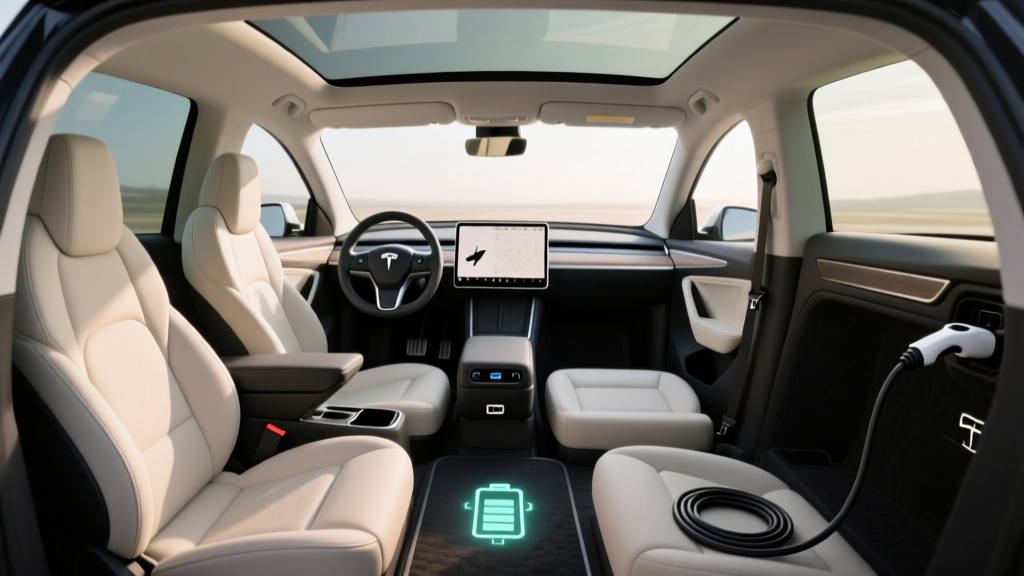
The Model Y's interior follows Tesla's minimalist philosophy: a single 15.4-inch center touchscreen handles navigation, climate, media, and vehicle settings. There is no instrument cluster — speed and driving information display on the upper-left corner of the main screen. The 2026 refresh (codenamed "Juniper") brought incremental improvements including ventilated front seats, ambient lighting, a rear-seat entertainment screen, and improved sound insulation.
Autopilot and FSD (Supervised): Every Model Y includes basic Autopilot (traffic-aware cruise control and lane centering). Tesla's Full Self-Driving (Supervised) package, currently $8,000 or $99/month, adds automated lane changes, traffic light recognition, and city-street navigation. However, FSD remains a SAE Level 2 driver-assistance system — the driver must remain attentive and keep hands on the wheel at all times. This is not autonomous driving. Tesla's naming convention has drawn scrutiny from NHTSA, and buyers should understand they are always responsible for vehicle operation.
Other notable tech: over-the-air software updates, Sentry Mode (parked-camera surveillance), Dog Mode (climate maintenance for pets), and Tesla's app-based remote pre-conditioning — which warms the battery before DC fast charging to optimize charge speed.
How It Compares: Model Y vs. Three-Row EV Rivals
If seven-passenger seating is a priority, the Model Y isn't the only game in town. Here's how it stacks up:
| Spec | Tesla Model Y LR (7-seat) | Kia EV9 GT-Line AWD | Hyundai Ioniq 9 (est.) |
|---|---|---|---|
| EPA Range | 320 mi | 270 mi | ~300 mi |
| 3rd-Row Legroom | ~26.5 in | ~42.0 in | ~38.0 in |
| Cargo (3rd row up) | 10.6 cu ft | 20.0 cu ft | ~18.0 cu ft |
| DC Fast Charge Peak | 250 kW | 236 kW (800V) | ~240 kW (800V) |
| 10–80% DCFC Time | ~25 min | ~24 min | ~24 min |
| Base MSRP (7-seat) | $50,990 | $63,900 | ~$58,000 |
| Federal Tax Credit | Eligible* | Eligible* | Eligible* |
*Eligibility subject to IRS §30D income, MSRP, and sourcing rules. Verify at purchase.
Bottom line: The Model Y is the most affordable and longest-range option, but has by far the least usable third row. The EV9 offers genuine adult-sized third-row space and competitive 800V charging, at a ~$13,000 premium. The Ioniq 9 splits the difference. Your choice depends entirely on how often and how far those third-row passengers need to travel.
Pros, Cons, and Who Should Buy
✅ Pros
- Best-in-class EPA range (320 mi) among 7-seat EVs
- Access to Tesla Supercharger network — the most reliable DC fast-charging ecosystem
- Lowest entry price for a 7-seat electric SUV
- Strong efficiency (122 MPGe) keeps charging costs minimal
- OTA updates continuously add features post-purchase
- Excellent 0–60 performance (4.8 sec) for a family hauler
❌ Cons
- Third-row seats are cramped — children only for anything beyond short trips
- Just 10.6 cu ft of cargo space with 3rd row deployed (less than many hatchbacks)
- No Apple CarPlay or Android Auto — Tesla's proprietary infotainment only
- FSD (Supervised) remains Level 2 despite the "self-driving" name
- Insurance costs run 15–25% higher than comparable ICE crossovers
- Minimal physical controls — everything routed through touchscreen
Choose the Model Y 7-seat if: You need occasional extra seating for small children, prioritize range and charging infrastructure above all else, and want the most affordable entry point into a 7-seat EV.
Choose the Kia EV9 or Ioniq 9 if: You regularly carry adults or teenagers in the third row, need meaningful cargo space with all seats deployed, and don't mind paying $10,000–$15,000 more for the privilege.
Frequently Asked Questions
What is the real-world range of the Tesla Model Y with third-row seats?
The EPA rates the 2026 Model Y Long Range AWD at 320 miles. With the third-row option adding ~60 lbs, real-world range drops to about 315 miles in ideal conditions. On highway road trips at 75 mph, expect 260–290 miles. In sub-freezing temperatures, plan for 210–250 miles depending on heating use.
How fast does the Model Y charge at home and on the road?
At a Tesla Supercharger (250 kW peak), the Model Y charges from 10–80% in approximately 25 minutes. At home with a 48A Wall Connector on a 240V/60A circuit, you'll add about 44 miles of range per hour — enough for a full overnight charge in 7–8 hours.
Does the Tesla Model Y qualify for the $7,500 federal EV tax credit?
As of 2026, the Model Y Long Range qualifies for the full $7,500 federal tax credit under IRS §30D, provided the buyer meets income caps ($300,000 joint / $150,000 single), and the vehicle's battery meets critical-mineral and component-sourcing thresholds. The credit can be applied at point of sale. Always verify current rules with a tax professional before purchase.
Can adults fit in the Tesla Model Y third-row trunk seats?
Technically yes, but uncomfortably. With ~26.5 inches of legroom and a low roofline, adults over 5'4" will find the space cramped. The seats are best suited for children or very short trips. For regular adult third-row use, the Kia EV9 is a far better choice.
Is the Model Y worth buying over the Kia EV9 for families?
It depends on your third-row needs. If you only occasionally carry extra passengers and they're small children, the Model Y saves $12,000+ and delivers 50 more miles of range. If you need genuine 7-passenger comfort with cargo space, the EV9 is the better family vehicle despite the price premium.
What is the battery replacement cost for a Model Y?
Out-of-warranty battery replacement at a Tesla service center currently ranges from $12,000 to $16,000 depending on pack configuration. However, Tesla's 8-year/120,000-mile battery warranty covers degradation below 70% capacity, and fleet data suggests most packs retain 88–92% at 100,000 miles — making replacement uncommon within the warranty period.