The Tesla Model Y Trunk: Dimensions, Volume, and Real-World Usability
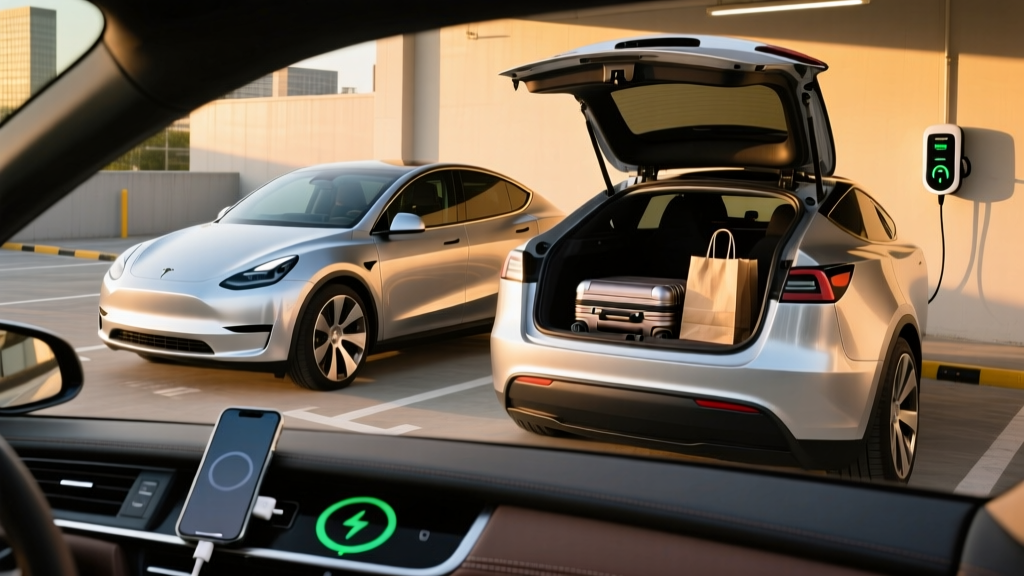
The Tesla Model Y trunk is one of the primary reasons buyers choose this compact electric crossover over the Model 3 sedan. With the rear seats upright, Tesla rates the rear cargo area at 30.2 cubic feet (2025 Juniper refresh, Long Range AWD). Fold the 60/40 split rear bench flat, and that expands to approximately 72.1 cubic feet — competitive with midsize SUVs like the Toyota RAV4 and Honda CR-V, but delivered in a fully electric package.
The load floor sits relatively low, and the hatch opening is wide enough to accommodate a full-size stroller, four large suitcases, or a week's worth of Costco runs without playing Tetris. A subtle but important detail: the cargo floor has a hidden sub-trunk compartment that adds roughly 2.5 cubic feet of concealed storage — useful for charging cables, a tire inflator kit, or groceries you want to keep from rolling around.
The Frunk: Bonus Front Cargo
The Model Y's front trunk (frunk) provides an additional 4.1 cubic feet of sealed, lockable storage. It easily fits a medium carry-on bag or a soft-sided cooler. On the 2025 Juniper update, Tesla added a powered frunk lid — a small but welcome quality-of-life improvement that owners of earlier Model Ys have been retrofitting for years.
Combined, the Model Y offers roughly 34.3 cubic feet with all seats in use and 76.2 cubic feet with rear seats folded. For context, that edges out the Hyundai Ioniq 5 (27.2 / 59.3 cu ft) and is in the same ballpark as the Ford Mustang Mach-E (29.7 / 59.7 cu ft), though the Mach-E's frunk is smaller.
| Rear cargo (seats up) | 30.2 cu ft |
| Rear cargo (seats folded) | 72.1 cu ft |
| Frunk | 4.1 cu ft |
| Total (seats up) | 34.3 cu ft |
| Total (seats folded) | 76.2 cu ft |
2026 Tesla Model Y: Trims, Pricing, and Federal Tax Credit
For the 2026 model year, Tesla sells the Model Y in three primary configurations. Pricing reflects Tesla's direct-to-consumer model — there are no dealer markups, but Tesla adjusts MSRPs frequently, sometimes mid-month. The figures below reflect the latest available pricing as of early 2026.
| Trim | Drivetrain | EPA Range | Base MSRP | Est. After §30D Credit |
|---|---|---|---|---|
| Long Range RWD | Rear-Wheel Drive | 320 mi | $44,990 | ~$37,490* |
| Long Range AWD | Dual-Motor AWD | 300 mi | $47,990 | ~$40,490* |
| Performance | Dual-Motor AWD | 277 mi | $52,490 | ~$44,990* |
*Estimated price assumes full $7,500 federal tax credit via point-of-sale transfer. Eligibility depends on your income, battery sourcing, and MSRP cap compliance. See the tax credit section below.
Does the Model Y Qualify for the Federal EV Tax Credit?
The Tesla Model Y qualifies for the full $7,500 federal tax credit under IRS §30D — but only if you also qualify. The rules have teeth:
- MSRP cap: The Model Y is classified as an SUV by the IRS, so the cap is $80,000. All current trims clear this easily.
- Buyer income cap: Modified Adjusted Gross Income (MAGI) must not exceed $150,000 (single), $225,000 (head of household), or $300,000 (married filing jointly).
- Battery sourcing: The battery must meet critical-mineral and battery-component requirements set by the Treasury Department. Tesla's Austin-built Model Y has largely met these thresholds, but the IRS updates qualifying lists periodically. Always verify on the IRS qualifying vehicle list before purchasing.
- Point-of-sale transfer: You can apply the $7,500 as an instant discount at purchase rather than waiting to claim it on your tax return. Tesla supports this at checkout.
Range, Battery, and Efficiency: What the EPA Number Doesn't Tell You
The 2026 Tesla Model Y Long Range RWD carries an EPA-estimated range of 320 miles. The Long Range AWD drops to 300 miles, and the Performance trim sits at 277 miles. All trims use a ~75 kWh usable lithium-ion battery pack.
EPA estimate: 320 mi (Long Range RWD) / 300 mi (AWD)
Expect on the highway (70-80 mph): ~260–280 mi (AWD), ~275–295 mi (RWD)
Expect in cold weather (below 32°F): ~220–250 mi (AWD), ~240–265 mi (RWD)
City driving with regen: Often matches or slightly exceeds EPA
Highway speeds and cold temperatures are the two biggest range killers in any EV. The Model Y's heat pump (standard on Juniper) significantly reduces cold-weather cabin-heating losses compared to older resistive-heater EVs, but battery chemistry itself is less efficient in the cold. Plan charging stops assuming ~80% of EPA range on winter road trips.
Battery Chemistry: NMC vs. LFP
Tesla uses NMC (nickel manganese cobalt) cells in the Long Range and Performance Model Y, sourced primarily from Panasonic (2170 cells) and, in some production runs, CATL. The Standard Range variant — when available — has used LFP (lithium iron phosphate) cells, which sacrifice some energy density for longer cycle life and the ability to charge to 100% daily without accelerated degradation.
For Long Range and Performance buyers: Tesla recommends charging to 80% for daily use and 100% only for road trips. This is standard NMC practice and helps preserve long-term battery health.
Efficiency Numbers
The Model Y Long Range AWD achieves an EPA-rated 122 MPGe combined, translating to approximately 28 kWh per 100 miles. That's among the most efficient vehicles in its class — a testament to Tesla's powertrain efficiency and the Juniper update's improved aerodynamics (drag coefficient of ~0.23 Cd).
Charging Speed: DC Fast Charging and Home Level 2
Charging speed is where the Juniper Model Y made meaningful gains. Here's the breakdown by charging level:
| Charging Level | Power / Rate | Speed (approx.) | Notes |
|---|---|---|---|
| Level 1 (120V household) | ~1.4 kW | ~3–4 mi/hr | Emergency/trickle only |
| Level 2 (240V home) | 11.5 kW (48A) | ~37 mi/hr | Full charge in ~7–8 hrs |
| DC Fast Charge | Peak 250 kW | 10–80% in ~22 min | Tapers above 80%; preconditioning required for peak rate |
| Tesla Supercharger V4 | Up to 250 kW (Model Y) | ~200 mi in 15 min | NACS connector native; no adapter needed |
Key nuance: The 250 kW peak is not sustained across the entire session. The Model Y's charge curve is aggressive from roughly 10–50% State of Charge (SoC), then progressively tapers. Expect an average rate closer to 150–170 kW over a full 10–80% session. This is why Tesla quotes "200 miles in 15 minutes" rather than a flat kW figure — the first 15 minutes capture the steepest part of the curve.
Home charging at 11.5 kW (48 amps on a 60-amp circuit) is the sweet spot for daily use. A full overnight charge from 20% to 80% takes about 4–5 hours. Tesla's Wall Connector costs $475 and is hardwired; installation by a licensed electrician typically runs $500–$2,000 depending on panel proximity and whether a 200-amp service upgrade is needed.
The Model Y uses the NACS (North American Charging Standard) connector natively — the same plug used across the Tesla Supercharger network, now the most extensive DC fast-charging network in the U.S. with over 25,000 stalls. Non-Tesla CCS chargers require the Tesla CCS adapter (included with newer vehicles or available for ~$175).
Performance, Drivetrain, and Ride Quality
| Spec | Long Range RWD | Long Range AWD | Performance |
|---|---|---|---|
| 0–60 mph | 6.4 sec | 4.8 sec | 3.5 sec |
| Horsepower | ~346 hp | ~384 hp | ~456 hp |
| Drivetrain | Single-motor RWD | Dual-motor AWD | Dual-motor AWD |
| Top Speed | 125 mph | 125 mph | 155 mph |
| Towing Capacity | 3,500 lbs | 3,500 lbs | 3,500 lbs |
The Juniper update brought a noticeably improved ride. Tesla retuned the suspension, added acoustic glass, and improved sound deadening throughout the cabin. The result is a quieter, more composed highway cruiser than the pre-refresh Model Y, which was often criticized for a firm, crashy ride over broken pavement.
The Performance trim's 3.5-second 0–60 time is legitimately sports-car quick, and the dual-motor AWD system provides confident traction in rain and light snow. For most buyers, the Long Range AWD at 4.8 seconds is more than adequate and offers the best balance of range, price, and all-weather capability.
Interior, Tech, and Driver Assistance
The 2026 Model Y interior is cleaner and more premium post-Juniper. The minimalist dashboard centers on a 15.4-inch touchscreen (slightly larger than the pre-refresh 15-inch unit), and Tesla added a second 8-inch screen for rear passengers — controlling climate, media, and entertainment. Ventilated front seats, ambient lighting, and power-folding rear seats are now standard on Long Range trims.
Notable tech features:
- Tesla's navigation with real-time Supercharger routing and battery preconditioning
- Over-the-air software updates (typically monthly, adding features and refinements)
- Sentry Mode dashcam recording (requires USB drive)
- Dog Mode and Camp Mode climate settings
- Phone-as-key with Bluetooth proximity unlock
- Vehicle-to-load (V2L) capability via the 12V/16V accessory outlet (limited wattage — not full V2L like Hyundai/Kia)
Autopilot and Full Self-Driving (Supervised)
Tesla Autopilot and FSD (Supervised) are SAE Level 2 driver-assistance systems. The driver must remain fully attentive, keep hands on the wheel, and be prepared to take over at any moment. These systems do not make the vehicle autonomous. Tesla's marketing language can be misleading — treat these as advanced cruise control + lane centering, not self-driving technology.
Autopilot (standard) includes Traffic-Aware Cruise Control and Autosteer (lane centering) on highways. FSD (Supervised) ($8,000 one-time or $99/month as of 2026) adds automatic lane changes, navigation-guided on/off-ramp transitions, traffic light and stop sign recognition, and Autopark. In real-world use, FSD is impressive on well-marked highways but can be hesitant or erratic in complex urban environments, construction zones, and inclement weather. It remains a supervised system — you are legally and practically the driver.
Warranty, Safety, and Long-Term Ownership
Tesla's warranty coverage for the 2026 Model Y:
| Coverage | Term |
|---|---|
| Basic Vehicle | 4 years / 50,000 miles |
| Battery & Drive Unit | 8 years / 120,000 miles (Long Range/Performance) |
| Battery Capacity Retention | Minimum 70% over warranty period |
The 8-year/120,000-mile battery warranty is competitive. Tesla guarantees the pack will retain at least 70% of its original capacity during the warranty period. Real-world data from fleet operators and owner surveys suggests Model Y batteries typically retain ~90% capacity at 100,000 miles under normal use — well above the warranty threshold. Battery replacement outside warranty, if ever needed, currently runs $12,000–$16,000 at Tesla Service Centers.
The Model Y earned a 5-star overall safety rating from NHTSA and has historically performed well in IIHS crash testing. Standard active safety includes automatic emergency braking, blind-spot monitoring, lane departure warning, and rear cross-traffic alert.
Pros and Cons: The Honest Verdict
✅ Pros
- Class-leading cargo space (30.2 cu ft trunk + 4.1 cu ft frunk)
- Best-in-class Supercharger network access (25,000+ stalls, NACS native)
- Excellent efficiency (122 MPGe / 28 kWh/100 mi)
- Strong real-world range (300–320 mi EPA)
- Post-Juniper ride quality and cabin quietness significantly improved
- Frequent OTA updates add features post-purchase
- $7,500 federal tax credit eligible (subject to buyer qualification)
- Strong resale value relative to EV market average
❌ Cons
- No physical buttons — all controls via touchscreen (climate, mirrors, glovebox)
- FSD ($8,000) remains Level 2 despite the "self-driving" name
- No Apple CarPlay or Android Auto
- Insurance costs above average for the segment (~$1,800–$2,400/yr nationally)
- Turn signal stalks removed in Juniper — buttons on steering wheel take adjustment
- Service center wait times can be long in some metro areas
- Rear passenger headroom slightly compromised by sloping roofline vs. boxier competitors
Who Should Buy the 2026 Tesla Model Y?
Choose the Model Y if:
- You need maximum cargo flexibility in a compact electric SUV (the trunk and frunk combo is hard to beat)
- You road-trip frequently and want access to the most reliable, dense DC fast-charging network in the U.S.
- You value efficiency and range over interior luxury materials
- You want a vehicle that improves via OTA updates over time
- You qualify for the $7,500 federal tax credit, making the effective price very competitive
Look elsewhere if:
- You want physical controls and Apple CarPlay (consider the Hyundai Ioniq 5 or Kia EV6)
- You need three-row seating (look at the Kia EV9 or Rivian R1S)
- You want a more luxurious interior with premium materials (consider the BMW iX or Genesis GV70 Electrified)
- You're uncomfortable with touchscreen-only vehicle controls
Frequently Asked Questions
How much cargo fits in the Tesla Model Y trunk?
With rear seats up, the Model Y trunk holds 30.2 cubic feet. With the 60/40 split rear bench folded flat, it expands to 72.1 cubic feet. The additional 4.1-cubic-foot frunk brings total cargo capacity to 34.3 cu ft (seats up) or 76.2 cu ft (seats folded).
What is the real-world range of the Tesla Model Y?
The EPA rates the Long Range RWD at 320 miles and the AWD at 300 miles. In real-world highway driving at 70–80 mph, expect roughly 260–280 miles (AWD) or 275–295 miles (RWD). In freezing temperatures, plan for 220–265 miles depending on conditions. City driving with regenerative braking often matches or slightly exceeds the EPA sticker.
How fast does the Model Y charge at home and on the road?
At home on a 240V Level 2 charger (48A), the Model Y charges at 11.5 kW, adding roughly 37 miles of range per hour. A 20–80% charge takes about 4–5 hours overnight. On DC fast chargers, it peaks at 250 kW and reaches 10–80% in approximately 22 minutes, though the charge curve tapers significantly above 80% SoC.
Does the 2026 Tesla Model Y qualify for the $7,500 federal tax credit?
Yes, the Model Y is on the IRS qualifying vehicle list for the full $7,500 §30D credit — provided you meet income limits ($150K single / $300K married filing jointly), the MSRP is under the $80K SUV cap (all trims qualify), and the battery meets critical-mineral and component-sourcing requirements. You can apply the credit as a point-of-sale discount. Always verify current eligibility at IRS.gov before purchasing.
Is the Model Y worth it vs. the Hyundai Ioniq 5 or Ford Mustang Mach-E?
The Model Y wins on cargo volume (34.3 vs. ~30 cu ft total), Supercharger network access, and software integration. The Ioniq 5 offers faster peak charging (up to 350 kW on 800V architecture, 10–80% in ~18 min), physical buttons, Apple CarPlay, and a more distinctive design. The Mach-E provides a more traditional SUV feel and Ford dealer service access. If charging network reliability is your top priority, the Model Y's Supercharger advantage remains significant — though CCS networks are improving rapidly.
How long will the Model Y battery last?
Tesla warranties the battery for 8 years or 120,000 miles (whichever comes first), guaranteeing at least 70% capacity retention. Real-world fleet data shows most Model Y packs retain ~90% capacity at 100,000 miles. With proper charging habits (daily limit of 80%, occasional 100% for trips), reaching 200,000+ miles on the original pack is realistic based on current degradation curves.