The Tesla Model Y is one of the best-selling electric vehicles in the United States, but for buyers who need to pull a small camper, utility trailer, or bike rack, the question is less about 0-60 times and more about what happens when you hitch up. The 2026 Tesla Model Y (refreshed "Juniper" generation) offers an optional factory trailer hitch and a 3,500-pound towing capacity — enough for teardrop campers, small boat trailers, and cargo haulers. But towing with an EV introduces range penalties, charging complications, and weight-distribution realities that gas-truck owners rarely think about.
This review covers the 2026 Model Y's towing hardware, how much range you actually lose with a trailer, charging logistics on the road, full powertrain specs, pricing with the hitch option, and whether it makes sense versus hybrid and gas SUV competitors for light-duty towing.
2026 Tesla Model Y Towing Specs at a Glance
| Specification | Value |
|---|---|
| Max Towing Capacity | 3,500 lbs (with factory hitch) |
| Trailer Hitch Type | Factory-installed 2" receiver (dealer option) |
| Tongue Weight Limit | 350 lbs |
| EPA Estimated Range | 320 miles (Long Range AWD) |
| Battery Capacity (Usable) | ~78 kWh (NMC chemistry) |
| Drivetrain | Dual-motor AWD |
| Horsepower | 384 hp (combined) |
| 0-60 mph | 4.8 seconds |
| Max DC Fast Charge Rate | 250 kW (peak) |
| 10-80% DC Fast Charge | ~25 minutes |
| Level 2 Home Charge Rate | 11.5 kW (~44 mi/hr) |
| Efficiency | 122 MPGe combined / 28 kWh/100 mi |
| Cargo Volume (rear seats up) | 30.2 cu ft |
| Cargo Volume (rear seats folded) | 72.1 cu ft |
| Battery/Powertrain Warranty | 8 years / 120,000 miles |
| Base MSRP (Long Range AWD) | $48,990 |
The Model Y Trailer Hitch: Factory Option vs Aftermarket
Tesla offers a factory-installed 2-inch receiver hitch on the Model Y Long Range and Performance trims. This is a dealer-installed option at the time of purchase or can be added post-delivery at a Tesla Service Center. The factory hitch integrates with the vehicle's software, enabling trailer-mode stability control and a rear-camera view optimized for hitch alignment.
Aftermarket hitches (Curt, Draw-Tite, and others) are available for roughly $200-$350 for the hardware, but they do not integrate with Tesla's trailer stability software. If you go aftermarket, budget an additional $150-$400 for professional installation and a 7-pin wiring harness for trailer brakes and lighting. Tesla's factory hitch option typically runs $1,000-$1,200 installed, which includes software integration and the wiring harness.
The 3,500-pound max tow rating applies to the Long Range AWD and Performance trims. The base Rear-Wheel Drive (RWD) model, equipped with an LFP battery, is rated for 2,000 pounds — a meaningful difference if you're planning to pull anything beyond a bike rack or small utility trailer.
Real-World Range: What Happens When You Hitch a Trailer
Real-World (No Trailer): Expect 280-300 miles on mixed highway driving; 250-270 miles at sustained 75+ mph in cold weather (below 40°F).
Real-World (Towing 2,000-lb Trailer): Expect 170-210 miles depending on trailer aerodynamics, terrain, and speed.
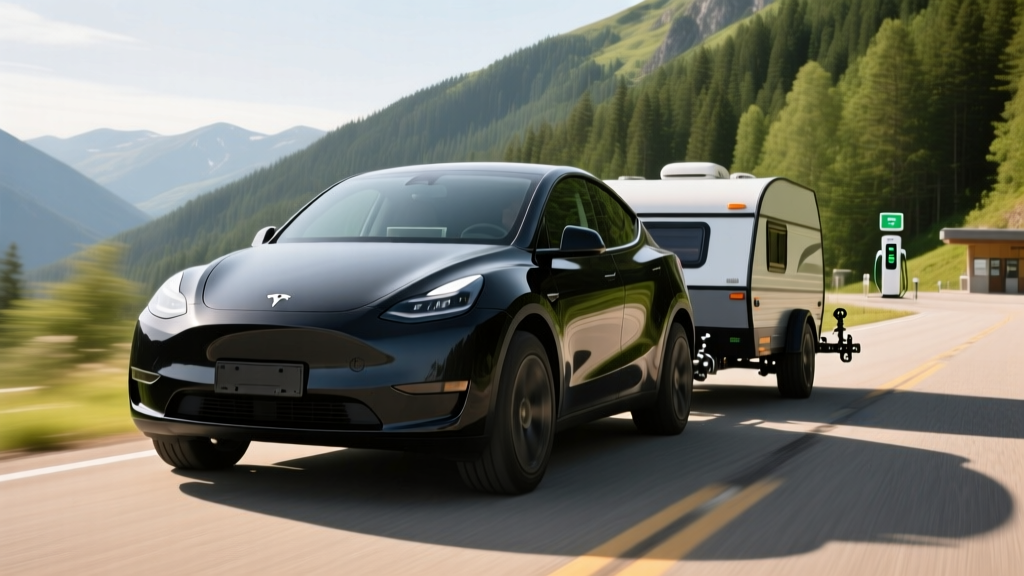
Real-World (Towing 3,500-lb Max Load): Expect 130-170 miles. A boxy camper at highway speeds will push consumption to 55-70 kWh/100 mi — more than double the unloaded rate.
This is the single most important factor for anyone researching a Model Y trailer setup. Towing an aerodynamic teardrop camper (like a NuCamp Tab 400 at roughly 2,200 lbs loaded) on flat terrain at 65 mph might net you 200 miles before needing to charge. A taller, boxier travel trailer near the 3,500-lb limit will cut that range nearly in half again.
The physics are straightforward: aerodynamic drag increases with the square of speed, and a trailer adds both frontal area and drag coefficient. An EV's efficiency advantage in stop-and-go city driving (thanks to regenerative braking) disappears almost entirely on the highway with a trailer, where you're fighting continuous wind resistance with no regen recovery opportunities on flat ground.
Cold weather compounds the loss. Below freezing, expect to lose another 15-25% of your already-reduced towing range due to battery resistance and cabin heating demands. A 200-mile towing range in summer could shrink to 150-165 miles in a 30°F headwind.
Charging With a Trailer: Logistics and Speed
Charging a Model Y while connected to a trailer introduces practical challenges beyond just the charge speed numbers.
| Charging Level | Power (kW) | Miles Added per Hour | Towing Notes |
|---|---|---|---|
| Level 1 (120V household) | 1.4 kW | ~4-5 mi/hr | Impractical for towing trips; overnight adds ~50 mi |
| Level 2 (240V home, 48A) | 11.5 kW | ~44 mi/hr | Full charge in ~7 hours; viable for home-base towing |
| DC Fast (V3 Supercharger) | 250 kW peak | ~158 mi in 15 min (unloaded) | Pull-through stalls limited; may need to unhitch at standard stalls |
Tesla's Supercharger network is the most extensive in the US, but most stalls are not pull-through — meaning you'll need to unhitch your trailer in the parking area, charge, and re-hitch. This adds 10-15 minutes to each charging stop. Some newer Supercharger locations (particularly along interstate corridors) are adding pull-through stalls designed for trucks and trailers, but availability is still limited as of early 2026.
The charge curve also matters when towing. The Model Y peaks at 250 kW only between roughly 10-30% state of charge. From 30-60%, it sustains around 150-170 kW. Above 80%, the rate tapers sharply to protect the battery — often below 50 kW. When towing, plan to charge from 10-80% and skip the slow top-off; you'll spend less time at the charger and more time on the road.
Powertrain, Performance, and Drivetrain for Towing
The Long Range AWD's dual-motor setup provides instant torque to all four wheels, which is a genuine advantage over many gas-powered crossovers when starting from a stop on an incline with a trailer. The 384 combined horsepower and 360 lb-ft of torque deliver confident merging and hill climbing even near max tow capacity.
Tesla's traction control and stability systems adapt when trailer mode is activated, adjusting throttle response and brake intervention to account for the additional mass behind the axle. The 0-60 mph time of 4.8 seconds (unloaded) will stretch considerably with a 3,500-lb trailer — expect roughly 8-10 seconds depending on the load — but that's still competitive with most V6-powered midsize SUVs.
One underappreciated EV towing advantage: regenerative braking. On downhill grades, the motors act as generators, slowing the vehicle and reducing brake wear. With a heavy trailer pushing the rig downhill, this is both a safety and maintenance benefit. However, on steep or prolonged descents, the battery may reach a high state of charge where regen capacity diminishes, so traditional friction brakes still do significant work.
Pricing, Trims, and Federal Tax Credit Eligibility
| Trim | Base MSRP | Hitch Option | Federal §30D Credit* | Effective Price |
|---|---|---|---|---|
| RWD (LFP battery) | $44,990 | +$1,000 | Up to $7,500 | ~$38,490 |
| Long Range AWD | $48,990 | +$1,000 | Up to $7,500 | ~$42,490 |
| Performance AWD | $53,490 | +$1,000 | Up to $7,500 | ~$46,990 |
*Federal EV tax credit eligibility under IRS §30D depends on multiple factors for 2026:
- MSRP Cap: SUVs must be below $80,000 (all Model Y trims qualify)
- Buyer Income Limits: AGI must not exceed $150,000 (single), $225,000 (head of household), or $300,000 (joint filers)
- Battery Sourcing: Critical minerals and battery components must meet increasing domestic/free-trade-partner thresholds — Tesla has worked to qualify, but verify current-year status at purchase on fueleconomy.gov
- Point-of-Sale Transfer: As of 2024+, eligible buyers can transfer the credit to the dealer for an immediate price reduction rather than waiting for a tax refund
The RWD trim's LFP (lithium iron phosphate) battery is notable for towing buyers who don't need maximum range. LFP chemistry offers superior cycle life and can be charged to 100% regularly without degradation concerns — useful if you're towing short distances from home and want maximum available capacity. However, the 2,000-lb tow rating limits it to lightweight utility trailers and bike racks.
Interior, Cargo, and Practical Ownership
The refreshed Juniper-generation Model Y interior is quieter and more refined than the pre-2025 models, with ventilated front seats, ambient lighting, and a rear-seat touchscreen for passengers. Cargo space remains generous at 30.2 cubic feet behind the second row and 72.1 cubic feet with seats folded — enough for camping gear, coolers, and luggage for a family trip without needing to rely solely on the trailer.
The 15.4-inch front touchscreen runs Tesla's latest software, including trip planning that accounts for elevation changes and can estimate energy consumption for a route with a trailer (though accuracy varies). Autopilot (standard) provides adaptive cruise control and lane centering; Full Self-Driving (Supervised) adds automated lane changes and navigation-based routing, but remains a SAE Level 2 driver-assistance system — the driver must remain fully engaged at all times, especially with a trailer attached.
Pros, Cons, and the Verdict
Pros
- 3,500-lb capacity handles teardrop campers and utility trailers
- Instant torque from dual motors excels on inclines with a load
- Regenerative braking reduces brake wear on descents
- Low running costs when not towing (~4¢/mile at home charging rates)
- Supercharger network access (growing pull-through stall availability)
- Factory hitch integrates with stability control software
Cons
- Range drops to 130-200 miles when towing — frequent charging stops
- Most Supercharger stalls require unhitching to charge
- Autopilot/FSD cannot be used while towing
- 350-lb tongue weight limit restricts trailer options
- No spare tire — a flat on the road with a trailer is a serious complication
- RWD trim limited to 2,000-lb tow rating
Model Y vs. Competitors for Towing: Is It Worth It?
If towing is a primary use case, the Model Y competes against both EVs and traditional options:
- vs. Ford Maverick Hybrid (tow package): The Maverick Hybrid tows 2,000 lbs (4,000 lbs with EcoBoost gas engine) and gets 37-42 MPG combined. For long-distance towing, the Maverick's gas range (~500 miles) is hard to beat, but the Model Y's per-mile cost is lower for local trips.
- vs. Rivian R1S (Dual-Motor): The R1S tows 7,700 lbs and has a larger battery (149 kWh Max Pack), but starts above $79,000. For serious trailer users, the Rivian is the superior tow vehicle — but at nearly double the price.
- vs. Toyota RAV4 Hybrid: Tows 1,500-1,750 lbs with 39 MPG combined. Less towing capacity than the Model Y, but far simpler road-trip logistics with no charging stops.
The Model Y makes sense as a trailer vehicle if your typical towing trip is under 150 miles one-way (a lake, a campsite, a dump run) and you can charge at home overnight. For cross-country towing trips, the charging logistics — unhitching at every Supercharger, managing 150-mile range segments — become tedious compared to a gas or hybrid alternative.
Frequently Asked Questions
What is the real-world range of the Model Y when towing a trailer?
With a 2,000-lb aerodynamic trailer at 65 mph on flat terrain, expect 170-210 miles. Near the 3,500-lb max with a boxy camper, range drops to 130-170 miles. Cold weather and high speeds reduce this further. Always plan charging stops conservatively — arrive at chargers with 15-20% remaining rather than pushing to single digits with a trailer behind you.
How fast does the Model Y charge at home and on the road?
At home on a Level 2 (240V, 48A) charger, the Model Y adds roughly 44 miles of range per hour, achieving a full charge in about 7 hours. On a Tesla V3 Supercharger, it peaks at 250 kW and charges from 10-80% in approximately 25 minutes. When towing, plan for 25-30 minute charging stops every 130-180 miles, plus 10-15 minutes for unhitching and re-hitching if a pull-through stall isn't available.
Does the 2026 Tesla Model Y qualify for the federal EV tax credit?
The Model Y is generally eligible for up to $7,500 under IRS §30D, but qualification depends on your income (AGI caps apply), the vehicle's battery sourcing compliance for the current year, and MSRP (all trims fall below the $80,000 SUV cap). Check the latest status on fueleconomy.gov and consult a tax professional. The credit can be transferred at point of sale for an immediate price reduction.
Can I install an aftermarket trailer hitch on the Model Y?
Yes. Curt and Draw-Tite manufacture hitches compatible with the Model Y. However, aftermarket hitches do not integrate with Tesla's trailer stability software, and you'll need a separate wiring harness for trailer lights and brakes. The factory option (~$1,000-$1,200 installed) includes software integration and is recommended for anyone towing regularly.
Is it worth buying a Model Y for towing vs. a gas SUV?
If you tow primarily within 100-150 miles of home and charge at home, the Model Y offers dramatically lower per-mile costs (roughly 4-6¢/mile on electricity vs. 15-20¢/mile on gas for a comparable SUV). For frequent long-distance towing trips, a gas or hybrid SUV avoids the charging logistics and range limitations. The Model Y is an excellent daily driver that can tow occasionally — not a dedicated tow vehicle.
What size trailer can the Model Y safely pull?
The 3,500-lb limit and 350-lb tongue weight restriction mean the Model Y is best suited for teardrop campers (1,500-2,500 lbs), small utility trailers, motorcycle trailers, and bike racks with cargo boxes. Pop-up campers near 3,000 lbs are feasible but leave little margin for cargo. Always weigh your loaded trailer at a CAT scale before hitting the road — most owners underestimate actual loaded weight by 500+ lbs.