Quick Verdict: The Model Y Can Tow, But Know the Trade-Offs
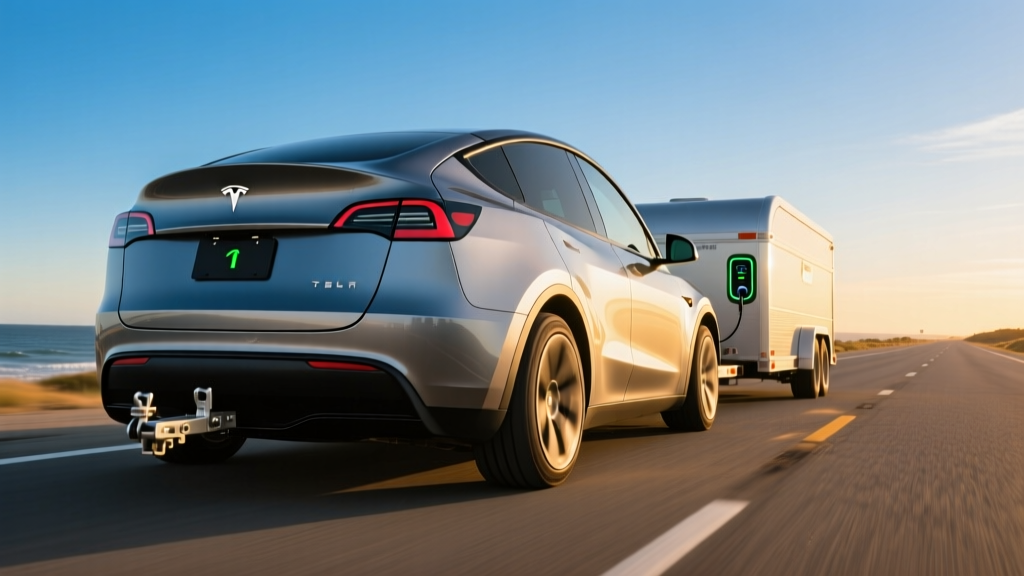
The Tesla Model Y is one of the best-selling electric vehicles in the U.S., but for buyers eyeing the Tesla Model Y trailer hitch, the question isn't whether it can pull a load — it's how much range you'll surrender doing it. Tesla offers a factory-installed tow package on the Long Range AWD and Performance trims with a 3,500-pound maximum tow rating, enough for a small camper, a pair of dirt bikes, or a lightweight utility trailer. But towing at capacity can cut your real-world range nearly in half, a physics-driven reality every EV owner planning to hitch up needs to understand before signing the paperwork.
This review covers the full 2026 Tesla Model Y lineup with a focus on towing capability, trailer hitch options, range penalties, charging logistics, and total ownership cost — including current federal tax credit eligibility.
2026 Tesla Model Y Towing Specs & Trailer Hitch Options
| Specification | Long Range AWD | Performance |
|---|---|---|
| Max Tow Rating | 3,500 lbs | 3,500 lbs |
| Trailer Hitch | 1.25" receiver (factory option) | 1.25" receiver (factory option) |
| Tow Package Price | $1,000 (factory add) | $1,000 (factory add) |
| Tongue Weight Max | 350 lbs | 350 lbs |
| Wiring Harness | 4-pin flat (included w/ package) | 4-pin flat (included w/ package) |
| Tow Mode Software | Yes (stability/trailering assist) | Yes (stability/trailering assist) |
| Rear View Camera Assist | Trailer-align overlay | Trailer-align overlay |
The factory Tesla Model Y trailer hitch is a 1.25-inch receiver — not the 2-inch receiver found on trucks and larger SUVs. That means you'll need a 1.25" ball mount or an adapter for standard accessories. Aftermarket 2-inch hitches exist (from brands like Curt and Draw-Tite), but installing one yourself can void portions of Tesla's warranty related to the rear subframe and electrical harness. We recommend the OEM tow package for warranty protection and integrated software features.
Tesla's tow mode recalibrates stability control, adjusts regenerative braking behavior to account for trailing mass, and provides a trailer-alignment camera overlay on the 15.4-inch center touchscreen. The 4-pin flat connector handles trailer lights but does not support electric trailer brakes — a critical limitation if you plan to tow near the 3,500-pound ceiling on steep grades.
Range & Efficiency: What Towing Actually Costs You
Real-World Highway (no trailer): ~265–285 miles at 70 mph
Real-World Towing (~2,500 lbs): ~155–180 miles at 60–65 mph
Cold Weather (30°F, no trailer): ~225–250 miles
The 2026 Model Y Long Range AWD carries an EPA-estimated 320 miles of range. In mixed city/highway driving at moderate temperatures, owners consistently report 270–290 miles before needing a charge. Highway-only driving at 75 mph drops that to roughly 255–270 miles due to the aerodynamic drag penalty that disproportionately affects efficiency at higher speeds.
Add a trailer, and the math changes dramatically. Drag coefficient and frontal area matter more than weight at highway speeds. Towing a 2,500-pound enclosed cargo trailer at 65 mph typically cuts range by 40–50%. An open utility trailer with a low-profile load may only reduce range by 25–35%. If you're pulling a 3,500-pound travel trailer with a tall box profile on the interstate, plan for as little as 140–160 miles between stops.
Efficiency without a trailer measures at approximately 28 kWh/100 miles (120 MPGe combined, per EPA data). Towing pushes that to 50–70 kWh/100 miles depending on trailer aerodynamics and terrain. This is not unique to Tesla — every EV experiences steep range loss under tow — but the Model Y's relatively compact 78.1 kWh battery (usable capacity) means fewer buffer miles than a Ford F-150 Lightning or Rivian R1S.
Battery, Chemistry & Long-Term Degradation
| Attribute | Long Range AWD / Performance |
|---|---|
| Battery Chemistry | NMC (Nickel Manganese Cobalt) |
| Gross Capacity | ~82 kWh |
| Usable Capacity | ~78.1 kWh |
| Thermal Management | Active liquid cooling + heat pump |
| Battery Warranty | 8 years / 120,000 miles (70% capacity retention) |
| Avg. Degradation (5 yr) | ~8–12% based on fleet data |
The Model Y Long Range and Performance use NMC (nickel manganese cobalt) battery packs, which offer higher energy density than LFP (lithium iron phosphate) but are more sensitive to sustained 100% state-of-charge storage. Tesla recommends daily charging to 80% for NMC packs and 100% only before long trips. If you're towing frequently, you'll regularly charge to 100%, which accelerates degradation slightly — expect closer to 10–14% capacity loss over five years versus 6–8% for owners who mostly stay under 80%.
The heat pump, standard since the 2021 refresh, is a meaningful advantage for cold-weather towing. It recovers waste heat from the drivetrain to warm the cabin, reducing the range penalty of heating in winter. Without a heat pump, cold-weather range loss can reach 40%; with it, expect 20–30% loss at freezing temperatures.
Charging Speed: DC Fast Charge, Home Level 2 & Towing Logistics
| Charging Level | Power / Rate | Speed | Notes |
|---|---|---|---|
| DC Fast Charge (V3 Supercharger) | Peak 250 kW | 10–80% in ~25 min | Tapers above 60%; 80–100% adds ~20 min |
| DC Fast Charge (V4 Supercharger) | Peak 250 kW (CCS native) | 10–80% in ~23 min | Newer stalls; no adapter needed |
| Level 2 Home (Tesla Wall Connector) | 11.5 kW (48A) | ~44 miles/hr | Full charge in ~8 hours |
| Level 2 Home (32A mobile connector) | 7.7 kW | ~30 miles/hr | Full charge in ~11 hours |
| Level 1 (120V standard outlet) | 1.4 kW | ~5 miles/hr | Emergency/trickle only |
At a Tesla V3 Supercharger, the Model Y peaks at 250 kW but does not sustain that rate. The charge curve is aggressive: you'll hit 60% in roughly 15 minutes, then taper drops the average rate. The 10–80% sprint takes about 25 minutes in ideal conditions (battery preconditioned via navigation routing to the charger). Above 80%, charging slows sharply to protect the NMC cells — adding the final 20% takes nearly as long as the first 70%.
For towing trips, this taper is a strategic problem. If your trailer cuts range to 170 miles, you'll arrive at chargers at a lower state of charge (good for fast charging) but need to charge to a higher SoC to reach the next stop, eating into taper territory. Plan stops at 30–40% SoC remaining and charge only to 70–75% for the fastest throughput. This means Supercharger stops every 100–120 miles when towing heavy — a significant time cost on road trips.
At home, the Tesla Wall Connector on a 60-amp circuit delivers 11.5 kW (48 amps), adding about 44 miles of range per hour. A full overnight charge from 10% to 100% takes roughly 8 hours. If your electrical panel can't support a 60-amp circuit, a 40-amp circuit (32A / 7.7 kW) still provides ~30 miles per hour — enough to fully recharge overnight for most daily driving, but tight for frequent towing schedules.
Performance & Drivetrain
| Metric | Long Range AWD | Performance |
|---|---|---|
| 0–60 mph | 4.8 seconds | 3.5 seconds |
| Horsepower | 384 hp | 456 hp |
| Torque | 376 lb-ft | 497 lb-ft |
| Drivetrain | Dual-motor AWD | Dual-motor AWD |
| Top Speed | 135 mph | 155 mph |
Both AWD trims use a permanent-magnet rear motor paired with an induction front motor. The dual-motor layout provides excellent traction for towing starts on wet or inclined ramps — a meaningful advantage over single-motor RWD EVs. The Performance trim's extra torque is noticeable in passing maneuvers with a trailer, but the Long Range AWD is the smarter pick for tow-focused buyers given its 25-mile range advantage.
Cargo, Passenger Space & Practicality
Interior volume remains a Model Y strength. Rear legroom measures 41.6 inches — enough for adult passengers on longer trips. Cargo space behind the second row is 30.2 cubic feet, expanding to 72.1 cubic feet with the 60/40 split rear seats folded. The front trunk (frunk) adds 4.1 cubic feet for charging cables and small gear.
With a trailer hitch installed, the Model Y loses no interior space, but the hitch receiver sits low, reducing departure angle slightly. Approach and departure angles are adequate for paved campground entrances but not suited for rock-crawling or steep off-road trailer retrieval.
Pricing, Trims & Federal Tax Credit Eligibility
| Trim | Base MSRP | + Tow Package | Est. §30D Credit | Effective Price |
|---|---|---|---|---|
| Long Range AWD | $48,990 | $49,990 | Up to $7,500* | ~$42,490* |
| Performance | $53,990 | $54,990 | Up to $7,500* | ~$47,490* |
*Federal tax credit eligibility under IRS §30D depends on multiple requirements that change periodically:
- MSRP Cap: SUVs/vans must be under $80,000 — Model Y qualifies.
- Buyer Income Cap: AGI must not exceed $150,000 (single), $225,000 (head of household), or $300,000 (joint). Check your current-year adjusted gross income.
- Battery Sourcing: Critical minerals and battery components must meet escalating domestic-content thresholds. Tesla's U.S. production (Fremont/Austin) and shifting supply chains affect partial vs. full credit — verify current-year eligibility on IRS.gov before purchase.
- Point-of-Sale Transfer: Eligible buyers can transfer the credit to the dealer at purchase, reducing the out-of-pocket price immediately rather than waiting for tax filing.
The Model Y's MSRP and Tesla's domestic manufacturing give it a structural advantage for credit eligibility, but the critical-minerals sourcing requirement can reduce the credit to $3,750 or disqualify it entirely in some model years. Always confirm with your tax professional and check the latest fueleconomy.gov credit listings before committing.
Competitor Comparison: Towing-Capable EVs at Similar Price
| Vehicle | Max Tow | EPA Range | Starting MSRP | Hitch Type |
|---|---|---|---|---|
| Tesla Model Y LR AWD | 3,500 lbs | 320 mi | $48,990 | 1.25" OEM |
| Ford Mustang Mach-E (GT) | Not rated for towing | 290 mi | $54,995 | N/A |
| Hyundai Ioniq 5 (AWD) | 2,300 lbs | 290 mi | $49,950 | Aftermarket only |
| Kia EV6 (GT-Line AWD) | 2,700 lbs | 282 mi | $52,400 | Dealer-installed |
| VW ID.4 (AWD Pro S) | 2,700 lbs | 275 mi | $49,545 | Dealer-installed |
Among midsize electric crossovers near $50,000, the Model Y's 3,500-pound tow rating leads the segment. The Hyundai Ioniq 5 and Kia EV6 can tow, but at lower ratings and without OEM-integrated hitch software. If you need more than 3,500 pounds, you'll need to step up to the Ford F-150 Lightning (7,700 lbs), Rivian R1S (7,700 lbs), or Chevrolet Silverado EV — all of which cost significantly more.
Pros
- Highest tow rating in its price class (3,500 lbs)
- Integrated tow mode with stability and camera assist
- 320-mile EPA range (best-in-class without towing)
- Access to Tesla Supercharger network (20,000+ stalls)
- Strong dual-motor AWD traction for slippery boat ramps
- Heat pump standard for cold-weather efficiency
Cons
- 1.25" receiver limits accessory compatibility
- No electric trailer brake support
- Range cut by 40–50% when towing near max capacity
- Supercharger stalls not designed for pull-through with trailer
- NMC battery degradation accelerates with frequent 100% tows
- Low ground clearance vs. truck-based tow vehicles
Who Should Buy the Model Y with a Trailer Hitch?
Choose the Model Y with tow package if:
- You tow a lightweight camper (teardrop/pop-up under 2,500 lbs) on weekend trips within 100 miles
- You need a daily driver that occasionally hauls bikes, kayaks, or a small utility trailer
- You want EV efficiency for commuting and can accept range trade-offs on tow days
- You have home Level 2 charging and access to Superchargers along your tow routes
Look elsewhere if:
- You regularly tow over 2,500 lbs on multi-state highway trips
- You need electric trailer brakes for mountain-grade towing
- You want a 2-inch receiver for standard hitch-mounted cargo carriers or bike racks
- Your tow routes lack reliable DC fast charging infrastructure
Frequently Asked Questions
What is the real-world range of the Tesla Model Y when towing?
Without a trailer, expect 265–285 miles highway. Towing a 2,500-pound enclosed trailer at 60–65 mph drops real-world range to approximately 155–180 miles. Aerodynamics matter more than weight — an open flatbed trailer may only cut range by 25–30%, while a tall travel trailer can halve it.
How fast does the Model Y charge at home and on the road?
On a V3 Supercharger, peak rate is 250 kW with a 10–80% time of ~25 minutes. At home with a Tesla Wall Connector on a 60-amp circuit, you get 11.5 kW / ~44 miles per hour, filling the battery overnight in about 8 hours.
Does the Tesla Model Y qualify for the federal EV tax credit?
The Model Y's MSRP is under the $80,000 SUV cap, and Tesla's U.S. manufacturing helps with domestic-content rules. However, eligibility depends on your income (AGI caps apply), the model year's battery-sourcing compliance, and current IRS rules. Verify at irs.gov and with a tax professional before purchase.
Can I install an aftermarket 2-inch hitch on the Model Y?
Aftermarket 2-inch hitches from Curt and Draw-Tite are available, but installation involves modifying the rear subframe area and may void portions of Tesla's warranty. The OEM 1.25-inch hitch includes integrated wiring and software tow mode, making it the safer choice for warranty preservation.
Does the Model Y support electric trailer brakes?
No. The factory 4-pin flat connector supports trailer lighting (turn signals, brake lights, running lights) but does not include a brake controller output. If your trailer has electric brakes, you'd need an aftermarket wireless brake controller — a workaround that adds complexity and may not satisfy all state towing regulations.
Is the Model Y worth buying over competitors for towing?
For light towing under 3,500 pounds with daily EV commuting, the Model Y Long Range AWD offers the best combination of range, tow rating, and charging network access in its price class. If you need more capacity, you'll need to move to a truck-platform EV at a much higher price point.