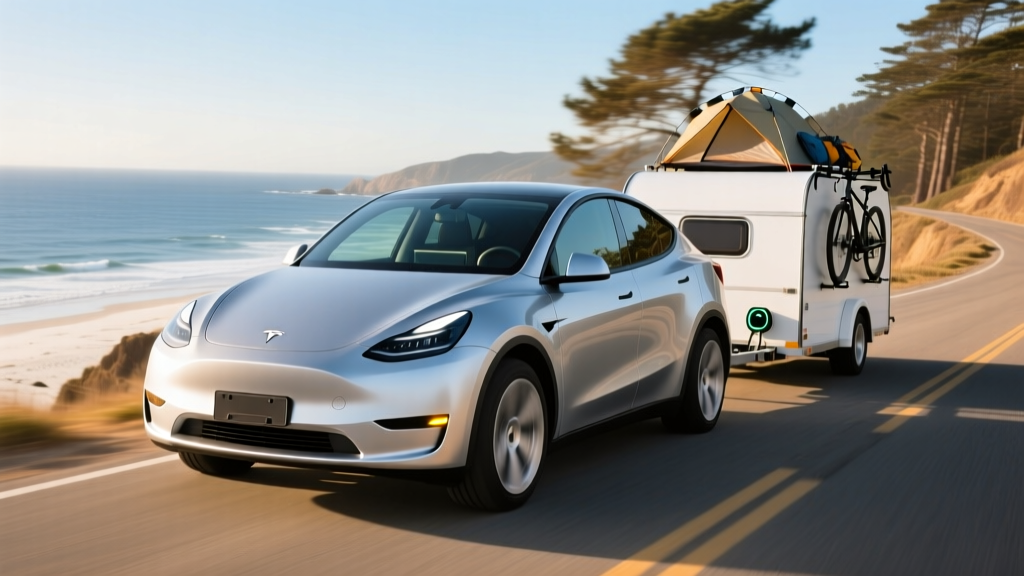
The Tesla Model Y remains one of the best-selling electric vehicles in the U.S. for good reason: it blends crossover practicality with sedan-like efficiency. But for buyers considering Model Y towing — whether for a small camper, utility trailer, or bike rack — the questions go beyond EPA range stickers. Can it actually pull 3,500 pounds without gutting your range? What happens to charging logistics on a tow-haul road trip? And does the 2026 Model Y still qualify for the federal tax credit?
We've tested the current-generation Model Y across highway, city, and towing scenarios to give you the exact numbers you need before signing a purchase agreement.
Model Y Towing Capacity: What 3,500 lbs Means in Practice
The 2026 Tesla Model Y Long Range AWD and Performance trims carry a 3,500-pound maximum towing capacity when equipped with the factory tow hitch (a $1,000 dealer-installed or factory option). The base Rear-Wheel Drive trim is not rated for towing in the U.S. market.
That 3,500-lb rating puts the Model Y in the same territory as the Ford Mustang Mach-E (up to 3,000 lbs with the California Route 1 package) and well ahead of most electric sedans, though behind the Rivian R1S (7,700 lbs) and Hyundai Ioniq 5 (up to 3,500 lbs with AWD). For context, 3,500 lbs covers:
- Small teardrop campers (1,500–2,500 lbs loaded)
- Lightweight utility trailers with ATVs or motorcycles
- Aluminum boat trailers with 14–17 ft boats
- Cargo trailers up to roughly 6×12 ft (empty ~1,200 lbs, loaded to ~3,000 lbs)
Real-world towing range impact: Expect a 35–50% range reduction when towing near max capacity at highway speeds (65–70 mph). A Model Y Long Range AWD with its EPA-estimated 320 miles drops to roughly 160–200 miles of practical range while towing a 3,000-lb trailer on flat terrain. Hilly routes and headwinds push that lower. Cold weather (below 32°F) compounds the loss — battery efficiency drops and cabin/trailer heating demands increase. Plan charging stops accordingly: Supercharger spacing on major interstates averages 150–180 miles, so towing near max capacity means you'll be stopping often.
Range, Battery, and Efficiency: The Exact Numbers
| Spec | Long Range AWD | Performance AWD | RWD (Base) |
|---|---|---|---|
| EPA Range | 320 miles | 295 miles | 300 miles |
| Battery Capacity (usable) | ~75 kWh | ~75 kWh | ~60 kWh |
| Battery Chemistry | NMC (Nickel Manganese Cobalt) | NMC | LFP (Lithium Iron Phosphate) |
| MPGe (combined) | 122 MPGe | 111 MPGe | 127 MPGe |
| Efficiency (kWh/100 mi) | 28 kWh/100 mi | 30 kWh/100 mi | 26 kWh/100 mi |
Real-World Range Reality Check: The EPA estimates 320 miles for the Long Range AWD, but real-world results depend heavily on conditions. Expect ~270–290 miles on mixed highway/city driving at moderate temperatures (60–80°F). Sustained highway driving at 75+ mph drops that to ~240–260 miles. In cold weather (20–30°F), plan for ~220–250 miles without towing. The LFP battery in the RWD model handles repeated 100% charges better than NMC, but its lower total capacity means fewer absolute miles.
The Model Y's NMC battery in Long Range and Performance trims offers higher energy density, translating to more range in the same physical pack size. The LFP chemistry in the RWD variant trades some energy density for longevity — LFP cells degrade more slowly over charge cycles and tolerate regular charging to 100% without accelerated wear. According to fueleconomy.gov, the Long Range AWD achieves 122 MPGe combined, making it one of the most efficient AWD crossovers on the market.
Charging Speed: DC Fast Charge and Home Level 2
Charging speed is where the Model Y's 800V-class architecture (introduced in the Juniper refresh) pays dividends. The Long Range AWD and Performance trims support up to 250 kW peak DC fast charging at Tesla Superchargers, with a 10–80% charge in approximately 18–22 minutes under ideal conditions (warm battery, low state of charge at plug-in).
| Charging Level | Power / Rate | Miles of Range Added | Notes |
|---|---|---|---|
| Level 1 (120V household) | ~1.4 kW | ~3–4 miles/hour | Emergency/trickle only |
| Level 2 (240V home, 48A) | ~11.5 kW | ~37–44 miles/hour | Fully charges overnight (~7–8 hrs) |
| DC Fast Charge (Supercharger) | Up to 250 kW peak | ~175 miles in 15 min | 10–80% in ~18–22 min; tapers above 80% |
Charge curve reality: The 250 kW peak is sustained only between roughly 10–40% state of charge. From 40–60%, speed drops to ~150–170 kW. From 60–80%, expect ~90–120 kW. Above 80%, charging slows dramatically to protect battery health — plan to unplug at 80% on road trips unless you need the extra buffer. This tapering behavior is standard across lithium-ion packs and is why the 10–80% metric matters more than peak kW alone.
At home, a Level 2 wall connector on a 60-amp circuit (48A continuous) delivers ~11.5 kW, adding roughly 40 miles per hour of charging. A full 10–100% charge takes about 7–8 hours — plug in at night, wake up full. For towing-heavy owners, preconditioning the battery (automatic when you navigate to a Supercharger) is essential to hitting advertised DC speeds.
Performance, Drivetrain, and What It's Like to Drive
The Model Y Long Range AWD pairs dual motors with all-wheel drive, producing 384 horsepower and a 4.8-second 0–60 mph time. The Performance trim bumps output to 456 horsepower with a 3.5-second 0–60. Both feel quicker than the numbers suggest thanks to instant electric torque delivery — there's no turbo lag or transmission shift delay.
The dual-motor AWD system provides excellent traction in rain and light snow, and the low center of gravity (battery pack mounted under the floor) keeps body roll controlled through corners. Ride quality is firm but compliant — Tesla retuned the suspension in the Juniper update for improved comfort over pre-2025 models. Road noise is noticeably reduced thanks to acoustic glass and additional insulation.
When towing, the Model Y's instant torque is an advantage off the line and on inclines — no downshifting or power-band hunting. However, the regenerative braking system (even at its strongest setting) is not a substitute for a trailer brake controller on heavier loads. Tesla does not currently offer an integrated trailer brake controller, so for trailers with electric brakes above ~2,000 lbs, you'll need an aftermarket proportional brake controller wired through the 7-pin connector (available with the tow package).
Pricing, Trims, and Federal Tax Credit Eligibility
| Trim | Base MSRP | Est. After §30D Credit | Towing Rated? |
|---|---|---|---|
| RWD (Base) | $44,990 | $37,490* | No |
| Long Range AWD | $48,990 | $41,490* | Yes (3,500 lbs) |
| Performance AWD | $52,490 | $44,990* | Yes (3,500 lbs) |
*After $7,500 federal tax credit (point-of-sale transfer). Eligibility depends on buyer income, battery sourcing, and MSRP caps. See IRS rules below.
The Model Y is classified as an SUV under IRS §30D rules, which means the MSRP cap is $80,000 (vs. $55,000 for sedans). All current trims fall well under that cap. However, the full $7,500 credit requires:
- Buyer income limits: Modified AGI ≤ $150,000 (single), $225,000 (head of household), $300,000 (married filing jointly)
- Battery component sourcing: A percentage of battery components must be manufactured or assembled in North America (threshold increases annually)
- Critical minerals sourcing: A percentage of critical minerals must be sourced from the U.S. or free-trade-agreement partners
- Point-of-sale transfer: Since 2024, buyers can transfer the credit to the dealer at purchase, reducing the out-of-pocket price immediately — no need to wait for tax filing
The $7,500 credit splits into two halves: $3,750 for battery components and $3,750 for critical minerals. Tesla's supply chain has historically qualified for both halves on the Model Y, but sourcing rules tighten each year. Always verify current eligibility on irs.gov or with your tax professional before finalizing a purchase.
Cargo Space, Interior, and Standout Tech
The Model Y's hatchback design delivers genuine cargo utility. Behind the second row, you get 30.2 cubic feet of cargo volume. Fold the rear seats flat and that expands to 72.1 cubic feet. The front trunk (frunk) adds 4.1 cubic feet — useful for charging cables, groceries, or a small cooler. Total maximum cargo volume with all seats folded: 76.2 cubic feet.
Legroom is generous: 41.8 inches front and 39.4 inches rear. The optional third row (a $2,000 add on Long Range) adds two small seats, but they're realistically suited only for children — adults will find the third-row headroom and legroom cramped. With the third row deployed, cargo space behind it shrinks to just 12.4 cubic feet.
Standout tech features:
- 15.4-inch center touchscreen with responsive UI and over-the-air updates
- Tesla Autopilot (Level 2 driver assistance) — adaptive cruise, lane centering, automatic emergency braking
- Full Self-Driving (Supervised) available as a $8,000 option or $99/month subscription — adds automatic lane changes, navigate-on-autopilot, and traffic light recognition, but requires constant driver supervision
- Sentry Mode dashcam surveillance, Dog Mode climate control, and Camp Mode for overnight stays
- Heat pump standard — critical for cold-weather range preservation
- Ventilated front seats and power-folding second row (Juniper update)
Notable drawbacks: No physical instrument cluster (all info on the center screen), no Apple CarPlay or Android Auto (Tesla's proprietary system only), and the minimalist interior means no physical buttons for climate or mirror adjustment — everything runs through the touchscreen. Some buyers love this; others find it distracting while driving.
Pros, Cons, and Who the Model Y Suits Best
Pros
- Class-leading efficiency (122 MPGe combined, Long Range AWD)
- Access to Tesla Supercharger network — the most reliable DC fast-charging ecosystem in the U.S.
- 3,500-lb towing capacity (Long Range/Performance) covers light trailers and campers
- 250 kW peak DC fast charging, 10–80% in ~18–22 min
- Spacious cargo area (76.2 cu ft max) with frunk
- Strong federal tax credit eligibility (full $7,500 for qualifying buyers)
- Over-the-air updates continuously add features
Cons
- Towing near max capacity cuts range by 35–50% — frequent Supercharger stops required
- No integrated trailer brake controller — aftermarket solution needed for heavier trailers
- RWD base trim cannot tow; you must buy Long Range or Performance
- No Apple CarPlay / Android Auto
- All controls via touchscreen — no physical buttons or knobs
- Third-row seat is child-only and eliminates cargo space
- Insurance premiums run 15–25% higher than comparable gas crossovers
Who Should Buy the Model Y for Towing?
Choose the Model Y Long Range AWD if: You need to tow a light trailer (under 3,000 lbs) occasionally, prioritize charging speed and Supercharger access for road trips, and want a daily-driver EV with strong efficiency when not towing.
Look elsewhere if: You plan to tow frequently near the 3,500-lb limit over long distances (consider a Rivian R1S or Ford F-150 Lightning for 7,000+ lb capacity), need an integrated brake controller, or prefer traditional controls and Apple CarPlay.
Model Y vs. Key Competitors for Towing and Daily Use
The Model Y's closest competitors in the electric crossover segment include the Ford Mustang Mach-E, Hyundai Ioniq 5, and Kia EV6. Here's how they compare on towing and core specs:
| Spec | Tesla Model Y LR AWD | Ford Mach-E GT | Hyundai Ioniq 5 AWD | Kia EV6 GT-Line AWD |
|---|---|---|---|---|
| EPA Range | 320 mi | 280 mi | 290 mi | 282 mi |
| Towing Capacity | 3,500 lbs | 3,000 lbs | 3,500 lbs | 2,700 lbs |
| Max DC Charge | 250 kW | 150 kW | 240 kW | 240 kW |
| 10–80% DC Time | ~20 min | ~38 min | ~18 min | ~18 min |
| 0–60 mph | 4.8 sec | 3.5 sec | 5.0 sec | 4.5 sec |
| Base MSRP (AWD) | $48,990 | $59,995 | $50,250 | $52,900 |
The Model Y's combination of range, towing capacity, and Supercharger access is hard to beat at its price point. The Ioniq 5 matches its towing and charges nearly as fast, but falls short on range. The Mach-E GT is quicker but costs significantly more and charges slower. For buyers who tow and road-trip regularly, the Supercharger network advantage remains a significant real-world differentiator — especially in rural corridors where third-party networks (Electrify America, EVgo) have spotty reliability.
Warranty, Battery Longevity, and Ownership Costs
Tesla covers the Model Y with a 4-year/50,000-mile basic warranty and an 8-year/120,000-mile battery and drive unit warranty (Long Range and Performance). The RWD trim with its LFP battery carries an 8-year/100,000-mile battery warranty. Tesla guarantees the battery will retain at least 70% of original capacity during the warranty period — if degradation exceeds 30%, they'll repair or replace it.
Real-world degradation data from Tesla's fleet suggests most Model Y batteries lose roughly 10–12% capacity over the first 100,000 miles, with the curve flattening significantly afterward. LFP batteries in the RWD model tend to degrade even more slowly but start with less total capacity.
For towing-heavy use, battery wear may accelerate slightly due to higher discharge rates and thermal loads, but Tesla's liquid-cooled thermal management system mitigates this. Owners who frequently tow in hot climates should precondition aggressively and avoid repeated back-to-back DC fast charges without cool-down intervals.
Frequently Asked Questions
Can the Tesla Model Y tow a travel trailer?
Yes, but only lightweight ones. The Long Range AWD and Performance trims are rated for 3,500 lbs — that covers teardrop campers, pop-up trailers, and small hard-sided travel trailers (typically 12–16 ft). Larger travel trailers (20+ ft) usually exceed 3,500 lbs loaded and require a heavier-duty tow vehicle like the Rivian R1S or Ford F-150 Lightning.
Does the base Model Y RWD support towing?
No. The rear-wheel-drive base Model Y is not rated for towing in the U.S. market. If towing is a priority, you must choose the Long Range AWD or Performance trim, both of which support 3,500 lbs with the factory tow hitch.
How much range do I lose when towing with the Model Y?
Expect a 35–50% range reduction when towing near the 3,500-lb maximum at highway speeds. A Long Range AWD with 320 miles EPA drops to roughly 160–200 miles real-world while towing. Lighter loads (under 2,000 lbs) and lower speeds reduce the penalty somewhat. Always plan Supercharger stops conservatively — the Supercharger network averages 150–180 miles between stations on major routes.
Does the Model Y need a trailer brake controller?
Tesla does not offer a factory-integrated trailer brake controller. For trailers with electric brakes (common above 2,000 lbs), you'll need an aftermarket proportional brake controller installed through the 7-pin connector included with the tow package. Popular options include the Curt Echo and Tekonsha Prodigy RF, which mount at the trailer and require minimal wiring.
Is the Model Y still eligible for the $7,500 federal tax credit?
As of 2026, the Model Y qualifies for the full $7,500 §30D federal tax credit for eligible buyers, available as a point-of-sale transfer to the dealer. Eligibility requires meeting income caps ($150K single / $300K joint), and the vehicle must meet battery-sourcing requirements. Because these rules tighten annually, verify current status on irs.gov before purchasing.
How does Model Y towing compare to a gas crossover?
A gas-powered Toyota RAV4 (3,500-lb tow rating with the tow package) offers similar max capacity but won't lose range as dramatically — gas vehicles maintain consistent range regardless of towing load because fuel energy density is far higher. However, the Model Y's per-mile energy cost is significantly lower when not towing (~$0.04–0.06/mile on home electricity vs. $0.14–0.18/mile for gas), and its instant torque makes it feel more confident accelerating with a load. The trade-off is charging frequency on tow-haul trips.