Tesla Model Y Towing Capacity: The Quick Verdict
The Tesla Model Y remains one of the most popular electric SUVs in the U.S., and for good reason: strong efficiency, access to the Supercharger network, and a practical crossover footprint. But for buyers who need to pull a small trailer, camper, or pair of jet skis, the Model Y towing capacity is a critical data point that often gets buried in spec sheets.
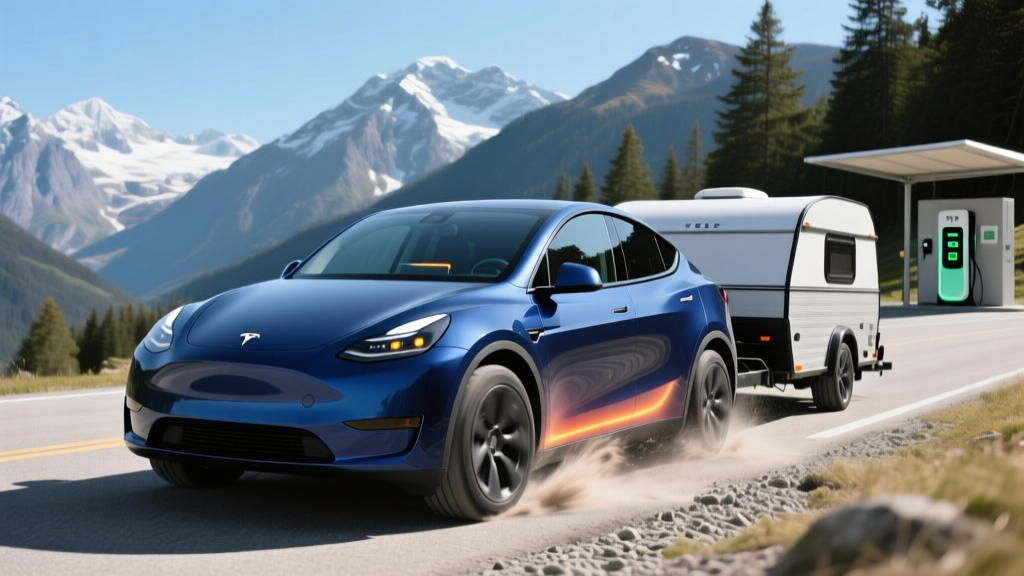
For the 2025–2026 model year, the Tesla Model Y is rated to tow up to 3,500 pounds when properly equipped with the factory tow hitch and harness. That figure applies to the Long Range AWD and Performance trims. The base Rear-Wheel Drive (RWD) model is not rated for towing.
That 3,500-lb rating puts the Model Y in the same class as the Ford Mustang Mach-E (which also maxes at roughly 3,000–3,500 lbs depending on trim) but well below body-on-frame electric trucks like the Ford F-150 Lightning or Rivian R1S. The Model Y is a unibody crossover — it's built for efficiency first, towing second.
| Spec | RWD (Base) | Long Range AWD | Performance |
|---|---|---|---|
| EPA Range | ~300 mi | ~320 mi | ~295 mi |
| Battery (usable) | ~60 kWh (LFP) | ~75 kWh (NMC) | ~75 kWh (NMC) |
| Max DC Fast Charge | 170 kW | 250 kW | 250 kW |
| 10–80% DC Time | ~30 min | ~22 min | ~22 min |
| Level 2 Home Charge | 11.5 kW (~37 mi/hr) | 11.5 kW (~37 mi/hr) | 11.5 kW (~37 mi/hr) |
| 0–60 mph | 6.6 sec | 4.8 sec | 3.5 sec |
| Horsepower | ~295 hp | ~384 hp | ~456 hp |
| Drivetrain | RWD (single motor) | Dual Motor AWD | Dual Motor AWD |
| Towing Capacity | Not rated | 3,500 lbs | 3,500 lbs |
| MPGe (combined) | ~123 MPGe | ~117 MPGe | ~111 MPGe |
| Base MSRP | $44,990 | $48,990 | $52,490 |
Real-World Range: What the EPA Sticker Doesn't Tell You
The EPA estimates for the refreshed Model Y are competitive within the compact electric SUV segment. But as any experienced EV owner knows, the sticker number is a starting point — not a guarantee.
- EPA Estimate: ~320 miles
- Real-World Highway (70–75 mph): ~260–280 miles
- Real-World Mixed Driving (55/50 city/highway): ~280–300 miles
- Cold Weather (below 32°F): Expect 20–30% range reduction, yielding ~220–260 miles
- While Towing (near 3,500 lbs): Range drops by roughly 40–50%, yielding ~140–170 miles
The towing range penalty is the single biggest shock for first-time EV towers. Aerodynamic drag scales with the square of speed, and a boxy camper trailer compounds the problem. At 65 mph with a loaded utility trailer, you'll likely see consumption jump from the Model Y's normal ~280 Wh/mi to over 500 Wh/mi. Plan your charging stops accordingly — Superchargers become mandatory every 90–120 miles when towing near the max rating.
Charging Speed: DC Fast, Home Level 2, and Towing Logistics
The Model Y Long Range and Performance trims support up to 250 kW peak DC fast charging on V3 Superchargers or equivalent CCS/NACS stations. The base RWD with the LFP battery peaks lower at roughly 170 kW. In practice, the charge curve matters more than the peak number.
| Charging Method | Power (kW) | Rate (miles of range/hr) | Notes |
|---|---|---|---|
| Level 1 (120V household) | ~1.4 kW | ~3–5 mi/hr | Emergency/trickle only |
| Level 2 (240V, 48A home) | 11.5 kW | ~37 mi/hr | Full charge in ~7–8 hours |
| DC Fast (V3 Supercharger) | Up to 250 kW | Up to ~1,000 mi/hr peak | 10–80% in ~22 min; tapers above 80% |
| DC Fast (50 kW station) | 50 kW | ~170 mi/hr | Older public chargers; 10–80% in ~60 min |
When towing, preconditioning the battery before a DC fast stop is essential. The Model Y's navigation system will automatically precondition the pack when you route to a Supercharger — this warms the battery to the optimal temperature for accepting peak charge rates. Skip preconditioning in cold weather, and your 250 kW peak might effectively become 100–120 kW, adding 10+ minutes to every stop.
For home charging, a Tesla Wall Connector on a 60-amp circuit delivers the full 48 amps (11.5 kW). Budget roughly $500–$1,500 for professional installation depending on panel proximity and whether your home needs a service upgrade.
Performance, Drivetrain, and What Makes Towing Work
The dual-motor AWD configuration on the Long Range and Performance trims isn't just about straight-line speed — it's critical for towing stability. Dual motors provide independent torque control to the front and rear axles, which helps manage trailer sway and maintain traction on wet or graded surfaces.
Performance specs are brisk even for a crossover:
- Long Range AWD: 0–60 mph in 4.8 seconds, ~384 hp combined
- Performance: 0–60 mph in 3.5 seconds, ~456 hp combined
- RWD: 0–60 mph in 6.6 seconds, ~295 hp (not rated for towing)
The Model Y's low center of gravity — thanks to the under-floor battery pack — gives it a stability advantage over comparable ICE crossovers when towing. That said, the factory tow package includes a hitch receiver and a 4-pin wiring harness, but Tesla does not include an integrated trailer brake controller. For trailers over 1,500–2,000 lbs with their own brakes, you'll need to research aftermarket brake controller solutions compatible with the Model Y's electrical system.
Pricing, Trim Levels, and Federal Tax Credit Eligibility
The refreshed Model Y lineup keeps things relatively simple with three trims. Here's where pricing and incentives stand for 2026:
| Trim | Base MSRP | Est. After §30D Credit | Tow Rating |
|---|---|---|---|
| RWD | $44,990 | ~$37,490* | Not rated |
| Long Range AWD | $48,990 | ~$41,490* | 3,500 lbs |
| Performance | $52,490 | ~$44,990* | 3,500 lbs |
*Assumes full $7,500 §30D credit eligibility. Actual credit depends on buyer income, battery sourcing, and MSRP cap compliance. See IRS §30D guidelines.
Critical §30D eligibility requirements for 2026:
- MSRP Cap: SUVs/crossovers must have an MSRP at or below $80,000 (all Model Y trims qualify)
- Buyer Income Cap: Modified AGI ≤ $150,000 (single), ≤ $225,000 (head of household), ≤ $300,000 (joint)
- Battery Sourcing: Critical minerals and battery component requirements phase in annually — Tesla's supply chain has largely adapted, but confirm at point of sale
- Point-of-Sale Transfer: Eligible buyers can transfer the credit to the dealer at purchase, reducing the purchase price directly rather than waiting for a tax return
Always verify current eligibility on fueleconomy.gov before committing to a purchase, as battery sourcing rules tighten each year.
Cargo Space, Interior, and Practicality
The Model Y's crossover form factor delivers strong utility even without a trailer attached:
- Cargo (behind 2nd row): ~30.2 cu ft
- Cargo (2nd row folded): ~72.1 cu ft
- Front trunk (frunk): ~4.1 cu ft
- Rear legroom: ~41.6 inches
- Seating: 5-passenger standard; 7-passenger option available on select trims (reduces cargo space)
The 15.4-inch center touchscreen handles infotainment, climate, and vehicle controls — there are no physical buttons for climate or mirrors. This minimalist approach keeps the cabin clean but can frustrate passengers who prefer tactile controls. The refreshed Model Y (sometimes called the "Juniper" update) improved ride quality with revised suspension tuning and added ambient lighting, ventilated front seats, and a rear-seat touchscreen.
On the tech front, the Model Y includes Tesla's basic Autopilot (SAE Level 2) as standard — adaptive cruise control and lane centering. Full Self-Driving (Supervised) remains an expensive add-on and is still Level 2: the driver must remain fully attentive at all times.
Pros and Cons: The Honest Assessment
- 3,500-lb towing capacity covers small campers, utility trailers, and watercraft
- Best-in-class Supercharger network access for road trips and towing routes
- 250 kW peak DC charging; 10–80% in ~22 minutes
- Low center of gravity aids towing stability vs. ICE crossovers
- ~320 mi EPA range (Long Range) is strong for the segment
- Spacious cargo area with frunk bonus storage
- OTA updates continuously add features
- Towing cuts range by 40–50%, requiring frequent Supercharger stops
- No integrated trailer brake controller from factory
- Base RWD trim is not rated for towing at all
- Minimalist interior controls aren't for everyone
- FSD (Supervised) is expensive and still requires full driver attention
- Insurance premiums tend to run higher than segment average
- Competitors like the Hyundai Ioniq 5 offer comparable range at similar or lower prices
Warranty and Long-Term Ownership
Tesla's warranty structure is straightforward:
- Basic Vehicle: 4 years / 50,000 miles
- Battery & Drive Unit (Long Range/Performance): 8 years / 120,000 miles
- Battery & Drive Unit (RWD, LFP): 8 years / 100,000 miles
- Battery capacity retention threshold: Tesla warrants a minimum of 70% retention over the warranty period
For towers, the 8-year battery warranty provides peace of mind. Towing puts higher sustained loads on the battery and motors, but Tesla's thermal management system (liquid cooling/heating) is robust. Real-world Tesla fleet data shows average battery degradation of roughly 12–15% at 150,000 miles — well within the warranty threshold.
Is the Model Y Worth It for Towing vs. Competitors?
If your primary need is a daily-driver EV that can occasionally tow a lightweight trailer, the Model Y Long Range AWD is an excellent choice. The combination of 320 miles of range, 250 kW charging, and Supercharger access makes it the most road-trip-capable electric crossover for towing.
However, if towing is a frequent or heavy-duty requirement, consider these alternatives:
- Rivian R1S (Dual Motor): 7,700-lb towing capacity, but starts at ~$75,000+ and is far less efficient
- Ford F-150 Lightning: 7,700–10,000 lbs, but truck form factor and lower efficiency
- Hyundai Ioniq 5 (AWD): Not rated for significant towing; better as a pure commuter crossover
The Model Y occupies a specific niche: the efficiency-first EV that can still handle weekend towing duties. Just don't expect it to replace a body-on-frame SUV or truck for heavy hauling.
What is the Tesla Model Y towing capacity?
The Model Y Long Range AWD and Performance trims are rated for up to 3,500 lbs when equipped with the factory tow package. The base RWD model is not rated for towing.
How far can the Model Y drive while towing?
Expect range to drop by roughly 40–50% when towing near the 3,500-lb max. A Long Range AWD with ~320 miles of EPA range will realistically deliver 140–170 miles between charges while towing a loaded trailer at highway speeds.
Does the Model Y qualify for the federal EV tax credit?
The Model Y qualifies for up to $7,500 under IRS §30D, subject to buyer income caps ($150K single / $300K joint), MSRP under $80,000, and battery sourcing requirements. The credit can be transferred at point of sale. Always verify eligibility on irs.gov before purchase.
Does Tesla include a trailer brake controller?
No. The factory tow package includes a hitch receiver and 4-pin wiring harness but no integrated trailer brake controller. Aftermarket solutions are available for trailers with electric brakes.
How fast does the Model Y charge at home?
On a Level 2 Tesla Wall Connector (240V, 48A), the Model Y charges at up to 11.5 kW, adding roughly 37 miles of range per hour. A full charge from empty takes approximately 7–8 hours.
Is the Model Y a good EV for road trips?
Yes. The combination of 320-mile EPA range (Long Range), 250 kW DC fast charging, and access to Tesla's Supercharger network makes the Model Y one of the most practical EVs for long-distance travel. Plan for reduced range in cold weather and when towing.