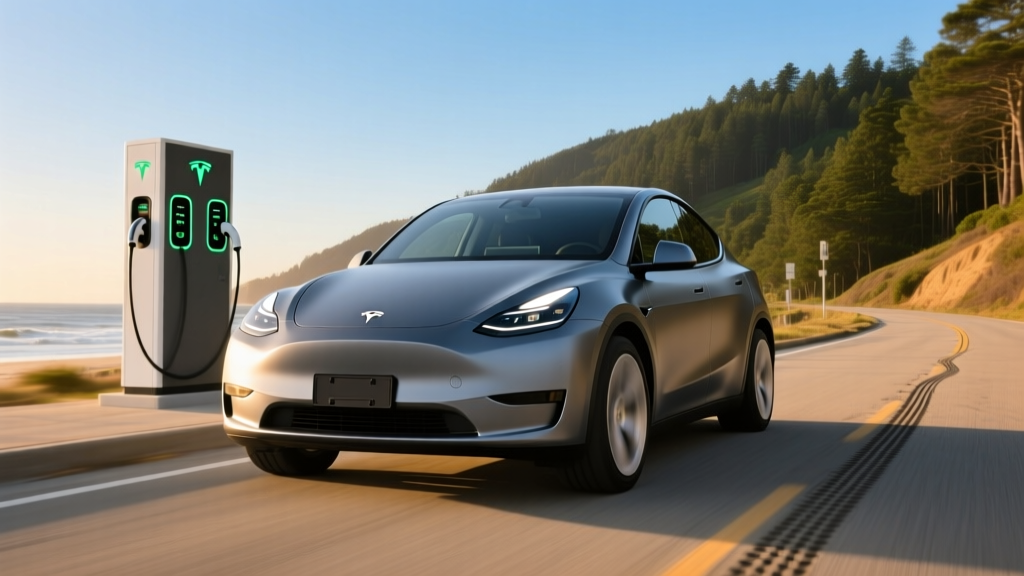
Quick Verdict: The Model Y's Towing Story in 2026
The 2026 Tesla Model Y Long Range AWD carries a maximum tow rating of 3,500 pounds when properly equipped with Tesla's factory tow package — identical to the figure Tesla has published since the Juniper refresh. That's enough for a lightweight teardrop camper, a pair of dirt bikes on a small trailer, or a compact utility trailer loaded with landscaping gear. It is not enough for a full-size boat on a dual-axle trailer or a 24-foot travel camper, which typically demand 5,000 pounds or more.
For buyers specifically searching the Tesla tow rating to see if the Model Y can replace their SUV for weekend hauling, the answer is conditional: yes for light-duty towing, no for mid-weight recreational trailers. The competing Ford Mustang Mach-E (select trims) and Hyundai Ioniq 5 both match or fall slightly short of this figure, while the Rivian R1S offers up to 7,700 pounds at a significantly higher price point.
This review covers the full ownership picture — range, charging, pricing after federal tax credits, and the real-world trade-offs of towing with a battery-electric crossover.
| Spec | Value |
|---|---|
| EPA Range | 320 miles |
| Battery (usable) | ~78 kWh, NMC chemistry |
| Drivetrain | Dual-motor AWD |
| Horsepower | 384 hp (combined) |
| 0–60 mph | 4.8 seconds |
| Max Tow Rating | 3,500 lbs (with factory tow package) |
| Peak DC Fast Charge | 250 kW |
| 10–80% DC Charge Time | ~27 minutes |
| Level 2 Charge Rate | 11.5 kW (~44 mi/hr) |
| MPGe (combined) | 111 MPGe |
| Efficiency | 30 kWh/100 mi |
| Cargo (rear seats up) | 30.2 cu ft |
| Cargo (rear seats folded) | 72.1 cu ft |
| Base MSRP | $48,990 |
| Battery Warranty | 8 years / 120,000 miles |
EPA Range vs. Real-World Miles — Especially While Towing
EPA sticker: 320 miles
Real-world highway (70 mph, 75°F): ~270–290 miles
Real-world cold weather (30°F, mixed driving): ~230–260 miles
While towing a 3,000-lb trailer: ~150–180 miles (40–50% range reduction)
The EPA's fueleconomy.gov listing rates the 2026 Model Y Long Range AWD at 320 miles on a full charge. That figure reflects a blended city-highway test cycle, and in practice, highway-only driving at sustained speeds trims the number by roughly 10–15% because EVs are less efficient at high velocity than in stop-and-go traffic where regenerative braking recaptures energy.
Cold weather compounds the loss. The Model Y uses a heat pump for cabin and battery thermal management, which mitigates but does not eliminate winter range drop. Owners in northern climates should budget a 20–25% reduction when temperatures hover around freezing, and up to 30% at 10°F or below.
Towing is the most severe range penalty the Model Y will face. Pulling a 3,000-pound camper or utility trailer roughly doubles the energy demand per mile. Expect effective range to drop to 150–180 miles depending on terrain, speed, and trailer aerodynamics. That means a 300-mile trip with a trailer requires at least one DC fast-charge stop — and you should plan stops around Supercharger stalls that allow pull-through parking, since backing a trailer into a standard perpendicular stall is impractical.
Charging Speed: DC Fast, Level 2, and the Towing Road-Trip Reality
| Level | Power | Miles Added per Hour | Typical Use |
|---|---|---|---|
| Level 1 (120V) | ~1.2 kW | ~3–4 mi/hr | Emergency / trickle |
| Level 2 (240V, 48A) | 11.5 kW | ~44 mi/hr | Home overnight, workplace |
| DC Fast (Supercharger V3/V4) | Up to 250 kW peak | ~1,000 mi/hr (peak) | Road trips |
On a V3 or V4 Tesla Supercharger, the Model Y Long Range peaks at approximately 250 kW and sustains strong charge rates through the mid-state-of-charge window. A 10–80% session takes roughly 27 minutes under ideal battery preconditioning. Above 80% SoC, the charge curve tapers sharply — going from 80% to 100% can add another 20+ minutes. For road trips, plan to charge in the 10–80% window and skip the top-off unless you need every mile for the next leg.
At home on a Tesla Wall Connector (hardwired, 60-amp circuit, 48 amps continuous), the Model Y adds about 44 miles of range per hour. A full overnight charge from 20% to 90% takes roughly 7–8 hours. Installation typically costs $800–$2,000 depending on panel proximity and whether a service upgrade is needed; always get a quote from a licensed electrician before purchasing equipment.
Towing-specific charging note: With a trailer attached, you will arrive at Superchargers with less remaining range than usual and need to charge more often. Tesla's navigation system automatically routes through Superchargers and preconditions the battery for faster charging — but verify that the planned stops have pull-through or trailer-friendly stalls. Apps like PlugShare let you filter for pull-through sites.
Tow Package Details: What's Required and What It Costs
The Model Y's 3,500-pound tow rating applies only when equipped with Tesla's factory tow package, which includes a Class III 2-inch receiver hitch and a 4-pin/7-pin wiring harness. The package is a dealer- or factory-installed option typically priced around $1,000–$1,200. Aftermarket hitches exist at lower cost, but using one may affect warranty coverage if a drivetrain or electrical issue is traced to the hitch installation.
Tesla's software includes a Trailer Mode that adjusts stability control, regenerative braking calibration, and Autopilot availability when a trailer is detected or manually enabled. Note that Autopilot and FSD (Supervised) are disabled when Trailer Mode is active — you are driving manually, which is appropriate given that these are SAE Level 2 systems designed for passenger-vehicle dynamics, not trailer articulation.
Practical towing limits to keep in mind:
- Gross Combined Weight Rating (GCWR): The Model Y's GCWR constrains how much you can load the vehicle itself while also towing near the 3,500-lb limit. Check the door-jamb sticker for your specific vehicle.
- Tongue weight: Maximum tongue weight is 350 pounds (10% of the tow rating). Use a scale to verify before departure.
- Trailer brakes: Any trailer over 1,000 pounds should have its own electric or surge brakes. The Model Y's 7-pin connector supports electric brake controllers.
Pricing, Trims, and Federal Tax Credit Eligibility
| Trim | MSRP | Est. Price After §30D Credit |
|---|---|---|
| Long Range AWD | $48,990 | ~$41,490* |
| Performance AWD | $53,990 | ~$46,490* |
*Assumes full $7,500 §30D credit eligibility. Point-of-sale transfer available at participating dealers.
The 2026 Model Y Long Range AWD starts at $48,990 before destination, and the Performance variant lists at $53,990. Both trims fall under the IRS §30D MSRP cap of $80,000 for SUVs, which is the first eligibility gate.
However, qualifying for the full $7,500 federal tax credit depends on several factors that change periodically and vary by buyer:
- Buyer income caps: Modified adjusted gross income must not exceed $150,000 (single), $225,000 (head of household), or $300,000 (joint filers).
- Battery component sourcing: The credit is split into two $3,750 halves — one for battery component manufacturing (North America) and one for critical minerals (US or FTA-partner sourcing). Tesla's US-built battery packs have historically met both halves, but supply-chain shifts can alter eligibility mid-year.
- Point-of-sale transfer: Under current IRS rules, you can transfer the credit to the dealer at purchase, reducing your out-of-pocket cost immediately rather than waiting for a tax refund. Confirm eligibility at the time of purchase via the IRS clean vehicle credit page.
Always verify current eligibility on the IRS website or with a tax professional before relying on the credit in your budget. Tesla's checkout page also displays a credit-eligibility indicator, but the IRS listing is the authoritative source.
Interior Space, Tech, and Daily Practicality
The Model Y's cabin remains one of the most spacious in the compact electric-crossover segment. With 30.2 cubic feet behind the second row and 72.1 cubic feet with the rear seats folded, it out-cargoes the Ford Mustang Mach-E and rivals the Hyundai Ioniq 5. Rear-seat legroom is generous at approximately 41.6 inches, enough for adults on longer trips.
The 15.4-inch center touchscreen handles all infotainment, climate, and vehicle controls. There is no instrument cluster — speed and navigation appear in the upper-left corner of the main display, which some buyers adapt to quickly and others never prefer. The Juniper-generation interior adds ventilated front seats, ambient lighting, and a rear-seat entertainment screen, all improvements over the pre-2025 cabin.
Standard driver-assistance includes Tesla Autopilot (SAE Level 2), which provides lane-centering and adaptive cruise control. Full Self-Driving (Supervised) remains a paid add-on and, despite its name, requires continuous driver attention. It is not autonomous driving — only Level 4 services like Waymo operate without a driver in the loop.
Pros
- 3,500-lb tow rating covers light campers and utility trailers
- Supercharger network reliability remains an industry benchmark
- Strong efficiency at 30 kWh/100 mi (111 MPGe combined)
- Spacious cargo area and rear-seat room
- Over-the-air updates continuously add features
Cons
- Towing cuts range roughly in half — plan charging stops carefully
- Autopilot/FSD disabled in Trailer Mode
- No instrument cluster; all info on center screen
- Ride quality firm on broken pavement (sport-tuned suspension)
- Insurance premiums tend to run 15–30% above segment average
How the Model Y Tow Rating Stacks Up Against Competitors
| Vehicle | Max Tow Rating | EPA Range | Base MSRP |
|---|---|---|---|
| Tesla Model Y LR AWD | 3,500 lbs | 320 mi | $48,990 |
| Ford Mustang Mach-E (w/ tow pkg) | 3,000 lbs | 300 mi (ER) | $52,495 |
| Hyundai Ioniq 5 (AWD) | 2,300 lbs | 290 mi | $49,500 |
| Kia EV6 (AWD) | 2,700 lbs | 282 mi | $50,200 |
| Rivian R1S (Dual-Motor) | 7,700 lbs | 330 mi | $79,900 |
The Model Y leads the mainstream electric-crossover segment in tow rating at 3,500 pounds. The Mach-E trails by 500 pounds, while the Ioniq 5 and EV6 are rated for lighter loads. If your towing needs exceed 3,500 pounds — say, a 5,000-pound travel trailer — the only electric option in the current market is a full-size platform like the Rivian R1S or Ford F-150 Lightning, both of which carry a substantial price premium.
Who Should Buy the 2026 Model Y — And Who Shouldn't
Choose the Model Y if: You need a daily-driver EV with 300+ miles of range, access to reliable DC fast charging, and the ability to tow a light teardrop trailer or utility trailer a few weekends a year. It's also the right call if you value OTA software updates, a proven Supercharger network, and strong cargo space.
Look elsewhere if: Your primary towing load exceeds 3,500 pounds, you regularly haul in extreme cold where range loss stacks with towing loss, or you prefer traditional gauges and physical buttons. Also reconsider if your home electrical panel cannot support a Level 2 charger — relying solely on public charging raises cost and inconvenience significantly.
Frequently Asked Questions
What is the real-world range of the 2026 Tesla Model Y while towing?
Expect 150–180 miles when towing near the 3,500-pound maximum. Aerodynamic trailers at highway speeds push consumption toward the lower end of that range. Flat terrain at moderate speeds may yield closer to 180 miles.
How fast does the Model Y charge on a road trip?
At a V3 or V4 Supercharger, 10–80% takes approximately 27 minutes with proper battery preconditioning. Plan stops around the 10–80% window, as charging above 80% slows dramatically.
Does the 2026 Model Y qualify for the $7,500 federal EV tax credit?
It can, provided the buyer meets IRS income caps, the vehicle's battery components and critical minerals meet North American/FTA sourcing requirements, and the MSRP is under $80,000 (it is). Check current eligibility at irs.gov before purchasing, as sourcing rules can shift.
Can I install an aftermarket hitch instead of Tesla's tow package?
Aftermarket hitches are available for less money, but any electrical or drivetrain issue traced to the aftermarket installation may not be covered under Tesla's warranty. The factory tow package includes integrated wiring and software Trailer Mode support.
Is the Model Y a better tow vehicle than a plug-in hybrid SUV?
For light loads under 2,000 pounds, a PHEV like the Toyota RAV4 Prime (3,500-lb tow rating, no range penalty while towing since the gas engine engages) may be more practical if your trips exceed EV range. For daily electric driving with occasional light towing, the Model Y offers lower operating costs.
What is the battery warranty on the 2026 Model Y?
Tesla covers the battery and drive unit for 8 years or 120,000 miles, whichever comes first, with a minimum 70% capacity retention threshold. This is competitive with the industry standard of 8 years / 100,000 miles.