If you're searching for a Model Y tow hitch, you're likely weighing whether Tesla's best-selling electric crossover can double as a light-duty hauler for a utility trailer, bike rack, or small camper. The short answer: yes, the Tesla Model Y comes available with a factory-installed tow hitch rated for up to 3,500 pounds — but towing with any EV dramatically reshapes your range, charging stops, and trip planning. This guide breaks down everything a 2026 Model Y buyer needs to know about the tow hitch option, real-world towing impact, and whether the math works for your use case.
Tesla Model Y Tow Hitch: Specs, Pricing, and How to Get One
The Tesla Model Y offers a dealer-installed tow hitch as a factory option across most trims. Here's what you need to know before adding one to your order or retrofitting an existing vehicle:
| Specification | Detail |
|---|---|
| Max Towing Capacity | 3,500 lbs (1,587 kg) |
| Hitch Type | Class III, 2-inch receiver |
| Tongue Weight Limit | 350 lbs |
| Factory Option Price | ~$1,000 (at time of new order) |
| Aftermarket Retrofit | $1,200–$1,800 (parts + labor) |
| Wiring Harness | Integrated 4-pin / 7-pin (factory); varies aftermarket |
| Tow Mode Software | Standard on factory-equipped models |
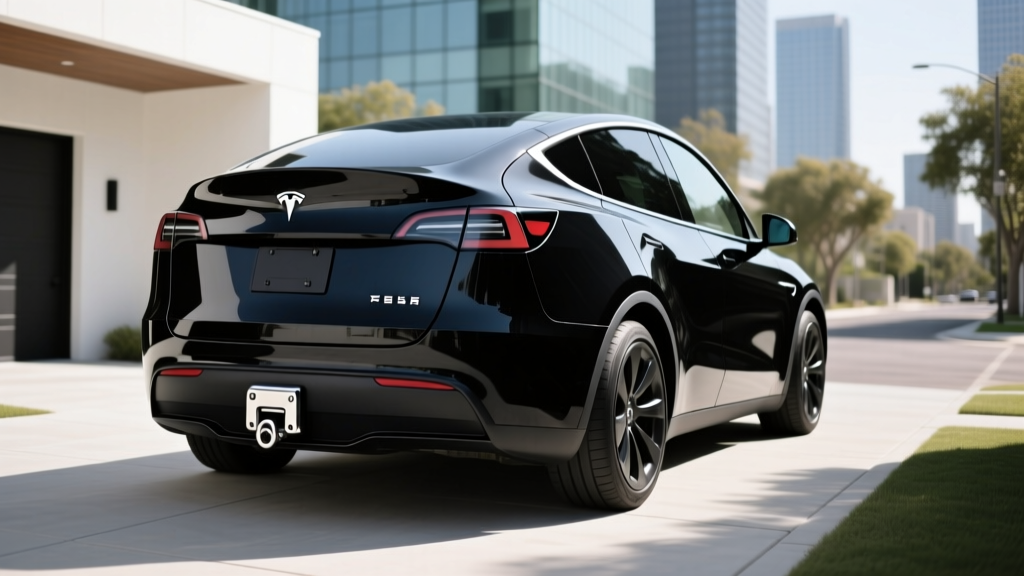
The factory tow package includes a hidden receiver that tucks behind the rear bumper fascia when not in use, along with integrated trailer light wiring and a software-based Tow Mode that adjusts stability control, regenerative braking behavior, and speed limiting. If your Model Y didn't ship with the hitch from the factory, aftermarket options from Curt, Draw-Tite, and EcoHitch are widely available, though you'll need to source a separate wiring harness and will not gain the integrated Tow Mode software without a third-party CAN-bus adapter.
2026 Tesla Model Y: Full Specs at a Glance
Before we talk about towing, here's the complete picture of what you're buying. The 2026 Model Y is offered in several trims with updated battery chemistry and efficiency improvements from Tesla's ongoing engineering revisions.
| Spec | Long Range AWD | Performance AWD | RWD (Standard) |
|---|---|---|---|
| EPA Range | 320 miles | 295 miles | 280 miles |
| Battery Capacity (usable) | ~75 kWh (NMC) | ~75 kWh (NMC) | ~60 kWh (LFP) |
| Drivetrain | Dual-Motor AWD | Dual-Motor AWD | Single-Motor RWD |
| Horsepower | ~384 hp | ~456 hp | ~295 hp |
| 0–60 mph | 4.8 sec | 3.5 sec | 6.6 sec |
| MPGe (combined) | 122 MPGe | 111 MPGe | 128 MPGe |
| Efficiency | 27 kWh/100mi | 30 kWh/100mi | 26 kWh/100mi |
| Max DC Fast Charge | 250 kW | 250 kW | 170 kW |
| 10–80% DC Charge | ~25 min | ~25 min | ~30 min |
| Level 2 Home Charge | 11.5 kW (~44 mi/hr) | 11.5 kW (~44 mi/hr) | 7.6 kW (~30 mi/hr) |
| Cargo (rear seats up) | 30 cu ft | 30 cu ft | 30 cu ft |
| Cargo (rear seats down) | 72 cu ft | 72 cu ft | 72 cu ft |
| Base MSRP | $47,990 | $52,990 | $39,990 |
| Towing Capacity | 3,500 lbs | 3,500 lbs | 3,500 lbs (if equipped) |
Real-World Range: What the EPA Sticker Doesn't Tell You
EPA Estimated: 320 miles
Real-World Highway (70–75 mph): ~265–285 miles
Real-World City/Suburban: ~295–315 miles
Cold Weather (below 32°F, highway): ~210–245 miles
While Towing (flat terrain, 60 mph): ~150–190 miles (estimated)
The Model Y's efficiency is among the best in its class, thanks to Tesla's heat pump standard on all trims and the vehicle's aerodynamic profile. According to fueleconomy.gov, the Long Range AWD achieves 122 MPGe combined. But EPA range assumes a mix of city and highway driving at moderate speeds in temperate conditions.
On real-world highway runs at 75 mph, expect to use roughly 28–32 kWh per 100 miles, which translates to 265–285 miles from a full charge. In cold weather (below freezing), battery resistance increases and cabin heating draws significant power — plan for 30–35% range reduction on highway trips. The LFP battery in the RWD trim handles cold somewhat less gracefully than NMC chemistry and Tesla recommends periodic charging to 100% for LFP state-of-health calibration.
Towing's Brutal Impact on Range
This is where the Model Y tow hitch reality check hits hard. Towing a loaded trailer adds frontal area, weight, and rolling resistance simultaneously. Real-world EV towing tests consistently show a 40–55% range reduction when pulling a trailer near the vehicle's max capacity. With a 2,500–3,000 lb loaded camper or utility trailer, expect your 320-mile Long Range to drop to roughly 150–190 miles of practical range on flat terrain at 60 mph. Add hills, headwinds, or cold weather, and you could see 120–140 miles between charges.
That means road trips while towing require careful Supercharger route planning — ideally with chargers spaced no more than 100–120 miles apart to maintain a safety buffer. For local towing (moving a utility trailer to the dump, hauling bikes to a trailhead 30 miles away), the range impact is manageable. For cross-country towing, it's a significant logistical challenge.
Charging Speed: DC Fast, Home, and Towing Logistics
| Charging Level | Power (kW) | Miles Added per Hour | Notes |
|---|---|---|---|
| Level 1 (120V outlet) | ~1.4 kW | ~4–5 mi/hr | Emergency/trickle only |
| Level 2 (240V, 48A) | 11.5 kW | ~44 mi/hr | Home Wall Connector; full charge ~7–8 hrs |
| Level 2 (240V, 32A) | 7.6 kW | ~30 mi/hr | Mobile Connector / lower-amp circuits |
| DC Fast (V3 Supercharger) | Up to 250 kW | ~1,000 mi/hr (peak) | 10–80% in ~25 min; tapers sharply above 80% |
| DC Fast (CCS adapter) | Up to 150–170 kW | Varies | Non-Tesla networks; speed depends on station |
Tesla's V3 Supercharger network remains the gold standard for DC fast charging. The Model Y Long Range and Performance trims accept a peak rate of 250 kW, though this peak only holds between roughly 10–30% state of charge. The charging curve tapers progressively: by 60% SoC you're typically seeing 100–120 kW, and above 80% it drops to 40–60 kW. This is why the 10–80% metric (~25 minutes) is the useful benchmark — charging past 80% at a DC fast charger is painfully slow and should be avoided on road trips unless absolutely necessary.
At home, a Tesla Wall Connector on a 60-amp circuit delivers 11.5 kW (48 amps), adding roughly 44 miles of range per hour of charging. A full overnight session easily replenishes a depleted battery. For towing-heavy use cases, Level 2 home charging is essential — relying on Level 1 (120V) would take multiple days to refill the pack after a towing session.
Towing charging tip: Tesla's navigation system with Tow Mode active will account for the trailer's drag when calculating Supercharger stops and arrival SoC. This is a significant advantage over aftermarket hitch installations, which lack software integration.
Pricing, Trims, and Federal Tax Credit Eligibility
| Trim | Base MSRP | With Tow Hitch (+~$1,000) | Est. After §30D Credit | Eligible? |
|---|---|---|---|---|
| RWD (Standard) | $39,990 | ~$40,990 | ~$33,490 (if eligible) | Yes (MSRP under cap) |
| Long Range AWD | $47,990 | ~$48,990 | ~$41,490 (if eligible) | Yes (MSRP under cap) |
| Performance AWD | $52,990 | ~$53,990 | ~$46,490 (if eligible) | Yes (MSRP under $80K SUV cap) |
The Model Y qualifies as an SUV under IRS guidelines, which sets the MSRP cap at $80,000 for the §30D federal clean vehicle credit. All current Model Y trims clear that threshold comfortably. However, the full $7,500 credit is not guaranteed for every buyer. Eligibility depends on:
- Buyer income caps: Modified AGI must not exceed $150,000 (single), $225,000 (head of household), or $300,000 (joint filers)
- Battery critical minerals and components sourcing: A percentage of battery minerals must be sourced from the U.S. or free-trade-agreement countries, and battery components must be manufactured/assembled in North America — these thresholds tighten annually
- Point-of-sale transfer: As of 2024+, eligible buyers can transfer the credit to the dealer at purchase, reducing the out-of-pocket price immediately rather than waiting for tax filing
- VIN verification: Confirm your specific vehicle's battery sourcing eligibility at fueleconomy.gov before purchasing
The RWD trim with its LFP battery may face different sourcing compliance than NMC trims, as LFP cells have historically been manufactured in China. Tesla has been shifting supply chains, but always verify current-year eligibility for your specific VIN before counting on the credit.
Battery Chemistry, Degradation, and Warranty Coverage
The Model Y lineup splits between two battery chemistries, and the choice matters for long-term ownership — especially if you plan to tow regularly:
| Factor | NMC (Long Range / Performance) | LFP (RWD Standard) |
|---|---|---|
| Energy Density | Higher — enables 320 mi range | Lower — limits to ~280 mi |
| Charge to 100% Regularly? | No — Tesla recommends 80% daily | Yes — required for calibration |
| Cold-Weather Performance | Better low-temp output | More range loss in freezing temps |
| Cycle Life Longevity | Good (~1,500+ cycles) | Excellent (~3,000+ cycles) |
| Towing Suitability | Better range buffer | Smaller buffer, more planning needed |
Tesla's battery and drive unit warranty covers 8 years or 120,000 miles (Long Range/Performance) and 8 years or 100,000 miles (RWD), whichever comes first, with a minimum 70% capacity retention threshold. Real-world data from high-mileage Tesla owners suggests typical degradation of 8–12% over the first 100,000 miles, with the curve flattening significantly after the initial break-in period.
If you'll tow frequently, the NMC battery in the Long Range AWD is the stronger choice. Its higher energy capacity gives you a larger buffer after the 40–55% range penalty of towing, and its better cold-weather performance matters when hauling in winter conditions. The LFP RWD trim can tow, but the smaller battery means tighter margins on every trip.
Who Should Tow With a Model Y — and Who Shouldn't
- Light utility trailers (landscape waste, small furniture moves) under 2,000 lbs
- Bike racks and cargo carriers (tongue weight well under 350 lbs)
- Small teardrop campers or pop-up trailers under 2,500 lbs for weekend trips
- Short-distance towing where range loss is manageable on a single charge
- Owners who already have home Level 2 charging and access to Superchargers
- You plan to tow a travel trailer or boat over 3,000 lbs regularly
- You need to tow long distances (200+ miles) without extensive charge-stop planning
- You tow in mountainous terrain where range loss compounds with elevation
- You need a full-size spare tire (Model Y has none — tire repair kit only)
The Model Y is a competent light-duty tow vehicle, but it's not a truck. Its 3,500-lb rating is competitive with other electric crossovers — the Ford Mustang Mach-E is not rated for towing at all, while the Hyundai Ioniq 5 matches at 3,500 lbs with its AWD trims. For anything approaching the Model Y's max capacity on a sustained basis, a body-on-frame EV like the Ford F-150 Lightning (7,700–10,000 lbs) or Rivian R1T (11,000 lbs) is a more appropriate tool.
Pros and Cons: Model Y as a Towing EV
- 3,500-lb capacity covers most light-duty needs
- Integrated Tow Mode (factory hitch) optimizes stability and regen
- Supercharger network simplifies route planning vs. other EVs
- Instant torque provides smooth, responsive trailer acceleration
- Heat pump standard — efficient cabin climate while towing
- Low center of gravity reduces trailer sway vs. tall SUVs
- 40–55% range loss while towing is severe
- No spare tire — a blowout while towing is a serious problem
- Tongue weight limit of 350 lbs restricts heavier trailers
- Aftermarket hitches lack Tow Mode software integration
- Charging stops while towing add significant trip time
- Ground clearance (6.6 in) limits rough-road trailer access
Frequently Asked Questions
What is the real-world range of the Model Y while towing?
Expect 150–190 miles from the Long Range AWD when towing a 2,500–3,000 lb trailer on flat terrain at 60 mph. Heavier loads, hills, headwinds, or cold weather can push this down to 120–140 miles. The RWD (LFP) trim will see even less — plan for 100–140 miles in similar conditions.
How fast does the Model Y charge on a road trip while towing?
The Long Range and Performance trims peak at 250 kW on V3 Superchargers, achieving 10–80% in roughly 25 minutes. However, you'll likely arrive at chargers at a lower state of charge when towing (due to higher consumption), which can actually keep you in the peak charge-rate window longer. Plan on 20–30 minute stops every 120–150 miles.
Does the Model Y qualify for the $7,500 federal EV tax credit?
All Model Y trims fall under the $80,000 SUV MSRP cap for §30D eligibility. However, the full credit depends on your income (AGI limits apply), battery sourcing compliance (which varies by trim and production batch), and your tax liability. The credit can now be transferred at point of sale. Always verify your specific VIN's eligibility on fueleconomy.gov and consult a tax professional.
Can I install a tow hitch on a Model Y that didn't come with one?
Yes. Aftermarket Class III hitches from brands like EcoHitch and Curt are widely available for the Model Y. Expect to pay $1,200–$1,800 including professional installation. However, you won't get Tesla's integrated Tow Mode software, which means the vehicle's stability control and regenerative braking won't be optimized for trailer loads.
Is the Model Y worth buying for towing vs. competitors?
For light-duty towing (under 2,500 lbs, short distances), the Model Y is an excellent choice — its efficiency, Supercharger network, and integrated tech are hard to beat. For heavier or longer-distance towing, consider the Ford F-150 Lightning, Rivian R1S/R1T, or a plug-in hybrid like the Toyota RAV4 Prime for shorter electric-only stints with a gas backup. The Hyundai Ioniq 5 matches the 3,500-lb rating but lacks Tesla's charging infrastructure advantage.
Does the Model Y have a spare tire, and why does that matter for towing?
No. The Model Y ships with a tire repair kit (sealant and compressor) rather than a spare. A tire failure while towing a loaded trailer is more dangerous and harder to manage roadside than in normal driving. Many owners who tow regularly carry a compact spare or ensure their roadside assistance plan covers trailer-related incidents.