The Tesla Model Y is the best-selling electric vehicle in the United States for good reason: strong range, access to the Supercharger network, and practical crossover packaging. But a growing number of buyers are asking a specific question — can you actually tow with it? The answer is yes, and the 2026 Tesla Model Y with tow hitch is a surprisingly capable light-duty hauler, provided you understand the range trade-offs and charging logistics that come with pulling a trailer.
In this review, we break down everything you need to know about towing with the Model Y: the factory tow hitch option, real-world range impact, charging speeds, pricing after federal tax credits, and whether it makes sense versus competitors like the Ford Mustang Mach-E and Hyundai Ioniq 5.
2026 Tesla Model Y: Core Specifications at a Glance
| Specification | Long Range AWD | Performance |
|---|---|---|
| EPA Range | 320 miles | 298 miles |
| Battery (usable) | ~75 kWh, NMC | ~75 kWh, NMC |
| Drivetrain | Dual-Motor AWD | Dual-Motor AWD |
| Horsepower | 384 hp | 456 hp |
| 0–60 mph | 4.8 sec | 3.5 sec |
| Max Tow Capacity | 3,500 lbs | 3,500 lbs |
| Max DC Fast Charge | 250 kW | 250 kW |
| 10–80% DC Time | ~25 min | ~25 min |
| Level 2 Home Charge | 11.5 kW (~44 mi/hr) | 11.5 kW (~44 mi/hr) |
| MPGe (combined) | 117 MPGe | 111 MPGe |
| Efficiency | 29 kWh/100 mi | 30 kWh/100 mi |
| Cargo (rear seats up) | 30.2 cu ft | 30.2 cu ft |
| Cargo (rear seats folded) | 72.1 cu ft | 72.1 cu ft |
| Rear Legroom | 41.6 in | 41.6 in |
| Base MSRP | $44,990 | $48,990 |
| Tow Hitch Option | $1,000 | $1,000 |
| Battery/Drive Unit Warranty | 8 yr / 120,000 mi | 8 yr / 120,000 mi |
Source: fueleconomy.gov, Tesla.com 2026 specifications.
Towing With the Model Y: Hitch, Capacity, and Real-World Range Impact
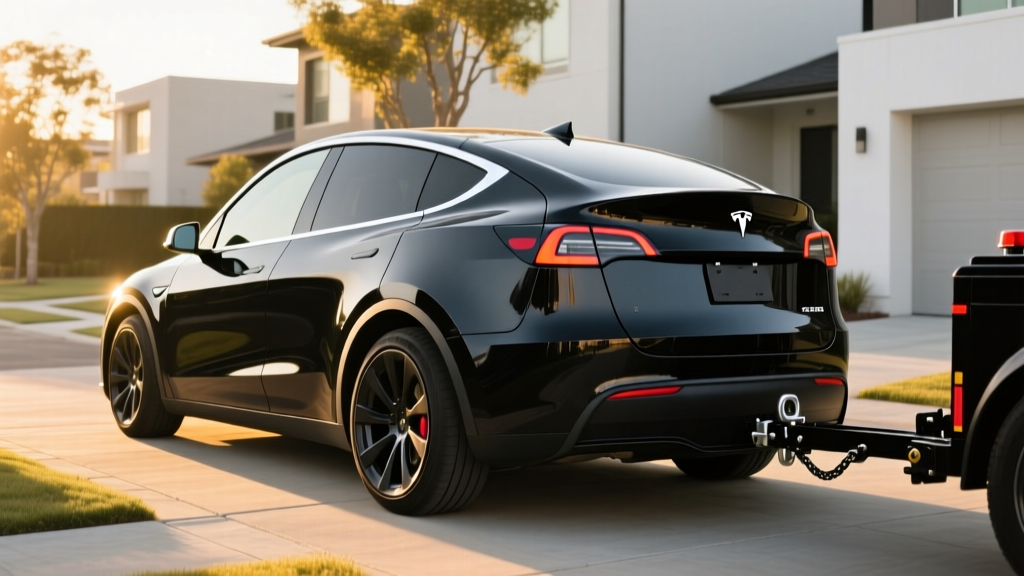
The Tesla Model Y tow hitch is a $1,000 factory-installed option available on both the Long Range AWD and Performance trims. It includes a 2-inch receiver with a 7-pin connector for trailer lighting and electric brakes. The maximum tow rating is 3,500 pounds with a tongue weight limit of 350 pounds — enough for a small camping trailer, a pair of jet skis, a lightweight utility trailer, or a bike rack carrying four bikes.
Real-World Range: Towing vs. Normal Driving
EPA sticker: 320 miles (Long Range AWD)
Normal driving (no trailer): Expect 270–295 miles on the highway at 70–75 mph. In city driving with regenerative braking, you may match or slightly exceed the EPA figure.
Cold weather (below 32°F): Plan for 20–30% range loss, dropping effective range to roughly 220–255 miles without a trailer.
While towing near max capacity (3,500 lbs): Range drops dramatically — expect 150–190 miles depending on trailer aerodynamics, terrain, and speed. A boxy travel trailer will hit the low end; a streamlined teardrop camper may approach 190 miles.
Bottom line: The Model Y with tow hitch is practical for short-to-medium towing runs (boat ramps, dump runs, moving day) but is not a cross-country towing solution. Plan Supercharger stops carefully and keep highway speeds under 65 mph to maximize range.
Tesla's onboard software includes a trailer mode that adjusts stability control, regenerative braking behavior, and energy consumption estimates when a trailer is connected. The navigation system factors trailer drag into route planning and Supercharger recommendations — a meaningful advantage over aftermarket hitch installations on competing EVs that lack software integration.
Charging Speed: DC Fast Charging and Home Level 2
Charging speed is where the Model Y continues to hold an edge, especially with access to the Tesla Supercharger network — now the largest and most reliable DC fast-charging network in North America. With the industry's transition to the North American Charging Standard (NACS), the Model Y uses its native connector at all Superchargers and at a growing number of third-party stations that have added NACS cables.
| Charging Level | Power | Speed (Approx.) | Use Case |
|---|---|---|---|
| Level 1 (120V household) | ~1.4 kW | ~5 miles per hour | Emergency / overnight trickle |
| Level 2 (240V home Wall Connector) | 11.5 kW | ~44 miles per hour | Daily home charging (full charge in ~7 hours) |
| DC Fast Charge (Supercharger V3/V4) | Up to 250 kW (peak) | ~162 miles in 15 minutes | Road trips; 10–80% in ~25 minutes |
Understanding the charge curve: The 250 kW peak rate is not sustained across the entire session. The Model Y's NMC battery accepts peak power roughly between 10–40% state of charge. Above 50%, the rate tapers to ~150 kW; above 80%, it drops further to under 50 kW to protect battery health. This is why Tesla and all EV manufacturers quote 10–80% times rather than 0–100%.
For home charging, the Tesla Wall Connector ($420) on a 60-amp circuit delivers the full 11.5 kW (48 amps continuous). Most owners who install a Wall Connector report waking up to a full battery every morning, making the daily cost of driving roughly $0.04–$0.06 per mile depending on local electricity rates — compared to $0.12–$0.18 per mile for a comparable gas crossover at current fuel prices.
Pricing, Trims, and Federal Tax Credit Eligibility
The 2026 Model Y is offered in two main trims. Here's what you'll actually pay after the federal EV tax credit, assuming you qualify:
| Trim | Base MSRP | + Tow Hitch | Destination | Est. §30D Credit | Effective Price |
|---|---|---|---|---|---|
| Long Range AWD | $44,990 | $1,000 | $1,390 | Up to $7,500 | ~$39,880 |
| Performance | $48,990 | $1,000 | $1,390 | Up to $7,500 | ~$43,880 |
Federal §30D Tax Credit: Key Eligibility Rules (2026)
- Credit amount: Up to $7,500, split between a critical minerals requirement ($3,750) and a battery component sourcing requirement ($3,750).
- MSRP cap: SUVs/crossovers must be priced at or below $80,000. The Model Y qualifies on all trims.
- Buyer income cap: Modified adjusted gross income must not exceed $150,000 (single), $225,000 (head of household), or $300,000 (joint filing).
- Battery sourcing: Vehicles must meet critical minerals and battery component thresholds that increase annually. Check the latest eligibility at fueleconomy.gov before purchasing.
- Point-of-sale transfer: As of 2024, you can transfer the credit to the dealer at purchase, reducing your out-of-pocket cost immediately rather than waiting to claim it on your tax return.
Source: IRS.gov — Credits for New Clean Vehicles. Consult a tax professional to confirm personal eligibility.
Performance, Efficiency, and Daily Driving
Even with a tow hitch bolted on, the Model Y Long Range AWD is a quick and efficient daily driver. The dual-motor powertrain delivers 384 horsepower and a 4.8-second 0–60 mph time — quicker than virtually every gas-powered compact SUV on the market. The Performance trim cuts that to 3.5 seconds with 456 hp, though the stiffer suspension tuning trades some ride comfort for cornering grip.
Efficiency is a Tesla strong suit. At 29 kWh per 100 miles (Long Range), the Model Y is among the most efficient electric crossovers available. That translates directly to lower charging costs and more miles per Supercharger stop. For comparison, the Ford Mustang Mach-E Extended Range AWD consumes roughly 34 kWh/100 mi, and the Hyundai Ioniq 5 AWD sits around 32 kWh/100 mi.
Ride quality in the refreshed Model Y (introduced for the 2025 model year) is noticeably improved over earlier versions, with better sound insulation, revised suspension tuning, and a more compliant ride over broken pavement. The cabin is minimalist but functional: a 15.4-inch center touchscreen handles all infotainment and vehicle controls, a rear 8-inch screen serves back-seat passengers, and ventilated front seats are now standard.
Cargo Space, Interior, and Standout Tech
With 30.2 cubic feet behind the second row and 72.1 cubic feet with the rear seats folded, the Model Y offers strong cargo utility. The rear trunk includes a deep under-floor storage well, and the front trunk (frunk) adds roughly 4.1 cubic feet for charging cables or a small bag. Rear legroom of 41.6 inches is generous for adults on longer trips.
Standout tech features:
- Tesla Supercharger network: 50,000+ global fast chargers, with the highest reliability rates in the industry (~95%+ uptime).
- Autopilot (standard): SAE Level 2 driver assistance including adaptive cruise, lane centering, and automatic emergency braking. The driver must remain engaged at all times.
- Full Self-Driving Supervised ($8,000 option): Adds automatic lane changes, on-ramp/off-ramp navigation, traffic light recognition, and parking assist. Still SAE Level 2 — not autonomous driving.
- Over-the-air updates: Continuous feature additions and performance improvements delivered wirelessly.
- Sentry Mode and Dashcam: Built-in cameras record incidents around the vehicle when parked and while driving.
- Trailer mode software: Integrated towing dynamics and range estimation when the hitch is connected.
Notable drawbacks:
- No physical buttons or stalks — turn signals are on the steering wheel (in the refreshed model), and climate controls are touchscreen-only.
- No Apple CarPlay or Android Auto — Tesla's proprietary infotainment is capable but a dealbreaker for some.
- Rear visibility is compromised by the sloping roofline; the backup camera is essential.
- Insurance premiums tend to run 15–25% higher than comparable gas crossovers.
Pros
- 3,500-lb tow rating with integrated trailer software
- Class-leading Supercharger network access
- Excellent efficiency (29 kWh/100 mi)
- Strong 0–60 performance even in Long Range trim
- Generous cargo volume (72.1 cu ft max)
- Over-the-air updates keep the vehicle current
- Qualifies for up to $7,500 federal tax credit (subject to eligibility)
Cons
- Towing cuts range by 40–55%
- No Apple CarPlay / Android Auto
- Touchscreen-only controls require adaptation
- Higher insurance costs than ICE competitors
- $1,000 tow hitch option not included in base price
- Performance trim ride can be firm for daily commuting
Model Y vs. Key Competitors: Towing Comparison
| Attribute | Tesla Model Y LR AWD | Ford Mustang Mach-E ER AWD | Hyundai Ioniq 5 AWD |
|---|---|---|---|
| EPA Range | 320 mi | 312 mi | 290 mi |
| Max Tow Capacity | 3,500 lbs | 3,500 lbs (w/ factory hitch) | 2,300 lbs |
| Tow Hitch Availability | Factory option ($1,000) | Dealer-installed accessory | Factory option |
| Integrated Tow Software | Yes | Limited | Limited |
| DC Fast Charge Peak | 250 kW | 150 kW | 240 kW |
| 10–80% DC Time | ~25 min | ~38 min | ~18 min |
| Charging Network | NACS (Supercharger native) | NACS adapter included | NACS adapter available |
| Base MSRP (AWD) | $44,990 | $48,995 | $49,650 |
The Model Y's combination of a 3,500-lb tow rating, native Supercharger access, and integrated trailer software gives it a clear towing advantage over the Ioniq 5 (limited to 2,300 lbs). The Mach-E matches the 3,500-lb rating but charges slower on DC fast chargers and lacks Tesla's seamless trailer-mode integration. For buyers who tow even occasionally, the Model Y is the most complete package in this segment.
Who Should Buy the Tesla Model Y With Tow Hitch?
Choose the Model Y with Tow Hitch If:
- You need to tow a small camper, boat, or utility trailer on weekend trips under 150 miles each way.
- You want a daily-driver EV with strong range that can also handle occasional towing duty.
- You value Supercharger network reliability for road trips — especially critical when towing reduces range.
- You want integrated trailer software rather than an aftermarket hitch with no vehicle integration.
Look Elsewhere If:
- You regularly tow over 200 miles one-way — range drops make this impractical without very frequent stops.
- You need more than 3,500 lbs of tow capacity (consider a Ford F-150 Lightning or Rivian R1S).
- You prefer physical buttons, Apple CarPlay, or a more traditional cabin layout.
Frequently Asked Questions
What is the real-world range of the Tesla Model Y while towing?
Without a trailer, expect 270–295 miles on the highway in moderate temperatures. While towing near the 3,500-lb maximum, plan for 150–190 miles depending on the trailer's aerodynamic profile, terrain, and speed. A streamlined teardrop camper will yield better range than a boxy travel trailer. Cold weather compounds the loss — towing in freezing conditions may drop range below 140 miles.
How fast does the Model Y charge at home and on the road?
At home with a Tesla Wall Connector on a 240V/60A circuit, the Model Y charges at 11.5 kW, adding roughly 44 miles of range per hour — a full charge takes about 7 hours overnight. On DC fast charging via Supercharger V3/V4, it peaks at 250 kW and can add approximately 162 miles in 15 minutes. A 10–80% session takes about 25 minutes. Remember that charge speed tapers significantly above 80% state of charge — this is normal battery management, not a defect.
How much does the Model Y with tow hitch cost after the federal tax credit?
The Long Range AWD with tow hitch and destination starts at approximately $47,380 before incentives. If you qualify for the full $7,500 federal §30D credit (income under the caps, vehicle meets battery sourcing requirements), the effective price drops to roughly $39,880. The credit can now be transferred to the dealer at the point of sale, reducing your upfront cost. Verify current eligibility at fueleconomy.gov and consult a tax professional.
Does the Tesla Model Y qualify for the $7,500 federal EV tax credit?
The Model Y qualifies on MSRP (under the $80,000 SUV cap) and has historically met battery sourcing requirements for the full or partial credit. However, eligibility depends on your income (under $150K single / $300K joint), the specific battery components in your vehicle's build, and current IRS rules that update periodically. Always check the latest sourcing data on fueleconomy.gov before purchasing.
Is the Model Y worth buying over the Mach-E or Ioniq 5 for towing?
For towing specifically, the Model Y holds an edge. It matches the Mach-E's 3,500-lb rating but offers faster DC charging, native Supercharger access, and dedicated trailer-mode software. The Ioniq 5 is limited to 2,300 lbs, ruling out heavier trailers. If towing is a priority — even occasionally — the Model Y is the most capable and integrated option in the electric compact crossover segment.
Can I install an aftermarket tow hitch instead of the factory option?
Aftermarket hitches are available from companies like Curt and Draw-Tite, typically for $200–$400 plus installation. However, you will lose Tesla's integrated trailer software (trailer mode, adjusted regen, towing range estimates) and may void portions of your warranty if the installation damages wiring or the rear structure. The $1,000 factory option is the recommended path for most buyers.
What is the battery warranty on the Model Y?
Tesla covers the Model Y battery and drive units for 8 years or 120,000 miles, whichever comes first, with a minimum 70% capacity retention guarantee. The NMC chemistry in the Long Range and Performance trims has shown strong longevity data, with most Model Y batteries retaining 90%+ capacity at 100,000 miles based on fleet telemetry data.
For the latest EPA range and efficiency data, visit fueleconomy.gov. For federal tax credit eligibility details, see the IRS Clean Vehicle Credits page. All pricing and specifications reflect 2026 model year data as of publication.