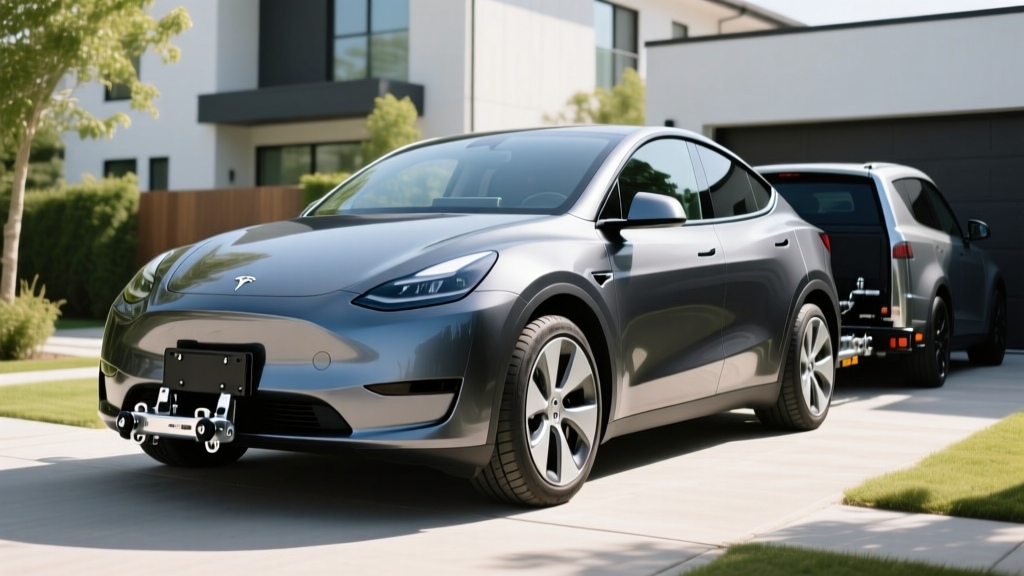
If you own a Tesla Model Y or are about to take delivery, a tow hitch dramatically expands what this compact electric SUV can do — from hauling a lightweight camping trailer to mounting a cargo carrier or bike rack. But a Tesla tow hitch install on an EV isn't as simple as bolting one onto a gas car. You need to understand the Model Y's factory towing rating, how towing affects real-world range, which hitch hardware to choose, and whether the installation impacts warranty or electrical systems.
This guide covers everything you need to know about adding a hitch to the Tesla Model Y, paired with a full 2025–2026 model-year review of the vehicle itself — range, charging, pricing, tax credits, and how it stacks up for buyers who need towing capability.
Tesla Model Y Towing Capacity and Hitch Options
The Tesla Model Y comes with a factory tow rating that varies by market and model year. In the United States, the current Long Range AWD and Performance variants carry a 3,500-pound maximum towing capacity with a 350-pound tongue weight limit. The base Rear-Wheel Drive (RWD) trim is typically rated at 2,000 pounds. Always verify your specific VIN's rating in the owner's manual or Tesla app before loading a trailer.
Factory vs. Aftermarket Hitch Hardware
Tesla offers a factory tow hitch as a dealer-installed or factory-order accessory on applicable trims. The OEM hitch includes a 1.25-inch receiver (some markets offer 2-inch) and integrates with the vehicle's software for trailer light detection and stability control adjustments. Pricing for the Tesla OEM hitch with installation typically runs $1,000–$1,200 at a Service Center.
Aftermarket options from manufacturers like Curt, Draw-Tite, and EcoHitch offer 2-inch receivers, often at lower cost ($300–$600 for hardware alone). However, aftermarket hitches may not integrate with Tesla's trailer lighting module, and some installations require tapping into the 12V system for a 4-pin or 7-pin wiring harness.
| Spec | Detail |
|---|---|
| Max Towing (Long Range / Performance) | 3,500 lbs (1,588 kg) |
| Max Towing (RWD) | 2,000 lbs (907 kg) |
| Max Tongue Weight | 350 lbs |
| OEM Hitch Receiver | 1.25" (2" available in some markets) |
| OEM Hitch + Install Cost | ~$1,000–$1,200 |
| Aftermarket Hitch Cost | $300–$600 (hardware only) |
| Wiring Harness | 4-pin flat (7-pin adapter available) |
Real-World Range Impact When Towing
This is where most EV tow-hitch buyers get a reality check. Towing a trailer significantly increases aerodynamic drag and rolling resistance, and the energy penalty is steep.
- EPA Estimated Range (no trailer): 320 miles (Long Range AWD), 303 miles (Performance)
- Real-World Highway (no trailer): ~270–290 miles at 70 mph in moderate temps
- Towing a 2,500-lb teardrop trailer: Expect ~160–190 miles of effective range (40–50% reduction)
- Towing a 3,500-lb enclosed cargo trailer: Expect ~130–160 miles (50–60% reduction)
- Cold-Weather Towing (below 32°F): Add another 10–15% range loss on top of towing reduction
The physics are straightforward: the Model Y's efficiency drops from roughly 28 kWh/100 mi (unloaded highway) to 50–65 kWh/100 mi under heavy tow. On a road trip, this means planning Supercharger stops every 130–170 miles instead of every 250+. For lightweight utility (bike rack, cargo carrier, small jet-ski trailer under 1,500 lbs), range loss is typically 10–20%, which is manageable.
Model Y 2025–2026: Full EV Specs Review
Beyond towing, here's the complete picture of what you're buying with a current Model Y.
| Specification | Long Range AWD | Performance | RWD (Base) |
|---|---|---|---|
| EPA Range | 320 mi | 303 mi | 260 mi (est.) |
| Battery (Usable) | ~75 kWh (NMC) | ~75 kWh (NMC) | ~60 kWh (LFP) |
| Drivetrain | Dual Motor AWD | Dual Motor AWD | Rear-Wheel Drive |
| Horsepower | ~384 hp | ~456 hp | ~295 hp |
| 0–60 mph | 4.8 sec | 3.5 sec | 6.6 sec |
| Max DC Fast Charge | 250 kW (V3 Supercharger) | 250 kW | 170 kW |
| 10–80% DC Charge Time | ~25 min | ~25 min | ~30 min |
| Level 2 Home Charge | 11.5 kW (~44 mi/hr) | 11.5 kW (~44 mi/hr) | 7.6 kW (~30 mi/hr) |
| Efficiency | 122 MPGe / 28 kWh/100mi | 117 MPGe / 29 kWh/100mi | 128 MPGe / 26 kWh/100mi |
| Cargo Volume (rear seats up) | 30.2 cu ft | 30.2 cu ft | 30.2 cu ft |
| Cargo Volume (rear seats down) | 72.0 cu ft | 72.0 cu ft | 72.0 cu ft |
| Max Towing | 3,500 lbs | 3,500 lbs | 2,000 lbs |
Battery Chemistry: LFP vs. NMC in the Model Y Lineup
The RWD base Model Y uses a lithium iron phosphate (LFP) battery pack. LFP offers a longer cycle life, better thermal stability, and Tesla recommends charging to 100% daily. The trade-off is lower energy density, which limits range and adds weight.
The Long Range and Performance trims use nickel manganese cobalt (NMC) chemistry, which packs more energy per kilogram but Tesla recommends a daily charge limit of 80% to preserve longevity, reserving 100% for road trips. For towing buyers, the NMC packs in the Long Range and Performance deliver the range buffer you'll need when hitched to a trailer.
Charging Setup for a Towing-Capable Model Y
If you're using the Model Y for towing, charging logistics become more critical — especially on road trips with a trailer in tow.
| Charge Level | Power (kW) | Miles of Range per Hour | Notes |
|---|---|---|---|
| Level 1 (120V household) | ~1.4 kW | ~3–5 mi/hr | Emergency/trickle only |
| Level 2 (240V, 32A Wall Connector) | 7.6 kW | ~30 mi/hr | RWD trim |
| Level 2 (240V, 48A Wall Connector) | 11.5 kW | ~44 mi/hr | Long Range / Performance |
| DC Fast (V3 Supercharger) | Up to 250 kW | ~200 mi in 15 min | Peak rate; tapers above 60% SoC |
| DC Fast (CCS adapter at EA/other) | Up to 150–250 kW | Varies | NACS to CCS adapter may be needed |
Home charging install reality: A Tesla Wall Connector on a dedicated 60-amp circuit costs $500 for hardware plus $800–$2,500 for electrician labor and permits, depending on panel proximity. If your home's electrical panel needs an upgrade to 200 amps, budget an additional $1,500–$3,500. Always consult a licensed electrician for final specs.
Supercharging with a trailer: Most Tesla Supercharger stalls are pull-through or have adequate space for a small trailer, but busy urban stations can be tight. Plan stops using Tesla's in-car navigation, which accounts for trailer mode when enabled.
Pricing, Trims, and Federal Tax Credit Eligibility
Here's what the Model Y costs before and after potential incentives, based on current 2025–2026 pricing.
| Trim | Base MSRP | Est. Federal Credit (§30D) | Effective Price |
|---|---|---|---|
| RWD (Base) | ~$44,990 | Up to $7,500* | ~$37,490 |
| Long Range AWD | ~$48,990 | Up to $7,500* | ~$41,490 |
| Performance | ~$52,490 | Up to $7,500* | ~$44,990 |
*Critical §30D eligibility requirements (per IRS guidelines):
- MSRP cap: SUVs/vans must be under $80,000 — all Model Y trims qualify.
- Buyer income cap: AGI must not exceed $150,000 (single), $225,000 (head of household), or $300,000 (joint).
- Battery sourcing: Critical minerals and battery components must meet phased-in sourcing thresholds. Tesla's North American battery production has largely met these requirements, but confirm eligibility at point of sale — rules tighten annually.
- Point-of-sale transfer: You can transfer the credit to the dealer at purchase for an immediate price reduction rather than claiming it on your tax return.
Consult a tax professional before relying on credit eligibility. State and local incentives may also apply — check fueleconomy.gov for updated lists.
Tow Hitch Installation: What's Involved
A proper Tesla tow hitch install involves more than sliding a receiver into a frame rail. Here's what to expect:
- Vehicle prep: The rear bumper fascia must be partially removed or trimmed (OEM hitch includes a pre-cut fascia insert; aftermarket may require cutting).
- Receiver mounting: The hitch bolts to the vehicle's structural frame rails using high-grade hardware. Torque specs must be followed precisely — this is a safety-critical connection.
- Wiring harness: A 4-pin flat connector is standard for trailer lights (running, brake, turn signals). Tesla's OEM harness plugs into a dedicated tow module port. Aftermarket installs may require a powered converter module tapped from the 12V system — this should be done carefully to avoid voiding electrical warranties.
- Software activation: On OEM installs, Tesla activates a "Trailer Mode" in software that adjusts stability control, regenerative braking behavior, and range estimation. Aftermarket hitches may not trigger this mode, though some owners use OBD tools or Tesla service visits to enable it.
- Post-install alignment: Adding tongue weight changes rear suspension geometry. For heavy tongue loads, verify headlight aim and consider aftermarket air-spring helpers if you tow frequently.
Warranty note: Tesla's New Vehicle Limited Warranty covers 4 years/50,000 miles basic and 8 years/120,000 miles (Long Range/Performance) or 8 years/100,000 miles (RWD) for battery and drive unit. A properly installed OEM hitch does not void the warranty. Aftermarket installs that cause electrical damage may not be covered — document everything and use a qualified installer.
How the Model Y Compares for Towing
- 3,500-lb rating leads the compact electric SUV class
- Supercharger network enables long-distance towing trips
- 250 kW DC fast charging minimizes stop time on the road
- Dual-motor AWD provides strong traction with a loaded trailer
- OEM hitch integrates with trailer mode software
- Over-the-air updates continue to improve features
- Strong cargo space (72 cu ft max) for gear when not towing
- Towing cuts range by 40–60% — plan charging stops carefully
- No spare tire — Tesla provides a tire repair kit only
- Aftermarket hitch wiring can be complex and warranty-risky
- 1.25" OEM receiver limits heavier hitch-mount accessories
- No integrated trailer brake controller — requires aftermarket add-on for trailers over ~1,500 lbs
- FSD (Supervised) is SAE Level 2 only — not autonomous; driver must remain engaged
- Insurance premiums can be higher than comparable ICE SUVs
Key Competitors for Towing
The Ford Mustang Mach-E offers a 1,500-lb tow rating with an optional hitch — significantly less than the Model Y. The Hyundai Ioniq 5 tows up to 2,300 lbs (with the Long Range AWD). The Rivian R1S and BMW iX offer higher tow ratings (7,700 lbs and 3,500 lbs respectively) but at much higher price points. For a sub-$55,000 electric SUV with a 3,500-lb rating, the Model Y Long Range AWD is essentially unmatched.
Who Should Install a Tow Hitch on a Model Y?
Choose a Model Y with a tow hitch if:
- You need to tow a teardrop camper, small boat, or utility trailer under 3,500 lbs on weekend trips
- You want a hitch-mount bike rack or cargo carrier for road trips
- You have reliable home charging and access to Superchargers along your tow routes
- You value the combination of daily EV commuting efficiency with occasional towing capability
Look elsewhere if:
- You tow heavy trailers (5,000+ lbs) regularly — consider a Rivian R1T, F-150 Lightning, or a PHEV like the Toyota RAV4 Prime
- Your tow routes pass through charging deserts where Supercharger coverage is sparse
- You need an integrated trailer brake controller without aftermarket modification
Frequently Asked Questions
Can I install a tow hitch on my Tesla Model Y myself?
Physically, yes — the receiver bolts to the frame rails with standard tools. However, the wiring harness for trailer lights requires electrical knowledge, and incorrect wiring can damage the vehicle's 12V system or lighting controllers. Most owners are better served by a professional installer, especially for OEM integration. Budget $200–$500 for labor on top of hardware cost.
Does adding a tow hitch void the Tesla warranty?
An OEM Tesla hitch installed at a Service Center does not void any warranty coverage. An aftermarket hitch does not automatically void the warranty either, thanks to the Magnuson-Moss Warranty Act — but if the hitch installation causes specific damage (e.g., electrical short from improper wiring), Tesla can deny coverage for that damage. Keep receipts and use a reputable installer.
How much range will I lose towing with the Model Y?
Expect a 40–60% range reduction depending on trailer weight, aerodynamics, speed, and temperature. A 320-mile EPA-rated Long Range AWD realistically delivers 160–190 miles when towing a 2,500-lb trailer at highway speeds. Lightweight loads (bike rack, cargo carrier) reduce range by 10–20%. Cold weather compounds the loss.
Does the Model Y have a trailer brake controller?
No. Tesla does not offer an integrated trailer brake controller. For trailers with electric brakes (common above 1,500 lbs), you'll need an aftermarket controller like the Curt Echo or Tekonsha Prodigy, wired into the 7-pin adapter. This is an additional $150–$300 in hardware and installation.
Is the Tesla Model Y tow hitch install worth it vs. competitors?
If you need 3,500 lbs of towing in an electric SUV under $55,000, the Model Y Long Range AWD has no direct rival. The Ioniq 5 maxes out at 2,300 lbs and the Mach-E at 1,500 lbs. The trade-off is range loss under tow and the lack of a factory brake controller. For the right use case — lightweight campers, utility trailers, bike racks — the hitch install pays for itself on the first trip.
Does the Model Y qualify for the full $7,500 federal tax credit?
As of current IRS §30D rules, the Model Y qualifies for up to $7,500 if you meet the income cap ($150K single / $300K joint AGI) and the vehicle meets battery sourcing requirements. Tesla's US-built battery packs have largely satisfied these thresholds, but confirm at purchase. The credit can be transferred at point of sale for an immediate price reduction.