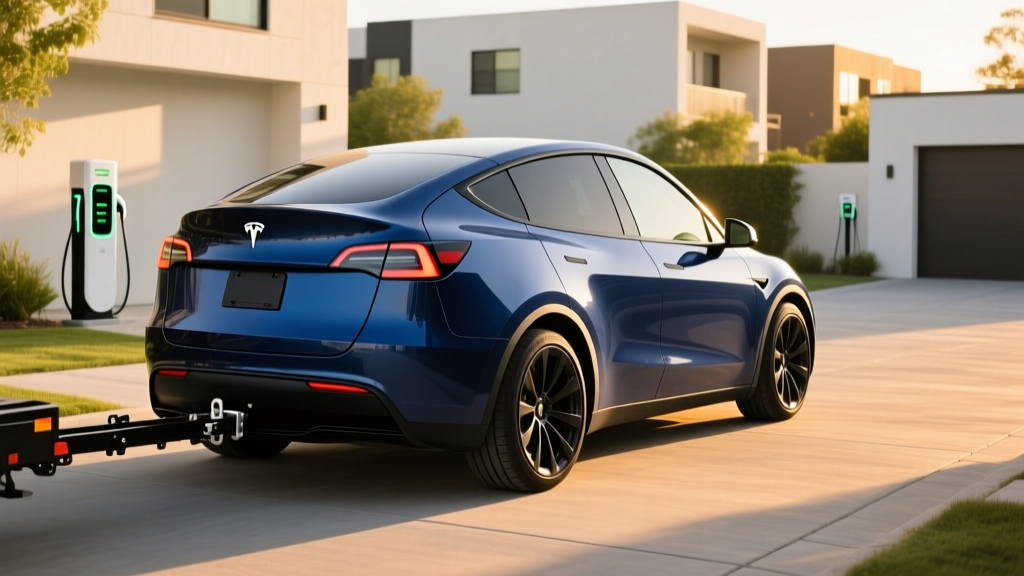
The Tesla Model Y remains one of the best-selling electric vehicles in the United States, and for good reason: it blends crossover practicality with strong efficiency and access to the Supercharger network. But buyers considering the Model Y for utility duties — light trailers, bike racks, small campers, or jet skis — need to look past the brochure. The tow capacity of Tesla Model Y variants is rated at 3,500 pounds when properly equipped, but towing an EV changes the math on range, charging stops, and energy consumption in ways that gas-truck owners rarely consider.
This review covers the 2026 Tesla Model Y lineup with a specific focus on what happens when you hook up a trailer: real-world range penalties, charging logistics, battery and powertrain specs, and whether the Model Y is actually a viable tow vehicle compared to competitors like the Ford Mustang Mach-E, Hyundai Ioniq 5, and Rivian R1S.
2026 Tesla Model Y: Trim Levels and Tow Ratings at a Glance
Tesla streamlined the Model Y lineup for the 2026 model year following the "Juniper" refresh that debuted in early 2025. All trains now feature the updated interior, ventilated front seats, rear touchscreen, and power-folding second row. The tow rating remains consistent across trims.
| Specification | Long Range RWD | Long Range AWD | Performance AWD |
|---|---|---|---|
| Base MSRP | $44,990 | $47,990 | $52,490 |
| EPA Range | 320 mi | 300 mi | 280 mi |
| Battery (usable) | ~75 kWh NMC | ~75 kWh NMC | ~75 kWh NMC |
| Drivetrain | Rear-Wheel Drive | Dual-Motor AWD | Dual-Motor AWD |
| Horsepower | 346 hp | 384 hp | 456 hp |
| 0–60 mph | 5.8 sec | 4.8 sec | 3.5 sec |
| Max Tow Capacity | 3,500 lbs | 3,500 lbs | 3,500 lbs |
| Tongue Weight Max | 350 lbs | 350 lbs | 350 lbs |
| Tow Hitch | Factory option ($1,200) | Factory option ($1,200) | Factory option ($1,200) |
| MPGe (combined) | 122 MPGe | 116 MPGe | 111 MPGe |
| Efficiency (kWh/100mi) | 27 | 29 | 30 |
The tow capacity of Tesla Model Y models is identical across all trims at 3,500 pounds — a figure that covers most small utility trailers, a pair of dirt bikes on a lightweight trailer, a teardrop camper, or a small aluminum boat. However, the 350-pound tongue weight limit is more restrictive than many buyers realize and rules out heavier enclosed cargo trailers or larger travel campers.
Real-World Range: What the EPA Number Doesn't Tell You
EPA sticker: 300 miles
Real-world highway (70 mph, mild weather): ~260–275 miles
Real-world highway (30°F, heater on): ~210–235 miles
Real-world towing (1,500-lb trailer, 65 mph): ~170–195 miles
Real-world towing (3,000-lb trailer, 65 mph): ~140–165 miles
The Model Y's EPA-rated range is a useful baseline, but it assumes a mix of city and highway driving with no cargo and moderate temperatures. In practice, highway driving at 70+ mph reduces range by roughly 10–15% due to aerodynamic drag, which EVs are far more sensitive to than internal-combustion vehicles because they lack multi-gear transmissions to optimize efficiency at speed.
Cold weather compounds this. Lithium-ion batteries lose efficiency below 40°F, and cabin heating (even with the Model Y's standard heat pump) draws 2–5 kW continuously. Expect a 20–30% range reduction in freezing conditions before you even consider towing.
Towing is the biggest range killer. A 1,500-pound teardrop camper adds substantial aerodynamic drag and rolling resistance, typically cutting range by 35–45%. A near-max 3,000-pound enclosed trailer can halve your range entirely. This is the single most important factor for Model Y tow-capacity shoppers: you are not buying a 300-mile vehicle when towing — you are buying a 150-mile vehicle.
Charging Speed: DC Fast, Level 2, and Towing Logistics
Charging speed determines how painful those reduced towing ranges will be on road trips. The Model Y's 400-volt architecture (not the 800V systems found in Hyundai/Kia's E-GMP vehicles or the Lucid Air) limits its peak charge rate, but Tesla's thermal management and Supercharger network reliability remain industry-leading.
| Charging Method | Power (kW) | Speed / Time |
|---|---|---|
| Level 1 (120V household) | ~1.4 kW | ~3–4 miles per hour |
| Level 2 (240V, 48A Wall Connector) | 11.5 kW | ~44 miles per hour / 7–8 hrs 10–80% |
| Level 2 (240V, 32A mobile connector) | 7.7 kW | ~30 miles per hour / 10–11 hrs 10–80% |
| DC Fast Charge (V3 Supercharger) | Peak 250 kW | 10–80% in ~25 minutes |
| DC Fast Charge (V4 Supercharger) | Peak 250 kW (vehicle-limited) | 10–80% in ~25 minutes |
| DC Fast (non-Tesla CCS/NACS station) | Up to 250 kW | Varies by station; 10–80% ~25–35 min |
A critical reality about DC fast charging: the Model Y peaks at 250 kW only briefly, typically between 10–30% State of Charge (SoC). Above 50%, the charge curve tapers significantly, and above 80%, charging slows to roughly 40–60 kW to protect battery longevity. This means a 10–80% session takes about 25 minutes, but a 10–95% session can take 50+ minutes.
For towing, this taper matters. If your towing range drops to 160 miles, you'll be charging more frequently and spending more time at each stop. Plan for 30–40-minute charging stops every 130–150 miles when towing near maximum capacity. According to Tesla's official towing guide, preconditioning the battery by navigating to a Supercharger is essential for achieving peak charge rates — skip this step and your charge speed may be limited to 100–150 kW, adding 10+ minutes per stop.
Battery Chemistry, Degradation, and Warranty Coverage
The 2026 Model Y Long Range and Performance trims use a nickel-manganese-cobalt (NMC) lithium-ion battery pack with approximately 75 kWh of usable capacity. Tesla does not publish exact pack chemistry for every model year, but teardown data and regulatory filings confirm NMC chemistry for the Long Range variants. The previously available Standard Range RWD trim (which used LFP chemistry) was discontinued after the Juniper refresh.
NMC batteries offer higher energy density than LFP (lithium iron phosphate), which is why the Model Y achieves 300+ miles in a relatively compact crossover footprint. The trade-off: NMC cells are more sensitive to sustained high SoC storage and extreme heat. Tesla recommends daily charging to 80–90% for NMC packs and only charging to 100% before long trips.
Towing accelerates battery wear modestly because of the higher sustained current draw and increased thermal load. However, Tesla's battery thermal management system is among the most robust in the industry, actively cooling the pack during high-load scenarios.
Warranty coverage:
- Battery & Drive Unit: 8 years / 120,000 miles (Long Range AWD), 8 years / 100,000 miles (RWD) — whichever comes first, with minimum 70% capacity retention
- Vehicle Limited Warranty: 4 years / 50,000 miles
The 70% retention threshold is standard across the industry. Independent data from sources like fueleconomy.gov and long-term fleet studies suggest Tesla's NMC packs retain approximately 85–90% capacity at 100,000 miles under normal use. Towing frequently will likely push degradation toward the lower end of that range.
Performance, Handling, and Towing Dynamics
The Model Y's dual-motor AWD system provides excellent traction for trailer starts on inclines and in wet conditions. The Long Range AWD's 384 hp and instant electric torque make merging onto highways with a trailer far less stressful than with a similarly rated gas-powered crossover.
However, the Model Y's curb weight of approximately 4,400 pounds (Long Range AWD) means you're asking a 4,400-lb vehicle to pull an additional 3,500 lbs — a combined gross weight of nearly 8,000 pounds. The regenerative braking system handles a significant portion of deceleration, which reduces brake wear substantially compared to gas vehicles when towing. Tesla's Trailer Mode (activated when the hitch electrical connector is engaged) adjusts stability control, regen behavior, and Autopilot availability.
Important Autopilot/FSD note: Tesla's Autopilot and Full Self-Driving (Supervised) are SAE Level 2 driver-assistance systems, not autonomous driving. When towing, Tesla disables certain Autopilot features, and the driver must remain fully engaged at all times. Do not rely on FSD for towing scenarios — trailer dynamics (sway, crosswinds, braking distance) require active human judgment.
Pricing, Tax Credits, and Total Cost with Tow Package
| Item | Long Range RWD | Long Range AWD | Performance AWD |
|---|---|---|---|
| Base MSRP | $44,990 | $47,990 | $52,490 |
| Tow Hitch (factory) | +$1,200 | +$1,200 | +$1,200 |
| Destination Fee | +$1,390 | +$1,390 | +$1,390 |
| Total Before Credit | $47,580 | $50,580 | $55,080 |
| Federal §30D Credit (max) | Up to $7,500 | Up to $7,500 | Up to $7,500 |
| Effective Price (if eligible) | ~$40,080 | ~$43,080 | ~$47,580 |
The IRS §30D federal tax credit offers up to $7,500 for qualifying new EVs, but eligibility is not automatic. The credit is split into two $3,750 halves based on battery-component sourcing and critical-mineral requirements that tighten annually. As of 2026, vehicles with battery components from a "foreign entity of concern" (FEOC) are disqualified entirely.
§30D eligibility requirements for the Model Y (2026):
- MSRP cap: SUVs/crossovers must be under $80,000 — all Model Y trims qualify
- Buyer income cap: Modified AGI ≤ $150,000 (single), $225,000 (head of household), $300,000 (joint)
- Battery sourcing: Must meet critical-mineral and component requirements — Tesla's Fremont-built Model Y has historically qualified for the full $7,500, but verify at purchase as supply chains shift
- Point-of-sale transfer: You can apply the credit as a down-payment reduction at purchase rather than waiting for tax filing
Always confirm current eligibility with your tax professional and the IRS clean vehicle credit lookup tool before purchasing. Tesla's website also displays real-time credit eligibility per trim.
Cargo Space, Interior, and Practical Utility
The Model Y's cargo volume remains one of its strongest selling points for the towing-and-utility buyer:
- Cargo behind 2nd row: 30.2 cu ft
- Cargo with 2nd row folded: 72.1 cu ft
- Front trunk (frunk): 4.1 cu ft
- Rear legroom: 41.6 inches
- Front headroom: 41.0 inches
- Ground clearance: 6.6 inches
The Juniper-refreshed interior adds ventilated front seats, ambient lighting, a rear 8-inch touchscreen for passengers, and power-folding second-row seats. Build quality has improved noticeably over pre-2025 models, with tighter panel gaps and upgraded materials. The minimalist interior (no physical instrument cluster, all controls through the 15.4-inch center touchscreen) remains polarizing — some owners love it, others find it frustrating for quick adjustments while driving.
For towing specifically, the frunk is useful for storing hitch accessories, wheel chocks, and trailer wiring adapters without eating into rear cargo space. The low load floor makes loading heavy items easier than in many competing crossovers.
Model Y Tow Capacity vs. Key Competitors
How does the tow capacity of Tesla Model Y compare to other electric crossovers and SUVs in its price range? Here's how the competitive set stacks up for the towing-focused buyer:
| Vehicle | Max Tow (lbs) | EPA Range | Base MSRP | Est. Towing Range |
|---|---|---|---|---|
| Tesla Model Y LR AWD | 3,500 | 300 mi | $47,990 | ~150–195 mi |
| Ford Mustang Mach-E (GT) | 3,500 | 290 mi | $52,995 | ~145–185 mi |
| Hyundai Ioniq 5 (AWD) | 2,300 | 290 mi | $49,950 | ~155–190 mi |
| Kia EV6 (GT-Line AWD) | 2,700 | 282 mi | $50,700 | ~145–180 mi |
| Rivian R1S (Dual-Motor) | 7,700 | 340 mi | $79,900 | ~180–230 mi |
| VW ID.4 (AWD Pro S) | 2,700 | 275 mi | $49,595 | ~140–175 mi |
The Model Y and Mustang Mach-E share the 3,500-lb tow rating, but the Model Y's Supercharger network advantage is significant for towing road trips. Hyundai and Kia offer faster 800V charging architecture (10–80% in ~18 minutes on a 350 kW charger), but their lower tow ratings limit utility. If you need to tow more than 3,500 lbs, the Rivian R1S is the only electric SUV in a comparable price tier that can handle serious loads — but at nearly double the price and with higher energy consumption.
Who Should Buy the Model Y for Towing — And Who Shouldn't
- You tow 1,500–3,000 lbs occasionally (teardrop camper, bike trailer, small boat)
- Your towing trips are under 150 miles one-way, or you're comfortable planning charging stops
- You value the Supercharger network for longer tow trips
- You want a daily-driver EV that can tow on weekends, not a dedicated tow vehicle
- Your budget is $45,000–$55,000 and you qualify for the §30D credit
- You regularly tow near the 3,500-lb maximum over long distances (200+ miles)
- You need to tow 5,000+ lbs — consider the Rivian R1S, Ford F-150 Lightning, or a gas/diesel truck
- You tow in extreme cold where range could drop below 120 miles with a trailer
- You need a full-size spare tire (the Model Y has no spare — only a tire repair kit)
Pros and Cons: The Honest Assessment
- 3,500-lb tow rating is best-in-class for compact electric crossovers
- Supercharger network is the most reliable DC fast-charging ecosystem in the US
- Instant torque makes trailer starts and highway merging effortless
- Regen braking reduces brake wear significantly when towing
- Class-leading efficiency (27–30 kWh/100mi) without a trailer
- Strong cargo volume (30.2 cu ft rear + 4.1 cu ft frunk)
- Over-the-air updates continuously add features
- Towing range drops to 140–195 miles — frequent charging stops on long trips
- 350-lb tongue weight limit is restrictive for enclosed trailers
- No spare tire — risky when towing through remote areas
- 400V architecture means slower peak charging vs 800V competitors
- Ground clearance of 6.6 inches limits rough-road trailer access
- FSD/Autopilot features are restricted or disabled while towing
- Minimalist interior controls can be distracting when managing a trailer
Frequently Asked Questions
What is the maximum tow capacity of the Tesla Model Y?
All 2026 Tesla Model Y trims (Long Range RWD, Long Range AWD, and Performance AWD) have a maximum tow rating of 3,500 pounds when equipped with the factory tow hitch ($1,200 option). The maximum tongue weight is 350 pounds.
How much range do you lose when towing with a Model Y?
Expect a 35–50% range reduction depending on trailer weight, aerodynamics, speed, and temperature. A 1,500-lb teardrop camper typically reduces the Long Range AWD's 300-mile EPA range to roughly 170–195 miles. A near-max 3,000-lb enclosed trailer can drop range to 140–165 miles. Cold weather compounds this loss further.
Does the Model Y qualify for the $7,500 federal EV tax credit?
The US-built Model Y has historically qualified for the full $7,500 §30D credit, but eligibility depends on your income (≤$150K single / $300K joint), the vehicle's MSRP (under $80K for SUVs), and battery-sourcing requirements that change annually. The credit can be applied at point of sale as a down-payment reduction. Always verify with the IRS clean vehicle credit page and your tax professional before purchasing.
Can I install an aftermarket tow hitch on the Model Y?
While aftermarket hitches exist, Tesla's factory tow hitch is required for the vehicle's Trailer Mode software to activate. Trailer Mode adjusts stability control, regenerative braking behavior, and provides trailer-light monitoring. Aftermarket hitches may not trigger these systems and could affect warranty coverage for drivetrain issues related to towing.
How does the Model Y's tow capacity compare to a gas crossover?
Competing gas crossovers like the Toyota RAV4 (3,500 lbs with Adventure trim) and Subaru Outback (3,500 lbs) match the Model Y's tow rating. However, gas vehicles don't lose 50% of their range when towing — a RAV4's 400-mile range drops to roughly 280–320 miles towing. The Model Y's advantage is instant torque and lower per-mile fuel cost; its disadvantage is charging logistics on long tow trips.
Is the Tesla Model Y a good tow vehicle for a travel trailer?
For lightweight teardrop campers and pop-up trailers under 2,500 pounds, the Model Y is a capable and comfortable tow vehicle for trips under 150 miles. For larger travel trailers or long-distance towing, the limited range and 350-lb tongue weight restriction make it impractical. Buyers needing serious towing capability should consider the Ford F-150 Lightning (7,700–10,000 lbs) or Rivian R1S (7,700 lbs).