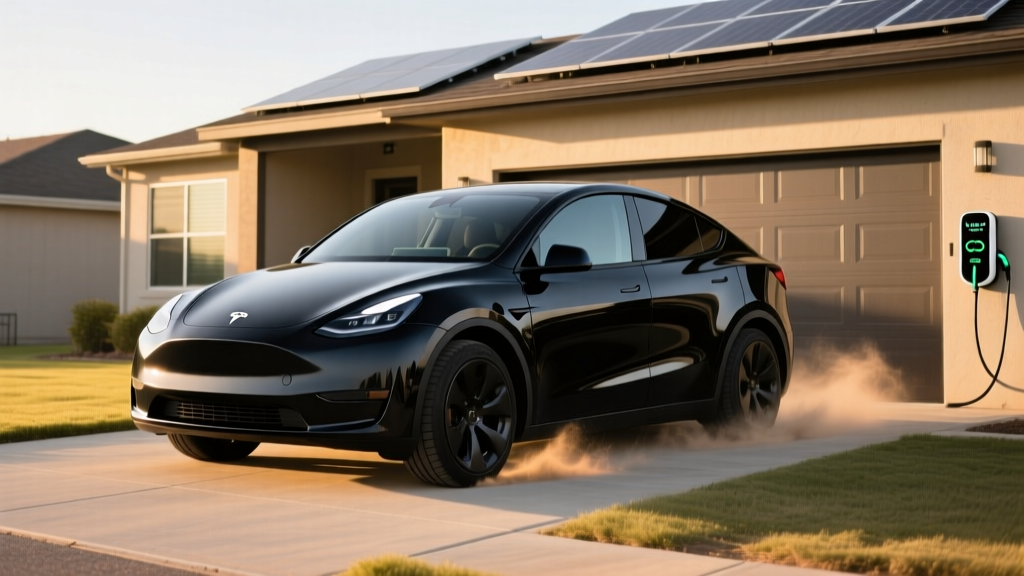
The Tesla Model Y remains America's best-selling electric vehicle, and since 2022, every US-bound Model Y has rolled off the line at Giga Texas in Austin. For buyers researching the "tesla building in texas" angle, the Austin factory matters: it introduced structural battery packs, 4680 cells, and a unibody casting process that changed the Model Y's weight, efficiency, and repair considerations. This review breaks down the 2026 Model Y Long Range AWD and Performance trims with real-world range data, charging curves, tax-credit math, and the manufacturing nuances only a Texas-built car carries.
2026 Model Y Quick Verdict
The refreshed Model Y (internally "Juniper") continues as a midsize electric crossover with class-leading efficiency, a mature Supercharger network advantage, and segment-best software. The Austin build brings a structural LFP or NMC pack depending on trim, revised suspension tuning for 2026, and improved panel gaps over early Giga Texas output. It's the default EV for buyers who want one vehicle to handle commuting, road trips, and family duty — but competitors like the Hyundai Ioniq 5 and Ford Mustang Mach-E now close the gap on interior materials and ride comfort.
Range, Battery, and Efficiency
| Trim | EPA Range | Battery (usable) | Chemistry | MPGe (combined) | kWh/100 mi |
|---|---|---|---|---|---|
| Long Range AWD | 320 mi | 78.1 kWh | NMC (4680 structural) | 122 MPGe | 28 |
| Performance AWD | 295 mi | 78.1 kWh | NMC (4680 structural) | 111 MPGe | 30 |
| Standard Range RWD | 290 mi | 60 kWh | LFP | 128 MPGe | 26 |
The Austin factory's 4680 structural battery pack integrates cells into the chassis, reducing weight and increasing torsional rigidity. Energy density is strong, but the structural design means a single damaged cell module can require a full pack replacement out of warranty — a consideration for high-mileage buyers. Per fueleconomy.gov, the Model Y Long Range remains one of the most efficient AWD crossovers sold, trailing only the smaller RWD trims and Ioniq 5 RWD.
Charging Speed: DC Fast, Level 2, and Supercharger Access
| Method | Peak Power | Speed | Notes |
|---|---|---|---|
| DC Fast (V4 Supercharger) | 250 kW peak | 10–80% in ~24 min | Sustains ~170 kW avg; tapers hard above 80% |
| DC Fast (CCS third-party) | 250 kW peak | 10–80% in ~26 min | NACS native; Magic Dock or adapter for CCS stalls |
| Level 2 (Tesla Wall Connector) | 11.5 kW | ~44 mi/hr | Full charge ~8 hrs from 10% |
| Level 1 (120V household) | 1.4 kW | ~4 mi/hr | Emergency/top-up only |
Tesla's charge curve is honest: the 250 kW peak holds only between roughly 10–30% SoC before stepping down. Average power 10–80% is closer to 170 kW, which is why the 24-minute claim is realistic rather than marketing fluff. A key Austin-built advantage is native NACS — the industry standard through 2026 — meaning direct Supercharger plug-in with no adapter friction. The Supercharger network remains the most reliable DC network in North America, with >99% uptime at most corridors.
For home Level 2, budget $800–$1,500 for a Tesla Wall Connector plus $600–$2,000 for electrician install on a 60A circuit (48A continuous). Older homes may need a $2,000–$4,000 panel upgrade to 200A — confirm with a licensed electrician before committing.
Performance and Drivetrain
| Trim | 0–60 mph | Horsepower | Drivetrain | Top Speed |
|---|---|---|---|---|
| Long Range AWD | 4.8 sec | 384 hp | Dual-motor AWD | 135 mph |
| Performance AWD | 3.5 sec | 510 hp | Dual-motor AWD | 155 mph |
| Standard Range RWD | 6.6 sec | 295 hp | Single-motor RWD | 135 mph |
Acceleration remains brisk across the lineup, with the Performance trim hitting supercar territory. The dual-motor AWD system uses a permanent-magnet rear and induction front motor, enabling coasting with the front disengaged for efficiency. Regenerative braking is strong but Tesla removed the adjustable regen setting years ago — one-pedal driving is the default, which most owners prefer but can surprise first-time EV drivers.
Interior, Cargo, and Tech
The 2026 Juniper refresh brought ventilated front seats, ambient lighting, a rear touchscreen for passengers, and acoustic glass that meaningfully cuts cabin noise at highway speed. The minimalist interior still divides opinion — no physical stalks (turn signals are on the steering wheel), and nearly all controls route through the 15.4-inch center display.
- Cargo (rear seats up): 30.2 cu ft
- Cargo (rear seats folded): 72.1 cu ft
- Frunk: 4.1 cu ft
- Rear legroom: 41.6 in
- Front headroom: 41.0 in
Tech highlights include the best-in-class navigation with real-time Supercharger routing and battery preconditioning, a native Tesla app ecosystem, and over-the-air updates that add features post-purchase. The biggest drawbacks: no Apple CarPlay or Android Auto (Tesla's ecosystem is closed), panel consistency still varies unit-to-unit from Austin, and the glass roof lacks a shade — cabin heat in Southern summers is noticeable even with the tinted glass.
Pricing, Trims, and the Federal Tax Credit
| Trim | MSRP | §30D Credit (max) | Effective Price* |
|---|---|---|---|
| Standard Range RWD | $44,990 | Up to $7,500 | ~$37,490 |
| Long Range AWD | $48,990 | Up to $7,500 | ~$41,490 |
| Performance AWD | $53,990 | Up to $7,500 | ~$46,490 |
*Effective price assumes full §30D eligibility. Verify per IRS.gov §30D rules.
- MSRP cap: SUVs/vans/pickups capped at $80,000 — all Model Y trims qualify.
- Buyer income cap (MAGI): $150k single / $225k HOH / $300k joint filers.
- Battery sourcing: Must meet critical-mineral and battery-component thresholds that tighten annually through 2026. Tesla's Austin-sourced LFP cells (CATL-derived) and NMC packs have faced scrutiny — verify current-year eligibility on the IRS clean vehicle list before purchase.
- Point-of-sale transfer: Eligible buyers can apply the credit as a down-payment reduction at delivery, rather than waiting for tax filing.
- VIN registration: The dealer must report the VIN to IRS within 3 days of sale.
State incentives stack on top — Colorado, California, and others offer additional rebates, but rules vary by jurisdiction. Consult your state's energy office or a tax professional for specifics.
Warranty and Ownership Costs
- Basic vehicle: 4 years / 50,000 miles
- Battery & drive unit: 8 years / 120,000 miles (Long Range/Performance); 8 years / 100,000 miles (Standard Range), with 70% minimum capacity retention
- Insurance: Model Y premiums average 15–25% above comparable ICE crossovers per IIHS data; Tesla Insurance is available in many states as a usage-based alternative.
- Maintenance: Minimal — cabin air filter, wiper fluid, tire rotation, brake fluid check. No oil, spark plugs, or transmission fluid.
- Class-leading efficiency (28 kWh/100 mi LR AWD)
- Native NACS + Supercharger network
- Strong OTA update pipeline
- Best-in-class cargo volume for the segment
- Point-of-sale tax credit transfer available
- No CarPlay/Android Auto
- Firm ride on 21" Performance wheels
- Glass roof lacks shade; hot in Southern climates
- Turn-signal buttons on wheel frustrate some drivers
- Out-of-warranty structural pack replacement is expensive
Who the Model Y Suits Best
Choose the Model Y Long Range AWD if: You need a single-vehicle solution for commuting, family duty, and 300+ mile road trips with reliable DC charging. The efficiency and Supercharger network are unmatched.
Choose the Performance trim if: You prioritize acceleration and handling, accept a 25-mile range penalty, and want the upgraded brakes and 21" wheels.
Choose the Standard Range RWD if: You charge at home nightly, rarely drive over 200 miles in a day, and want the lowest entry price with LFP's 100%-charge-friendly chemistry.
Consider the Hyundai Ioniq 5 or Mach-E instead if: You want CarPlay, a more traditional ride, or a physical button layout — and don't mind using Electrify America or other CCS networks.
Is the Austin-Built Model Y Worth It vs. Competitors?
Against the Hyundai Ioniq 5, the Model Y wins on range (320 vs 305 mi), cargo space, and charging network reliability; the Ioniq 5 wins on interior materials, 800V architecture (faster 10–80% at 350 kW stalls), and CarPlay support. Against the Ford Mustang Mach-E, Tesla holds the efficiency and software edge, while Ford offers a more conventional cabin layout and BlueCruise hands-free driving on mapped highways.
The Austin build quality has matured considerably since 2022 launch. Panel gaps, paint consistency, and trim alignment on 2026 units are competitive with German rivals, though a pre-delivery walkaround is still recommended. The structural pack and unibody casting make the Austin Model Y stiffer and slightly lighter than the older Fremont design — a genuine engineering win.
Frequently Asked Questions
What is the real-world range of the 2026 Model Y?
Expect 270–290 miles highway in mild weather for the Long Range AWD (EPA 320 mi). Cold weather and aggressive driving reduce this to 210–240 miles. The Standard Range RWD is 250–270 real-world miles.
How fast does the Model Y charge?
Peak 250 kW on V4 Superchargers, averaging ~170 kW for a 10–80% charge in roughly 24 minutes. Home Level 2 at 11.5 kW adds ~44 miles per hour of charging.
Does the 2026 Model Y qualify for the federal EV tax credit?
Yes, subject to IRS §30D rules: buyer MAGI caps ($150k–$300k depending on filing status), MSRP under $80k (all trims qualify), and battery-sourcing requirements that shift annually. Confirm eligibility on IRS.gov at the time of purchase.
How much does the Model Y cost after tax credits?
With the full $7,500 §30D credit applied at point-of-sale, the Standard Range RWD starts near $37,490, Long Range AWD near $41,490, and Performance near $46,490. State incentives may stack on top.
Is Autopilot or FSD actually self-driving?
No. Both are SAE Level 2 driver-assist systems. The driver must remain engaged, hands on or near the wheel, and eyes on the road at all times. Only Level 4 services like Waymo operate without a driver. FSD (Supervised) is a $8,000 option or $99/mo subscription that handles more scenarios but still requires supervision.
Should I be concerned about Austin build quality?
Early 2022–2023 Giga Texas units had panel-gap and paint issues that are largely resolved on 2026 production. Still, inspect the car at delivery and document any concerns before signing.
How does the structural battery pack affect repairs?
The 4680 structural pack is bonded into the chassis. Out-of-warranty replacement costs are estimated at $15,000–$22,000. Within the 8-year/120,000-mile battery warranty, Tesla covers defects and capacity loss below 70%.
Is the Model Y good for towing?
Rated at 3,500 lbs with the factory tow package — adequate for a small trailer or two jet skis, but towing cuts range by roughly 40–50%. Not ideal for heavy trailers; consider the F-150 Lightning or Rivian R1S for that use case.
For the latest EPA figures, consult fueleconomy.gov; for safety ratings, check NHTSA.gov and IIHS. Texas-built or not, the 2026 Model Y remains the pragmatic default in the electric crossover segment — efficient, fast-charging, and backed by the most reliable public charging network in the country. Buyers who can accept the minimalist cabin, closed software ecosystem, and premium insurance costs will find it hard to beat on total cost of ownership.