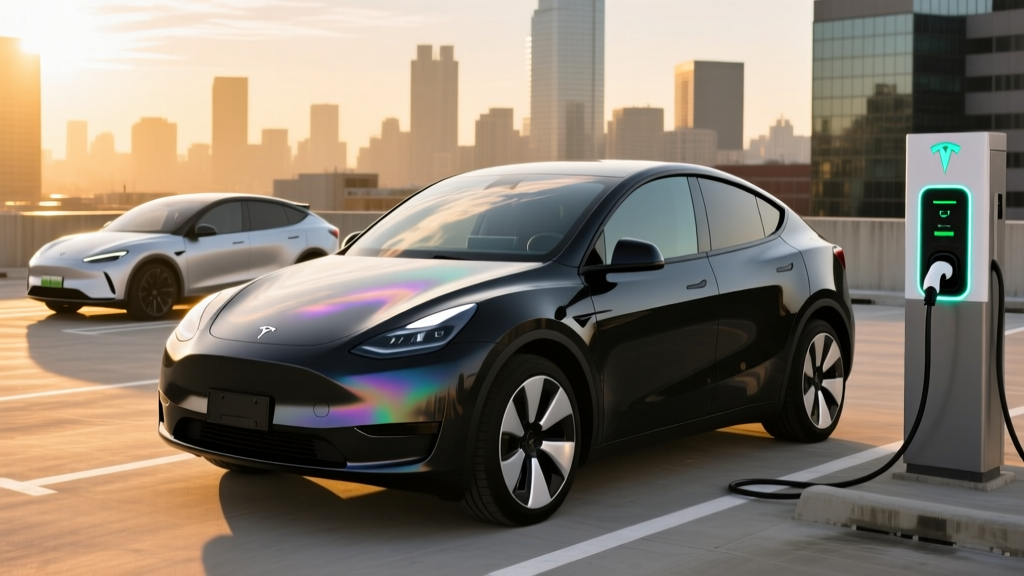
Quick Verdict: The Refreshed Model Y Still Sets the Benchmark
The Tesla Model Y remains the best-selling electric vehicle in the United States for good reason. With the Juniper refresh now fully in production for the 2026 model year, Tesla has addressed many of the interior quality and ride-comfort complaints that plagued earlier builds. The result is a compact electric SUV that delivers 320 miles of EPA-estimated range, charges at up to 250 kW on DC fast chargers, and starts at $44,990 before incentives — all while offering access to the most reliable public charging network in North America.
But what about the so-called "Tequila Tesla"? That viral moniker refers to the Model Y's available warm amber-and-cream interior colorway that flooded social media in late 2025. It's an aesthetic package, not a mechanical one — but it signals Tesla's broader push to make the Model Y feel less like a tech demo and more like a premium daily driver. Below, we break down every spec that matters for real buyers.
Range, Battery, and Real-World Efficiency
The 2026 Model Y Long Range AWD carries a 78.1 kWh usable battery pack (NMC chemistry) and earns an EPA-estimated 320 miles of combined range. The Rear-Wheel Drive variant, which uses an LFP (lithium iron phosphate) battery, is rated at 295 miles EPA with a 60 kWh usable pack.
Long Range AWD: EPA 320 mi | Expect ~275–290 mi on mixed highway driving; ~240–255 mi in sustained cold weather (below 32°F) at highway speeds.
RWD (LFP): EPA 295 mi | Expect ~255–270 mi mixed highway; ~220–235 mi in cold conditions.
LFP batteries tolerate 100% daily charging better than NMC, partially offsetting the lower sticker range for RWD owners who charge at home nightly.
| Spec | Long Range AWD | RWD |
|---|---|---|
| EPA Range | 320 mi | 295 mi |
| Battery (usable) | 78.1 kWh (NMC) | 60 kWh (LFP) |
| Drivetrain | Dual-Motor AWD | Single-Motor RWD |
| Horsepower | 384 hp | 295 hp |
| 0–60 mph | 4.8 sec | 6.5 sec |
| MPGe (combined) | 111 MPGe | 119 MPGe |
| Efficiency | 28 kWh/100mi | 26 kWh/100mi |
| Base MSRP | $47,990 | $44,990 |
Efficiency is where Tesla's engineering advantage shows. At 28 kWh/100 miles (Long Range), the Model Y sips electrons more frugally than most competitors in its class, including the Hyundai Ioniq 5 (30 kWh/100mi) and Ford Mustang Mach-E (31 kWh/100mi). That efficiency translates directly into lower charging costs and more range per kWh of battery.
Charging Speed: DC Fast, Level 2, and the Supercharger Advantage
The 2026 Model Y Long Range AWD peaks at 250 kW on DC fast chargers via its native NACS connector. Tesla quotes a 10–80% charge time of approximately 25 minutes at a V3 or V4 Supercharger. The RWD variant, constrained by its smaller LFP pack and lower charge C-rate, peaks around 170 kW and takes roughly 30 minutes from 10–80%.
| Level | Power / Rate | Miles Added per Hour | Notes |
|---|---|---|---|
| Level 1 (120V) | ~1.4 kW | ~4–5 mi/hr | Emergency/trickle only |
| Level 2 (240V, 48A) | 11.5 kW | ~37–44 mi/hr | Home Wall Connector; full charge in ~7–8 hrs |
| DC Fast (Supercharger V3/V4) | Peak 250 kW (LR AWD) | ~1,000+ mi/hr at peak | 10–80% in ~25 min; tapers above 80% |
Charging curve reality check: The 250 kW peak only holds roughly from 10% to 35% State of Charge. By 60% SoC, the rate drops to approximately 120–140 kW, and above 80% it falls below 50 kW. This is normal lithium-ion behavior, but it means a 10–90% charge will take closer to 38–42 minutes, not 25. Plan your road-trip stops accordingly — Tesla's navigation system accounts for this taper when routing.
One major advantage: Tesla's native NACS connector now works at non-Tesla chargers equipped with NACS cables (increasingly common at Electrify America and EVgo stations as of 2026). And Tesla owners still get the best plug-and-charge experience at Superchargers — no apps, no RFID cards, just plug in.
Performance and Driving Dynamics
The Long Range AWD's dual-motor setup produces 384 horsepower and rockets the Model Y from 0–60 mph in 4.8 seconds. That's genuinely quick for a family SUV, and the instant torque delivery makes highway merging and city driving feel effortless. The RWD model, at 295 hp and 6.5 seconds to 60, is less exciting but still perfectly adequate for commuting.
The Juniper refresh brought meaningful improvements to ride quality. Tesla retuned the suspension with new dampers and added acoustic laminated glass to the rear windows. Road noise is noticeably lower than the pre-2025 Model Y, and the ride over broken pavement is less jittery. It's still firmer than a Hyundai Ioniq 5 or Kia EV6, but no longer harsh.
Regenerative braking remains strong and predictable. Tesla removed the user-adjustable regen setting several years ago, so one-pedal driving is the default and only mode. Most owners adapt within a week, but if you prefer a coasting feel, this is a non-negotiable characteristic of the car.
Interior, Tech, and the "Tequila" Colorway
The Juniper interior is a substantial upgrade. Tesla replaced the minimalist-but-cheap feel of earlier Model Y cabins with softer materials, ambient lighting, a rear-seat touchscreen, and ventilated front seats (now standard on Long Range). The available amber-and-cream interior — the one dubbed the "Tequila Tesla" online — uses a warm tan vegan leather with open-pore wood trim that gives the cabin a Scandinavian-lounge aesthetic.
Cargo and passenger space:
- Cargo volume (behind second row): 30.2 cu ft
- Cargo volume (second row folded): 72.1 cu ft
- Front legroom: 41.8 in
- Rear legroom: 37.4 in (improved ~0.6 in over pre-refresh)
- Frunk (front trunk): 4.1 cu ft — useful for charging cables or a small bag
The 15.4-inch center touchscreen handles everything: navigation, media, climate, vehicle settings, and even gaming while parked. There are no physical buttons for climate or mirrors — everything runs through the screen. This remains polarizing; some owners love the simplicity, others find it distracting. The new rear 8-inch screen lets back-seat passengers control their own climate zone and entertainment.
Driver assistance: Tesla's Autopilot (standard) is an SAE Level 2 system — it handles lane centering and adaptive cruise competently, but requires active driver supervision at all times. Full Self-Driving (Supervised), an $8,000 add-on or $99/month subscription, adds automatic lane changes, traffic light recognition, and city-street navigation. Despite the name, FSD is still Level 2: you must keep your hands on the wheel and eyes on the road. It is not a self-driving system.
Tesla Autopilot and FSD (Supervised) are Level 2 driver-assistance systems. The driver must remain fully engaged, monitor the road, and be prepared to take over instantly. This is fundamentally different from Level 4 robotaxi services like Waymo, which operate without a human driver in geofenced areas.
Pricing, Trims, and Federal Tax Credit Eligibility
The 2026 Tesla Model Y is offered in two main configurations:
| Trim | Base MSRP | Est. Max §30D Credit | Effective Price (if eligible) |
|---|---|---|---|
| RWD | $44,990 | Up to $7,500 | ~$37,490 |
| Long Range AWD | $47,990 | Up to $7,500 | ~$40,490 |
| Long Range AWD (as tested, FSD + Tequila interior) | ~$57,490 | Up to $7,500 | ~$49,990 |
Federal tax credit caveats (§30D, 2026 rules): The full $7,500 credit requires meeting both critical-mineral and battery-component sourcing thresholds set by the IRS. As of early 2026, Tesla's US-built battery cells and North American mineral sourcing have generally qualified the Model Y for the full amount — but this is subject to change as sourcing requirements tighten annually. Additionally:
- MSRP cap: SUVs/vans/pickups must have an MSRP at or below $80,000. All Model Y trims qualify.
- Income cap: Modified AGI must not exceed $150,000 (single), $225,000 (head of household), or $300,000 (joint filers).
- Point-of-sale transfer: As of 2024, eligible buyers can transfer the credit to the dealer at purchase, reducing the purchase price upfront rather than waiting for a tax refund.
- Battery sourcing: Verify current eligibility at fueleconomy.gov before purchasing — requirements phase in more strictly each year.
Always consult a tax professional to confirm your personal eligibility. State and local incentives (such as California's CVRP or Colorado's state credit) may stack on top but vary by jurisdiction.
Ownership Costs, Warranty, and Long-Term Outlook
Tesla covers the Model Y's battery and drive unit for 8 years or 120,000 miles (Long Range AWD) and 8 years or 100,000 miles (RWD), whichever comes first, with a minimum 70% capacity retention threshold. The basic vehicle limited warranty is 4 years or 50,000 miles.
Charging at home using a Tesla Wall Connector on a 240V/48A circuit costs roughly $0.13–$0.16 per kWh depending on your utility rate, translating to about $3.60–$4.50 per 100 miles of driving. Compare that to a 25 MPG gas SUV at $3.50/gallon — roughly $14.00 per 100 miles. Over 15,000 miles annually, that's a fuel savings of approximately $1,400–$1,550 per year.
Insurance tends to run higher than comparable non-Tesla SUVs. Expect $1,800–$2,400 annually depending on your state and driving record. Tesla offers its own insurance product in many states, sometimes competitive with traditional carriers — worth quoting at purchase time.
Pros, Cons, and Who Should Buy
- Best-in-class Supercharger network access
- 320 mi EPA range with excellent efficiency (28 kWh/100mi)
- Spacious cargo area (72.1 cu ft max) with usable frunk
- Strong 0–60 performance (4.8 sec AWD)
- Over-the-air updates continuously add features
- Juniper refresh significantly improved ride and cabin quality
- No physical buttons — all controls via touchscreen
- FSD ($8,000) remains Level 2 despite the name and cost
- Regen not adjustable — one-pedal only
- Insurance premiums above segment average
- RWD model's LFP pack has lower range and slower DC charging
- Visibility compromised by thick rear pillars; camera-reliant
Choose the Model Y Long Range AWD if: You want a do-everything electric SUV with road-trip capability (Supercharger network), family-hauling cargo space, and quick acceleration. Ideal for suburban commuters who can install a Level 2 home charger and take 2–4 road trips per year.
Choose the Model Y RWD if: Your daily commute is under 80 miles round-trip, you charge at home every night, and you want the lowest entry price. The LFP battery's tolerance for daily 100% charging makes it practical for this use case despite the lower range.
Look elsewhere if: You need physical buttons and knobs, want a traditional dealership service experience, or require a true self-driving system. Consider the Hyundai Ioniq 5 for a softer ride and more distinctive styling, or the Ford Mustang Mach-E if you prefer a sportier driving feel and BlueCruise hands-free highway driving.
Competitor Comparison: Model Y vs. Ioniq 5 vs. Mach-E
| Spec | Tesla Model Y LR AWD | Hyundai Ioniq 5 Limited AWD | Ford Mustang Mach-E ER AWD |
|---|---|---|---|
| EPA Range | 320 mi | 290 mi | 290 mi |
| Battery | 78.1 kWh (NMC) | 77.4 kWh (NMC) | 88 kWh (NMC) |
| Peak DC Charge | 250 kW | 240 kW | 150 kW |
| 10–80% DC Time | ~25 min | ~18 min | ~38 min |
| 0–60 mph | 4.8 sec | 4.5 sec | 5.1 sec |
| Cargo (max) | 72.1 cu ft | 59.3 cu ft | 59.7 cu ft |
| Base MSRP (AWD) | $47,990 | $52,200 | $48,995 |
The Model Y wins on range, cargo space, and charging network access. The Ioniq 5 charges faster (thanks to its 800V architecture) and offers a more comfortable ride. The Mach-E provides the most traditional car-like driving experience but lags significantly in DC charging speed. Per EPA data on fueleconomy.gov, the Model Y's combined efficiency edge is measurable and translates into real savings over ownership.
Frequently Asked Questions
What is the real-world range of the 2026 Tesla Model Y?
The Long Range AWD is EPA-rated at 320 miles, but expect roughly 275–290 miles in real-world mixed highway driving and 240–255 miles in sustained cold weather (below freezing). The RWD model's 295-mile EPA rating translates to approximately 255–270 miles highway, dropping to 220–235 in cold conditions.
How fast does the Model Y charge at home and on the road?
At home on a 240V/48A Tesla Wall Connector (11.5 kW), the Long Range adds roughly 37–44 miles of range per hour, fully recharging overnight in about 7–8 hours. On DC fast chargers, it peaks at 250 kW and charges from 10–80% in approximately 25 minutes, though the charge curve tapers significantly above 60% State of Charge.
Does the 2026 Tesla Model Y qualify for the $7,500 federal tax credit?
As of early 2026, the US-built Model Y has generally qualified for the full $7,500 §30D credit, subject to buyer income limits ($300,000 joint / $150,000 single AGI), the $80,000 SUV MSRP cap, and battery-sourcing requirements. Eligibility can change as sourcing rules tighten — verify at fueleconomy.gov and consult a tax professional before purchase. The credit can be transferred at point of sale to reduce your purchase price upfront.
Is the Model Y worth buying over the Hyundai Ioniq 5 or Ford Mach-E?
If you road-trip frequently, the Model Y's Supercharger network access and 320-mile range are decisive advantages. If you prioritize ride comfort and distinctive styling, the Ioniq 5 is a strong alternative with faster DC charging. The Mach-E suits buyers who want a more conventional driving feel and Ford dealer service. For most buyers seeking a single-vehicle solution, the Model Y's combination of range, space, and charging infrastructure still leads the segment.
What does "Tequila Tesla" mean?
The "Tequila Tesla" nickname refers to the Model Y's available warm amber-and-cream interior colorway introduced with the Juniper refresh. It's a cosmetic option, not a separate trim or performance variant. The name went viral on social media in late 2025 due to the interior's warm, tequila-toned aesthetic.
Is Tesla's Full Self-Driving actually self-driving?
No. FSD (Supervised) is an SAE Level 2 driver-assistance system. Despite its name and $8,000 price tag, it requires continuous driver supervision — hands on the wheel, eyes on the road. It can handle many city and highway scenarios but can make errors and requires you to intervene. True self-driving (Level 4) is currently only available through geofenced robotaxi services like Waymo, not in any consumer vehicle.