Why Tempe Owners Ask About the Tesla Model Y Differently
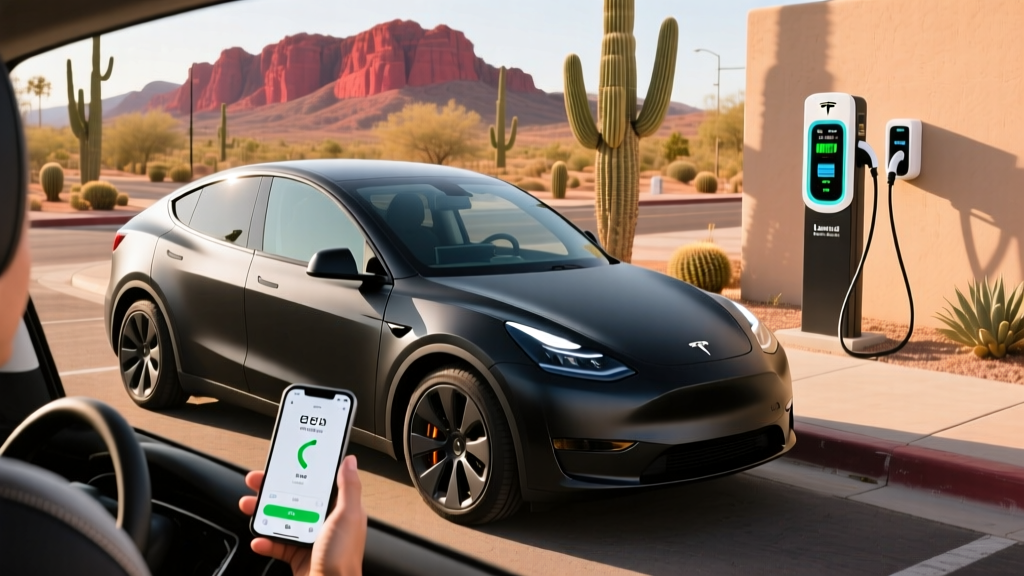
If you're searching for Tesla Tempe AZ information, you're likely evaluating whether the Model Y — Tesla's best-selling electric SUV — actually holds up in the Sonoran Desert. Tempe routinely sees 110°F+ summer days, and that heat changes the EV ownership equation in ways most coastal reviews ignore. Battery cooling loads climb, cabin preconditioning draws real energy, and range expectations need recalibrating.
This guide cuts through generic spec sheets and gives Tempe-area buyers the numbers that matter: what range you'll actually see on the Loop 202 in July, how fast the Model Y charges at local Superchargers, whether the LFP battery handles Arizona heat better than NMC chemistry, and what the 2026 federal tax credit actually looks like at the point of sale.
Range Reality Check: Tempe Edition
EPA Estimated Range: 320 miles (2026 Model Y Long Range AWD)
Real-World Expectation in Tempe: 270–295 miles in mild months (Oct–Apr); 245–270 miles in peak summer (Jun–Sep) with A/C running and highway speeds above 70 mph. Heat forces the thermal management system to work harder, consuming 8–15% more energy than the EPA cycle assumes.
2026 Tesla Model Y: Core Specs at a Glance
Below are the figures that define daily ownership. All specs reflect the 2026 model year as of publication.
| Spec | Long Range AWD | Performance (if available) |
|---|---|---|
| EPA Range | 320 miles | ~290 miles |
| Battery Capacity (usable) | ~75 kWh (LFP, structural pack) | ~75 kWh (LFP) |
| Drivetrain | Dual-Motor AWD | Dual-Motor AWD |
| Horsepower | ~384 hp | ~456 hp |
| 0–60 mph | 4.8 seconds | 3.5 seconds |
| Efficiency | 122 MPGe / 28 kWh/100mi | ~115 MPGe / ~30 kWh/100mi |
| Cargo Volume | 30.2 cu ft (rear seats up) / 72.1 cu ft (folded) | 30.2 / 72.1 cu ft |
| Rear Legroom | 41.6 inches | 41.6 inches |
| Towing Capacity | 3,500 lbs | 3,500 lbs |
| Battery Warranty | 8 years / 120,000 miles (70% retention) | 8 years / 120,000 miles |
Source: fueleconomy.gov and Tesla's official 2026 specification pages.
Charging Speeds: Superchargers on I-10 and Home Level 2
Charging infrastructure is where Tempe Tesla owners have a genuine advantage. The Phoenix metro has one of the densest Supercharger networks in the country, with V3 (250 kW) and V4 stalls scattered from the Tempe Marketplace to Chandler and Scottsdale.
| Charging Level | Power / Rate | What You Get |
|---|---|---|
| Level 1 (120V standard outlet) | ~1.4 kW | ~4 miles per hour — emergency/top-up only |
| Level 2 (240V home Wall Connector) | 11.5 kW (48A) | ~44 miles per hour; full charge in ~7 hours |
| Level 2 (public, e.g., ChargePoint) | 7.2–19.2 kW | ~28–72 miles per hour depending on station |
| DC Fast Charge (V3 Supercharger) | Peak 250 kW | 10–80% in ~22 minutes; tapers significantly above 80% |
| DC Fast Charge (V4 Supercharger) | Peak ~325 kW (vehicle-limited) | 10–80% in ~18–20 minutes (model-dependent) |
Desert Charging Insight: In July, battery preconditioning works harder. If you navigate to a Supercharger using the car's built-in nav, the Model Y actively cools or heats the pack before arrival. Skip this step (e.g., using a third-party map) and you'll see charge rates 20–30% slower for the first 5 minutes. LFP chemistry in the Model Y is more heat-tolerant than NMC, but sustained fast-charging at 110°F ambient still accelerates long-term degradation slightly — Tesla's thermal management mitigates this, but it's not free.
LFP Battery Chemistry: Why It Matters in Arizona Heat
The 2026 Model Y Long Range uses a lithium iron phosphate (LFP) structural battery pack. For Tempe owners, this is arguably the most consequential spec on the sheet.
| Factor | LFP (Model Y LR) | NMC (typical competitor) |
|---|---|---|
| Heat Tolerance | Excellent — less thermal runaway risk, slower degradation at high temps | Good, but degrades faster above 95°F sustained |
| Recommended Daily Charge | 100% OK (Tesla recommends periodic 100% for calibration) | 80% daily; 100% only for trips |
| Energy Density | Lower — heavier pack for same range | Higher — lighter, more range per kg |
| Cycle Life | 3,000+ cycles to 80% SoH | 1,000–2,000 cycles to 80% SoH |
| Cold Performance | Weaker in freezing temps (irrelevant for Tempe) | Better in sub-30°F conditions |
For a Tempe-based owner who rarely sees freezing temperatures, LFP is nearly ideal. You can charge to 100% nightly without the guilt associated with NMC packs, and the chemistry's inherent stability handles 115°F garage temperatures better. The trade-off is slightly lower energy density, which is why the Model Y's 75 kWh pack delivers 320 miles rather than the 350+ you'd see from a larger NMC pack in a heavier competitor.
Pricing, Trims, and the 2026 Federal Tax Credit
Tesla pricing shifts frequently, but here's the current landscape for the 2026 Model Y in the U.S.
| Trim | Base MSRP | Federal §30D Credit | Effective Price (if eligible) |
|---|---|---|---|
| Long Range AWD | $44,990 | Up to $7,500 (point-of-sale) | ~$37,490 |
| Performance | $48,990 | Up to $7,500 (point-of-sale) | ~$41,490 |
Critical eligibility caveats under IRS §30D (2026 rules):
- MSRP Cap: SUVs/vans must be ≤$80,000 MSRP — the Model Y clears this easily.
- Buyer Income Cap: Modified AGI must not exceed $150,000 (single), $225,000 (head of household), or $300,000 (joint). Check your prior-year or current-year tax return.
- Battery Sourcing: The credit splits into two halves — $3,750 for critical-minerals sourcing and $3,750 for battery-component assembly. The Model Y's LFP pack sourcing has been in flux; verify current eligibility on IRS.gov's qualified vehicle list before purchasing.
- Point-of-Sale Transfer: You can transfer the credit to Tesla at purchase, reducing your out-of-pocket cost immediately rather than waiting for tax filing.
Always confirm eligibility with a tax professional. Rules change, and Tesla's sourcing compliance can shift quarterly.
Tempe Supercharger Network and Daily Charging Practicalities
For Tempe residents, home Level 2 charging is the baseline. Most homes near Arizona State University, South Mountain, or the broader 85282/85283 zip codes have 200-amp electrical panels that support a 60-amp circuit for Tesla's Wall Connector ($420 hardware + $500–$1,500 electrician installation depending on conduit runs).
When you need public fast charging, the metro's Supercharger density is a real asset:
- Tempe Marketplace (V3, 250 kW): Convenient for shopping trips; 8 stalls, rarely queued.
- Chandler Fashion Center (V3): ~15 minutes south via I-10; good for southbound road trips.
- Scottsdale (multiple V3/V4 locations): North via Loop 101.
- Phoenix Sky Harbor area: Useful before flights; some stalls are V4.
Cost reality: At Arizona's average residential rate of ~$0.13/kWh, a full home charge costs roughly $9.75 for 320 miles of range — about $0.03/mile. Supercharger rates in the Phoenix area run $0.28–$0.36/kWh depending on time of day, making road-trip charging roughly $0.08–$0.10/mile. Compare that to a 25 MPG gas SUV at $3.40/gallon: $0.14/mile.
Tech, Driver Assistance, and What the Model Y Doesn't Do
The 2026 Model Y continues with Tesla's minimalist interior: a 15.4-inch center touchscreen handles nearly every function, from climate to mirrors to glovebox. There's no instrument cluster — speed and nav live on the left edge of the main screen.
Autopilot and FSD (Supervised):
SAE Automation Level: 2 — Both Autopilot (included) and Full Self-Driving Supervised ($8,000 option or $99/month) require continuous driver attention. These are not self-driving systems. You must keep hands on the wheel and eyes on the road. Only Level 4 services like Waymo's robotaxi (which operates in parts of Phoenix/Scottsdale) offer true driverless operation.
What FSD Supervised Does NOT Do
- Drive without your supervision — you are legally and practically the driver at all times
- Handle all construction zones, unmapped roads, or extreme weather without intervention
- Replace attentive driving in Tempe's monsoon-season haboob conditions
- Qualify as "autonomous" under NHTSA or SAE definitions
Standout features:
- Over-the-air updates that add functionality (recent: improved battery preconditioning algorithms, enhanced Sentry Mode)
- Sentry Mode with cameras recording when parked — valuable in hot parking lots where break-ins target visible items
- Dog Mode keeps cabin cooled for pets — a genuine safety feature in 115°F weather
- Camp Mode for overnight climate control during cooler desert evenings
- Heat pump standard — highly efficient cabin heating in winter (minimal range loss vs. resistive heaters)
Notable drawbacks:
- No physical buttons for climate or volume — everything is touchscreen, which some drivers find distracting
- Rear visibility is compromised by the sloping roofline; the backup camera is essential
- Panel-gap quality has improved but still inconsistent vs. legacy luxury brands
- Insurance premiums in Maricopa County run 15–25% higher than comparable gas SUVs (Tesla's own insurance program may offer competitive rates)
Pros, Cons, and Who Should Buy
Pros
- LFP battery excels in sustained desert heat with lower degradation risk
- Supercharger network in Phoenix metro is among the best in the U.S.
- 100% daily charging OK — no SoC babysitting needed
- 320-mile EPA range handles Phoenix–Tucson–Flagstaff without en-route charging
- Dog Mode and Sentry Mode are genuine desert-lifestyle features
- OTA updates keep the vehicle current years after purchase
- Low running costs: ~$0.03/mile on home charging
Cons
- Summer range drops 8–15% below EPA due to cooling loads
- No physical buttons — steep learning curve for some drivers
- Insurance costs above segment average in Arizona
- FSD is expensive and still SAE Level 2, not autonomous
- Panel gaps and interior material quality lag premium competitors
- Home charger installation may require panel upgrade in older Tempe homes (add $1,500–$3,000)
Is the Model Y Right for Your Tempe Lifestyle?
Choose the Model Y if: You want a daily-commuter EV with strong Supercharger coverage for road trips to Sedona, the Grand Canyon, or San Diego. You value LFP heat tolerance and don't mind touchscreen-only controls. You can install a Level 2 charger at home.
Look at competitors (Hyundai Ioniq 5, Ford Mustang Mach-E, Kia EV6) if: You prefer physical buttons, want 800V ultra-fast charging (Ioniq 5/EV6: 10–80% in ~18 min on 350 kW chargers), need a more traditional interior layout, or want NMC chemistry for frequent cold-weather trips to Flagstaff/show Low.
Frequently Asked Questions
What is the real-world range of the Tesla Model Y in Tempe summers?
Expect 245–270 miles on the highway at 75–80 mph in June through September, with A/C running. The EPA rates it at 320 miles, but sustained heat and high speeds reduce that by 15–25%. In milder months (October through April), real-world range closely matches the EPA figure at 290–310 miles.
How fast does the Model Y charge at Tempe-area Superchargers?
At V3 Superchargers (250 kW), the LFP pack charges from 10–80% in approximately 22 minutes. Above 80%, the charge curve tapers sharply — expect 80–100% to take an additional 15–20 minutes. At home on a 48-amp Wall Connector (11.5 kW), a full charge takes about 7 hours, easily covering overnight.
How much does the Model Y cost after the federal tax credit?
The 2026 Long Range AWD starts at $44,990 MSRP. If you qualify for the full $7,500 §30D credit (income caps apply, battery sourcing must be verified on IRS.gov), the effective price drops to ~$37,490 via point-of-sale transfer. Always confirm eligibility before purchase — sourcing rules change.
Does the Tesla Model Y qualify for the federal EV tax credit in 2026?
It depends on current battery-sourcing compliance. The MSRP ($44,990–$48,990) is well under the $80,000 SUV cap, and most buyers fall under income limits. However, the LFP battery's critical-mineral and component sourcing determines whether you get the full $7,500, a partial $3,750, or nothing. Check the IRS qualified vehicles list for the specific build month.
Is the Model Y worth buying vs. the Hyundai Ioniq 5 or Kia EV6 in Arizona?
The Model Y wins on Supercharger network access, LFP heat tolerance, and cargo space (72.1 cu ft vs. ~59 cu ft for the Ioniq 5). The Ioniq 5 and EV6 win on 800V charging architecture (faster peak DC speeds on compatible chargers), physical controls, and interior quality. For Tempe specifically, the Supercharger density and LFP chemistry give Tesla a practical edge for most buyers — unless you prioritize cabin refinement and ultra-fast CCS charging.
Do I need to upgrade my electrical panel for a home charger in Tempe?
Many Tempe homes built after 1990 have 200-amp panels that can support a 60-amp dedicated circuit for Tesla's Wall Connector. Older homes (pre-1980s, especially near the ASU campus or in historic districts) may have 100-amp panels requiring a $1,500–$3,000 upgrade. Have a licensed electrician evaluate your panel before purchasing charging equipment.
How does monsoon season affect the Model Y?
Arizona's July–September monsoon brings dust storms (haboobs) and flash flooding. The Model Y's sealed battery pack handles water immersion far better than a gas engine's air intake, but reduced visibility in haboobs demands manual driving — disable Autopilot/FSD in these conditions. Dust accumulation on cameras may require more frequent cleaning for Autopilot reliability.