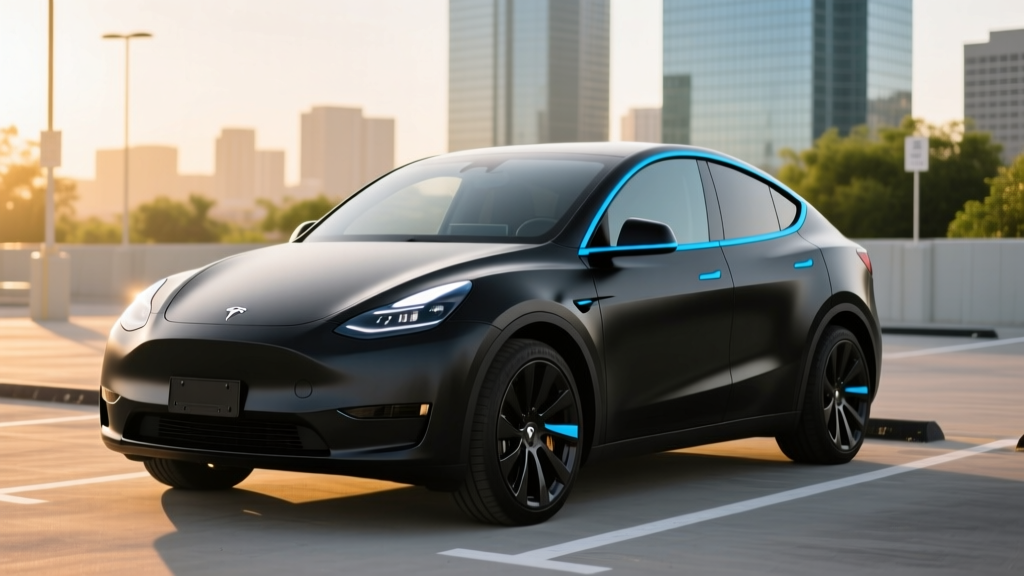
If you've been searching for a clear picture of a Tesla SUV — meaning a comprehensive snapshot of what it's actually like to own one — you've landed in the right place. The Tesla Model Y remains the best-selling electric vehicle in the United States and one of the most popular vehicles period. But glossy marketing photos only tell part of the story. This review fills in the real numbers: range when you're actually driving on the highway in January, how fast it charges at a Supercharger after the battery tapers, what you'll pay after the federal tax credit, and how it stacks up against rivals like the Hyundai Ioniq 5, Ford Mustang Mach-E, and Kia EV6.
We're evaluating the 2026 Tesla Model Y (the refreshed "Juniper" generation that debuted for the 2025 model year), covering Long Range AWD, Performance, and the new Standard Range RWD trims.
2026 Tesla Model Y at a Glance: Full Spec Sheet
| Specification | Long Range AWD | Performance AWD | Standard Range RWD |
|---|---|---|---|
| EPA Range | 320 miles | 294 miles | 280 miles |
| Battery (Usable) | ~75 kWh (NMC) | ~75 kWh (NMC) | ~60 kWh (LFP) |
| Drivetrain | Dual-Motor AWD | Dual-Motor AWD | Single-Motor RWD |
| Horsepower | 384 hp | 456 hp | 295 hp |
| 0-60 mph | 4.8 sec | 3.5 sec | 6.2 sec |
| Peak DC Charge Rate | 250 kW | 250 kW | 170 kW |
| 10-80% DC Fast Charge | ~25 min | ~25 min | ~30 min |
| Level 2 Home Charge | 11.5 kW (~37 mi/hr) | 11.5 kW (~37 mi/hr) | 11.5 kW (~37 mi/hr) |
| MPGe (Combined) | 111 MPGe | 103 MPGe | 117 MPGe |
| Efficiency | 30 kWh/100 mi | 33 kWh/100 mi | 29 kWh/100 mi |
| Cargo (Behind 2nd Row) | 30.2 cu ft | 30.2 cu ft | 30.2 cu ft |
| Cargo (Seats Folded) | 72.1 cu ft | 72.1 cu ft | 72.1 cu ft |
| Frunk | 4.1 cu ft | 4.1 cu ft | 4.1 cu ft |
| Rear Legroom | 40.5 in | 40.5 in | 40.5 in |
| Base MSRP | $48,990 | $53,990 | $44,990 |
| Battery Warranty | 8 yr / 120,000 mi | 8 yr / 120,000 mi | 8 yr / 100,000 mi |
Sources: EPA / fueleconomy.gov, Tesla.com specifications (2026 model year). Prices exclude destination fee.
Real-World Range: What the EPA Sticker Doesn't Tell You
Long Range AWD — EPA 320 mi: Expect 280-300 mi on mixed highway driving at 70-75 mph. In freezing temperatures (below 32°F), plan for 220-260 mi. City driving with regenerative braking recovers energy and can match or slightly exceed the EPA number.
Performance AWD — EPA 294 mi: Expect 250-275 mi highway; ~200-230 mi in cold weather. The stickier tires and more aggressive tuning trade efficiency for grip.
Standard Range RWD — EPA 280 mi: Expect 250-265 mi highway; ~200-220 mi in cold. The LFP battery handles degradation better long-term but doesn't change the physics of cold-weather lithium-ion resistance.
The Juniper refresh improved the Model Y's aerodynamic efficiency and thermal management, which helps in cold weather compared to the pre-2025 generation. Tesla's heat pump is standard across all trims, pulling ambient and waste heat to warm the cabin rather than relying solely on resistive heating. This typically saves 15-25% of range in winter compared to EVs without a heat pump.
That said, physics is physics. If your daily commute is 80 miles round-trip in a Minnesota winter, the Standard Range trim will feel tight. The Long Range AWD gives you a comfortable buffer. For road trips, Tesla's Supercharger network — now over 6,000 stations in North America — largely mitigates range anxiety, but you should plan stops every 200-250 miles to stay in the fast-charging sweet spot.
Charging Speed: DC Fast, Level 2, and the Taper Curve
| Charging Method | Power / Rate | Speed (Miles Added) | Notes |
|---|---|---|---|
| Level 1 (120V household) | ~1.4 kW | ~4-5 mi/hr | Emergency/trickle only; adds ~50 mi overnight |
| Level 2 (240V home, 48A) | 11.5 kW | ~37 mi/hr | Fully recharges overnight in 7-8 hours |
| DC Fast (Tesla Supercharger V3) | Up to 250 kW | ~162 mi in 15 min (peak) | Peak rate only below ~50% SoC; tapers significantly above 80% |
| DC Fast (CCS adapter, non-Tesla) | Up to 250 kW | ~150 mi in 15 min (peak) | Requires Tesla CCS adapter (included with 2026 models) |
Here's what the marketing materials won't tell you: that 250 kW peak charge rate only holds between roughly 10% and 50% state of charge (SoC). The Long Range's charge curve looks something like this:
- 10-50% SoC: ~250 kW sustained (the "peak" window)
- 50-80% SoC: Ramps down from ~200 kW to ~90 kW
- 80-100% SoC: Drops to ~30-50 kW (taper to protect battery)
This is why Tesla (and we) quote 10-80% times — that's the practical fast-charging window. Charging from 80-100% at a Supercharger can take as long as 10-80%. On road trips, plan to charge to 80% and move on; the last 20% is painfully slow and wastes time.
For home charging, a Tesla Wall Connector on a 60A circuit delivers the full 11.5 kW (48A continuous). That's roughly 37 miles of range per hour of charging, or a full battery in 7-8 hours. Most owners wake up to a full "tank" every morning. Budget $500-$1,500 for professional installation depending on your electrical panel — a 200A panel upgrade can add $1,500-$3,000 if your home needs it.
Performance, Drivetrain, and the NACS Advantage
The Performance trim's 3.5-second 0-60 mph time puts it in sports-car territory, and the dual-motor AWD system delivers instant torque with no turbo lag or transmission shift. Even the "base" Standard Range RWD at 6.2 seconds is quicker than most gas-powered compact SUVs.
One major advantage the Model Y holds over nearly every competitor: native NACS (North American Charging Standard) compatibility. Tesla's proprietary connector — now the industry standard adopted by Ford, GM, Rivian, Hyundai, and others — gives you seamless access to the Supercharger network without adapters. For 2026, Tesla includes a CCS1 adapter in the frunk for use at Electrify America, EVgo, and other CCS-equipped public stations.
The Juniper refresh also brought a quieter cabin (acoustic glass, improved insulation), ventilated front seats, a rear-seat touchscreen, and ambient lighting. The 15.4-inch front touchscreen handles everything — navigation, media, climate, vehicle settings — with no physical buttons. Some buyers love the minimalism; others find the lack of knobs frustrating for volume and temperature adjustments while driving.
Battery Chemistry: NMC vs. LFP and What It Means for You
The Long Range and Performance trims use NMC (nickel manganese cobalt) lithium-ion cells, which offer higher energy density — that's how Tesla packs 320 miles of range into a relatively compact battery. The trade-off: NMC cells degrade slightly faster over time and Tesla recommends daily charging to 80% rather than 100% for longevity.
The Standard Range RWD uses LFP (lithium iron phosphate) chemistry. LFP cells are heavier and less energy-dense (hence the lower range), but they offer two significant advantages:
- You can charge to 100% daily without accelerated degradation — Tesla explicitly recommends it for LFP.
- Longer cycle life — LFP cells typically retain 90%+ capacity after 1,000+ full cycles, outperforming NMC in long-term durability.
If you plan to keep the car 8-10 years and charge at home every night, LFP's longevity advantage is meaningful. If you need maximum range for road trips or live in a cold climate where every mile counts, NMC's energy density wins.
Pricing, Tax Credits, and Total Cost
| Trim | Base MSRP | Destination | Est. Before Credit | Federal Credit (§30D) | Est. Net Price |
|---|---|---|---|---|---|
| Standard Range RWD | $44,990 | $1,390 | $46,380 | Up to $7,500* | ~$38,880 |
| Long Range AWD | $48,990 | $1,390 | $50,380 | Up to $7,500* | ~$42,880 |
| Performance AWD | $53,990 | $1,390 | $55,380 | Up to $7,500* | ~$47,880 |
* Federal tax credit eligibility under IRS §30D depends on multiple factors that change frequently:
- MSRP cap: SUVs must be under $80,000 — all Model Y trims qualify.
- Buyer income cap: Modified AGI must not exceed $300,000 (joint), $225,000 (head of household), or $150,000 (individual).
- Battery sourcing: Critical minerals and battery components must meet phased-in domestic/free-trade-partner sourcing thresholds. Tesla's US-built battery packs have generally met these requirements, but verify current-year compliance at fueleconomy.gov.
- Point-of-sale transfer: As of 2024+, you can transfer the credit to the dealer at purchase, reducing your out-of-pocket cost immediately rather than waiting for tax filing.
Important: Tax credit rules are subject to change. Consult a tax professional and check the IRS website before purchasing. Do not assume you qualify based on past eligibility.
Driver Assistance: Autopilot and FSD Supervised
Tesla Autopilot (standard) and Full Self-Driving (Supervised) are SAE Level 2 driver-assistance systems. They provide steering, acceleration, and braking assistance, but you must keep your hands on the wheel and eyes on the road at all times. These are NOT self-driving systems. Tesla's own name "Full Self-Driving" is a branding term, not a description of capability.
True driverless operation (SAE Level 4) currently exists only in geofenced robotaxi services like Waymo in select cities.
Autopilot comes standard and includes adaptive cruise control, lane centering, and automatic emergency braking. FSD Supervised ($8,000 one-time or $99/month) adds automatic lane changes, on/off-ramp navigation, traffic light and stop sign recognition, and enhanced city-street driving. In practice, FSD handles most highway scenarios competently but still requires intervention in construction zones, unusual lane markings, and complex intersections.
Tesla's camera-only vision system (no LiDAR or radar) has drawn criticism from the NHTSA, which has investigated multiple Autopilot-related incidents. Drive with appropriate caution and never treat any Level 2 system as a substitute for attention.
Pros, Cons, and the Competition
- Best-in-class Supercharger network access (native NACS)
- Class-leading efficiency (29-33 kWh/100 mi)
- Strong real-world range across trims
- Over-the-air updates add features post-purchase
- Spacious cargo area (72.1 cu ft) with usable frunk
- Strong resale value relative to EV segment
- LFP option for longevity-focused buyers
- No physical buttons — all controls via touchscreen
- FSD Supervised is expensive and still requires full attention
- Ride quality is firm; some rivals are more comfortable
- Insurance premiums run 15-30% above gas equivalents
- Build quality variability (panel gaps, trim alignment)
- Regenerative braking is not adjustable (single strong mode)
- No Apple CarPlay or Android Auto
Key competitors: The Hyundai Ioniq 5 (EPA 305 mi, ~$47,000) offers faster 800V charging (10-80% in ~18 min) and a more conventional interior. The Ford Mustang Mach-E (EPA 312 mi, ~$45,000) delivers engaging driving dynamics and CarPlay support. The Kia EV6 (EPA 310 mi, ~$44,000) matches Ioniq 5's 800V architecture. All three now use NACS adapters for Supercharger access, narrowing Tesla's charging-network moat.
The Model Y's advantages remain its efficiency, integrated software ecosystem, and the seamlessness of Supercharger plug-and-charge (no app, no RFID card, no credit card swipe — just plug in). For buyers who prioritize simplicity and a proven network, it's still hard to beat.
Who Should Buy the 2026 Tesla Model Y?
- You regularly drive 200+ miles between charges (road trips, long commutes)
- You live in a cold-weather climate and need AWD plus range buffer
- You want the simplest public charging experience (native Supercharger access)
- You value OTA updates and Tesla's software ecosystem
🎯 Choose the Model Y Standard Range RWD if:
- Your daily driving is under 150 miles and you charge at home nightly
- You plan to keep the vehicle 8+ years (LFP battery longevity)
- You want the lowest entry price and live in a mild climate
🎯 Look at competitors if:
- You want physical buttons and knobs (Ioniq 5, EV6)
- You need Apple CarPlay/Android Auto (Mach-E, Ioniq 5)
- You want faster DC charging (Ioniq 5/EV6 with 800V: 10-80% in ~18 min vs. Model Y's ~25 min)
- Ride comfort is a top priority (Mach-E, Ioniq 5 are more compliant)
Frequently Asked Questions
What is the real-world range of the 2026 Tesla Model Y?
The Long Range AWD delivers roughly 280-300 miles in mixed highway driving and 220-260 miles in freezing weather. The Standard Range RWD nets about 250-265 miles highway and 200-220 in cold conditions. City driving with regenerative braking can match or slightly exceed the EPA estimates.
How fast does the Model Y charge at home and on the road?
At home on a Level 2 (240V/48A) Wall Connector, the Model Y charges at 11.5 kW, adding about 37 miles of range per hour — a full charge takes 7-8 hours overnight. On DC fast charging, the Long Range and Performance peak at 250 kW (10-80% in ~25 minutes), while the Standard Range peaks at 170 kW (10-80% in ~30 minutes). Actual speeds depend on state of charge, battery temperature, and charger availability.
How much does the 2026 Model Y cost after the federal tax credit?
If you qualify for the full $7,500 §30D credit, the Standard Range RWD drops to approximately $38,880, the Long Range AWD to about $42,880, and the Performance to roughly $47,880. Eligibility depends on your income, the vehicle's battery sourcing compliance, and MSRP caps. Verify current rules at irs.gov and consult a tax professional.
Does the Tesla Model Y qualify for the $7,500 federal EV tax credit?
As of the 2026 model year, the Model Y has generally qualified for the full $7,500 credit because it's assembled in the US (Fremont, CA and Austin, TX), falls under the $80,000 SUV MSRP cap, and Tesla's battery supply chain has met critical-mineral and component sourcing thresholds. However, these rules change and vary by production batch. Always confirm at fueleconomy.gov before purchasing.
Is the Model Y worth buying over the Ioniq 5 or Mach-E?
It depends on your priorities. The Model Y wins on charging-network simplicity, efficiency, cargo space, and software integration. The Ioniq 5 and EV6 win on DC charging speed (800V architecture) and interior ergonomics. The Mach-E wins on driving engagement and CarPlay support. All three are excellent — test-drive each before deciding.
What's the battery warranty on the 2026 Model Y?
The Long Range AWD and Performance trims carry an 8-year/120,000-mile battery and drive unit warranty. The Standard Range RWD carries 8 years/100,000 miles. Tesla guarantees the battery will retain at least 70% of its original capacity during the warranty period. Real-world data from high-mileage Teslas suggests most NMC packs retain 85-90% capacity at 100,000 miles, and LFP packs often perform even better.