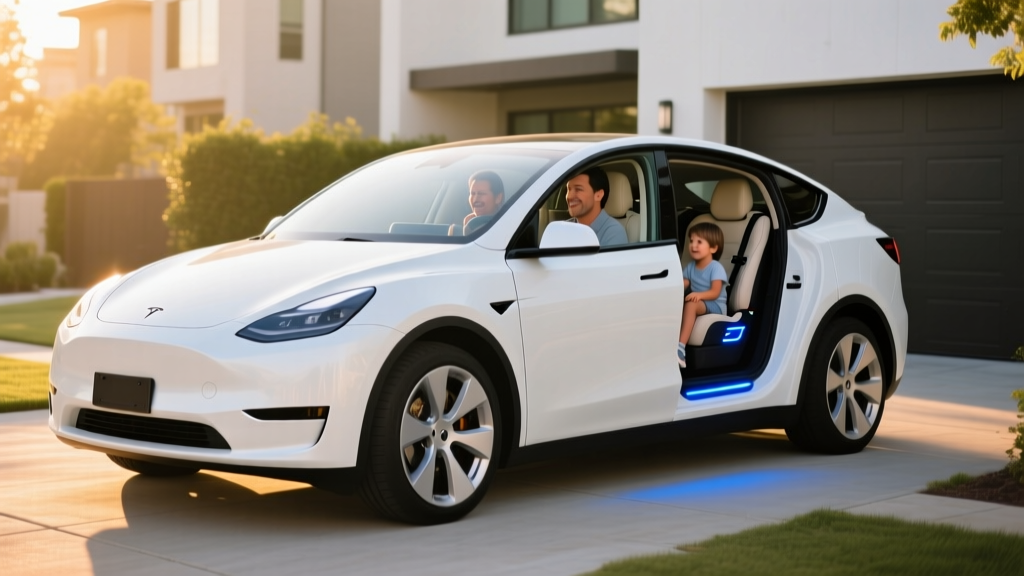
The optional third row in the Tesla Model Y has been one of the most debated packaging decisions in the EV market. For 2026, the refreshed Model Y (internally dubbed "Juniper") carries over the six-seat configuration, promising a compact electric crossover that can technically haul six passengers. But a third row in a vehicle with a 113.8-inch wheelbase raises immediate questions about usability, range impact, and whether this is a genuine family solution or a marketing checkbox. After spending time with the six-seat layout and analyzing the latest EPA data, here is the complete picture.
Quick Verdict: Who the Six-Seat Model Y Actually Serves
The six-seat Model Y works best for families with two small children who occasionally need to transport one or two additional kids on short trips. The third row is strictly for passengers under about 5'4" and is not a substitute for a three-row SUV like the Kia EV9 or Rivian R1S. If your use case involves regular full-occupancy driving, you will outgrow this layout quickly. If you need the third row perhaps twice a month for carpools or grandparent visits, the packaging trade-off is reasonable — especially given the Supercharger network advantage and the vehicle's efficiency.
Range, Efficiency & Real-World Expectations
The 2026 Model Y Long Range AWD with the six-seat option carries an EPA-estimated range of 310 miles on its 78.1 kWh usable battery pack (NMC chemistry). The six-seat option adds approximately 50-60 lbs of hardware, which Tesla accounts for in the EPA rating — meaning the five-seat variant rates slightly higher at 320 miles.
- EPA sticker: 310 miles
- Real-world highway (70-75 mph, mild weather): ~265-280 miles
- Real-world mixed city/highway (55-65°F): ~280-295 miles
- Cold-weather highway (20-30°F, cabin heat): ~210-240 miles
- Full-load (6 passengers + cargo, summer): ~250-265 miles
The Model Y's heat pump (standard since 2021 refresh) mitigates cold-weather loss better than many competitors, but a fully loaded cabin with six occupants and HVAC demand will pull efficiency down to roughly 3.8-4.0 miles/kWh from its rated 4.0-4.2 mi/kWh.
Efficiency is rated at 106 MPGe combined (112 city / 99 highway) per fueleconomy.gov. In terms of consumption, that translates to approximately 29 kWh per 100 miles combined — among the most efficient all-wheel-drive crossovers in its class, though the added weight of the third row and passengers does erode this advantage under load.
Battery, Charging Speed & Home Setup
The 2026 Model Y Long Range uses an 78.1 kWh usable battery pack (approximately 82 kWh gross) with NMC (nickel manganese cobalt) cell chemistry supplied primarily by Panasonic and LG Energy Solution, depending on production batch. NMC offers higher energy density than LFP, which is critical for fitting sufficient range into the Model Y's platform, but it does recommend a daily charge limit of 80-90% for longevity — unlike LFP packs that tolerate regular 100% charges.
| Metric | Value |
|---|---|
| Max DC Fast Charge Rate | 250 kW peak (V3 Supercharger / CCS) |
| 10-80% DC Fast Charge Time | ~25 minutes (with preconditioning) |
| Sustained DC Rate (10-50%) | ~170-220 kW average |
| Level 2 Home Charge Rate | 11.5 kW (48A) onboard charger |
| Level 2 Miles Per Hour | ~37-44 mi/hr at 11.5 kW |
| Level 1 (120V) Miles Per Hour | ~3-4 mi/hr |
| NACS Connector | Standard (native Tesla connector) |
Charging curve reality: The 250 kW peak is only sustained between roughly 10-30% state of charge. Above 50%, the rate tapers to approximately 120 kW, and above 80%, it drops further to 40-60 kW. This is why Tesla and most EV analysts quote 10-80% times rather than 0-100%. Navigation-based battery preconditioning is automatic when routing to a Supercharger, warming the pack to optimal temperature for peak charge acceptance — a feature that makes a meaningful 5-8 minute difference in cold weather.
For home charging, the 11.5 kW onboard charger means a full charge from 10-90% takes roughly 6.5 hours on a properly installed 60-amp circuit (Wall Connector or equivalent). Most six-seat Model Y buyers will want a Level 2 home installation — budget $800-$2,000 for a quality electrician install depending on panel proximity and local permit requirements.
Performance & Drivetrain
| Performance Metric | Model Y LR AWD Six-Seat |
|---|---|
| Drivetrain | Dual-Motor All-Wheel Drive |
| Horsepower | 384 hp (combined) |
| Torque | 360 lb-ft |
| 0-60 mph | 4.8 seconds |
| Top Speed | 135 mph (electronically limited) |
| Towing Capacity | 3,500 lbs (with tow package) |
The dual-motor setup provides a permanent-magnet rear motor paired with an induction front motor, allowing the front motor to freewheel under light-load cruising for efficiency gains. Acceleration remains brisk even with the added third-row weight — 4.8 seconds to 60 mph is quicker than nearly every three-row crossover in its price range. The low center of gravity from the floor-mounted battery pack keeps body roll well-controlled, though the ride quality on the 2026 Juniper refresh has been improved with revised damper tuning that absorbs sharp impacts more compliantly than pre-2025 models.
Interior Space: Third-Row Reality Check
This is where the six-seat Model Y either works for your family or doesn't. The dimensions tell the story:
| Dimension | Measurement |
|---|---|
| Front Legroom | 41.8 inches |
| Second-Row Legroom | 38.4 inches |
| Third-Row Legroom | 29.5 inches |
| Third-Row Headroom | 35.2 inches |
| Cargo (behind 3rd row) | 12.2 cu ft |
| Cargo (3rd row folded) | 34.3 cu ft |
| Cargo (all rear rows folded) | 72.1 cu ft |
The honest assessment: At 29.5 inches of third-row legroom, this seat is viable only for children approximately 4-10 years old, or very short adults on trips under 30 minutes. The seat cushion sits low to the floor (a packaging compromise for the battery), creating a knees-up posture that becomes uncomfortable quickly. Access requires a slide-and-tilt second-row mechanism that is adequate but slower than the walk-through access you get in larger three-row SUVs. With the third row deployed, 12.2 cu ft of cargo space remains — enough for a couple of backpacks and a stroller, but not a week's groceries for six.
The 2026 Juniper refresh improved second-row comfort with a longer seat cushion and slightly more recline range. Rear-seat passengers now get a small touchscreen for climate and media controls, addressing one of the most common complaints from rear occupants in previous model years.
Technology, Driver Assistance & Safety
The 2026 Model Y features a 15.4-inch center touchscreen running Tesla's latest vehicle software, with AMD Ryzen processor hardware that keeps the interface responsive. Wireless Apple CarPlay and Android Auto are not available — Tesla continues to rely on its proprietary infotainment ecosystem, which includes native Spotify, YouTube, Netflix (while parked), and a capable navigation system with real-time Supercharger routing.
Both Autopilot (standard) and Full Self-Driving Supervised ($8,000 option or $99/month) are SAE Level 2 driver-assistance systems. They require continuous driver supervision, hands-on-wheel (or torque-based) monitoring, and do not make the vehicle self-driving. Tesla's FSD Supervised can handle highway interchanges, traffic lights, and some neighborhood streets impressively, but the driver remains legally and practically responsible at all times. Only Level 4 services like Waymo operate without a human driver in geofenced areas.
Standard safety equipment includes automatic emergency braking, lane departure warning and prevention, blind-spot monitoring, and 360-degree cameras. The Model Y has consistently earned top marks from both NHTSA (5-star overall) and IIHS (Top Safety Pick+ when equipped with acceptable headlights).
Pricing, Trims & Federal Tax Credit
| Trim | Base MSRP | Six-Seat Add-On | As-Configured |
|---|---|---|---|
| Long Range AWD | $47,990 | +$2,500 | $50,490 |
| Performance AWD | $52,990 | Not Available | $52,990 |
| Long Range RWD | $44,990 | +$2,500 | $47,490 |
Destination charge of $1,390 applies to all trims. FSD Supervised adds $8,000; Premium Interior packages and paint colors add $1,000-$2,500.
The Model Y Long Range AWD qualifies for up to $7,500 in federal tax credit, available as a point-of-sale reduction at the dealership (or direct from Tesla) under current IRS §30D rules. However, eligibility depends on several factors:
- MSRP cap: SUVs must be under $80,000 — all Model Y trims qualify.
- Buyer income cap: Modified AGI must not exceed $150,000 (single), $225,000 (head of household), or $300,000 (joint filers).
- Battery sourcing: Critical minerals and battery component requirements phase in annually. Tesla's North American battery supply chain has largely met these thresholds for 2026, but verify your specific VIN on the IRS qualified vehicle list before purchasing.
- Point-of-sale transfer: You can transfer the credit to Tesla at purchase, reducing your out-of-pocket cost immediately — even if you have no tax liability.
Effective price after max credit: Model Y LR AWD six-seat from ~$50,490 to ~$42,990 (before state incentives, destination, or options).
Pros, Cons & the Competition
Pros
- Best-in-class Supercharger network access for road trips
- Excellent efficiency (106 MPGe) for a dual-motor AWD
- 250 kW DC fast charging with reliable preconditioning
- Strong 0-60 performance (4.8s) even with six-seat weight
- Over-the-air updates continuously add features
- Top safety ratings from NHTSA and IIHS
- Qualifies for full $7,500 federal tax credit (verify VIN)
Cons
- Third row is extremely tight — children only, short trips
- Only 12.2 cu ft cargo space with third row deployed
- No Apple CarPlay or Android Auto
- Panel gaps and interior material quality lag competitors at this price
- FSD remains Level 2 despite $8,000 price tag
- Insurance costs 20-35% higher than comparable non-Tesla EVs
- Rear visibility compromised with third row upright
Key competitors: The Kia EV9 ($54,900+) offers a genuinely usable third row with 31.9 inches of legroom and 320 miles of range, but charges slower at 236 kW peak and lacks Supercharger access (CCS only). The Rivian R1S ($75,900+) is a proper three-row SUV with far more space but costs significantly more. The Hyundai Ioniq 9 (2026 launch) targets the same space with NACS charging access and a more usable third row at a comparable price. For buyers who need six seats regularly, these alternatives are worth cross-shopping despite the Tesla charging-network advantage.
Warranty & Long-Term Ownership
Tesla provides a 8-year / 120,000-mile battery and drive unit warranty on the Model Y Long Range, with a guaranteed minimum 70% capacity retention threshold over that period. The basic vehicle limited warranty covers 4 years / 50,000 miles. These terms are competitive with the segment, though some rivals like Hyundai offer longer basic warranties (5yr/60,000mi) and battery coverage (10yr/100,000mi).
For long-term ownership, the NMC battery chemistry in the Long Range model benefits from daily charge limits of 80-90% and avoiding prolonged storage at 100% or below 10%. Tesla's thermal management system is among the best in the industry, and real-world degradation data from high-mileage Model Y owners suggests approximately 8-12% capacity loss over 100,000 miles — well within the warranty threshold.
Frequently Asked Questions
What is the real-world range of the six-seat Tesla Model Y?
The EPA rates the 2026 Model Y LR AWD six-seat at 310 miles. In real-world highway driving at 70-75 mph in mild weather, expect 265-280 miles. In cold weather (below 30°F) with cabin heating, plan for 210-240 miles. With six passengers and cargo, range drops to approximately 250-265 miles in summer conditions.
How fast does the Model Y six-seater charge?
On a V3 Supercharger or equivalent 250 kW DC fast charger, the Model Y charges from 10-80% in approximately 25 minutes with battery preconditioning enabled. At home on a Level 2 Wall Connector (11.5 kW / 48A), it adds roughly 37-44 miles of range per hour, reaching a full charge overnight in about 6.5 hours from 10-90%.
How much does the six-seat Model Y cost after tax credits?
The Model Y LR AWD with the six-seat option starts at $50,490 (including destination). With the maximum $7,500 federal tax credit (subject to income caps, MSRP limits, and battery sourcing verification), the effective price drops to approximately $42,990. State incentives may reduce this further — check your local DMV or energy office for current programs.
Does the Tesla Model Y qualify for the $7,500 federal EV tax credit?
The Model Y qualifies for up to $7,500 under IRS §30D, provided the buyer meets income thresholds ($300,000 joint / $150,000 single), the vehicle MSRP is under $80,000 (all Model Y trims qualify), and the battery meets critical-mineral and component sourcing requirements for the 2026 model year. The credit can be transferred at point of sale. Always verify your specific VIN on the IRS qualified manufacturer list before finalizing a purchase.
Is the Model Y six-seater worth buying over a Kia EV9 or three-row hybrid?
If you need a usable third row for regular use with older children or adults, the Kia EV9 or a plug-in hybrid like the Toyota Grand Highlander Hybrid are better choices — they offer significantly more third-row space. The Model Y six-seater makes sense only if your third-row needs are occasional and involve small children, and you prioritize Tesla's Supercharger network, efficiency, and performance. For daily six-passenger hauling, the Model Y's 29.5 inches of third-row legroom is a compromise most families outgrow.
Can I tow with the six-seat Model Y?
Yes. The Model Y LR AWD with the optional tow package is rated for 3,500 lbs — sufficient for a small boat trailer, bike rack, or light camping trailer. Note that towing significantly reduces range (expect 40-50% reduction at highway speeds with a loaded trailer).