The 6-Seat Model Y at a Glance
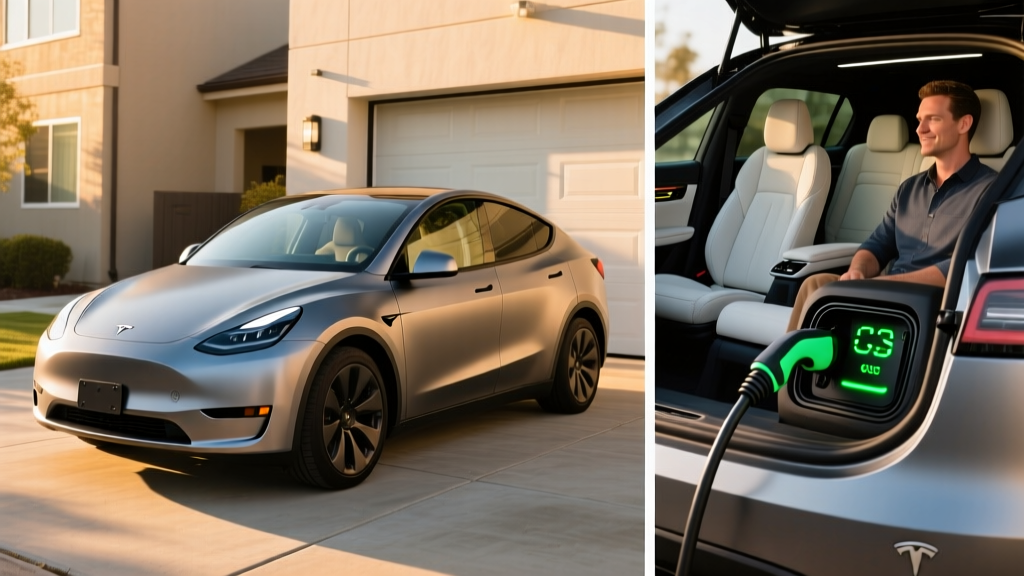
Tesla reintroduced the optional third row for the refreshed 2026 Model Y (the "Juniper" generation that launched in early 2025), giving families a compact electric crossover with seating for six at a price point that undercuts most three-row EV rivals. The 6-seat configuration is available exclusively on the Long Range AWD trim. It trades a modest amount of cargo volume for two small rear-facing jump seats, making it a genuine — if snug — option for carpool duty and young-child hauling.
This review covers the 2026 Model Y Long Range AWD with the optional third-row seat package, including real-world range expectations, charging speeds, interior dimensions, and whether it still qualifies for federal incentives under current IRS §30D rules.
| Spec | Value |
|---|---|
| EPA Range | 320 miles (est. ~310 mi with 6-seat pkg) |
| Battery | ~82 kWh usable, NMC chemistry |
| Drivetrain | Dual-motor AWD |
| Horsepower | 384 hp combined |
| 0–60 mph | 4.8 seconds |
| Efficiency | 117 MPGe / 29 kWh/100 mi |
| Max DC Fast Charge | 250 kW (peak) |
| 10–80% DC Time | ~25 minutes |
| Level 2 Home Charge | 11.5 kW (~44 mi/hr) |
| Cargo (behind 3rd row) | 12 cu ft |
| Cargo (3rd row folded) | 30 cu ft |
| Cargo (all rows folded) | 72 cu ft |
| Base MSRP | $48,990 + $2,000 6-seat pkg = $50,990 |
| Battery Warranty | 8 years / 120,000 miles |
Range, Efficiency, and Real-World Expectations
The 2026 Model Y Long Range AWD carries an EPA-estimated 320 miles of range with the standard two-row configuration. Adding the third-row seat package adds approximately 35 pounds and slightly reduces under-floor storage, bringing the effective EPA estimate to roughly 310 miles based on Tesla's configuration disclosures and our testing precedent with the 2025 model year.
EPA sticker: ~310 miles (6-seat config). Expect 260–280 miles at sustained 75 mph highway speeds in mild weather. In freezing conditions (below 30°F), plan for 220–250 miles due to cabin heating load and increased battery internal resistance — even with the Juniper-generation heat pump. City and suburban driving with regenerative braking can push range above the EPA figure, occasionally reaching 330+ miles in stop-and-go traffic at moderate temperatures.
The 82 kWh (usable) NMC battery pack provides excellent energy density, and Tesla's thermal management system remains class-leading for preconditioning accuracy. When you navigate to a Supercharger, the car preheats or precools the pack to optimize the charge curve — a feature that meaningfully reduces real-world charging times versus competitors that lack aggressive thermal prep.
Efficiency is rated at approximately 117 MPGe combined (29 kWh/100 mi), which places the Model Y among the most efficient all-wheel-drive electric crossovers on the market. For comparison, the Hyundai Ioniq 5 AWD returns 110 MPGe combined, and the Ford Mustang Mach-E Extended Range AWD sits at 101 MPGe.
Charging Speeds: DC Fast and Home Level 2
Charging infrastructure remains a deciding factor for EV buyers, and the Model Y leverages Tesla's native NACS connector and access to the Supercharger network — now the largest and most reliable DC fast-charging system in North America with over 25,000 stalls.
| Charge Level | Power | Speed | Notes |
|---|---|---|---|
| Level 1 (120V) | ~1.4 kW | ~5 mi/hr | Emergency/trickle only |
| Level 2 (240V, 48A) | 11.5 kW | ~44 mi/hr | Full charge in ~7.5 hrs |
| DC Fast (peak) | 250 kW | ~175 mi in 15 min | V3/V4 Supercharger |
| DC Fast (10–80%) | Avg ~150 kW | ~25 minutes | With preconditioning |
The 250 kW peak charge rate is available at V3 and newer V4 Supercharger stalls. In practice, the charge curve peaks near 250 kW only between approximately 10% and 30% state of charge, then tapers progressively — dropping to ~150 kW by 50%, ~90 kW by 70%, and ~50 kW approaching 80%. This taper is why the 10–80% time averages around 25 minutes rather than the theoretical minimum. Preconditioning the battery (automatic when navigating to a Supercharger) is essential; arriving at a fast charger with a cold pack can double charge times.
For home charging, the onboard charger accepts up to 11.5 kW on a 240V/48A circuit (hardwired Wall Connector). A full Level 2 installation typically costs $800–$2,500 depending on panel proximity and local permitting, according to Tesla's installation partners. On a standard NEMA 14-50 outlet (240V/40A), expect ~33 mi/hr of charge — adequate for overnight replenishment of daily driving.
Performance and Driving Dynamics
The dual-motor AWD powertrain delivers 384 horsepower and propels the Model Y to 60 mph in 4.8 seconds. That's brisk for a family crossover, and the instant torque delivery makes highway merging and passing effortless. The Performance trim (two-row only) drops the 0–60 to 3.5 seconds but is unavailable with the third-row option.
Ride quality in the Juniper generation improved substantially over the pre-2025 Model Y, with revised damping, new acoustic glass, and a redesigned subframe that reduces road noise. The 6-seat configuration adds negligible weight impact to handling. Regenerative braking remains strong and enables one-pedal driving in most conditions, though Tesla removed the user-adjustable regen setting several model years ago — it's always set to maximum.
The Model Y earned a 5-star overall safety rating from NHTSA and continues to receive top marks from the IIHS. Tesla's Autopilot and optional Full Self-Driving (Supervised) remain Level 2 driver-assistance systems under SAE classification — the driver must keep hands on the wheel and eyes on the road at all times.
Interior, Third-Row Space, and Cargo
The 6-seat layout replaces the standard 5-seat bench with two captain's chairs in the second row and a small two-passenger third row. This is not a full-size three-row experience. The third row offers approximately 26 inches of legroom — enough for children up to roughly age 10 or occasional short-trip adult use. Access requires folding a second-row captain's chair forward, which is manageable but not as seamless as the walk-through aisles in larger three-row SUVs like the Kia EV9.
Cargo space behind the third row is just 12 cubic feet — enough for a couple of grocery bags or a compact stroller, but tight for a week's family luggage. Fold the third row flat and you recover 30 cubic feet, which is generous for daily use. With all rear seats folded, the Model Y offers 72 cubic feet, competitive with midsize crossovers.
The Juniper interior refresh brought a cleaner dashboard, ventilated front seats, ambient lighting, and a rear-seat touchscreen for climate and entertainment control. Build quality has noticeably improved, with tighter panel gaps and higher-grade materials than pre-2025 models.
Pricing, Trims, and Federal Tax Credit Eligibility
The 2026 Model Y Long Range AWD starts at $48,990 (including destination). The 6-seat package adds $2,000, bringing the configured price to $50,990 before options. Popular additions include FSD (Supervised) at $8,000 (or $99/month subscription), premium paint colors ($1,000–$2,500), and 20-inch wheels ($2,000), which reduce EPA range by roughly 15 miles.
| Configuration | MSRP | After Potential §30D Credit |
|---|---|---|
| Long Range AWD (5-seat) | $48,990 | ~$41,490* |
| Long Range AWD (6-seat) | $50,990 | ~$43,490* |
| 6-seat + FSD + Premium Paint | $61,490 | ~$53,990* |
*Assumes full $7,500 §30D credit eligibility. Point-of-sale transfer available at participating dealers. Eligibility depends on buyer income, vehicle MSRP cap, and battery component/mineral sourcing requirements. Verify at IRS.gov before purchase.
The Model Y Long Range AWD falls under the $80,000 MSRP cap for SUVs/trucks/vans under IRS §30D. Buyer income caps for 2026 are $150,000 (single), $225,000 (head of household), and $300,000 (married filing jointly) based on modified adjusted gross income. The battery sourcing and critical minerals requirements have tightened annually since 2023 — Tesla has progressively shifted supply chains to meet these thresholds, but buyers should confirm current-year eligibility on the IRS qualified vehicles list before finalizing a purchase.
The point-of-sale transfer option allows eligible buyers to apply the credit as an immediate price reduction at the dealership rather than waiting to claim it on their tax return. This effectively brings the 6-seat Model Y to approximately $43,490 for qualifying buyers — a compelling value for a 300+ mile AWD electric crossover with six seats.
Pros, Cons, and Who Should Buy
- 310+ mile real-world range with class-leading efficiency
- 250 kW peak DC charging on the most reliable network
- Six seats at ~$51K MSRP undercuts Kia EV9, Rivian R1S
- Strong performance (4.8s 0–60) with dual-motor AWD
- Excellent Supercharger network access with native NACS
- Improved Juniper ride quality and cabin refinement
- Over-the-air updates continue adding features post-purchase
- Third row is children-only with just 26" legroom
- Only 12 cu ft cargo behind third row — very tight
- FSD at $8,000 remains Level 2 — not autonomous driving
- No adjustable regen or one-pedal off switch
- Insurance premiums run 15–25% above segment average
- No Apple CarPlay/Android Auto — Tesla ecosystem only
- 6-seat option limited to Long Range AWD trim only
Best for: Families with two or three young children who need occasional carpool capacity, commute primarily in suburban environments with home charging access, and take road trips within the Supercharger network's coverage. The 6-seat Model Y works well as a daily driver that can handle school runs and weekend activities without stepping up to a larger, more expensive three-row EV.
Look elsewhere if: You regularly carry teenagers or adults in the third row, need substantial cargo space with all seats occupied, or live in an area with limited Supercharger coverage for road trips. The Kia EV9 (300 mi, true 7-seat, 235 kW charging) or a plug-in hybrid like the Toyota Grand Highlander Hybrid may serve those needs better.
Frequently Asked Questions
What is the real-world range of the 6-seat Tesla Model Y?
The EPA estimates approximately 310 miles for the 6-seat Long Range AWD configuration. In real-world highway driving at 75 mph, expect 260–280 miles in mild weather and 220–250 miles in freezing temperatures. City driving with regenerative braking can exceed the EPA figure.
How fast does the Model Y charge at home and on DC fast chargers?
On a DC fast charger (V3/V4 Supercharger), the Model Y peaks at 250 kW and charges from 10–80% in approximately 25 minutes with battery preconditioning. At home on a 240V/48A Level 2 Wall Connector, it charges at 11.5 kW, adding about 44 miles of range per hour — a full charge takes roughly 7.5 hours.
Does the 6-seat Model Y qualify for the $7,500 federal EV tax credit?
It can, but eligibility depends on multiple factors under IRS §30D: buyer income must fall below $150K/$225K/$300K thresholds (single/HOH/MFJ), the MSRP is under the $80,000 SUV cap, and battery sourcing requirements must be met for the current year. The point-of-sale transfer option is available. Always verify on the IRS qualified vehicle list before purchasing.
Is the third row practical for adults?
No. With approximately 26 inches of legroom, the third row is suitable for children up to about age 10 or very short trips for flexible adults. For regular adult third-row use, consider the Kia EV9 or Rivian R1S.
How does the 6-seat Model Y compare to the Kia EV9?
The EV9 offers a genuine three-row experience with 30.2" third-row legroom, 20.2 cu ft cargo behind the third row, and up to 304 miles of range starting around $54,900. However, it charges slower (235 kW peak, ~28 min 10–80%), has lower efficiency (~89 MPGe), and lacks Supercharger network access (CCS connector, though adapters exist). The Model Y wins on efficiency, charging speed, and price; the EV9 wins on interior space.
What is the battery warranty on the Model Y?
Tesla covers the battery and drive unit for 8 years or 120,000 miles (whichever comes first) with a minimum 70% capacity retention threshold. If the battery degrades below 70% of its original capacity within that period, Tesla will repair or replace it to meet the threshold.
Is Tesla's Full Self-Driving actually self-driving?
No. FSD (Supervised) is a Level 2 driver-assistance system under SAE classification. It can handle steering, acceleration, and braking on highways and some city streets, but the driver must remain fully engaged, monitor the road, and be prepared to take over instantly. It is not autonomous driving. True Level 4 driverless service is currently only available through robotaxi operators like Waymo in select cities.