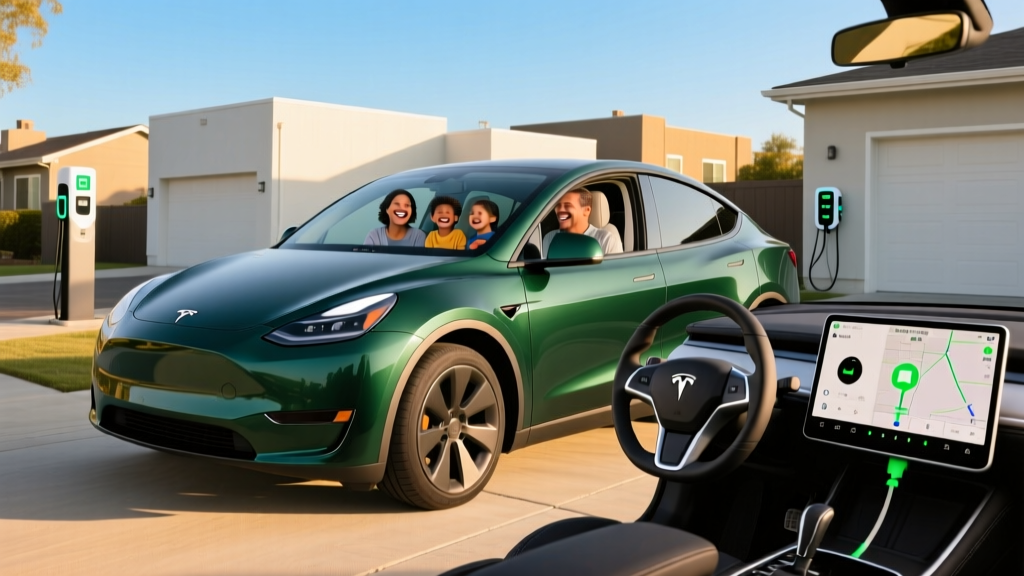
If you search for a Tesla seven seater, you'll find exactly one current option: the Tesla Model Y Long Range AWD with the optional third-row seat package. It's a $2,000 add-on that transforms a five-passenger compact luxury crossover into a 2-3-2 family hauler — but it comes with measurable tradeoffs in cargo volume, third-row comfort, and efficiency. This review breaks down the real numbers behind the 2026 Model Y 7-seater: range, charging curves, interior dimensions, ownership costs, and whether the third row is genuinely usable or just a marketing checkbox.
Quick Verdict: Who Is the Tesla 7-Seater For?
The Model Y's third row is best understood as a part-time, child-sized solution. Legroom in the way-back measures roughly 26.5 inches — tight even for average-height kids on longer drives, and essentially unusable for adults beyond a quick trip across town. If your household occasionally needs to ferry two extra children to soccer practice or school drop-off, the 7-seat Model Y fills a niche that no other compact electric crossover currently matches. If you regularly carry six or seven passengers, you'll want to look at the Model X or a three-row electric SUV like the Kia EV9.
That said, the underlying vehicle — the Long Range AWD Model Y — remains one of the most efficient, best-charging, and most technologically complete electric crossovers on the market. The 7-seat option doesn't change the powertrain, the battery, or the Supercharger access. It just adds two small rear-facing seats and a corresponding reduction in cargo flexibility.
Spec Table: 2026 Tesla Model Y Long Range AWD (7-Seat)
| Specification | Value |
|---|---|
| EPA Range | 311 miles (7-seat config: est. ~303 mi) |
| Battery Capacity | ~78.1 kWh usable (NMC chemistry) |
| Drivetrain | Dual-motor AWD |
| Horsepower | 384 hp (combined) |
| 0–60 mph | 4.8 seconds |
| Efficiency | 122 MPGe combined / 28 kWh/100 mi |
| Max DC Fast Charge | 250 kW peak (V3 Supercharger) |
| 10–80% DC Charge Time | ~27 minutes |
| Level 2 Home Charge Rate | 11.5 kW (44 mi/hr at 48A) |
| Cargo (behind 3rd row) | 12.8 cu ft |
| Cargo (3rd row folded) | 30.2 cu ft |
| Cargo (all rear seats folded) | 72.1 cu ft |
| Base MSRP (7-seat) | $46,990 (incl. destination) |
| Battery Warranty | 8 years / 120,000 miles |
| Basic Vehicle Warranty | 4 years / 50,000 miles |
Sources: fueleconomy.gov, Tesla.com order configurator (2026 model year).
Range and Efficiency: EPA vs. Real World
The standard 5-seat Model Y Long Range AWD carries an EPA estimate of 311 miles. Adding the third-row package introduces approximately 50–70 lbs of seat hardware and marginally alters aerodynamic load, which Tesla estimates reduces range by roughly 5–8 miles. Expect ~303 miles EPA in the 7-seat configuration.
In mixed real-world driving, plan for:
- City/suburban: 290–310 mi (regen braking recovers energy effectively)
- Highway (70–75 mph): 250–275 mi (aerodynamic drag dominates)
- Cold weather (below 32°F): 210–250 mi (battery conditioning + cabin heating draw)
Efficiency is a Model Y hallmark. At 28 kWh per 100 miles (combined), it remains one of the most energy-efficient electric crossovers available. That efficiency translates directly to lower charging costs: at the US average residential electricity rate of ~$0.17/kWh, a full home charge costs roughly $13.25 for 300+ miles of range — about $0.044 per mile, compared to $0.12–$0.15/mile in a comparable gas crossover at $3.40/gallon.
Charging Speed: DC Fast, Level 2, and the Charge Curve
The Model Y Long Range supports Tesla's V3 Supercharger architecture at a peak rate of 250 kW. Under ideal conditions — battery preconditioned via onboard navigation routing to a Supercharger, state of charge (SoC) between 10–30% — the charge curve ramps quickly to peak and holds strong through roughly 50% SoC before tapering.
| Charging Method | Power (kW) | Rate | 10–80% Time |
|---|---|---|---|
| Tesla V3 Supercharger (DC) | 250 kW peak | ~1,000 mi/hr at peak | ~27 minutes |
| CCS Adapter + Non-Tesla DC | Up to 250 kW | Varies by station | ~27–35 minutes |
| Level 2 (Tesla Wall Connector, 48A) | 11.5 kW | 44 mi/hr | ~7 hours (full) |
| Level 2 (32A mobile connector) | 7.7 kW | 30 mi/hr | ~10 hours (full) |
| Level 1 (120V household) | ~1.4 kW | 3–4 mi/hr | Multiple days |
Charge curve reality check: The 250 kW peak is sustained only in the lower portion of the battery (roughly 10–50% SoC). Above 60%, the rate tapers progressively — by 80% you're typically seeing 60–80 kW, and above 90% it drops below 30 kW. This is normal lithium-ion behavior to protect cell longevity, but it means the last 20% of a charge takes nearly as long as the first 60%. For road trips, the optimal strategy is to charge to 80% and drive on, rather than waiting for a full battery.
Tesla's CCS adapter (included with new vehicles since late 2023) opens access to Electrify America, EVgo, and other non-Tesla networks. However, Supercharger reliability and plug-and-charge simplicity remain a significant ownership advantage — particularly for families who don't want to troubleshoot network authentication on a road trip with kids in the car.
Third-Row Space and Cargo Practicality
Here's where the 7-seat option requires honest expectations. The Model Y was engineered from the ground up as a five-passenger vehicle. The third row is a retrofit into an existing footprint, and the dimensions reflect that.
| Measurement | Model Y (7-seat) | Model X (6-seat) | Kia EV9 (7-seat) |
|---|---|---|---|
| 3rd-row legroom | ~26.5 in | ~34.9 in | ~32.0 in |
| 3rd-row headroom | ~35.0 in | ~37.1 in | ~37.3 in |
| Cargo behind 3rd row | 12.8 cu ft | ~16.3 cu ft | ~20.2 cu ft |
| Cargo (all rear folded) | 72.1 cu ft | ~81.5 cu ft | ~81.7 cu ft |
With the third row upright, you have 12.8 cubic feet behind it — enough for a couple of backpacks and a small grocery run, but not a full family's luggage. Fold the third row flat and you recover 30.2 cubic feet, which is generous for a compact crossover. Fold everything and the 72.1 cu ft maximum is competitive with the segment.
The third-row seats are best suited for children under about 5'4" in height. The seat cushion is low to the floor (a consequence of the battery pack underneath), which means older kids and adults will sit knees-up with limited thigh support. Entry and exit require folding and sliding the second-row seat, which is manageable but not effortless — particularly with a child seat installed in the second row.
Child seat note: The second row has two full LATCH anchor sets (outboard positions). The third row does not have LATCH anchors. If you need to install child seats and still carry extra passengers, the 7-seat Model Y becomes logistically difficult.
Performance and Driving Dynamics
The dual-motor AWD powertrain produces 384 horsepower and delivers a 4.8-second 0–60 mph time — quick by any family-crossover standard, and genuinely useful for highway merging and passing. The instant torque delivery means you don't need to plan acceleration the way you would in a turbocharged gas engine.
Ride quality is firm but controlled. The Model Y's suspension tuning prioritizes efficiency and handling over plushness, which you'll notice on rough pavement. Road noise is moderate — improved in the refreshed model with additional acoustic glass, but still noticeable on coarse-surface highways at 70+ mph. For families with sleeping children in the back, it's worth noting that the third row sits directly over the rear axle, which amplifies bump impact relative to the second row.
The Model Y has not been crash-tested by IIHS in its refreshed body style as of early 2026. The previous-generation Model Y earned an IIHS Top Safety Pick+ and a 5-star NHTSA overall rating. Tesla's structural battery pack and low center of gravity provide inherent rollover protection advantages. Check NHTSA.gov for the latest ratings before purchasing.
Pricing, Trims, and Federal Tax Credit Eligibility
The 7-seat option is available exclusively on the Model Y Long Range AWD. It is not offered on the Performance trim or the base rear-wheel-drive variant.
| Configuration | MSRP | Est. After §30D Credit* |
|---|---|---|
| Model Y LR AWD (5-seat) | $44,990 | From ~$37,490 |
| Model Y LR AWD (7-seat) | $46,990 | From ~$39,490 |
| + FSD (Supervised) | + $8,000 | Not credit-eligible |
| + Premium paint (e.g., Ultra Red) | + $2,000 | N/A |
*Federal tax credit eligibility under IRS §30D is subject to multiple requirements that change periodically. As of 2026, key rules include:
- MSRP cap: SUVs/crossovers must be below $80,000 (Model Y qualifies)
- Buyer income cap: AGI must not exceed $150,000 (single) / $300,000 (joint) — verified at point of sale or on tax return
- Battery sourcing: Critical minerals and battery components must meet phased-in domestic/free-trade-agreement sourcing thresholds, which tighten annually
- Point-of-sale transfer: Eligible buyers can apply the credit as an instant rebate at purchase rather than waiting for tax filing
The credit amount can be $0, $3,750, or $7,500 depending on whether the battery meets the critical-minerals and battery-component tests independently. Always verify current eligibility on IRS.gov before relying on a specific credit amount in your purchase budget. State and local incentives may stack on top but vary by jurisdiction.
Tech, Driver Assistance, and Standout Features
The Model Y's tech stack is comprehensive and, in typical Tesla fashion, largely screen-centric. The 15.4-inch center touchscreen handles navigation, media, climate, vehicle settings, and the driver-assist visualization display. There is no separate instrument cluster; speed and navigation instructions appear in the upper-left corner of the main screen.
Standard driver assistance (Autopilot): Includes Traffic-Aware Cruise Control and Autosteer (lane centering). This is an SAE Level 2 system — the driver must keep hands on the wheel and eyes on the road at all times. It is not self-driving.
Full Self-Driving (Supervised): The optional $8,000 FSD package adds automated lane changes, traffic light/stop sign recognition, and Navigate on Autopilot (highway on-ramp to off-ramp). Despite the name, FSD remains an SAE Level 2 driver-assist system requiring continuous supervision. Tesla has not received regulatory approval for any Level 3 or Level 4 consumer vehicle.
Other notable tech:
- Over-the-air (OTA) software updates that add features and refine performance post-purchase
- Sentry Mode (360° camera recording when parked)
- Dog Mode (climate control maintains cabin temp with a display message for passersby)
- Tesla app with remote preconditioning, location tracking, and charge management
- 15.4-inch touchscreen with Netflix/YouTube/Theater streaming (while parked)
Notable drawbacks:
- No physical buttons for climate or volume — everything is touchscreen or voice
- Turn signal stalks have been removed on refreshed models; signals are on the steering wheel (controversial and requires adaptation)
- Build quality has improved but panel-gap variability still exceeds German/Japanese competitors
- Service center wait times in high-population areas can stretch to several weeks for non-urgent repairs
Pros and Cons
Pros
- Class-leading efficiency (122 MPGe combined)
- 250 kW Supercharger network access — most reliable DC charging in the US
- 384 hp / 4.8-sec 0–60 in a 7-seat family vehicle
- Strong OTA update pipeline keeps the vehicle current
- Low running costs (~$0.04/mi on home electricity)
- Under $80K MSRP — eligible for §30D credit (subject to sourcing/income rules)
Cons
- Third row is very small — children only, short trips
- Only 12.8 cu ft cargo with third row up
- No LATCH anchors in the third row
- FSD ($8,000) remains Level 2 despite the name
- No physical controls for climate/volume
- Insurance premiums run 15–30% above segment average
Is the Tesla 7-Seater Worth It vs. Competitors?
- Choose the Model Y 7-seat if: You need a compact electric crossover with occasional 6–7 passenger capacity for short trips, you value Supercharger network reliability, and your third-row passengers will primarily be children under 12.
- Choose the Kia EV9 if: You regularly carry adults or older children in the third row, need more cargo space behind the third row (20.2 cu ft), and want a more traditional SUV layout with physical controls. The EV9 starts at ~$54,900 and offers up to 304 miles of range.
- Choose the Tesla Model X if: You need genuine adult-capable third-row seating (34.9 in legroom), falcon-wing rear doors for easier loading, and are willing to pay $79,990+ for the privilege.
- Choose a 3-row PHEV (e.g., Mazda CX-90 PHEV) if: You don't have reliable home charging access and need longer total range flexibility. You sacrifice pure-electric running costs but gain 400+ mile total range.
The Model Y 7-seater occupies a narrow niche: it's the most affordable and most efficient electric vehicle that can technically carry seven people. That efficiency and charging-infrastructure advantage are real, measurable benefits. But the third row itself is a compromise — and buyers who need genuine three-row comfort should test-fit their actual passengers before committing.
Frequently Asked Questions
What is the real-world range of the Tesla Model Y 7-seater?
Expect approximately 303 miles EPA in the 7-seat configuration. Real-world highway driving at 70+ mph yields 250–275 miles; cold-weather driving (below freezing) can drop to 210–250 miles depending on cabin heating load and trip length.
How fast does the Model Y 7-seater charge?
On a Tesla V3 Supercharger, the peak rate is 250 kW, with a 10–80% charge in approximately 27 minutes. At home on a Level 2 Tesla Wall Connector (48 amps), the car adds about 44 miles of range per hour, or a full charge in roughly 7 hours.
Does the Tesla Model Y 7-seater qualify for the federal EV tax credit?
The Model Y Long Range AWD is below the $80,000 MSRP cap for SUVs and is generally eligible, but the actual credit amount ($3,750 or $7,500) depends on battery component and critical-mineral sourcing requirements that change annually. Buyer income must not exceed $150,000 (single) or $300,000 (joint). Verify current eligibility at IRS.gov before purchasing.
Can adults fit in the Model Y third row?
Technically yes, but not comfortably. With approximately 26.5 inches of legroom and a low seat cushion, the third row is practical only for children or very short trips for small adults. For regular adult passengers, consider the Model X or Kia EV9.
Is Tesla's FSD self-driving?
No. Full Self-Driving (Supervised) is an SAE Level 2 driver-assistance system. The driver must remain fully engaged — hands on the wheel, eyes on the road — at all times. Tesla has not received regulatory approval for Level 3 or higher automation in any consumer vehicle.
How much does it cost to charge a Model Y at home?
At the US average residential rate of ~$0.17/kWh, a full charge of the 78.1 kWh battery costs about $13.25. For a driver covering 12,000 miles per year at 28 kWh/100 mi, annual home charging costs roughly $570 — compared to $1,500–$1,800 in gasoline for a comparable 25 MPG crossover.