Quick Verdict: The Tesla Model Y Seven-Seat Option Explained
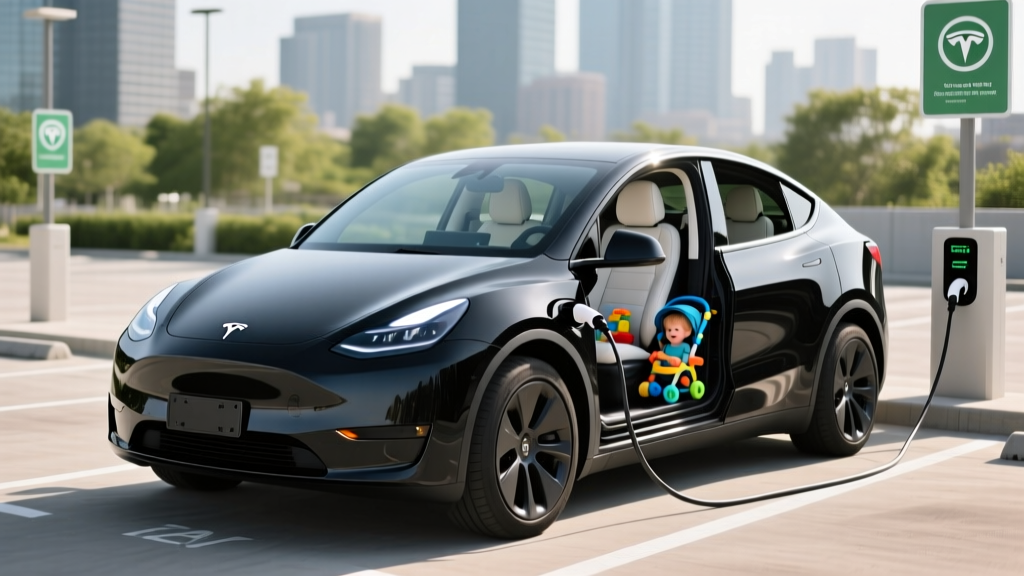
The Tesla Model Y remains one of the best-selling electric vehicles in the United States, and the optional third row is a major draw for growing families who want EV efficiency without stepping up to a full-size SUV. The seven-seat configuration adds two small rear-facing seats in the cargo area, transforming the Model Y from a five-passenger crossover into a compact family hauler. But the trade-offs are real: reduced cargo volume, tight third-row legroom, and a slight hit to efficiency.
For the 2025 model year (sold through 2026), Tesla offers the Model Y Long Range AWD with the seven-seat option at a $2,000 premium over the standard five-seat layout. This review covers everything you need to know — from real-world range expectations to whether those back seats can actually fit anyone over age eight.
Range, Efficiency, and the Real-World Reality
The seven-seat Model Y Long Range AWD carries the same battery pack as its five-seat sibling, but the added weight and slightly different aerodynamic profile marginally affect efficiency. Here's what the EPA says versus what you'll actually experience.
Real-World Expectation: 260–280 miles on mixed highway driving; 220–250 miles in sustained cold weather (below 32°F) with cabin heating. City driving with heavy regenerative braking can push closer to or slightly above the EPA figure.
The difference between the five-seat (320 miles EPA) and seven-seat (308 miles EPA) configurations is modest — about 12 miles — but it compounds on road trips when you're also carrying a full passenger load and cargo. Tesla's heat pump, standard on all current Model Y variants, helps mitigate cold-weather range loss compared to resistive heating systems, but expect a 15–25% reduction in winter conditions regardless.
Efficiency comes in at approximately 122 MPGe combined (28 kWh/100 miles) per fueleconomy.gov. That's competitive with the Hyundai Ioniq 5 and slightly behind the most efficient configurations of the Ford Mustang Mach-E.
Battery, Chemistry, and Longevity
| Spec | Value |
|---|---|
| Battery Capacity (usable) | ~75 kWh |
| Battery Chemistry | NMC (Nickel Manganese Cobalt) |
| EPA Range | 308 miles |
| Efficiency | 122 MPGe / 28 kWh/100mi |
| Drivetrain | Dual-Motor AWD |
| Horsepower | 384 hp (combined) |
| 0–60 mph | 4.8 seconds |
| Max DC Fast Charge | 250 kW (peak) |
| 10–80% DC Charge Time | ~27 minutes |
| Level 2 Home Charge Rate | 11.5 kW (~44 mi/hr) |
| Battery Warranty | 8 years / 120,000 miles |
| Base MSRP (7-seat) | $49,990 (incl. destination) |
The Long Range AWD uses an NMC (nickel manganese cobalt) lithium-ion pack. NMC offers higher energy density than LFP (lithium iron phosphate), which is why Tesla reserves it for the Long Range and Performance trims that prioritize maximum range. The trade-off: NMC cells degrade slightly faster over thousands of cycles than LFP, and Tesla recommends daily charging to 80% rather than 100% for routine use to preserve long-term battery health.
The 8-year/120,000-mile battery and drive unit warranty guarantees a minimum of 70% capacity retention. In practice, Tesla's battery degradation data shows most Model Y packs retain 88–92% capacity at 100,000 miles, based on fleet data aggregated by third-party sources.
Charging Speed: DC Fast, Level 2, and Home Setup
Charging speed is where the Model Y's 400-volt architecture shows its age compared to 800-volt competitors like the Hyundai Ioniq 5 and Kia EV6. Still, Tesla's Supercharger network reliability remains a decisive advantage for road-tripping families.
| Charging Level | Power / Rate | Miles Added per Hour | Notes |
|---|---|---|---|
| Level 1 (120V) | ~1.4 kW | ~5 mi/hr | Emergency/top-off only |
| Level 2 (240V, 48A) | 11.5 kW | ~44 mi/hr | Full charge in ~7 hours |
| DC Fast (Supercharger V3) | 250 kW peak | ~175 mi in 15 min | 10–80% in ~27 min |
| DC Fast (V4 Supercharger) | Up to 250 kW | Similar to V3 | CCS adapter may be needed for non-Tesla networks |
The charge curve matters more than the peak number. The Model Y hits 250 kW only at a low state of charge (roughly 5–15%) and tapers significantly above 50%. From 80–100%, charging slows to roughly 30–40 kW. This is why Tesla and most EV experts recommend charging to 80% on road trips — the last 20% can add 20+ minutes to your stop.
At home on a Level 2 Wall Connector (hardwired, 60A circuit), the Model Y charges at 11.5 kW, adding about 44 miles of range per hour. A full overnight charge easily replenishes a day's driving for most families. Installation costs for a Level 2 home setup typically run $800–$2,000 depending on panel capacity and conduit distance — factor in a potential $500–$1,500 panel upgrade if your home has a 100A service.
Third-Row Practicality: Who Actually Fits Back There?
This is the question that defines the seven-seat Model Y purchase decision. The third row consists of two small, forward-facing seats that fold flat into the cargo floor when not in use.
Third-row legroom: approximately 26.5 inches. For context, that's roughly 5 inches less than the third row of a Toyota Highlander. These seats work for children up to about 5'2" or so — roughly age 10–12 depending on the kid. Adults will find them unusable for anything beyond a short trip across town.
Cargo volume impact: With all three rows in use, cargo space behind the third row drops to roughly 12.2 cubic feet — enough for a couple of grocery bags or a small stroller, but not much more. Fold the third row flat and you recover about 30.2 cubic feet. Fold both the second and third rows and maximum cargo volume reaches approximately 72.1 cubic feet, which is competitive with the class.
Second-row space: The second row offers about 38.4 inches of legroom, which is adequate for adults and older children. The second row slides and reclines, which helps with comfort on longer trips.
Frunk: The front trunk provides an additional 4.1 cubic feet of storage — useful for charging cables, a small cooler, or groceries you want to keep separate from the main cabin.
Pricing, Tax Credits, and Total Cost
| Item | Amount |
|---|---|
| Base MSRP (Long Range AWD, 7-seat) | $49,990 |
| Common Add-Ons (FSD, paint, wheels) | +$2,000–$10,000 |
| As-Tested Price (typical build) | ~$52,000–$55,000 |
| Federal Tax Credit (§30D, if eligible) | Up to $7,500 |
| Estimated Net Price (with full credit) | ~$42,490–$47,500 |
Federal tax credit eligibility under IRS §30D depends on several factors that change periodically:
- MSRP cap: SUVs must have an MSRP at or below $80,000. The Model Y seven-seat clears this easily.
- Buyer income cap: Modified adjusted gross income must not exceed $150,000 (single), $225,000 (head of household), or $300,000 (joint filers).
- Battery sourcing: Critical minerals and battery component requirements phase in progressively. Tesla's North American battery supply chain has largely met these thresholds, but verify current eligibility at the point of sale, as sourcing rules tighten annually.
- Point-of-sale transfer: As of 2024, buyers can transfer the credit to the dealer at purchase, effectively reducing the purchase price upfront rather than waiting for a tax refund.
Always confirm eligibility with your tax professional and check the latest fueleconomy.gov tax credit listings before purchasing, as rules and qualifying configurations can shift between model years.
Technology, Driver Assistance, and Interior
The Model Y interior follows Tesla's minimalist philosophy: a single 15-inch center touchscreen handles all infotainment, climate, navigation, and vehicle settings. There's no traditional instrument cluster — speed and driving info live in the upper-left corner of the main display.
Driver assistance: Basic Autopilot (adaptive cruise control + lane-keeping) comes standard. Full Self-Driving (Supervised) is available as a $8,000 option or $99/month subscription. It's critical to understand that FSD is an SAE Level 2 system — it requires continuous driver attention and hands-on or eyes-on supervision at all times. It is not autonomous driving. The system handles highway lane changes, on-ramp-to-off-ramp navigation, and some city street scenarios, but driver vigilance is non-negotiable.
Notable tech features: Over-the-air software updates, Sentry Mode (surveillance recording), Dog Mode (climate control for pets), Tesla app integration with preconditioning and charging management, and access to the Supercharger network (over 6,000 U.S. stations and growing).
Drawbacks: No Apple CarPlay or Android Auto (Tesla uses its proprietary system), no physical buttons for climate or volume, phantom braking incidents reported by some owners on Autopilot, and panel gap quality remains inconsistent across production batches.
How It Compares: Model Y 7-Seat vs. the Competition
The seven-seat EV market is still small, but families have options:
- Kia EV9 (3-row, starting ~$54,900): Larger, more usable third row (adults can fit), 800V architecture for faster charging (~18 min 10–80%), but higher base price and smaller charging network.
- Hyundai Ioniq 5 (no 3rd row): More efficient, faster charging, but seats only five — not a direct competitor for the seven-seat use case.
- Ford Mustang Mach-E (no 3rd row): Sportier driving dynamics, but five seats only.
- Rivian R1S (3-row, starting ~$79,900): Far more capable off-road and far more spacious, but significantly more expensive and may not qualify for the full federal credit depending on configuration.
The Model Y seven-seat occupies a unique niche: the most affordable three-row EV with access to the best charging network. If your third-row passengers are small children and your budget is under $55K, it's essentially without direct rival. If you need a genuinely usable third row for teenagers or adults, the Kia EV9 or Rivian R1S are better choices at higher price points.
Pros
- Most affordable 3-row EV available in the U.S.
- Access to Tesla Supercharger network (most reliable in the U.S.)
- Strong efficiency (122 MPGe combined)
- Quick acceleration (4.8s 0–60) even with 7 seats
- Over-the-air updates continuously add features
- 8-year/120,000-mile battery warranty
Cons
- Third row only fits small children (26.5" legroom)
- Minimal cargo space with all three rows up (~12.2 cu ft)
- 400V architecture = slower DC charging vs 800V competitors
- No Apple CarPlay or Android Auto
- FSD costs $8,000 extra and is still Level 2 only
- Inconsistent build quality (panel gaps, interior trim)
Who Should Buy the Tesla Model Y Seven-Seat?
- You have two small children (under age 10) who can use the third row occasionally
- You want the lowest-cost entry into a three-row EV
- Supercharger network access is a priority for family road trips
- Your daily commute is under 60 miles round-trip and you can charge at home
- You need the third row for teenagers or adults regularly
- You need serious cargo volume with all seats in use
- You want the fastest DC charging speeds available (consider the EV9 or Ioniq 5)
- You prefer traditional infotainment with Apple CarPlay/Android Auto
The Tesla Model Y seven-seat is a pragmatic solution for a specific family: one with young kids, home charging access, and a budget that doesn't stretch to a Rivian or a three-row Kia EV9. It's not a minivan replacement, and the third row is best thought of as occasional-use overflow seating. But for the price, efficiency, and charging infrastructure it provides, it remains a compelling family EV option in 2026.
Frequently Asked Questions
What is the real-world range of the Tesla Model Y seven-seat?
The EPA rates it at 308 miles. In real-world mixed driving, expect 260–280 miles. In cold weather (below freezing), plan for 220–250 miles. Highway-only driving at 75+ mph will also reduce range to roughly 250–270 miles.
How fast does the Model Y seven-seat charge?
On a Tesla V3 Supercharger, it peaks at 250 kW and charges from 10–80% in approximately 27 minutes. At home on a Level 2 Wall Connector (11.5 kW), a full charge takes about 7 hours, adding roughly 44 miles of range per hour.
Does the Model Y seven-seat qualify for the federal EV tax credit?
It can qualify for up to $7,500 under IRS §30D, provided the buyer meets income limits ($300K joint / $150K single), the MSRP is under $80,000 (it is), and the battery meets current critical-mineral and component sourcing requirements. Confirm eligibility at the point of sale and with a tax professional, as sourcing rules tighten annually.
Can adults fit in the Model Y third row?
Not comfortably. With approximately 26.5 inches of legroom, the third row is suitable for children up to roughly age 10–12. Adults will find it cramped even for short trips.
Is the Model Y seven-seat worth it vs. the Kia EV9?
If budget is the priority and third-row passengers are small children, the Model Y wins on price (~$50K vs ~$55K+) and charging network access. If you need a usable third row for older kids or adults and faster 800V charging, the EV9 is the better vehicle at a higher cost.
What's the warranty coverage on the Model Y battery?
Tesla covers the battery and drive unit for 8 years or 120,000 miles (whichever comes first), with a minimum 70% capacity retention guarantee. The basic vehicle limited warranty is 4 years or 50,000 miles.