The Tesla Model Y remains one of the best-selling electric vehicles in the United States for good reason: it blends crossover practicality, strong efficiency, and access to the Supercharger network. But for family shoppers, the first question is often about passenger space — specifically, Tesla Model Y seating capacity and whether the optional third row makes sense. This review covers the 2026 Model Y lineup with exact EPA data, real-world range expectations, charging speeds, pricing, and tax-credit eligibility so you can decide if it fits your household.
Tesla Model Y Seating Capacity: 5-Passenger vs. 7-Passenger
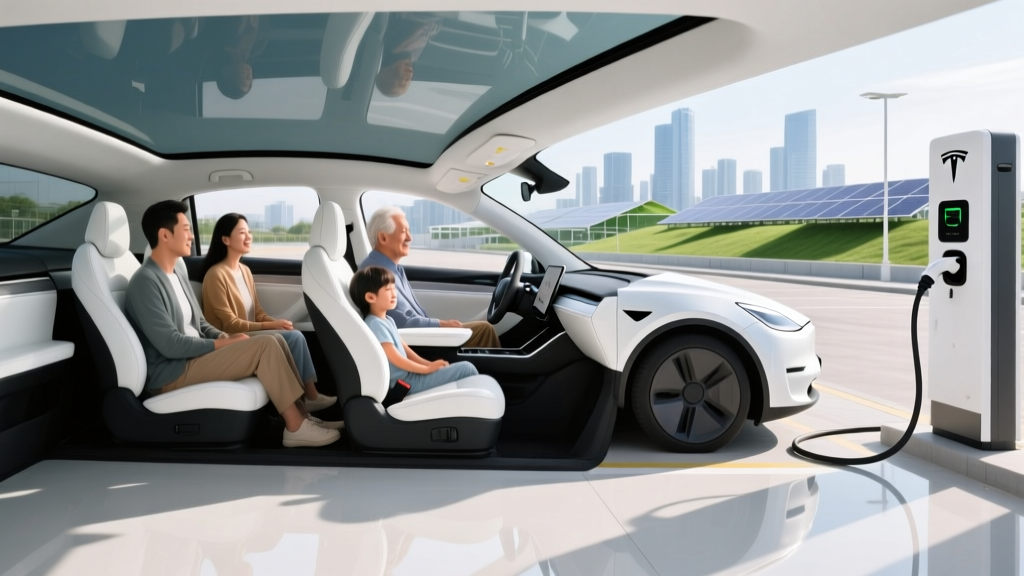
The standard Model Y configuration seats five passengers across two rows. Tesla offers an optional third-row seat on the Long Range AWD trim, raising total capacity to seven. However, the third row is best understood as a 50/50 emergency bench — not a full-size row.
| Specification | 5-Seat Config | 7-Seat Config (Optional) |
|---|---|---|
| Front headroom | 41.0 in | 41.0 in |
| Front legroom | 41.8 in | 41.8 in |
| Second-row headroom | 39.4 in | 38.6 in |
| Second-row legroom | 41.6 in | 41.6 in |
| Third-row headroom | N/A | ~35.0 in (est.) |
| Third-row legroom | N/A | ~26.5 in (est.) |
| Cargo behind 2nd row | 30.2 cu ft | 12.8 cu ft |
| Cargo (all rows folded) | 72.1 cu ft | 67.4 cu ft |
| Front trunk (frunk) | 4.1 cu ft | 4.1 cu ft |
The third row suits children on short trips. Adults will find knee room tight and the seat cushion low to the floor, creating a knees-up posture. With the third row deployed, cargo space shrinks to roughly a few grocery bags. If you regularly carry more than five, a three-row EV like the Kia EV9 or a minivan may serve you better. For occasional use — school carpools, visiting grandparents — the option adds genuine flexibility at a ~$3,000 premium.
2026 Model Y Trim Lineup & Pricing
Tesla restructured the Model Y lineup for the 2026 model year following the "Juniper" refresh. Here's the current pricing structure before incentives:
| Trim | Base MSRP | Drivetrain | §30D Credit Eligible? |
|---|---|---|---|
| Long Range RWD | $44,990 | Rear-Wheel Drive | Yes (up to $7,500) |
| Long Range AWD | $47,990 | Dual-Motor AWD | Yes (up to $7,500) |
| Long Range AWD (7-seat) | $50,990 | Dual-Motor AWD | Yes (up to $7,500) |
| Performance | $52,490 | Dual-Motor AWD | Yes (up to $7,500) |
All 2026 Model Y trims fall under the IRS §30D SUV MSRP cap of $80,000. Eligibility for the full $7,500 federal tax credit depends on your taxable income (≤$150,000 single / ≤$300,000 married filing jointly) and whether the vehicle meets critical-mineral and battery-component sourcing requirements. As of 2026, Tesla's North American battery sourcing qualifies the Model Y for the full credit, which can be transferred to the dealer at the point of sale — effectively reducing your purchase price by $7,500 on the spot. Always verify current eligibility on IRS.gov before purchasing, as sourcing rules can shift.
EPA Range, Efficiency & Real-World Expectations
The 2026 Model Y Long Range AWD carries an EPA-estimated 320 miles of range. The RWD variant is rated at 310 miles, while the Performance trim drops to 280 miles due to stickier tires and more aggressive tuning.
Real-World Range Check
EPA sticker: 320 miles (Long Range AWD)
Highway driving (70-75 mph): Expect ~270-285 miles in mild weather
Cold weather (below 32°F): Range can drop 20-30%, yielding ~220-255 miles
City / stop-and-go with regen: Close to EPA or slightly above, ~310-330 miles
Combined mixed driving: ~285-300 miles is a realistic planning number
Tesla's heat pump (standard on all trims) mitigates cold-weather losses better than resistive heaters, but any EV loses range when the battery is cold and cabin heating is running. On a 300-mile winter road trip through the Rockies, plan for a charging stop — don't rely on the EPA sticker alone.
Efficiency is rated at 122 MPGe combined (Long Range AWD), which translates to approximately 28 kWh per 100 miles. That's among the most efficient all-wheel-drive crossovers on the market, thanks to Tesla's powertrain integration and low drag coefficient.
Battery Chemistry, Capacity & Longevity
The 2026 Model Y Long Range and Performance trims use a ~78 kWh usable battery pack with NMC (nickel manganese cobalt) chemistry supplied by Panasonic and built at Gigafactory Nevada. NMC offers higher energy density than LFP, enabling the Model Y's strong range in a relatively compact pack.
For buyers prioritizing longevity over maximum range, note that Tesla previously offered the Standard Range Model Y with an LFP (lithium iron phosphate) battery. LFP packs tolerate regular 100% charging and show slower degradation over time, but they sacrifice some range and cold-weather performance. If an LFP-equipped variant returns to the lineup, it will be clearly labeled on Tesla's configurator.
| Specification | Detail |
|---|---|
| Usable battery capacity | ~78 kWh (Long Range / Performance) |
| Chemistry | NMC (Long Range / Performance) |
| Battery warranty | 8 years / 120,000 miles |
| Warranty retention threshold | 70% minimum capacity |
| Drive unit warranty | 8 years / 120,000 miles |
| Basic vehicle warranty | 4 years / 50,000 miles |
Tesla's battery warranty guarantees that the pack will retain at least 70% of its original capacity over 8 years or 120,000 miles (whichever comes first). Real-world degradation data from fleet monitoring suggests most Model Y packs lose roughly 5-8% capacity in the first 50,000 miles, then plateau — meaning you're unlikely to hit the 70% threshold under normal use. Full battery replacement outside warranty currently runs $12,000-$16,000 depending on pack configuration.
Charging Speed: DC Fast, Level 2 & Home Setup
The 2026 Model Y uses the NACS (North American Charging Standard) connector natively — the same plug used across Tesla's Supercharger network. This gives Model Y owners access to over 20,000 Supercharger stalls in North America, widely regarded as the most reliable public DC fast-charging network available.
| Charging Level | Power / Rate | Speed | Notes |
|---|---|---|---|
| Level 1 (120V household) | ~1.4 kW | ~3-4 mi/hr | Emergency / overnight trickle only |
| Level 2 (240V home / public) | 11.5 kW (max onboard) | ~37 mi/hr | Full charge in ~8 hours |
| DC Fast (Supercharger V3/V4) | Peak 250 kW | 10-80% in ~25 min | Speed tapers significantly above 80% |
| DC Fast (CCS adapter) | Up to 250 kW | Varies by station | Requires Tesla CCS adapter (sold separately or included) |
The peak 250 kW DC fast-charge rate applies only when the battery is preconditioned (navigate to a Supercharger via the car's navigation to trigger automatic preconditioning) and the state of charge is low — typically below 30%. The charging curve tapers steeply: you'll see ~250 kW at 10% SoC, dropping to ~100 kW by 60%, and ~40 kW above 85%. This is why Tesla and most EV analysts quote the 10-80% time (~25 minutes) rather than a full 0-100% charge.
For home charging, a Wall Connector ($420 from Tesla) on a 60-amp circuit delivers the full 11.5 kW (48 amps continuous), adding roughly 37 miles of range per hour. Most owners plug in overnight and wake up with a full battery. Installation costs vary widely: expect $500-$1,500 if your electrical panel has capacity, or $2,000-$4,000+ if a panel upgrade to 200 amps is needed. Always get a quote from a licensed electrician before purchasing equipment.
Performance & Driving Dynamics
The Model Y's performance varies meaningfully across trims:
| Trim | Horsepower | 0-60 mph | Top Speed | Drivetrain |
|---|---|---|---|---|
| Long Range RWD | ~346 hp | 5.8 sec | 135 mph | Rear-Wheel Drive |
| Long Range AWD | ~384 hp | 4.8 sec | 135 mph | Dual-Motor AWD |
| Performance | ~510 hp | 3.5 sec | 155 mph | Dual-Motor AWD |
Even the base Long Range RWD delivers confident highway merging and quick off-the-line acceleration. The AWD dual-motor setup provides genuine all-weather traction — torque is distributed independently front and rear, giving it an edge over mechanical AWD systems in snow and rain. The Performance trim is genuinely fast, but the ride is firmer and the 21-inch wheels reduce range by ~40 miles versus the Long Range.
Regenerative braking is strong and adjustable, enabling one-pedal driving in most conditions. The steering is quick but light on feedback — a common criticism from driving enthusiasts, though most crossover buyers won't mind.
Technology, Autopilot & Smart Features
Every 2026 Model Y includes Tesla's 15.4-inch center touchscreen running the latest Tesla OS, which handles navigation, media, climate, and vehicle settings. There is no traditional instrument cluster — all driving information appears on the center screen (and, on refreshed models, a small secondary display for rear passengers).
Standard driver-assist features include:
- Traffic-Aware Cruise Control
- Autosteer (lane centering on marked highways)
- Automatic Emergency Braking
- Blind-spot monitoring and lane-departure warning
- 360-degree cameras and parking assist
⚠ Autopilot & FSD Are NOT Self-Driving
Tesla's Autopilot and Full Self-Driving (Supervised) are SAE Level 2 driver-assistance systems. You must keep your hands on the wheel and eyes on the road at all times. FSD Supervised ($8,000 one-time or $99/month) adds automatic lane changes, traffic-light recognition, and city-street navigation assistance, but it does not make the car autonomous. The driver is legally responsible for all vehicle operation. Only Level 4 robotaxi services like Waymo operate without a human driver — and those are geofenced to specific cities.
Other standout tech includes over-the-air (OTA) software updates that regularly add features, a built-in trip planner that automatically routes through Superchargers with preconditioning, Sentry Mode (360-degree security recording while parked), and Dog Mode (maintains cabin climate for pets). The Model Y also supports Vehicle-to-Load (V2L) via a Tesla accessory, allowing you to power small devices or a campsite from the traction battery.
Pros, Cons & Verdict: Who Should Buy the Model Y?
✅ Pros
- Class-leading efficiency (122 MPGe combined)
- Access to the Supercharger network — the most reliable DC fast-charging ecosystem
- Strong real-world range (285-300 mi mixed driving)
- OTA updates continuously improve the vehicle
- Excellent safety ratings (NHTSA 5-star, IIHS Top Safety Pick+)
- Optional third row adds flexibility for families
- Low running costs (~$0.04-$0.06/mi on home charging)
❌ Cons
- Third row is child-sized; adults won't fit comfortably
- Minimalist interior lacks physical buttons (climate, mirrors adjusted via screen)
- No Apple CarPlay or Android Auto
- Ride quality can be firm, especially on Performance trims with 21" wheels
- FSD subscription is expensive and still requires full driver attention
- Cargo space with 3rd row up is very limited (~12.8 cu ft)
- Insurance premiums run 15-25% higher than comparable gas crossovers
Is the Model Y Right for You?
Choose the Model Y if: You want a highly efficient electric crossover with best-in-class charging infrastructure, strong range, and optional family seating for occasional 7-passenger use.
Look elsewhere if: You regularly carry more than five adults (consider the Kia EV9 or a minivan), you need Apple CarPlay, or you prioritize a plush ride over sporty handling.
Frequently Asked Questions
What is the real-world range of the 2026 Tesla Model Y?
The EPA rates the Long Range AWD at 320 miles. In real-world mixed driving, expect 285-300 miles. Highway-only driving at 75 mph drops this to ~270-285 miles, and cold weather (below freezing) can reduce range by 20-30%, yielding as low as ~220 miles on a full charge.
How fast does the Model Y charge at home and on the road?
At home on a 240V Level 2 charger (11.5 kW), the Model Y gains about 37 miles of range per hour, fully charging in roughly 8 hours. On a Tesla V3/V4 Supercharger, it peaks at 250 kW and charges from 10-80% in approximately 25 minutes, though speed tapers significantly above 80% SoC.
How much does the Model Y cost after the federal tax credit?
The Long Range AWD starts at $47,990. If you qualify for the full $7,500 §30D credit (income and sourcing requirements met), the effective price drops to ~$40,490. The credit can be applied at the point of sale as a down-payment reduction. Always confirm eligibility on IRS.gov before purchasing.
Does the Tesla Model Y qualify for the federal EV tax credit?
Yes — all 2026 Model Y trims are under the $80,000 SUV MSRP cap and currently qualify for up to $7,500 under IRS §30D, provided the buyer meets income thresholds (≤$150K single / ≤$300K joint) and the vehicle's battery sourcing meets critical-mineral and component requirements. Rules can change; verify before purchase.
Is the Model Y worth buying vs. competitors like the Hyundai Ioniq 5 or Ford Mustang Mach-E?
The Model Y wins on charging-network access, efficiency, and available 7-seat flexibility. The Hyundai Ioniq 5 charges faster on non-Tesla DC networks (up to 350 kW, 10-80% in ~18 min) and offers a more comfortable ride. The Mach-E offers a more engaging driving experience. If Supercharger reliability is your top priority, the Model Y is still the benchmark. Check current specs at fueleconomy.gov for side-by-side EPA comparisons.
Can adults fit in the Model Y's optional third row?
Not comfortably. The third row offers roughly 26.5 inches of legroom and a low seat cushion. It works for children on short trips or very brief adult rides. For regular 7-passenger use with adults, a larger three-row EV like the Kia EV9 or Rivian R1S is a better fit.
What is the Model Y's towing capacity?
The 2026 Model Y is rated to tow up to 3,500 pounds when properly equipped with Tesla's tow hitch accessory. This covers small boat trailers, bike racks, and light utility trailers. Keep in mind that towing significantly reduces range — expect a 30-50% reduction depending on trailer weight and aerodynamics.