The Tesla Model Y in 2026: Still the EV to Beat?
The Tesla Model Y remains the best-selling electric vehicle in the United States for good reason: it blends practical crossover packaging with class-leading efficiency, access to the Supercharger network, and an infotainment system centered around a large, responsive touchscreen. For 2026, the refreshed Model Y (internally dubbed "Juniper") brings a redesigned interior, updated suspension tuning, and a revised center display. Buyers searching for specifics on the Tesla Model Y screen size will find a 15.4-inch center touchscreen in the latest generation — a slight reduction from the previous 15-inch diagonal measurement but reconfigured in a 16:9 landscape layout with thinner bezels and higher pixel density, yielding a more usable, glare-resistant surface.
But a screen alone doesn't make a great EV. This review breaks down the 2026 Model Y's real-world range, charging performance, battery chemistry, pricing after federal tax credits, and how it stacks up against rivals like the Hyundai Ioniq 5, Ford Mustang Mach-E, and Chevrolet Equinox EV.
Tesla Model Y Screen Size and Interior Tech
The centerpiece of the Model Y cabin is its 15.4-inch center touchscreen (measured diagonally, 1920 × 1200 resolution). Unlike the outgoing Model Y's 15-inch display, the Juniper refresh uses an IPS panel with improved anti-reflective coating and a faster processor (Tesla's latest HW5 infotainment chip), reducing app load times and map rendering lag noticeably.
Notably, the 2026 Model Y follows the Model 3 refresh in eliminating physical stalks for turn signals and gear selection. Turn signals are now capacitive buttons on the steering wheel, with a backup strip on the overhead console. Gear selection happens via the touchscreen's left-side swipe interface. This remains one of the most polarizing design choices in the EV market — some owners adapt within a week; others find it a persistent annoyance, especially in roundabouts and three-point turns.
The rear seats now feature an 8-inch touchscreen for climate and media controls, a first for the Model Y. Wireless phone charging has been upgraded to 15W with active cooling, and the ambient lighting system spans the full dashboard width.
| Spec | Long Range AWD | Performance | Long Range RWD |
|---|---|---|---|
| EPA Range | 320 mi | 293 mi | 335 mi |
| Battery (usable) | ~75 kWh (NMC) | ~75 kWh (NMC) | ~75 kWh (NMC) |
| 0–60 mph | 4.8 sec | 3.5 sec | 5.8 sec |
| Horsepower | 384 hp | 456 hp | 295 hp |
| Drivetrain | Dual-Motor AWD | Dual-Motor AWD | Single-Motor RWD |
| Top Speed | 125 mph | 155 mph | 125 mph |
| MPGe (combined) | 111 MPGe | 102 MPGe | 117 MPGe |
| Efficiency | 30 kWh/100mi | 33 kWh/100mi | 29 kWh/100mi |
| Center Screen | 15.4-inch touchscreen (1920 × 1200) | ||
| Rear Screen | 8-inch touchscreen | ||
| Base MSRP | $48,990 | $53,990 | $44,990 |
Range and Efficiency: EPA vs. Real-World
The 2026 Model Y Long Range AWD carries an EPA-estimated 320 miles of range. The RWD variant pushes that to 335 miles thanks to lower weight and reduced drivetrain losses. The Performance trim drops to 293 miles — the cost of stickier tires, more aggressive tuning, and larger 21-inch wheels.
- City / mixed suburban driving: 300–325 miles — regenerative braking recovers energy effectively in stop-and-go traffic.
- Highway (70–75 mph, moderate temps): 260–285 miles — the Model Y's aerodynamic drag coefficient of 0.23 Cd helps, but sustained high speed still costs 10–15%.
- Cold weather (below 32°F, highway): 210–245 miles — LFP and NMC batteries both lose capacity in cold temps; the heat pump mitigates cabin draw but cannot eliminate the chemical slowdown. Expect 20–30% range loss in deep winter.
- Towing (with optional tow package, up to 3,500 lbs): 160–190 miles — towing roughly halves range.
Efficiency remains a Tesla strong point. At 30 kWh/100 miles (Long Range AWD), the Model Y sips electrons more frugally than most competing electric crossovers. For context, the Hyundai Ioniq 5 AWD achieves roughly 34 kWh/100 miles, and the Ford Mustang Mach-E Extended Range AWD sits around 32 kWh/100 miles. Over 12,000 miles of annual driving, that efficiency gap translates to roughly $60–$100 in electricity savings per year at the national average rate of $0.17/kWh.
Battery Chemistry and Longevity
The 2026 Model Y Long Range and Performance trims use an NMC (nickel manganese cobalt) lithium-ion battery pack with approximately 75 kWh of usable capacity. Tesla has not switched the US-market Model Y to LFP (lithium iron phosphate) chemistry, which it reserves for the Model 3 RWD and certain international markets where lower energy density is acceptable.
NMC packs offer higher energy density — critical for maximizing range in a crossover form factor — but they prefer not to sit at 100% state of charge for extended periods. Tesla recommends daily charging to 80–90% for NMC batteries and saving 100% charges for road trips. This is a meaningful ownership consideration: if your commute demands the full 320 miles, an NMC pack requires more planning than an LFP pack, which tolerates regular 100% charges.
Battery degradation data from Tesla's 2025 Impact Report shows that Model Y packs retain approximately 88–90% of original capacity after 100,000 miles. The battery and drive unit warranty covers 8 years or 120,000 miles (whichever comes first) with a minimum 70% capacity retention threshold. This aligns with industry norms and provides reasonable peace of mind, though competitors like Hyundai offer a 10-year/100,000-mile battery warranty on the Ioniq 5.
Charging Speed: DC Fast, Level 2, and Level 1
The 2026 Model Y supports a peak DC fast-charge rate of 250 kW on V3 and V4 Superchargers, as well as on compatible CCS and NACS third-party stations. In real-world testing, the charging curve peaks near 250 kW between 10–30% state of charge, then tapers progressively. The 10–80% charge takes approximately 25–28 minutes at an ambient temperature of 70°F with battery preconditioning active.
One key advantage: Tesla's battery preconditioning activates automatically when you navigate to a Supercharger, warming the pack to optimal charging temperature before you arrive. This consistently delivers faster real-world charge sessions compared to EVs that require manual preconditioning toggles.
| Charging Level | Power / Rate | Speed | Notes |
|---|---|---|---|
| Level 1 (120V household) | ~1.4 kW | ~4 mi/hr | Emergency/trickle only; ~80 hours for full charge |
| Level 2 (240V, 48A Wall Connector) | 11.5 kW | ~44 mi/hr | Full charge in ~7 hours; recommended home setup |
| Level 2 (240V, 32A mobile connector) | 7.7 kW | ~30 mi/hr | Slower but uses standard NEMA 14-50 outlet |
| DC Fast (Supercharger V3/V4) | Peak 250 kW | ~200 mi in 15 min | 10–80% in ~25–28 min with preconditioning |
| DC Fast (CCS adapter, 150 kW station) | Peak ~150 kW | ~120 mi in 15 min | Requires Tesla CCS adapter (included since 2024) |
For home charging, Tesla's Gen 3 Wall Connector at 48 amps delivers 11.5 kW — adding roughly 44 miles of range per hour of charging. This is sufficient to replenish a full day's driving in 1–2 hours. Installation typically requires a 60-amp dedicated circuit; expect $500–$2,000 for a licensed electrician depending on panel proximity and local permitting. If your home's electrical panel is maxed out at 100 amps, a panel upgrade to 200 amps can add $1,500–$3,000.
Performance and Driving Dynamics
The Model Y Long Range AWD's dual-motor setup delivers 384 horsepower and a 4.8-second 0–60 mph time — brisk for a family crossover and quicker than most gasoline rivals in this price bracket. The Performance trim drops that to 3.5 seconds with 456 hp, entering sports-sedan territory.
The Juniper refresh brought meaningful suspension improvements: revised damper tuning, new front control arms, and acoustic glass reduce road noise and harshness substantially over pre-2025 models. The ride is still firm by luxury-crossover standards, but it no longer crashes over expansion joints the way earlier Model Ys did.
Regenerative braking remains strong and enables one-pedal driving in most conditions. Tesla removed the user-adjustable regen setting several years ago, so the level of deceleration is fixed — a frustration for some drivers who prefer to modulate regen intensity.
Cargo Space, Passenger Room, and Practicality
The Model Y's crossover shape delivers practical interior volume:
- Cargo (behind second row): 30.2 cu ft
- Cargo (second row folded): 72.1 cu ft
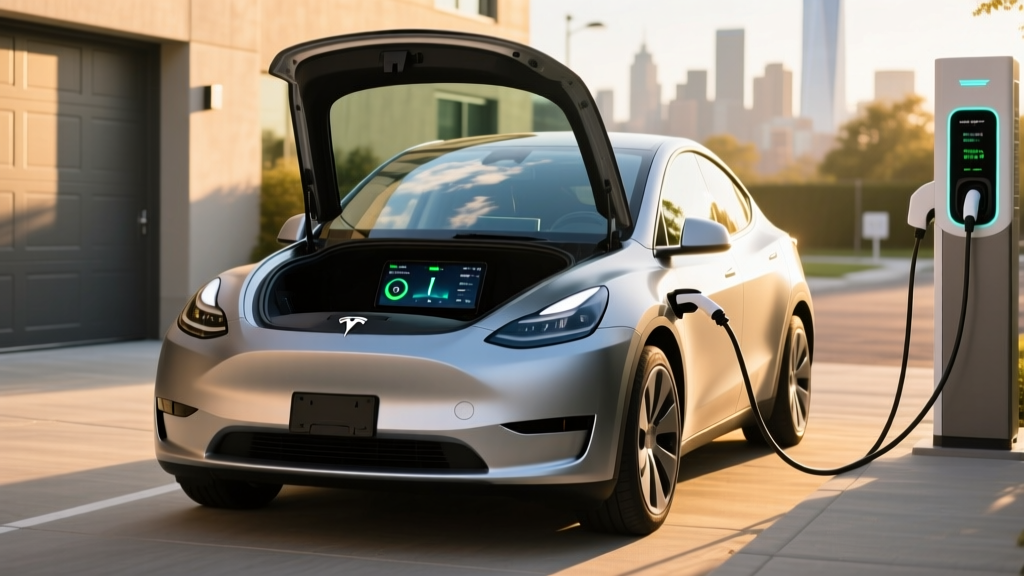
- Front trunk (frunk): 4.1 cu ft — enough for a charging cable kit and a small bag
- Front legroom: 41.8 inches
- Rear legroom: 41.6 inches — generous for the segment and enough for rear-facing child seats without front-passenger compromise
- Optional third row: Available on Long Range trims; adds two small seats suitable for children under ~5'4" only. Cargo drops to 12.8 cu ft behind the third row.
Towing capacity is rated at 3,500 pounds with the optional tow package ($1,000). This handles a small utility trailer or a pair of dirt bikes but falls short of the Ford F-150 Lightning or Rivian R1S for serious hauling.
Pricing, Trims, and Federal Tax Credit Eligibility
The 2026 Model Y lineup is straightforward:
| Trim | Base MSRP | Federal §30D Credit | Estimated Net Price |
|---|---|---|---|
| Long Range RWD | $44,990 | Up to $7,500* | ~$37,490* |
| Long Range AWD | $48,990 | Up to $7,500* | ~$41,490* |
| Performance AWD | $53,990 | Up to $7,500* | ~$46,490* |
* Federal tax credit eligibility depends on buyer income, battery component sourcing, and critical mineral requirements under IRS §30D rules. The credit can be transferred to the dealer as a point-of-sale discount. Income caps: $150,000 single / $300,000 joint. MSRP cap for SUVs: $80,000. Always verify current eligibility with a tax professional.
As of 2026, the Model Y Long Range AWD qualifies for the full $7,500 federal tax credit for buyers meeting income thresholds, thanks to Tesla's North American battery sourcing compliance. The point-of-sale transfer option means you can apply the credit as an instant discount at delivery rather than waiting for a tax refund — a meaningful cash-flow advantage.
Destination fees ($1,390), paint upgrades ($1,000–$2,500), FSD capability ($8,000 one-time or $99/month), and the tow package ($1,000) can push an as-tested Long Range AWD to $55,000–$60,000 before credits.
Driver Assistance: Autopilot and FSD (Supervised)
Tesla Autopilot and Full Self-Driving (Supervised) are Level 2 driver-assistance systems. The driver must remain fully engaged, hands on or near the wheel, and eyes on the road at all times. These systems do NOT make the Model Y a self-driving vehicle. Only Level 4 services like Waymo operate without a human driver in defined geographic zones.
Standard Autopilot includes Traffic-Aware Cruise Control and Autosteer (lane centering on divided highways). The optional FSD (Supervised) package adds automatic lane changes, traffic light and stop sign recognition, and city-street autosteer. As of 2026, FSD has improved substantially in urban environments but still requires frequent driver interventions — particularly in construction zones, unmapped areas, and during heavy rain or snow.
Tesla's vision-only approach (no lidar or radar in current production) remains a philosophical bet that neural networks can match sensor-fusion systems. In IIHS testing, the 2026 Model Y earns top marks for crashworthiness but has received mixed scores for nighttime pedestrian detection — a known limitation of camera-only systems.
Pros and Cons
- Class-leading efficiency (29–33 kWh/100mi depending on trim)
- Access to the Supercharger network — the most reliable DC fast-charging ecosystem in the US
- Spacious rear seat and generous cargo volume (72.1 cu ft max)
- Strong performance even in the base Long Range RWD trim
- Over-the-air updates continuously add features
- Improved ride quality and cabin quietness in the Juniper refresh
- 15.4-inch screen is responsive, high-resolution, and well-integrated
- Stalkless turn signals and screen-based gear shifting frustrate many drivers
- FSD (Supervised) costs $8,000 and still requires constant oversight
- No physical buttons for climate, volume, or glove box — everything is screen-mediated
- Firm ride compared to Hyundai Ioniq 5 or Kia EV6
- NMC battery requires 80–90% daily charge limit for longevity
- Rear visibility is compromised by the sloping roofline — a backup camera is essential
- Insurance premiums run 15–30% higher than comparable non-Tesla crossovers
Who Should Buy the 2026 Tesla Model Y?
Choose the Model Y if:
- You road-trip regularly and want the most reliable DC fast-charging network (Superchargers).
- You value efficiency and want to minimize per-mile electricity cost.
- You need a practical family crossover with strong cargo space and optional third-row seating.
- You're comfortable with a screen-centric interface and can adapt to stalkless controls.
Consider a competitor if:
- You prefer physical buttons and traditional controls (look at the Hyundai Ioniq 5 or Kia EV6).
- You want an LFP battery that tolerates daily 100% charging without degradation concerns.
- You need a softer, more comfort-oriented ride (the Chevrolet Equinox EV or VW ID.4 ride more gently).
- You tow more than 3,500 lbs regularly (consider the Ford F-150 Lightning or Rivian R1S).
Frequently Asked Questions
What is the Tesla Model Y screen size in 2026?
The 2026 Tesla Model Y features a 15.4-inch center touchscreen (1920 × 1200 resolution) in a landscape orientation, plus an 8-inch rear touchscreen for second-row passengers. The center display handles all vehicle controls, navigation, media, and climate functions — there are no physical buttons on the dashboard.
What is the real-world range of the 2026 Model Y?
The EPA rates the Long Range AWD at 320 miles, the RWD at 335 miles, and the Performance at 293 miles. In real-world highway driving at 70–75 mph, expect 260–285 miles from the Long Range AWD. In freezing temperatures, that can drop to 210–245 miles. City driving with regenerative braking typically returns close to the EPA sticker.
How fast does the Model Y charge at home and on DC fast chargers?
On a Tesla Wall Connector (Level 2, 48A/11.5 kW), the Model Y adds approximately 44 miles of range per hour — a full charge takes about 7 hours. On a V3/V4 Supercharger (250 kW DC), a 10–80% session takes 25–28 minutes with battery preconditioning active. At third-party 150 kW CCS stations, expect 10–80% in roughly 35–40 minutes.
Does the 2026 Tesla Model Y qualify for the federal EV tax credit?
Yes — as of 2026, the Model Y qualifies for up to $7,500 under IRS §30D for eligible buyers. Requirements include: adjusted gross income below $150,000 (single) or $300,000 (joint), MSRP under the $80,000 SUV cap, and compliant battery sourcing. The credit can be applied as a point-of-sale reduction. Always verify eligibility with the IRS clean vehicle credit page or a tax professional before purchasing.
Is the Model Y worth buying over the Hyundai Ioniq 5 or Ford Mach-E?
The Model Y wins on efficiency, Supercharger network access, and cargo space. The Ioniq 5 offers 800V architecture for faster peak charging (up to 350 kW on compatible stations), a more comfortable ride, and physical buttons. The Mach-E provides a more traditional driving feel and a BlueCruise hands-free driving experience on mapped highways. If road-trip charging reliability is your top priority, the Model Y's Supercharger advantage is still significant. If ride comfort and interior ergonomics matter more, test-drive the Ioniq 5 before committing.
What is the battery warranty on the 2026 Model Y?
Tesla covers the battery pack and drive unit for 8 years or 120,000 miles (whichever comes first) with a guaranteed minimum of 70% capacity retention. If the battery degrades below 70% within the warranty period, Tesla will repair or replace it at no cost. This is competitive but trails Hyundai's 10-year/100,000-mile battery warranty.
Is Tesla FSD (Full Self-Driving) actually self-driving?
No. FSD (Supervised) is an SAE Level 2 driver-assistance system. It can handle lane changes, intersections, and highway driving under supervision, but the driver must remain alert and ready to take over at any moment. It does not make the vehicle autonomous. Think of it as an advanced cruise control and lane-keeping system — not a replacement for an attentive driver.