Tesla's October sales figures have drawn attention across the automotive press, with registration data pointing to a noticeable dip in new-vehicle deliveries compared to the same month last year. For shoppers researching their next EV, the headline isn't just about corporate momentum — it's about what a cooling sales environment means for pricing, incentives, and whether the 2026 Tesla Model Y remains the default electric crossover to beat.
This review breaks down the 2026 Model Y Long Range AWD with the exact numbers buyers need: EPA range, real-world efficiency, DC fast-charging curves, battery chemistry, tax-credit eligibility under IRS §30D, and how it stacks up against the Hyundai Ioniq 5, Ford Mustang Mach-E, and Kia EV6.
2026 Tesla Model Y: Core Specifications
| Spec | Value |
|---|---|
| EPA Estimated Range | 320 miles |
| Battery Capacity (usable) | ~75 kWh, NMC (nickel manganese cobalt) |
| Max DC Fast Charge Rate | 250 kW peak (Supercharger V3/V4) |
| 10–80% DC Charge Time | ~27 minutes |
| Level 2 Home Charging | 11.5 kW (~44 mi/hr) |
| 0–60 mph | 4.8 seconds |
| Horsepower | 384 hp (dual motor) |
| Drivetrain | AWD (dual motor) |
| Efficiency | 122 MPGe combined / 28 kWh/100 mi |
| Cargo Volume (rear seats up / folded) | 30.2 / 72.1 cu ft |
| Rear Legroom | 37.2 inches |
| Battery & Drive Unit Warranty | 8 years / 120,000 miles |
| Base MSRP (Long Range AWD) | $47,990 |
Tesla continues to use NMC chemistry in the Long Range Model Y, prioritizing energy density for maximum range. The Standard Range (RWD) variant, priced lower at approximately $44,990, uses an LFP (lithium iron phosphate) battery with slightly less range but the advantage of regular 100% charging without degradation concern — a trade-off worth understanding before you choose a trim.
Real-World Range vs. EPA Sticker
The Model Y's efficiency of 28 kWh/100 mi remains among the best in its class. Tesla's thermal management system and heat pump (standard since the 2021 refresh) help mitigate cold-weather losses compared to competitors still using resistive heaters, but physics is physics — any EV loses 15–30% of range in sustained freezing temperatures.
According to fueleconomy.gov, the Model Y Long Range AWD achieves 122 MPGe combined, placing it ahead of the Ford Mustang Mach-E Extended Range AWD (101 MPGe) and competitive with the Hyundai Ioniq 5 AWD (110 MPGe).
Charging Speed: Supercharger Network and Home Setup
| Charging Level | Power / Connector | Miles Added per Hour | Notes |
|---|---|---|---|
| Level 1 (120V household) | ~1.4 kW / NACS | ~4–5 mi/hr | Emergency/trickle only |
| Level 2 (240V home) | 11.5 kW / NACS (J1772 adapter included) | ~44 mi/hr | Full charge in ~7–8 hours |
| DC Fast Charge | 250 kW peak / NACS | Up to ~1,000 mi/hr (peak) | 10–80% in ~27 min; tapers sharply above 80% |
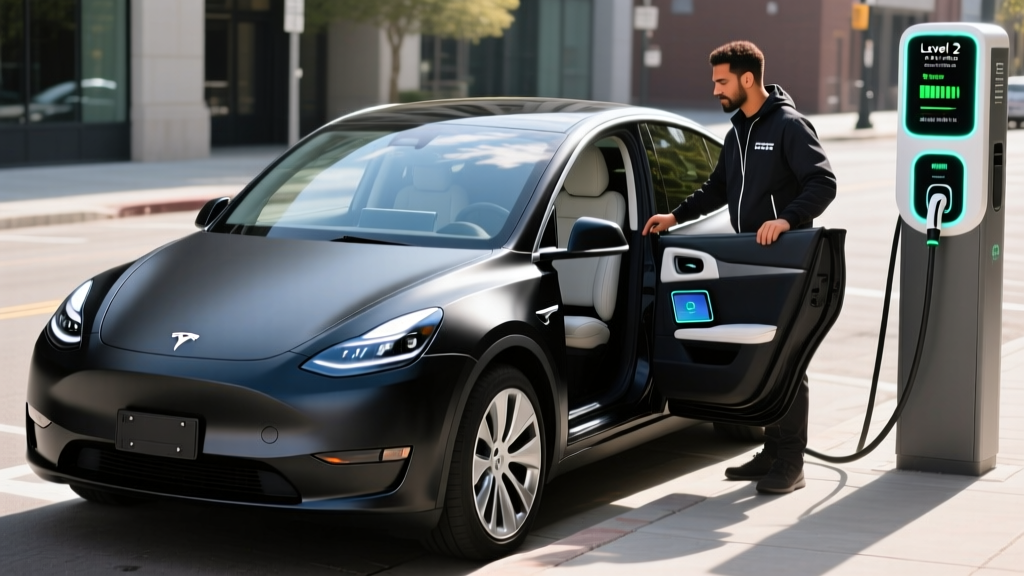
The Model Y's native NACS (North American Charging Standard) connector gives it seamless access to the Tesla Supercharger network — now exceeding 25,000 stalls in North America. This remains Tesla's strongest ownership advantage: plug-in reliability and billing integration that third-party networks (Electrify America, EVgo) still struggle to match consistently.
On a V3 Supercharger (250 kW), the Model Y Long Range peaks near 250 kW at low state-of-charge but sustains roughly 150–170 kW through the 30–70% window before tapering. A 10–80% session takes approximately 27 minutes under ideal conditions (battery preconditioned via navigation routing to the charger). Above 80%, charge speed drops dramatically to protect the NMC cells — expect the final 20% to take as long as the first 60%.
For home charging, Tesla's Wall Connector ($420) on a 60-amp circuit delivers the full 11.5 kW (48 amps continuous). A typical professional installation runs $800–$2,000 depending on panel proximity and whether your home needs a 200-amp service upgrade.
Pricing, Trims, and Federal Tax Credit Eligibility
| Trim | MSRP | Est. Price After §30D Credit* |
|---|---|---|
| Standard Range RWD (LFP) | $44,990 | ~$37,490 (if eligible) |
| Long Range AWD (NMC) | $47,990 | ~$40,490 (if eligible) |
| Performance AWD | $52,490 | ~$44,990 (if eligible) |
*Federal tax credit eligibility under IRS §30D is not guaranteed and depends on multiple requirements that change periodically. As of 2026, key criteria include:
- MSRP Cap: SUVs/crossovers must be below $80,000 — all Model Y trims qualify.
- Buyer Income Cap: Modified AGI must not exceed $150,000 (single), $225,000 (head of household), or $300,000 (joint). If your income exceeds these limits, the credit phases out entirely.
- Battery Sourcing: The $7,500 credit is split into $3,750 for critical-minerals sourcing and $3,750 for battery-component manufacturing (both must meet North American or FTA-partner thresholds). Tesla's shifting supply chain means eligibility can change month-to-month — always verify on the IRS qualified vehicles list before purchase.
- Point-of-Sale Transfer: Since 2024, buyers can transfer the credit to the dealer at purchase, reducing the upfront price rather than waiting for a tax refund. Tesla supports this at delivery.
Given the October sales slowdown, Tesla has been more aggressive with referral incentives and reduced APR financing. Check Tesla's current offers page before ordering — these can stack with the federal credit in some cases.
Performance and Driving Dynamics
The Long Range AWD's dual-motor setup delivers 384 horsepower and a 4.8-second 0–60 mph time — quick by any measure and decisively faster than most gasoline crossovers in this price range. The instant torque delivery and low center of gravity (battery pack under the floor) make it feel planted in corners, though the steering remains numb and overly assisted compared to the Ford Mustang Mach-E's more engaging tuning.
The Performance trim drops the 0–60 to 3.5 seconds with 456 hp, but at a $4,500 premium and a modest range reduction to approximately 285 miles EPA.
Ride quality improved with the 2025 suspension refresh — firmer damping and revised bushings reduced the floatiness that plagued earlier Model Y builds. Road noise remains noticeable at highway speeds, a long-standing Tesla weak point that competitors like the Ioniq 5 and BMW iX address more effectively.
Tech, Interior, and Driver Assistance
Tesla's minimalist interior centers on the 15.4-inch touchscreen controlling virtually all vehicle functions — no physical buttons for climate, mirrors, or glovebox. This remains polarizing: some owners love the clean aesthetic, while others find it distracting for simple adjustments while driving.
Standout Tech:
- Over-the-air (OTA) updates that add features post-purchase (new UI themes, efficiency improvements, entertainment apps)
- Sentry Mode dashcam recording with USB storage
- Frunk (front trunk) with 4.1 cu ft of additional cargo space
- Phone-as-key with Bluetooth proximity unlock
- Optional third-row seat (adds two small rear-facing seats, reducing cargo to 10.6 cu ft behind the third row)
Notable Drawbacks:
- No Apple CarPlay or Android Auto — Tesla's proprietary system only
- Turn-signal buttons on the steering wheel (post-2025 refresh) are less intuitive than a stalk for roundabouts and lane changes
- Panel-gap inconsistency still appears on some deliveries despite Fremont and Austin production improvements
How the Model Y Stacks Up Against Key Competitors
| Attribute | Tesla Model Y LR AWD | Hyundai Ioniq 5 AWD | Ford Mach-E ER AWD | Kia EV6 GT-Line AWD |
|---|---|---|---|---|
| EPA Range | 320 mi | 290 mi | 290 mi | 282 mi |
| Battery (usable) | ~75 kWh NMC | 77.4 kWh NMC | 91 kWh NMC | 77.4 kWh NMC |
| Max DC Charge | 250 kW | 238 kW (350 kW capable) | 150 kW | 238 kW (350 kW capable) |
| 10–80% Time | ~27 min | ~18 min (on 350 kW) | ~45 min | ~18 min (on 350 kW) |
| 0–60 mph | 4.8 sec | 5.1 sec | 5.1 sec | 4.5 sec |
| Base MSRP | $47,990 | $49,500 | $48,995 | $51,900 |
| MPGe (combined) | 122 | 110 | 101 | 117 |
| NACS Native? | Yes | No (CCS, adapter avail.) | No (CCS, adapter avail.) | No (CCS, adapter avail.) |
The Ioniq 5 and EV6 charge faster on 350 kW Electrify America stations (18-minute 10–80%), but real-world 350 kW availability is inconsistent. The Mach-E's 150 kW peak charge rate is a meaningful road-trip disadvantage. The Model Y's combination of range, Supercharger access, and efficiency keeps it at the top of this segment on paper — but the October sales drop suggests buyers are increasingly weighing interior quality, ride comfort, and brand sentiment alongside specs.
Pros and Cons
- Class-leading 320-mile EPA range and 122 MPGe efficiency
- Unmatched Supercharger network reliability and billing seamlessness
- Strong OTA update pipeline adds real value over time
- Spacious cargo area (72.1 cu ft) with optional third row
- Competitive pricing after potential §30D credit
- No Apple CarPlay/Android Auto — Tesla-only ecosystem
- Highway road noise remains above segment average
- FSD (Supervised) costs $8,000 extra and remains Level 2, not autonomous
- Panel gaps and paint quality can be inconsistent at delivery
- Touchscreen-only controls for mirrors, glovebox, and climate are distracting
Who the 2026 Model Y Suits Best
Ideal for: Daily commuters with home charging access, families needing cargo versatility (strollers, groceries, road-trip luggage), and road-trippers who value Supercharger network reliability over third-party DC charging. The Model Y's efficiency and range make it one of the lowest-cost EVs to operate long-term.
Consider alternatives if: You prioritize interior luxury and quietness (look at the BMW iX or Genesis GV60), need the fastest possible DC charging on non-Tesla networks (Ioniq 5/EV6 on 350 kW chargers), or want Apple CarPlay integration (nearly every competitor offers it).
Frequently Asked Questions
What is the real-world range of the 2026 Tesla Model Y?
The EPA rates the Long Range AWD at 320 miles. Real-world highway driving at 70–75 mph typically yields 270–295 miles. In sustained cold weather below 30°F, expect 220–250 miles. City driving with regenerative braking can match or exceed the EPA number.
How fast does the Model Y charge at home and on the road?
At home on a 240V Level 2 charger (11.5 kW), the Model Y adds approximately 44 miles of range per hour, achieving a full charge in 7–8 hours. On a Tesla V3 Supercharger (250 kW DC), a 10–80% session takes about 27 minutes with a preconditioned battery. Charging slows significantly above 80% to protect the NMC cells.
Does the 2026 Model Y qualify for the $7,500 federal EV tax credit?
It can, but eligibility under IRS §30D depends on your income (caps at $150K single / $300K joint), the vehicle's MSRP (under $80K for SUVs — all trims qualify), and current battery-sourcing/critical-minerals requirements. Tesla's supply chain compliance can shift — verify on the IRS qualified vehicle list at the time of purchase. The credit can be transferred at point-of-sale to reduce your purchase price directly.
Is the Model Y still worth buying given the October sales drop?
The October sales decline reflects a mix of increased competition (Ioniq 5, EV6, Mach-E refreshes), market saturation among early adopters, and shifting consumer sentiment around Tesla's brand. From a pure-spec standpoint, the Model Y Long Range AWD remains the efficiency and range leader in its price class. If Supercharger access and OTA updates matter to you, it's still the strongest all-around package. If interior refinement, CarPlay, or brand perception are higher priorities, the Ioniq 5 and Mach-E deserve serious test drives.
What are the biggest ownership costs to budget for?
Beyond the purchase price, budget for: home Level 2 charger installation ($800–$2,000), insurance (Tesla premiums run 15–30% above segment average per IIHS data), and tire replacement (EV-specific tires wear faster due to torque and weight — expect replacement at 25,000–35,000 miles at $200–$350 per tire). The 8-year/120,000-mile battery and drive-unit warranty provides long-term peace of mind, and Tesla's degradation data shows most packs retain 85–90% capacity at 100,000 miles.