Quick Verdict: The Tesla Model Y Safety Story in 2026
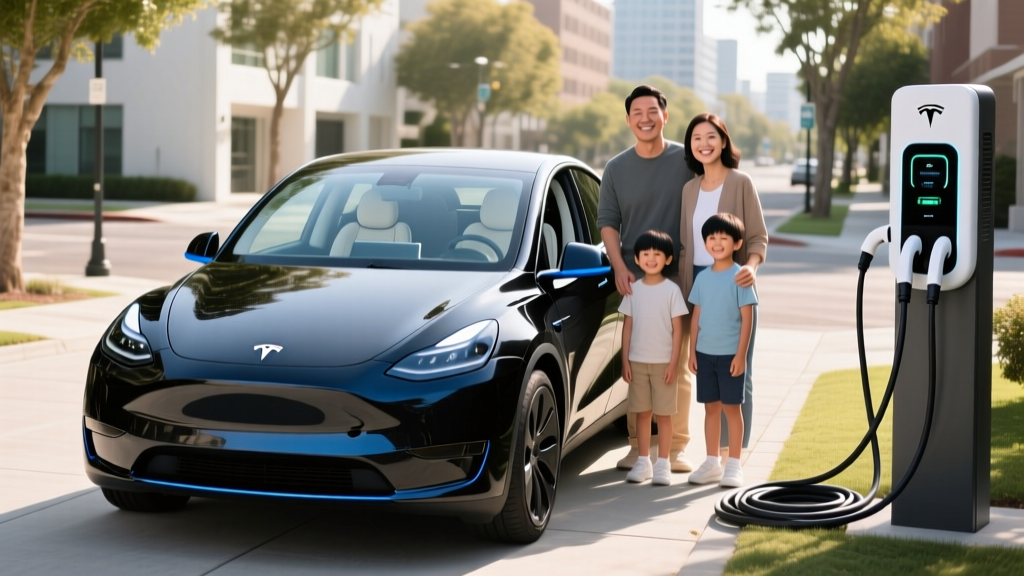
If you're researching whether the Tesla Model Y is safe for your family, the short answer is yes — it remains one of the highest-scoring mainstream SUVs in both government and independent crash testing. But safety is more than a five-star badge. It's structural engineering, active collision-avoidance tech, driver-assist limitations, battery integrity, and real-world usability under stress. This review covers the 2026 Tesla Model Y through the lens of safety, while also giving you the full ownership picture: real-world range, charging speed, pricing after federal tax credits, and how it stacks up against the Hyundai Ioniq 5, Ford Mustang Mach-E, and Kia EV6.
EPA estimated: 320 miles (Long Range AWD, 19" wheels).
Real-world expectation: ~270–290 miles on highway trips at 70 mph; ~230–250 miles in sub-30°F winter conditions with cabin heat. The Model Y's heat pump helps, but cold still saps 15–25% of usable range.
Crash Test Ratings: NHTSA and IIHS Scores
The NHTSA has historically awarded the Model Y a 5-Star Overall Safety Rating across frontal crash, side crash, and rollover categories. The vehicle's skateboard architecture — with the battery pack mounted low in the floor — gives it an exceptionally low center of gravity, which translates to a rollover risk of roughly 7–8%, among the lowest for any SUV.
The IIHS has tested the Model Y in its updated moderate overlap front and side crash protocols (which are significantly tougher than legacy tests). Key scores to watch:
| IIHS Test | Model Y Rating |
|---|---|
| Driver-side small overlap front | Good |
| Passenger-side small overlap front | Good |
| Updated moderate overlap front | Acceptable–Good (trim dependent) |
| Updated side crash | Good |
| Roof strength | Good |
| Head restraints & seats | Good |
| Headlight evaluation | Acceptable (LED reflector) |
The headlight rating is a recurring weak point — the Model Y's reflector-style LEDs don't throw as far down dark roads as the projector units on the Ioniq 5 or EV6, which matters for nighttime safety on unlit rural highways.
Active Safety and Autopilot: What It Actually Does
Every 2026 Model Y comes standard with Tesla's basic Autopilot suite: automatic emergency braking (AEB), forward collision warning, lane-departure warning, lane-keeping assist, and blind-spot monitoring. In NHTSA's crash-imminent braking tests, Tesla's AEB has consistently performed at or near the top of its class.
Tesla Autopilot and Full Self-Driving (Supervised) are SAE Level 2 driver-assist systems. You must keep your hands on the wheel and eyes on the road at all times. The car does not drive itself. Only Level 4 services like Waymo operate without a human driver in defined zones.
Full Self-Driving (Supervised), a $8,000 option or $99/month subscription as of 2026, adds features like automatic lane changes, navigate-on-autopilot for highway interchanges, and traffic-light/stop-sign recognition. It is impressive on well-marked interstates but can struggle with construction zones, faded lane markings, and unprotected left turns. Treat it as an advanced cruise-control system, not a replacement for your attention.
- It does not detect all stationary objects at highway speed (documented NHTSA investigations into crashes with parked emergency vehicles).
- It does not handle severe weather (heavy rain, snow, fog) reliably — sensors and cameras degrade.
- It does not replace the driver. You are legally and physically responsible for the vehicle at all times.
- Phantom braking — unexpected deceleration on clear highways — has been reported and remains an area of active NHTSA scrutiny.
2026 Model Y Specs: Range, Battery, Charging, and Performance
| Specification | Long Range AWD | Performance AWD |
|---|---|---|
| EPA Range | 320 mi | 295 mi |
| Battery (usable) | ~75 kWh, NMC | ~75 kWh, NMC |
| Drivetrain | Dual-motor AWD | Dual-motor AWD |
| Horsepower | ~384 hp | ~456 hp |
| 0–60 mph | 4.8 sec | 3.5 sec |
| Peak DC Fast Charge | 250 kW | 250 kW |
| 10–80% DCFC Time | ~27 min | ~27 min |
| Level 2 Home Charge | 11.5 kW (~44 mi/hr) | 11.5 kW (~44 mi/hr) |
| MPGe (combined) | 122 MPGe | 111 MPGe |
| kWh/100 mi | 28 kWh | 30 kWh |
| Base MSRP | $48,990 | $53,990 |
Charging Speed in Practice
The Model Y's 250 kW peak DC fast-charge rate is strong, but like all EVs, it doesn't sustain that peak for the entire session. The charge curve ramps quickly from 10% to roughly 40% SoC near peak power, then tapers progressively. Expect a 10–80% session at a V3 Supercharger (250 kW) to take approximately 25–28 minutes. At older V2 Superchargers (150 kW), plan for 38–42 minutes.
For home charging on a 48-amp Level 2 circuit (the recommended setup), the onboard 11.5 kW charger adds about 44 miles of range per hour — a full overnight session easily replenishes a day's driving. Installation typically costs $800–$2,000 depending on your panel capacity and run length; a 200-amp panel is usually sufficient, but older homes may need a $2,000–$4,000 upgrade.
Pricing, Tax Credits, and Total Cost
| Trim | MSRP | Est. §30D Credit | Effective Price |
|---|---|---|---|
| Long Range AWD | $48,990 | Up to $7,500* | ~$41,490 |
| Performance AWD | $53,990 | Up to $7,500* | ~$46,490 |
*Federal §30D tax credit eligibility depends on: buyer AGI limits ($150K single / $300K joint), vehicle MSRP cap ($80,000 for SUVs — both trims qualify), and battery critical-mineral and component sourcing requirements that shift annually. As of 2026, Tesla's US-assembled battery supply chain generally qualifies, but always verify current-year rules at IRS.gov before purchasing. The credit can now be transferred to the dealer at point of sale as an immediate discount.
5-Year Ownership Snapshot
At 15,000 miles/year and a national average electricity cost of $0.16/kWh, the Long Range AWD costs roughly $670/year in energy. A comparable gas SUV at 25 MPG and $3.40/gallon runs about $2,040/year in fuel — a savings of ~$1,370/year or ~$6,850 over five years. Insurance, however, is typically 15–25% higher on the Model Y than on a gas-powered RAV4 due to repair costs and parts pricing.
Interior, Cargo, and Family Practicality
The Model Y's minimalist cabin centers on a 15.4-inch touchscreen that handles nearly every vehicle function — including glovebox release, mirror adjustment, and vent direction. There is no traditional instrument cluster; speed and navigation appear on the left third of the screen. This is clean for some, frustrating for others.
- Cargo (rear seats up): 30.2 cu ft
- Cargo (rear seats folded): 72.1 cu ft
- Front trunk (frunk): 4.1 cu ft
- Rear legroom: 41.6 inches
- Optional third row: Adds two small seats (best for children under ~5'4")
The available third row is genuinely tight — fine for a 7-year-old on a school run, not viable for road trips. If you regularly carry more than five passengers, a Kia EV9 or three-row hybrid like the Toyota Grand Highlander is a better fit.
Battery Longevity and Warranty
Tesla covers the Model Y's battery and drive units for 8 years / 120,000 miles (Long Range) with a minimum 70% capacity retention threshold. Real-world data from Tesla's fleet shows average degradation of approximately 8–12% over the first 100,000 miles for NMC packs — meaning most owners will retain 88–92% of original range at the warranty midpoint.
The NMC chemistry in the Long Range and Performance trims offers higher energy density than LFP (lithium iron phosphate), which is why these variants achieve 320 and 295 miles respectively. The trade-off: Tesla recommends daily charging to 80% for NMC batteries (only charge to 100% for road trips), whereas LFP packs can be charged to 100% daily without accelerated degradation. If you want an LFP Model Y for simpler daily charging habits, check whether the base RWD trim (when available) uses LFP cells — this has varied by model year and production batch.
Tesla Model Y vs. Key Competitors
| Attribute | Tesla Model Y LR | Hyundai Ioniq 5 LR AWD | Ford Mach-E ER AWD | Kia EV6 LR AWD |
|---|---|---|---|---|
| EPA Range | 320 mi | 290 mi | 290 mi | 282 mi |
| Peak DCFC | 250 kW | 238 kW (800V arch) | 150 kW | 238 kW (800V arch) |
| 10–80% Time | ~27 min | ~18 min | ~45 min | ~18 min |
| Base MSRP | $48,990 | $49,500 | $48,995 | $48,900 |
| NHTSA Overall | 5 Stars | 5 Stars | 5 Stars | 5 Stars |
| IIHS Top Safety Pick+ | Yes (prior years) | Yes | Yes | Yes |
| Charging Network | Supercharger (native) | NACS adapter / CCS | NACS adapter / CCS | NACS adapter / CCS |
The Model Y's range and Supercharger network access remain its strongest advantages. However, the Ioniq 5 and EV6 charge significantly faster (18 minutes 10–80% vs. 27) thanks to their 800-volt architectures — a meaningful gap on road trips. The Mach-E's slower 150 kW peak charging is its most significant weakness.
- Class-leading EPA range (320 mi)
- Access to 17,000+ Supercharger stalls natively (NACS)
- Top NHTSA 5-Star and IIHS crash scores
- Strong AEB and active safety standard on all trims
- Spacious cargo area, optional third row
- Over-the-air updates continuously improve features
- Headlights rated only Acceptable by IIHS
- No physical buttons — all controls via touchscreen
- Phantom braking incidents reported
- Insurance premiums above segment average
- NMC battery: daily charge limited to 80% for longevity
- Ride quality firm; road noise noticeable at highway speed
Who Should Buy the 2026 Model Y?
- You road-trip frequently and want the most reliable, dense DC fast-charging network (Superchargers).
- You prioritize top crash-test scores and standard active safety.
- You need 300+ miles of range without paying luxury-badge prices.
- You can install Level 2 charging at home.
- Fastest possible DC charging matters more than range (Ioniq 5 / EV6).
- You want physical buttons and a traditional instrument cluster.
- You need a genuine three-row family hauler (Kia EV9, Grand Highlander Hybrid).
- You want LFP chemistry for 100% daily charging simplicity (check base RWD availability).
Frequently Asked Questions
Is the Tesla Model Y the safest electric SUV?
It is among the safest. The Model Y has earned NHTSA's 5-Star Overall rating and IIHS Top Safety Pick+ in prior model years. Competitors like the Hyundai Ioniq 5, Kia EV6, and Volvo XC40 Recharge match or come close in crash scores. The Model Y's low rollover risk (~7%) is a structural advantage of its battery-floor design.
What is the real-world range of the 2026 Model Y?
The EPA rates the Long Range AWD at 320 miles. In real-world highway driving at 70 mph with mild temperatures, expect 270–290 miles. In winter conditions below 30°F, range drops to roughly 230–250 miles. City driving with regenerative braking recovers more energy and can approach or exceed the EPA figure.
How fast does the Model Y charge at home and on the road?
At home on a 48-amp Level 2 charger (11.5 kW), the Model Y adds about 44 miles of range per hour — a 10-hour overnight session fully replenishes the battery. On a 250 kW V3 Supercharger, 10–80% takes approximately 25–28 minutes. At 150 kW V2 stations, plan for 38–42 minutes.
Does the 2026 Tesla Model Y qualify for the federal EV tax credit?
As of 2026, the Model Y generally qualifies for up to $7,500 under IRS §30D, subject to buyer income limits ($150K single / $300K joint AGI), the $80,000 SUV MSRP cap (both trims pass), and battery critical-mineral and component sourcing requirements. The credit can be applied at point of sale as an immediate price reduction. Always confirm eligibility at IRS.gov or with a tax professional before purchase.
Is Autopilot safe for daily commuting?
Autopilot (Level 2) is effective for highway commuting when you remain engaged. It handles lane centering and adaptive cruise competently on well-marked roads. It is not self-driving, and NHTSA has investigated incidents involving stationary emergency vehicles and phantom braking. Keep your hands on the wheel and eyes on the road — always.
How does the Model Y compare to the Hyundai Ioniq 5 for families?
The Model Y wins on range (320 vs. 290 miles) and charging network access (native Supercharger). The Ioniq 5 wins on DC charging speed (18 vs. 27 minutes, 10–80%) and offers more rear-seat headroom and physical climate controls. Both are NHTSA 5-Star vehicles. If your family takes frequent road trips, the Model Y's Supercharger advantage is significant; if you prioritize fastest stops and more conventional controls, the Ioniq 5 is compelling.
What is the battery warranty on the 2026 Model Y?
Tesla covers the battery and drive units for 8 years or 120,000 miles (whichever comes first) on the Long Range and Performance trims, with a guaranteed minimum 70% capacity retention. Real-world fleet data suggests most NMC packs retain 88–92% capacity at 100,000 miles when charged responsibly (daily limit of 80%).