The Tesla Model Y remains one of the best-selling electric vehicles in the United States, but buyers in 2026 are asking a more specific question: how does its crash protection stack up against a growing field of rivals? This review examines the Tesla Model Y safety rating alongside the data that actually determines daily ownership satisfaction — real-world range, charging speed, battery chemistry, and total cost after federal incentives.
2026 Tesla Model Y Safety Rating: What the Crash Tests Show
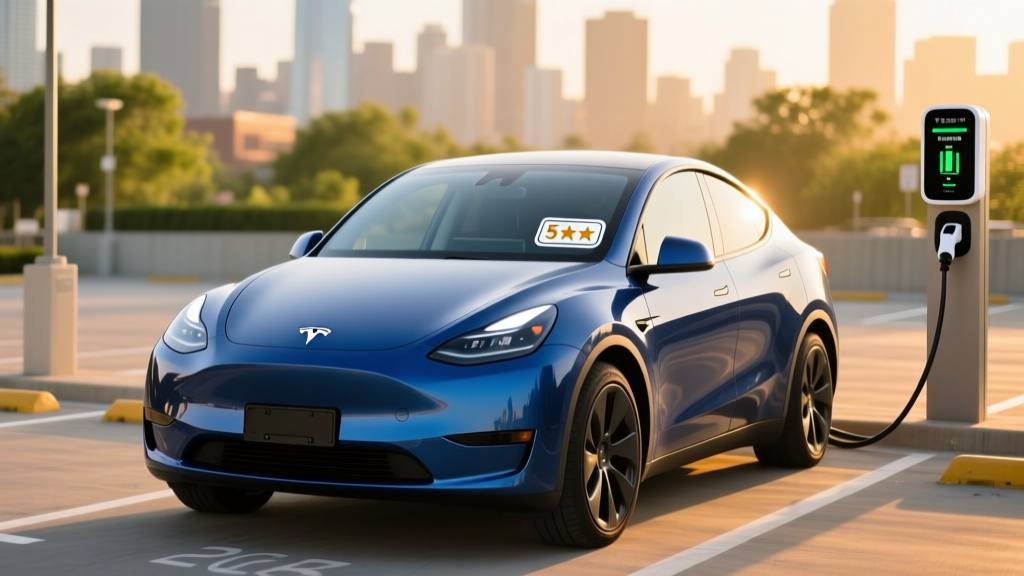
The National Highway Traffic Safety Administration (NHTSA) awarded the Tesla Model Y a 5-Star Overall Safety Rating, the highest score in its program. The vehicle earned 5 stars in frontal crash, side crash, and rollover resistance. The low center of gravity from the under-floor battery pack contributes to a rollover risk of approximately 7.8%, well below the average for compact SUVs.
The Insurance Institute for Highway Safety (IIHS) has evaluated the Model Y across its full battery of tests. In the updated moderate overlap front test — which now includes a rear-seat dummy — the Model Y earned an "Acceptable" rating, one tier below "Good." It scored "Good" in the original moderate overlap front, side, roof strength, and head restraint tests. Standard automatic emergency braking performed well in vehicle-to-vehicle and vehicle-to-pedestrian evaluations.
Range, Battery, and Real-World Efficiency
The 2026 Tesla Model Y Long Range AWD carries an EPA-estimated range of 320 miles on a full charge. The Rear-Wheel Drive (Standard Range) variant is rated at 290 miles EPA. These figures are competitive but not class-leading — the Hyundai Ioniq 5 Long Range AWD posts 290 miles with faster charging, while the Chevrolet Equinox EV pushes past 315 miles at a lower price point.
| Spec | Long Range AWD | Standard Range RWD |
|---|---|---|
| EPA Range | 320 mi | 290 mi |
| Battery (usable) | ~75 kWh (NMC) | ~57.5 kWh (LFP) |
| Efficiency | 122 MPGe / 28 kWh/100mi | 128 MPGe / 26 kWh/100mi |
| 0–60 mph | 4.8 sec | 6.5 sec |
| Horsepower | 384 hp | 295 hp |
| Drivetrain | Dual-Motor AWD | Single-Motor RWD |
| Cargo Volume | 30.2 cu ft (rear up) / 72.1 cu ft (rear folded) | 30.2 / 72.1 cu ft |
Battery Chemistry: LFP vs. NMC in the Model Y
The Standard Range RWD uses a lithium iron phosphate (LFP) battery. LFP cells tolerate frequent charging to 100% without accelerated degradation, making them ideal for daily commuters who can charge at home nightly. The trade-off is lower energy density — you get fewer miles per pound of battery — and slower performance in extreme cold.
The Long Range AWD uses nickel manganese cobalt (NMC) chemistry for higher energy density and better cold-weather output. Tesla recommends charging NMC packs to 80% for daily use and reserving 100% for road trips to preserve long-term health.
Charging Speed: DC Fast Charge and Home Level 2
Charging speed is where the refreshed Model Y remains competitive but no longer leads the segment. The Long Range AWD peaks at approximately 250 kW on a DC fast charger, achieving a 10–80% charge in about 25 minutes. The Standard Range RWD peaks around 170 kW, with 10–80% taking roughly 30 minutes.
For context, the Hyundai Ioniq 5 and Kia EV6 (both on 800V architecture) can peak above 235 kW and complete 10–80% in approximately 18 minutes. The Model Y's 400V architecture limits its peak charge rate relative to battery size.
| Method | Long Range AWD | Standard Range RWD |
|---|---|---|
| DC Fast Charge (peak) | 250 kW | 170 kW |
| 10–80% DCFC Time | ~25 min | ~30 min |
| Level 2 Home (11.5 kW) | ~37 mi/hr | ~37 mi/hr |
| Level 1 (120V, 1.4 kW) | ~4 mi/hr | ~4 mi/hr |
| Connector | NACS (native Supercharger) | NACS (native Supercharger) |
At home on a 48-amp Level 2 circuit (11.5 kW), the Model Y adds roughly 37 miles of range per hour — enough to fully replenish overnight. Tesla's Wall Connector costs approximately $475 for the unit, with professional installation typically running $600–$1,500 depending on panel proximity and local permitting.
Charge-curve reality: The 250 kW peak on the Long Range model is sustained only between roughly 10% and 35% state of charge. Above 50%, the rate tapers significantly — charging from 80% to 100% on DCFC can add another 20+ minutes. For road trips, plan stops around the 10–80% window to minimize time at the charger.
Pricing, Trim Levels, and Federal Tax Credit Eligibility
The 2026 Tesla Model Y lineup starts at $44,990 for the Standard Range RWD (including destination). The Long Range AWD lists at $48,990, and the Performance variant is priced at $52,490. All trims fall under the IRS §30D MSRP cap of $80,000 for SUVs.
| Trim | Base MSRP | Est. After $7,500 Credit |
|---|---|---|
| Standard Range RWD | $44,990 | ~$37,490 |
| Long Range AWD | $48,990 | ~$41,490 |
| Performance AWD | $52,490 | ~$44,990 |
- MSRP cap: Vehicle must be ≤ $80,000 (SUVs/vans/pickups) — all Model Y trims qualify ✓
- Buyer income cap: AGI ≤ $150,000 (single), $225,000 (head of household), $300,000 (joint)
- Battery sourcing: Critical minerals and battery components must meet phased-in percentages — verify current-year compliance on IRS.gov eligible vehicle list before purchasing
- Point-of-sale transfer: The $7,500 credit can be transferred to the dealer at purchase, reducing your out-of-pocket cost immediately
- Assembly: Must be assembled in North America — Model Y (Fremont, CA & Austin, TX) qualifies ✓
Credit rules and eligible-vehicle lists change. Confirm with a tax professional and the IRS before relying on credit eligibility.
Interior, Cargo, and Technology
The Model Y's cabin is minimalist by design — a single 15.4-inch touchscreen handles infotainment, climate, navigation, and vehicle settings. There is no traditional instrument cluster; speed and range are displayed on the left edge of the central screen. Build quality on 2026 models has improved noticeably over earlier Fremont-built units, with tighter panel gaps and upgraded materials.
Passenger space is generous for the compact SUV class. Rear-seat legroom measures approximately 41.6 inches, and headroom accommodates adults comfortably on longer trips. Cargo volume behind the second row is 30.2 cubic feet, expanding to 72.1 cubic feet with the 60/40 split rear seats folded — enough for a week's camping gear or a full Costco run. The front trunk (frunk) adds roughly 4.1 cubic feet for charging cables or a small bag.
Standard technology includes Tesla's Autopilot (traffic-aware cruise control and lane centering), over-the-air software updates, Sentry Mode dashcam recording, and access to the Supercharger network — now the largest and most reliable DC fast-charging network in the U.S. Full Self-Driving (Supervised) remains an $8,000 add-on or $99/month subscription and requires active driver supervision at all times.
Warranty and Long-Term Battery Outlook
Tesla covers the Model Y with a 4-year / 50,000-mile basic vehicle limited warranty. The battery and drive unit warranty extends to 8 years / 120,000 miles for the Long Range and Performance trims, and 8 years / 100,000 miles for the Standard Range RWD. The warranty guarantees a minimum of 70% battery capacity retention over the coverage period.
Real-world degradation data from fleet aggregators like Recurrent and Teslanomics shows NMC Model Y packs typically retain 88–92% capacity at 100,000 miles when charged primarily to 80%. LFP packs in the Standard Range model show slower initial degradation but are more sensitive to cold-weather range loss. Full battery replacement out of warranty currently costs approximately $12,000–$16,000 depending on pack size and labor — a figure worth factoring into 10-year ownership projections.
How Does the Model Y Compare to Key Competitors?
- Choose the Model Y if: You prioritize Supercharger network access, over-the-air updates, and a proven software ecosystem. The 5-star NHTSA safety rating and strong resale value are compelling for families.
- Choose the Hyundai Ioniq 5 if: Faster DC charging (10–80% in ~18 min) matters for road trips, and you prefer a more conventional interior layout with physical buttons.
- Choose the Chevrolet Equinox EV if: Budget is a priority — it undercuts the Model Y by several thousand dollars while offering competitive range (~315+ mi).
- Choose the Ford Mustang Mach-E if: Driving dynamics and a sportier feel are important; the Mach-E Extended Range AWD offers strong acceleration with BlueCruise hands-free driving on approved highways.
Pros, Cons, and Final Verdict
- 5-Star NHTSA overall safety rating
- Access to Tesla Supercharger network (17,000+ stalls in U.S.)
- Strong efficiency: 122–128 MPGe across trims
- Over-the-air updates continuously add features
- Class-leading cargo capacity (72.1 cu ft)
- Competitive pricing after $7,500 federal tax credit
- DC charging speed trails 800V rivals (25 vs. 18 min 10–80%)
- Minimalist interior lacks physical climate/volume controls
- FSD (Supervised) is expensive and still requires driver attention
- Rear-seat ride quality is firm over rough pavement
- Insurance premiums run 15–25% higher than segment average
- LFP Standard Range model loses more range in cold weather
The 2026 Tesla Model Y earns its sales volume through a combination of strong safety credentials, practical range, and unmatched charging infrastructure access. Its NHTSA 5-star rating and IIHS performance make it a defensible family hauler. The gap between the Model Y and its competitors has narrowed — particularly on charging speed and interior refinement — but the Supercharger advantage and software ecosystem remain significant ownership differentiators.
Frequently Asked Questions
What is the real-world range of the 2026 Tesla Model Y?
The Long Range AWD is EPA-rated at 320 miles. In real-world highway driving at 70–75 mph, expect 275–295 miles. In cold weather below 30°F, range drops to roughly 220–250 miles. The Standard Range RWD (290 mi EPA) typically delivers 245–265 miles in mixed conditions.
How fast does the Model Y charge at home and on road trips?
On a 48-amp Level 2 home charger (11.5 kW), the Model Y adds about 37 miles per hour, fully recharging overnight. On DC fast chargers, the Long Range peaks at 250 kW (10–80% in ~25 min), while the Standard Range peaks at 170 kW (10–80% in ~30 min). Both benefit from native NACS compatibility with Tesla Superchargers.
Does the 2026 Model Y qualify for the $7,500 federal EV tax credit?
All Model Y trims fall under the $80,000 MSRP cap and are assembled in the U.S. Eligibility depends on your income (≤$150K single / $300K joint), the vehicle's battery sourcing compliance for the current year, and your tax liability. The credit can be transferred at point of sale. Verify on the IRS eligible vehicles page before purchasing.
Is the Model Y worth buying over the Ioniq 5 or Equinox EV?
The Model Y wins on Supercharger access, cargo space, software, and NHTSA safety ratings. The Ioniq 5 charges faster on road trips, and the Equinox EV costs less upfront. Your priority — charging speed, budget, or ecosystem — should drive the decision.
What are the biggest drawbacks of the Model Y?
Charging speed trails 800V competitors, the all-touchscreen interface frustrates some drivers, FSD remains a Level 2 assist (not self-driving) despite its cost, and insurance premiums are above average. Cold-weather range loss is more pronounced on the LFP Standard Range model.
How long will the Model Y battery last?
Tesla warranties the battery for 8 years / 100,000–120,000 miles (depending on trim) with a minimum 70% capacity retention guarantee. Fleet data suggests most NMC packs retain 88–92% at 100,000 miles with proper charging habits (daily charge to 80%). Out-of-warranty replacement costs $12,000–$16,000.