The Quick Verdict: Does a 5-Star NCAP Rating Make the Model Y Worth It?
The Tesla Model Y consistently earns top marks in government crash testing, but safety is only one pillar of EV ownership. Buyers searching for Tesla safety NCAP data usually want reassurance that the vehicle protecting their family also delivers on range, charging, and cost. This review puts the 2025-2026 Model Y under a data-driven microscope — pairing its NHTSA 5-Star Overall Safety Rating with exact EPA range figures, charging curves, battery chemistry, and the real-world ownership economics that crash-test dummies can't measure.
The Model Y Long Range AWD remains Tesla's volume seller for good reason: it delivers 320 miles of EPA range, charges at up to 250 kW on DC fast chargers, and qualifies for the full $7,500 federal tax credit when sourced through a qualifying dealer. But it's not without trade-offs — firm ride quality, a minimalist interior that polarizes, and a starting price that has crept upward. Let's look at the numbers.
Range, Efficiency, and the Real-World Reality Check
The 2025 Model Y Long Range AWD carries an EPA-estimated 320 miles of range from its 75 kWh usable battery pack (NMC chemistry). The base Long Range RWD variant pushes that to 337 miles EPA thanks to the efficiency gains of a single-motor layout. The Performance trim drops to 285 miles EPA with its stickier tires and more aggressive tuning.
EPA Sticker: 320 mi (Long Range AWD) / 337 mi (RWD)
Mixed Highway/City Driving (65-70 mph): Expect 275-295 mi in moderate temperatures. The Model Y's heat pump helps, but sustained highway speeds above 70 mph consume noticeably more energy than city regen-heavy driving.
Cold Weather (below 30°F): Plan for 220-260 mi depending on cabin heating use and whether you precondition. LFP-equipped Standard Range variants lose proportionally more range in cold due to chemistry limitations at low temperatures.
Efficiency: 122 MPGe combined / 28 kWh per 100 miles (Long Range AWD, per fueleconomy.gov)
Tesla's NMC (nickel manganese cobalt) battery chemistry in the Long Range and Performance trims offers higher energy density than the LFP (lithium iron phosphate) cells used in the Standard Range model. That means more range in a similar physical pack size — but NMC cells benefit from charging habits that avoid sustained 100% states of charge, whereas LFP owners are encouraged to charge to 100% regularly for accurate state-of-charge calibration.
| Spec | Long Range AWD | Long Range RWD | Performance |
|---|---|---|---|
| EPA Range | 320 mi | 337 mi | 285 mi |
| Battery (usable) | 75 kWh (NMC) | 75 kWh (NMC) | 75 kWh (NMC) |
| Drivetrain | Dual-Motor AWD | Rear-Wheel Drive | Dual-Motor AWD |
| Horsepower | 384 hp | 295 hp | 456 hp |
| 0-60 mph | 4.8 sec | 5.8 sec | 3.5 sec |
| MPGe (combined) | 122 | 125 | 111 |
| kWh/100 mi | 28 | 27 | 30 |
| Cargo (rear seats up) | 30.2 cu ft | 30.2 cu ft | 30.2 cu ft |
| Cargo (seats folded) | 72.1 cu ft | 72.1 cu ft | 72.1 cu ft |
| Base MSRP | $48,990 | $44,990 | $53,990 |
Charging Speed: DC Fast Charging and Home Level 2
The Model Y supports a peak DC fast-charge rate of 250 kW on V3 Superchargers and compatible CCS/NACS stations. In practice, the charging curve peaks near 250 kW between roughly 10-30% state of charge, then tapers progressively. Tesla claims a 10-80% charge time of approximately 25 minutes under optimal conditions (battery preconditioned, warm ambient temperature, V3 stall availability).
| Charging Level | Power | Speed (mi/hr added) | Notes |
|---|---|---|---|
| Level 1 (120V) | ~1.4 kW | ~3-4 mi/hr | Emergency/trickle only |
| Level 2 (240V, 48A) | 11.5 kW | ~37-44 mi/hr | Full overnight charge in ~8 hrs |
| Level 2 (240V, 32A Mobile) | 7.7 kW | ~25-30 mi/hr | Tesla Mobile Connector included |
| DC Fast (V3 Supercharger) | 250 kW peak | ~1,000+ mi/hr (peak) | 10-80% in ~25 min |
| DC Fast (V4 Supercharger) | 250 kW peak | Similar to V3 | Newer stalls; same vehicle limit |
At home, the Model Y's onboard charger accepts up to 11.5 kW (48 amps) on a 240V Level 2 circuit, which requires a 60-amp dedicated breaker. A full charge from 10% to 100% takes roughly 7-8 hours at this rate. Most owners who install a Tesla Wall Connector or equivalent Level 2 unit report waking to a full battery every morning, making daily range effectively unlimited for commutes under 200 miles round-trip.
Charging curve reality check: The advertised 250 kW peak rate is not sustained across the full session. Above 50% SoC, expect rates to drop to 100-120 kW; above 80%, the rate falls below 50 kW as the battery management system protects cell longevity. This is why Tesla (and most EV makers) quote 10-80% times rather than 0-100%.
Safety Deep Dive: NCAP, NHTSA, and IIHS Ratings
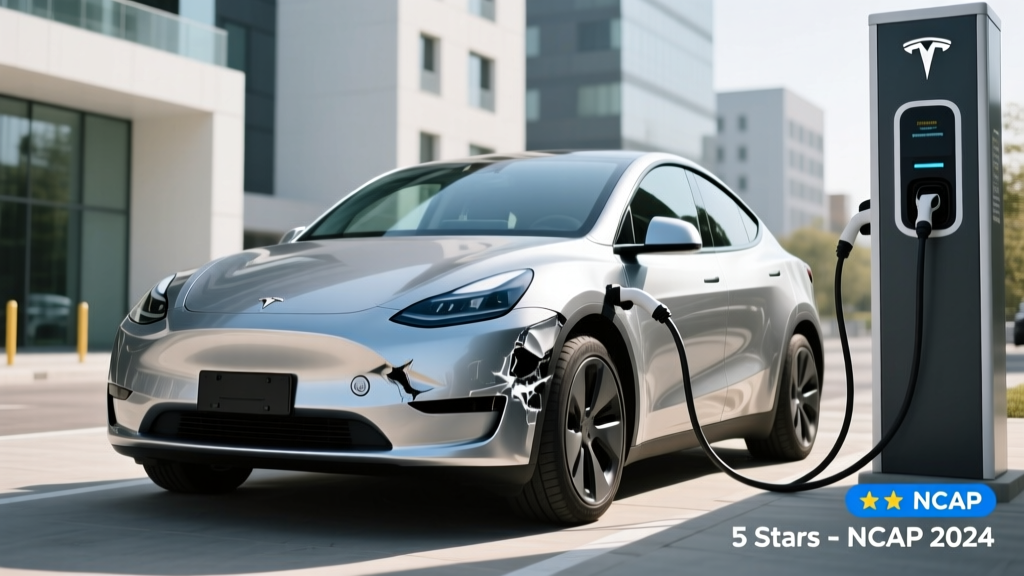
The keyword that brought you here — Tesla safety NCAP — refers to the New Car Assessment Program crash-test ratings administered by NHTSA in the United States (Euro NCAP and other regional programs test separately). The 2025 Tesla Model Y has earned:
- NHTSA Overall Rating: 5 out of 5 stars
- Frontal Crash: 5 stars (driver and passenger)
- Side Crash: 5 stars
- Rollover Risk: 5 stars (approximately 7.9% risk — among the lowest in its class due to the low center of gravity from the floor-mounted battery pack)
The Model Y's structural advantage in crash testing comes from its skateboard architecture: the heavy battery pack sits low in the chassis, reducing rollover propensity and creating large front and rear crumple zones without an engine block intruding into the passenger cell. Tesla's restraint systems include 8 airbags (front, side, curtain, and knee) and a rigid safety cage that has performed well across model years.
Crash-test ratings measure passive safety — how well the vehicle protects occupants during an impact. Tesla's Autopilot and optional FSD (Supervised) are active safety features designed to prevent collisions. However, these are SAE Level 2 driver-assistance systems, meaning the driver must remain fully engaged, hands on or near the wheel, and eyes on the road at all times. They are not self-driving systems. Only Level 4 services like Waymo operate without a human driver in the loop.
The IIHS (Insurance Institute for Highway Safety) has historically tested the Model Y with mixed results — strong crashworthiness scores but varying marks for headlight effectiveness and front crash prevention under updated, more stringent test protocols. For 2025-2026, check the IIHS site for the latest TOP SAFETY PICK status, as criteria tighten annually.
Interior, Tech, and Daily Livability
The Model Y's cabin is defined by its radical minimalism. A single 15.4-inch touchscreen handles virtually every function — climate, navigation, media, vehicle settings — with no physical instrument cluster or dedicated HVAC buttons. This approach divides opinion: tech-forward buyers love the clean aesthetic; traditionalists find it distracting to adjust fan speed through a screen while driving.
Passenger space is generous for a compact crossover:
- Front headroom: 41.0 in / legroom: 41.8 in
- Rear headroom: 39.4 in / legroom: 37.0 in
- Cargo behind rear seats: 30.2 cu ft (plus a small front trunk/frunk)
- Cargo with seats folded: 72.1 cu ft — competitive with midsize SUVs
The optional third row (available on select trims) adds two small seats suitable only for children under about 5'4", and it eliminates the under-floor rear cargo storage. Most families find the two-row layout more practical.
Standout tech features:
- Over-the-air software updates that add features post-purchase
- Sentry Mode (360° camera-based security recording)
- Dog Mode and Camp Mode for climate control while parked
- Tesla Supercharger network access (17,000+ stalls in North America)
- Tesla app with remote preconditioning, location tracking, and charging management
Notable drawbacks:
- No Apple CarPlay or Android Auto — Tesla's native infotainment only
- Firm suspension tuning transmits road imperfections more than competitors like the Hyundai Ioniq 5 or Ford Mustang Mach-E
- Panel gap quality and interior material quality lag behind legacy luxury brands at this price point
- No physical buttons for common functions (turn signal stalk removed in latest refresh — signals are on the steering wheel)
Pricing, Tax Credits, and Ownership Economics
The 2025-2026 Model Y lineup starts at $44,990 for the Long Range RWD and climbs to $53,990 for the Performance trim. Destination fees add approximately $1,390. Options like Full Self-Driving (Supervised) capability add $8,000 (or $99/month subscription), and premium paint colors range from $1,000 to $2,500.
| Trim | Base MSRP | §30D Credit | Effective Price |
|---|---|---|---|
| Long Range RWD | $44,990 | $7,500* | ~$37,490 |
| Long Range AWD | $48,990 | $7,500* | ~$41,490 |
| Performance | $53,990 | $7,500* | ~$46,490 |
*Federal tax credit eligibility under IRS §30D requires meeting ALL of the following:
- MSRP cap: Vehicle MSRP must not exceed $80,000 for SUVs (Model Y qualifies)
- Buyer income cap: Adjusted gross income ≤ $150,000 (single) / $300,000 (married filing jointly)
- Battery sourcing: Critical minerals and battery components must meet phased percentage thresholds from US or FTA-partner countries — Tesla's US-assembled battery supply chain currently meets these requirements for qualifying vehicles
- Point-of-sale transfer: As of 2024+, buyers can transfer the credit to the dealer at purchase, receiving the $7,500 as an immediate price reduction rather than waiting for tax filing
- VIN registration: The dealer must report the sale and VIN to the IRS within 3 days
Always verify current-year eligibility with your tax professional and check the latest rules at IRS.gov, as battery-sourcing requirements tighten annually and can affect which specific vehicles qualify at any given time.
Warranty and Long-Term Battery Outlook
Tesla covers the Model Y with the following warranty structure:
- Basic Vehicle: 4 years / 50,000 miles
- Battery & Drive Unit: 8 years / 120,000 miles (Long Range & Performance, AWD)
- Battery & Drive Unit: 8 years / 100,000 miles (RWD variants)
- Battery capacity retention threshold: Tesla warrants that the battery will retain at least 70% of its original capacity during the warranty period
Real-world degradation data from Tesla's fleet suggests NMC packs in the Model Y typically lose approximately 8-12% capacity over the first 100,000 miles, with the curve flattening significantly after the initial break-in period. Most owners report the battery outlasting the vehicle's useful economic life. Replacement cost, if ever needed out of warranty, is estimated at $12,000-$16,000 depending on pack configuration and labor.
Pros, Cons, and Who Should Buy the Model Y
- 5-star NHTSA safety rating across all crash categories
- 320-337 mi EPA range — among the highest in its class
- Access to the Tesla Supercharger network (most reliable DC network in the US)
- Over-the-air updates continuously improve the vehicle
- Class-leading cargo volume (72.1 cu ft) for a compact EV crossover
- Qualifies for the full $7,500 federal tax credit
- Minimalist interior lacks physical controls — divisive ergonomics
- Firm ride quality compared to Hyundai Ioniq 5 or Kia EV6
- No Apple CarPlay / Android Auto support
- Turn signals moved to steering wheel buttons (no stalk) — adjustment period required
- Insurance premiums tend to run 15-25% higher than comparable non-Tesla EVs
- FSD (Supervised) remains Level 2 despite the "Full Self-Driving" name
- Safety ratings and crash-test performance are a top priority for your family
- You want access to the most mature DC fast-charging network in North America
- You value OTA software updates and tech-forward features
- Your daily commute is under 150 miles and you can charge at home
- You prefer physical buttons, a traditional instrument cluster, or Apple CarPlay
- Ride comfort and cabin quiet are higher priorities than acceleration
- You want a more distinctive exterior design
Frequently Asked Questions
What is the real-world range of the Tesla Model Y?
The EPA rates the 2025 Model Y Long Range AWD at 320 miles, but expect 275-295 miles in real-world mixed highway/city driving at moderate temperatures. In cold weather (below 30°F), plan for 220-260 miles depending on cabin heating and preconditioning habits.
How fast does the Model Y charge at home and on DC fast chargers?
On a Level 2 home charger (240V, 48A), the Model Y adds approximately 37-44 miles of range per hour, fully charging overnight in about 7-8 hours. On a V3 Supercharger at 250 kW peak, a 10-80% charge takes roughly 25 minutes with a preconditioned battery.
How much does the Model Y cost after the federal tax credit?
The Long Range RWD starts at $44,990 and drops to approximately $37,490 after the $7,500 §30D credit, assuming you meet income caps (≤$150K single / ≤$300K joint) and the vehicle meets battery-sourcing requirements. Verify current eligibility at IRS.gov or with your tax professional.
Is the Tesla Model Y worth buying vs. the Hyundai Ioniq 5 or Ford Mach-E?
The Model Y wins on Supercharger network access, cargo space, and software integration. The Ioniq 5 offers faster 10-80% charging (under 18 minutes at 350 kW), a more comfortable ride, and CarPlay support. The Mach-E provides a more traditional SUV driving feel. Test-drive all three — the right choice depends on your priorities.
What are the biggest pros and cons of the Model Y?
Top pros: 5-star safety, 320+ mile range, Supercharger access, OTA updates, and strong cargo capacity. Top cons: minimalist controls, firm ride, no CarPlay, and higher insurance costs compared to rivals.
Does the Model Y qualify for the federal EV tax credit?
Yes — as of 2025-2026, the US-assembled Model Y qualifies for the full $7,500 §30D credit for buyers meeting income requirements (≤$150K single / ≤$300K joint). The credit can be transferred to the dealer at point of sale for an immediate price reduction. Battery-sourcing rules apply and are subject to change; confirm eligibility at the time of purchase.