The Tesla Model Y has been America's best-selling electric vehicle for good reason: crossover utility, access to the Supercharger network, and a starting price that undercuts most rivals. But for buyers eyeing the Tesla Model Y with roof rack capability — whether for skis, kayaks, cargo boxes, or bikes — the practical questions multiply fast. How much range do you lose with a loaded roof? Does the panoramic glass roof limit your mounting options? And in 2026, does the Model Y still hold up against a wave of competitors with their own cargo solutions?
This profile covers the 2026 Tesla Model Y lineup with a specific focus on roof-rack compatibility, real-world range when loaded, charging logistics on road trips with gear, and the total ownership picture including federal tax credit eligibility.
2026 Tesla Model Y: Trim Lineup and Key Specs
For 2026, Tesla offers the Model Y in three primary configurations: Long Range Rear-Wheel Drive, Long Range All-Wheel Drive, and the Performance variant. The Juniper refresh introduced in early 2025 brought a revised interior, ambient lighting, ventilated front seats, and a rear touchscreen for passengers. Battery chemistry remains split: the standard-range models use LFP (lithium iron phosphate) cells, while Long Range and Performance trims use NMC (nickel manganese cobalt) for higher energy density.
| Spec | Long Range RWD | Long Range AWD | Performance |
|---|---|---|---|
| EPA Range | 320 mi | 300 mi | 277 mi |
| Battery (usable) | ~60 kWh (LFP) | ~75 kWh (NMC) | ~75 kWh (NMC) |
| Drivetrain | Rear-Wheel Drive | Dual-Motor AWD | Dual-Motor AWD |
| Horsepower | 295 hp | 384 hp | 456 hp |
| 0-60 mph | 6.5 sec | 4.8 sec | 3.5 sec |
| MPGe (combined) | 122 MPGe | 116 MPGe | 110 MPGe |
| Efficiency | 27 kWh/100mi | 29 kWh/100mi | 31 kWh/100mi |
| Max DC Fast Charge | 170 kW | 250 kW | 250 kW |
| 10-80% DCFC Time | ~28 min | ~22 min | ~22 min |
| Level 2 Home Charge | 11.5 kW (~44 mi/hr) | 11.5 kW (~44 mi/hr) | 11.5 kW (~44 mi/hr) |
| Base MSRP | $44,990 | $47,990 | $52,490 |
Real-World Range: EPA Sticker vs What You'll Actually See
Tesla's efficiency engineering is industry-leading. The Model Y's heat pump, integrated into the Octovalve thermal management system, reduces cold-weather cabin heating losses compared to resistive heaters found in older EVs. Even so, physics wins: cold temperatures slow electrochemical reactions in the battery, increasing internal resistance, and the energy required to warm both the cabin and the battery pack itself draws from the same 75 kWh pool that propels the car.
For the Long Range RWD with its LFP battery, the real-world calculus is slightly different. LFP cells tolerate being charged to 100% daily (unlike NMC, which Tesla recommends keeping at 80-90% for daily use), so the 320-mile EPA figure is more routinely accessible. However, LFP cells lose more range percentage in extreme cold than NMC — plan conservatively if you live in the northern tier.
Tesla Model Y With Roof Rack: Cargo Capacity and Range Impact
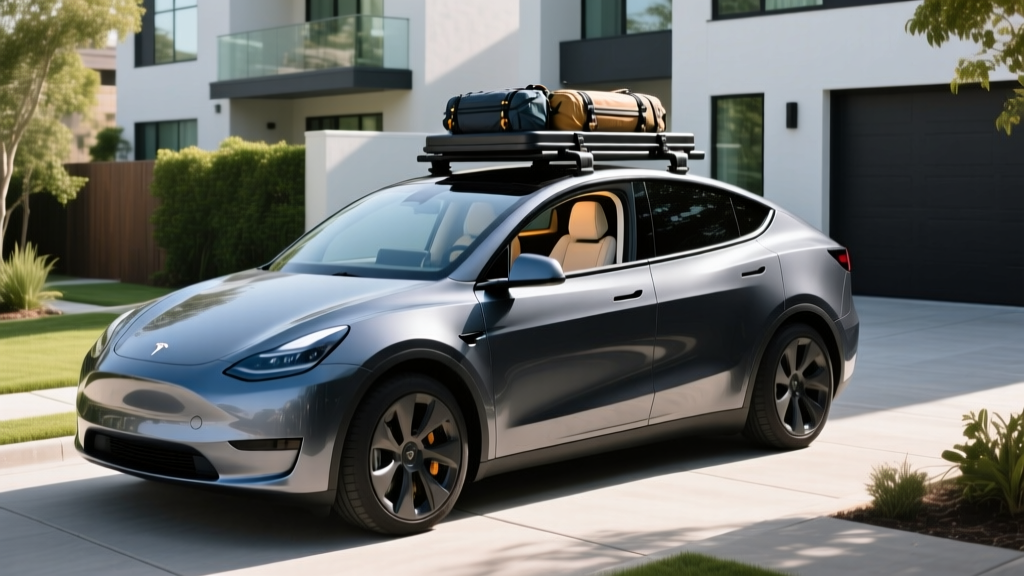
The 2026 Model Y supports Tesla's official crossbar roof rack system, which mounts to fixed points integrated into the roof structure — critical because the Model Y's full glass panoramic roof cannot support clamp-style racks designed for raised side rails. The Tesla crossbars (approximately $350 for the set) feature aerodynamically shaped aluminum bars with a T-slot channel compatible with most aftermarket accessories: Thule, Yakima, and Rhino-Rack bike carriers, ski boxes, and cargo platforms.
Dynamic load limit: Tesla rates the Model Y roof rack for up to 165 lbs (75 kg) of dynamic (driving) load and a static load capacity sufficient for rooftop tent use. This is competitive with the segment — the Ford Mustang Mach-E and Hyundai Ioniq 5 offer similar ratings.
How Much Range Does a Roof Rack Cost?
This is the question every prospective buyer asks, and the answer depends on what's mounted:
- Empty crossbars: Expect a 3-5% range reduction at highway speeds due to added drag. On the Long Range AWD, that's roughly 10-15 miles lost from a 300-mile charge.
- Crossbars + cargo box (e.g., Thule Motion XT): Range penalty increases to 10-15%. Plan for 250-260 real-world miles instead of 275.
- Crossbars + bike rack with 2-4 bikes: This is the worst-case scenario. Bikes are essentially flat plates facing the wind. Expect a 15-25% range reduction — potentially dropping real-world highway range to 200-225 miles on the AWD Long Range.
- Crossbars + kayak carrier: Similar to bikes, roughly 15-20% loss depending on whether the kayak is hull-up or hull-down.
The key insight: aerodynamic drag scales with the square of velocity. At 55 mph, a roof box costs you maybe 8% range. At 80 mph, that same box costs 15%+. If you're road-tripping with a loaded roof, driving 65-70 mph instead of 75-80 mph is the single most effective way to preserve range.
Interior Cargo Space (Roof Rack Not Needed for These)
Before committing to a roof rack, consider what fits inside. The 2026 Model Y offers:
- Behind second row: 30.2 cu ft of cargo volume
- Second row folded: 72.1 cu ft
- Front trunk (frunk): 4.1 cu ft — enough for a charging cable bag and a small duffel
- Second-row legroom: 41.6 inches (improved with Juniper's revised seat cushion)
- Front headroom: 40.9 inches (glass roof maximizes this)
- Rear headroom: 39.4 inches
For comparison, the Hyundai Ioniq 5 provides 27.2 cu ft behind the rear seats and 59.3 cu ft folded — notably less than the Model Y. The Ford Mustang Mach-E offers 29.7 / 59.7 cu ft. Tesla's packaging advantage is real and meaningful for families.
Charging Speed: DC Fast Charging and Home Setup
Charging speed matters enormously when you're driving with a roof load and reduced range. The Long Range AWD and Performance models peak at 250 kW on V3 and V4 Tesla Superchargers. Here's what that means in practice:
| Charging Level | Power (kW) | Speed | Notes |
|---|---|---|---|
| Level 1 (120V outlet) | ~1.4 kW | ~5 mi/hr | Emergency/trickle only |
| Level 2 (240V, 48A) | 11.5 kW | ~44 mi/hr | Full overnight charge in ~8 hrs |
| DC Fast (V3 Supercharger) | Peak 250 kW | ~175 mi in 15 min | 10-80% in ~22 min |
| DC Fast (CCS adapter) | Up to 250 kW | Varies by station | Non-Tesla networks |
Charging curve reality: The 250 kW peak is not sustained for the full session. The Model Y's NMC battery typically holds peak rate from roughly 10-35% State of Charge (SoC), then tapers to ~150 kW through 60%, ~100 kW through 75%, and drops sharply above 80%. This is why Tesla (and all EV makers) quote 10-80% times — the final 20% can take as long as the first 70%. On a road trip with a loaded roof rack, plan stops around the 10-80% window for maximum time efficiency.
For LFP-equipped Long Range RWD models, the DC fast-charge peak is lower (around 170 kW) because LFP chemistry accepts charge more slowly at high rates. The 10-80% time stretches to approximately 28 minutes. This is a trade-off: LFP offers better longevity and daily 100% charging convenience but slower road-trip replenishment.
Preconditioning matters. When you navigate to a Supercharger in the Tesla's built-in navigation, the car automatically warms or cools the battery to optimal charging temperature. Arriving without preconditioning — for instance, at a non-Tesla DC charger using the CCS adapter — can add 5-10 minutes to your session as the battery thermally adjusts. Always route through the car's nav for the fastest possible charge.
Pricing, Tax Credits, and Total Cost
The 2026 Model Y pricing structure reflects Tesla's ongoing price adjustments. As of early 2026:
| Trim | Base MSRP | §30D Credit Eligibility | Effective Price (if eligible) |
|---|---|---|---|
| Long Range RWD | $44,990 | Up to $3,750 (partial) | ~$41,240 |
| Long Range AWD | $47,990 | Up to $3,750 (partial) | ~$44,240 |
| Performance | $52,490 | Up to $3,750 (partial) | ~$48,740 |
Important IRS §30D caveats: Under current IRS rules, the federal clean vehicle credit is structured as two components — $3,750 for critical minerals sourcing and $3,750 for battery component manufacturing. Tesla's US-built Model Y qualifies for the critical-minerals half in most configurations, but battery component sourcing rules have tightened progressively. As of 2026, the full $7,500 is difficult to achieve for most trims. Always verify current eligibility on the IRS website before purchasing.
Buyer eligibility limits:
- Adjusted gross income cap: $150,000 (single), $225,000 (head of household), $300,000 (joint)
- Vehicle MSRP cap: $80,000 for SUVs/crossovers (Model Y qualifies)
- Point-of-sale transfer: You can transfer the credit to the dealer at purchase for an immediate price reduction rather than waiting for tax filing
Adding Tesla's official roof rack crossbars (~$350) and a quality cargo box ($400-$700) brings the total investment for a fully equipped Model Y to roughly $42,000-$49,000 after credits, depending on trim and accessories.
Technology, Driver Assistance, and Standout Features
The 2026 Model Y continues to set the benchmark for software-defined vehicle features. Every trim includes:
- 15.4-inch center touchscreen with Tesla's latest UI, navigation, and streaming media
- 8-inch rear passenger screen (added with Juniper) for climate control and entertainment
- Ventilated front seats and ambient interior lighting
- Over-the-air updates that have historically added range, performance, and features post-purchase
- Sentry Mode and Dashcam using the 8-camera surround-vision array
- Tesla Supercharger network access — still the most reliable and widespread DC fast-charging network in North America, with over 6,500 V3/V4 stalls in the US alone
Notable drawbacks: The Model Y's minimalist interior is polarizing — no physical stalks (turn signals are steering-wheel buttons in the Juniper generation), no instrument cluster, and no Apple CarPlay or Android Auto. Tesla's panel-gap consistency has improved but still draws criticism compared to Hyundai or BMW build quality. The ride on 20-inch wheels (standard on Performance) is firm; 19-inch wheels offer a more compliant experience.
How the Model Y Stacks Up Against Competitors
The crossover EV segment is crowded in 2026. Here's how the Model Y compares to key rivals for buyers who need roof-rack utility:
- Hyundai Ioniq 5: Starts at ~$42,000, EPA range up to 305 mi (SEL AWD), 800V architecture enabling 10-80% in ~18 min at 350 kW chargers. Smaller cargo area (27.2 cu ft). Supports roof crossbars. Strong value but less range and space.
- Ford Mustang Mach-E: Starts at ~$43,000, EPA range up to 312 mi (Extended Range RWD), competitive cargo (29.7 cu ft). Ford's BlueCruise offers hands-free highway driving on approved routes. Roof-rack compatible but less Supercharger-equivalent infrastructure.
- Kia EV6: Shares the Ioniq 5's 800V platform. Up to 310 mi EPA, 350 kW DC fast charging. Cargo space is tighter at 24.4 cu ft. Sportier styling but less practical for cargo-heavy buyers.
- BMW iX: Premium segment, starts ~$68,000. Larger, more luxurious, up to 324 mi EPA. Overkill for most Model Y shoppers but worth noting for luxury cross-shoppers.
The Model Y's combination of range, Supercharger access, cargo volume, and software integration remains unmatched at its price point. Competitors close the gap on individual metrics (the Ioniq 5 charges faster, the Mach-E offers hands-free driving), but none match the full package.
Pros and Cons at a Glance
- Class-leading cargo volume (72.1 cu ft folded)
- Supercharger network reliability
- 250 kW DC fast charging (LR AWD/Perf)
- Official roof rack with 165-lb dynamic load
- OTA updates continuously improve the vehicle
- Strong efficiency (116-122 MPGe combined)
- Heat pump standard for cold-weather efficiency
- Roof rack + cargo cuts range 10-25%
- No physical turn-signal stalk (Juniper)
- No Apple CarPlay / Android Auto
- FSD costs $8,000 extra and is still Level 2
- Panel gaps can vary unit to unit
- Firm ride on 20-inch Performance wheels
- Partial federal tax credit only (~$3,750)
Who Should Buy the Tesla Model Y With Roof Rack?
- Choose the Model Y with roof rack if: You need a single vehicle for daily commuting (sub-80-mile round trips) AND weekend adventures with bikes, skis, or kayaks. The 300-mile EPA range handles most road trips even with a loaded roof, and the Supercharger network makes long hauls stress-free.
- Choose the Long Range AWD if: You live in a region with real winters. AWD provides traction confidence, and the NMC battery's 75 kWh capacity gives you the buffer to absorb roof-rack range loss without sweating it.
- Look at competitors if: Ultra-fast DC charging is your priority (Ioniq 5/EV6 at 350 kW), you want hands-free highway driving without Tesla's ecosystem lock-in (Mach-E with BlueCruise), or you prefer a traditional instrument cluster and Apple CarPlay.
- Skip the roof rack if: Your cargo fits in 72.1 cu ft of interior space. Most camping gear, luggage for four, and even a disassembled bike frame fit inside — saving you 10-25% range and the $350+ rack cost.
Warranty and Long-Term Ownership
Tesla's warranty structure for the 2026 Model Y:
- Basic vehicle: 4 years / 50,000 miles
- Battery and drive unit: 8 years / 120,000 miles (Long Range and Performance) with a guaranteed minimum 70% capacity retention over the warranty period
- LFP battery (Long Range RWD): 8 years / 100,000 miles, 70% retention
Real-world battery degradation data from fleet analytics (including DOE and EPA research) shows Tesla's NMC batteries typically retain 88-92% capacity after 100,000 miles. LFP batteries show even slower degradation curves in most datasets, though they are more sensitive to extreme cold.
Insurance costs remain a consideration: the Model Y typically costs 15-25% more to insure than a comparable gas-powered crossover, driven by higher repair costs for the aluminum-intensive structure and battery replacement pricing. Get quotes before purchasing.
Frequently Asked Questions
What is the real-world range of the Tesla Model Y with a roof rack?
With empty crossbars, expect roughly 280-290 real-world highway miles on the Long Range AWD (vs ~275 without). Add a cargo box and you're looking at 250-260 miles. Load up a 4-bike rack and plan for 200-225 miles between charges. These figures assume 70-75 mph highway driving in moderate temperatures.
How fast does the Model Y charge at home and on the road?
At home on a 240V Level 2 charger (48 amps), the Model Y adds roughly 44 miles of range per hour — a full overnight session replenishes the entire battery. On the road, V3/V4 Superchargers deliver peak rates of 250 kW (LR AWD/Performance) with a 10-80% session taking approximately 22 minutes. The LFP Long Range RWD peaks at 170 kW, taking about 28 minutes for the same session.
Does the 2026 Tesla Model Y qualify for the federal EV tax credit?
Yes, partially. Under current IRS §30D rules, the Model Y qualifies for up to $3,750 of the potential $7,500 credit, depending on battery component and critical-mineral sourcing compliance. Buyer income must fall below IRS thresholds ($150K single / $300K joint), and the MSRP must be under the $80,000 SUV cap — all Model Y trims clear this. The credit can be transferred to the dealer at point of sale for an immediate price reduction. Verify current eligibility at the time of purchase, as sourcing rules tighten annually.
Is the Tesla Model Y worth buying vs the Hyundai Ioniq 5 or Ford Mach-E?
It depends on your priorities. The Model Y wins on cargo volume (72.1 vs 27.2-29.7 cu ft), Supercharger network reliability, and software integration. The Ioniq 5 wins on DC fast-charge speed (350 kW capable) and interior design. The Mach-E wins on available hands-free BlueCruise driving. For roof-rack buyers specifically, the Model Y's combination of space, range, and charging infrastructure makes it the most practical all-around choice.
Can I install third-party roof rack accessories on the Model Y?
Yes. Tesla's official crossbars feature a standard T-slot channel that accepts accessories from Thule, Yakima, Rhino-Rack, and other major brands. You must use Tesla's crossbars (or verified compatible aftermarket bars designed for the Model Y's fixed mounting points) — clamp-style racks designed for raised side rails will not work with the glass roof. Always verify the combined weight of bars + accessories + cargo stays under the 165-lb dynamic limit.
What are the biggest pros and cons of the Model Y as a cargo-hauling EV?
The biggest advantage is 72.1 cu ft of interior cargo space plus roof-rack capability, backed by 300 miles of EPA range and the Supercharger network for road trips. The biggest disadvantage is the 10-25% range penalty when the roof is loaded, which compresses your driving range on the exact trips where you need maximum flexibility. Plan charging stops accordingly.