2026 Tesla Model Y: The Benchmark Compact Electric SUV
The Tesla Model Y remains the best-selling electric vehicle in the United States for good reason: it delivers strong range, access to the most reliable DC fast-charging network, and continuous software improvements. For 2026, the Model Y receives subtle refinements to its interior materials, a slightly updated battery management system, and expanded Supercharger V4 stall availability. But with growing competition from the Hyundai Ioniq 5, Ford Mustang Mach-E, and Chevrolet Equinox EV, is the Model Y still the smartest buy in the compact electric SUV segment? This review covers every spec that matters — and includes practical ownership advice for buyers in the Pacific Northwest navigating Tesla service center Seattle logistics.
Spec Sheet: 2026 Tesla Model Y at a Glance
| Spec | Long Range AWD | Performance |
|---|---|---|
| EPA Range | 320 miles | 295 miles |
| Battery Capacity (usable) | 78 kWh (NMC) | 78 kWh (NMC) |
| Drivetrain | Dual-Motor AWD | Dual-Motor AWD |
| Horsepower | 384 hp | 456 hp |
| 0–60 mph | 4.8 seconds | 3.5 seconds |
| Max DC Fast Charge | 250 kW | 250 kW |
| 10–80% DC Charge Time | ~27 minutes | ~27 minutes |
| Level 2 Home Charge Rate | 11.5 kW (44 mi/hr) | 11.5 kW (44 mi/hr) |
| MPGe (combined) | 122 MPGe | 111 MPGe |
| Efficiency | 28 kWh/100 mi | 30 kWh/100 mi |
| Cargo Volume (rear seats up) | 30.2 cu ft | 30.2 cu ft |
| Cargo Volume (rear seats folded) | 72.1 cu ft | 72.1 cu ft |
| Rear Legroom | 36.5 inches | 36.5 inches |
| Base MSRP | $44,990 | $49,990 |
| Battery/Drive Unit Warranty | 8 yr / 120,000 mi | 8 yr / 120,000 mi |
Real-World Range: What the EPA Number Doesn’t Tell You
Real-World Expectation: ~260–280 miles highway; ~220–240 miles in cold weather (below 40°F)
The EPA’s 320-mile estimate for the Long Range AWD is achievable in mixed city/highway driving during mild weather. However, highway speeds above 70 mph reduce efficiency noticeably — expect closer to 260–280 miles on a long road trip. In Seattle’s damp, cool winters, battery preconditioning and cabin heating can shave 15–25% off range, dropping real-world figures to 220–240 miles. The Model Y’s heat pump helps mitigate this compared to resistive heating systems, but cold-weather range loss is a physics reality for all lithium-ion EVs.
For Pacific Northwest commuters, the 78 kWh usable NMC battery provides ample daily buffer. A typical Seattle round-trip commute of 30–40 miles leaves plenty of headroom, and regenerative braking on hilly routes like I-5 or SR-520 helps recapture energy on descents.
Charging Speed: Supercharger Network Advantage
Tesla’s Supercharger network remains the most reliable public DC fast-charging infrastructure in the U.S. The 2026 Model Y peaks at 250 kW on V3 and V4 Superchargers, adding up to 200 miles of range in 15 minutes under optimal conditions. However, sustained charge rates taper above 60% state of charge — a full 10–80% session takes approximately 27 minutes.
| Charging Level | Power (kW) | Charge Time / Rate |
|---|---|---|
| Level 1 (120V household) | 1.4 kW | ~4 miles per hour |
| Level 2 (240V home, 48A) | 11.5 kW | ~44 miles per hour / ~8 hours (0–100%) |
| DC Fast Charge (Supercharger V3/V4) | Up to 250 kW | 10–80% in ~27 minutes |
For home charging in Seattle, a Level 2 wall connector on a 60-amp circuit delivers the best overnight experience. Most homeowners with a 200-amp electrical panel can accommodate this without an upgrade. Installation costs in the Seattle metro area typically range from $800 to $2,500 depending on panel proximity and permitting, according to local electricians. Always consult a licensed electrician for final specifications.
The Model Y now ships with a NACS (North American Charging Standard) port natively, eliminating the need for adapters at Tesla Superchargers. For non-Tesla networks like Electrify America or EVgo, a CCS-to-NACS adapter is included.
Performance, Efficiency, and Daily Drivability
The Long Range AWD’s 384 hp and 4.8-second 0–60 mph time provide confident highway merging and passing. The Performance trim’s 456 hp and 3.5-second sprint are thrilling but come at the cost of 25 miles of EPA range and a firmer ride. Both trims feature Tesla’s dual-motor all-wheel-drive system, which excels in Seattle’s rainy conditions and occasional mountain snow on passes like Snoqualmie or Stevens.
Efficiency is a Tesla strong suit. At 122 MPGe combined (28 kWh/100 mi), the Long Range AWD is among the most efficient compact electric SUVs available. This translates to roughly $0.04–$0.06 per mile on Washington’s low-cost electricity (averaging $0.10/kWh), compared to $0.12–$0.15 per mile for a 25-MPG gas SUV at $3.50/gallon.
Pricing, Trims, and Federal Tax Credit Eligibility
| Trim | Base MSRP | Est. Federal Credit | Effective Price |
|---|---|---|---|
| Long Range AWD | $44,990 | Up to $7,500* | ~$37,490* |
| Performance | $49,990 | Up to $7,500* | ~$42,490* |
*Federal §30D tax credit eligibility depends on buyer income caps ($150K single / $300K joint), MSRP limits ($80K for SUVs), and battery critical-mineral sourcing requirements. As of 2026, the Model Y qualifies for the full $7,500 credit for eligible buyers, and the credit can be transferred at the point of sale as a purchase-price reduction. Verify current eligibility at IRS.gov or with a tax professional.
Destination fees, optional paint colors ($1,500–$2,500), and FSD (Supervised) software ($8,000 one-time or $99/month) increase the as-tested price. A well-equipped Long Range AWD with premium paint and no FSD typically lands around $47,500 before credits.
Interior, Tech, and Driver Assistance
The Model Y’s minimalist interior centers on a 15.4-inch touchscreen that controls nearly all vehicle functions. The 2026 refresh adds improved acoustic glass, ventilated front seats, and a rear-seat entertainment screen. Cargo space is generous at 30.2 cu ft behind the second row and 72.1 cu ft with seats folded — competitive with the Ioniq 5 and Mach-E.
Tesla’s Autopilot comes standard and includes adaptive cruise control and lane-keeping assist. Full Self-Driving (Supervised) is an optional upgrade that enables automated lane changes, intersection navigation, and parking assistance. However, FSD is a SAE Level 2 driver-assist system — the driver must remain fully engaged and supervise at all times. It is not autonomous driving.
Tesla Service Center Seattle: Ownership Logistics
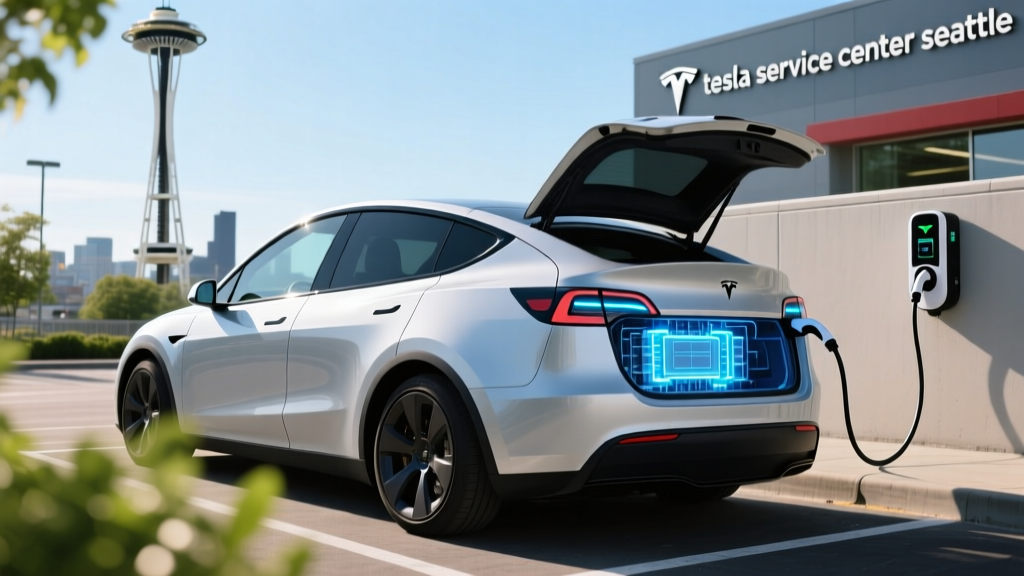
For Seattle-area buyers, Tesla operates multiple service locations including the Seattle Service Center on Airport Way South and additional mobile service coverage throughout King County. Common service needs include tire rotations (every 6,250 miles), cabin air filter replacements, and occasional 12V battery maintenance. Tesla’s mobile service vans handle many routine tasks at your home or workplace, reducing the need for in-center visits.
Wait times at the Seattle service center can extend to 2–3 weeks for non-urgent body work or warranty claims during peak seasons. Scheduling via the Tesla app is straightforward, and loaner vehicles or ride-share credits are sometimes provided for longer repairs. Overall, Tesla’s service infrastructure in Seattle is more robust than in many U.S. metro areas, though it still lags legacy automakers in sheer service-bay volume.
Pros and Cons
- Best-in-class Supercharger network access
- Strong efficiency (122 MPGe combined)
- Spacious cargo area (72.1 cu ft max)
- Over-the-air updates continuously add features
- Point-of-sale tax credit transfer available
- FSD is expensive and still Level 2 (not autonomous)
- Service center wait times for body work
- Minimalist interior lacks physical controls
- Cold-weather range loss (15–25%)
- Insurance premiums higher than segment average
Frequently Asked Questions
What is the real-world range of the 2026 Tesla Model Y?
Expect 260–280 miles highway in mild weather and 220–240 miles in cold conditions. The EPA estimates 320 miles for the Long Range AWD in mixed driving.
How fast does the Model Y charge at home and on the road?
At home on Level 2 (11.5 kW), it adds ~44 miles per hour. On a 250 kW Supercharger, 10–80% takes approximately 27 minutes.
Does the 2026 Model Y qualify for the federal EV tax credit?
Yes, eligible buyers can receive up to $7,500 under IRS §30D, subject to income caps and battery sourcing rules. The credit can be applied at the point of sale. Verify details at IRS.gov.
Is the Model Y worth buying vs. the Hyundai Ioniq 5 or Ford Mach-E?
The Model Y wins on charging network reliability and efficiency. The Ioniq 5 offers faster peak charging (350 kW on 800V architecture) and a more conventional interior. The Mach-E provides a sportier driving feel. Choose the Model Y if Supercharger access and Tesla’s software ecosystem are priorities.
Where is the Tesla service center in Seattle?
Tesla operates a primary service center on Airport Way South in Seattle, plus mobile service coverage throughout King County. Schedule appointments via the Tesla app.
Sources: EPA Fuel Economy, IRS Clean Vehicle Credits, Tesla.com official specifications.