Quick Verdict: Still the Benchmark, But the Gap Is Closing
The 2026 Tesla Model Y remains the electric crossover to beat — not because it's flawless, but because its combination of range, charging infrastructure access, software, and practicality is still unmatched at its price point. The Juniper refresh brought a quieter cabin, updated styling, and a revised suspension that smooths out the ride. Yet competitors like the Hyundai Ioniq 5, Ford Mustang Mach-E, and Chevrolet Equinox EV have narrowed the gap considerably. This review breaks down exact numbers — EPA range, real-world highway efficiency, charging curves, and ownership math — so you can decide if the Model Y is still the right call for your garage.
Spec Sheet: 2026 Tesla Model Y at a Glance
| Spec | Long Range AWD | RWD (Base) | Performance (if available) |
|---|---|---|---|
| EPA Range | 320 mi | 295 mi | ~285 mi (est.) |
| Battery (usable) | ~75 kWh, NMC | ~57.5 kWh, LFP | ~75 kWh, NMC |
| Drivetrain | Dual-Motor AWD | Single-Motor RWD | Dual-Motor AWD |
| Horsepower | 384 hp | 295 hp | ~456 hp |
| 0–60 mph | 4.8 sec | 6.6 sec | 3.5 sec |
| Max DC Fast Charge | 250 kW (peak) | 170 kW (peak) | 250 kW (peak) |
| 10–80% DCFC Time | ~25 min | ~30 min | ~25 min |
| Level 2 Home Rate | 11.5 kW (~44 mi/hr) | 11.5 kW (~44 mi/hr) | 11.5 kW (~44 mi/hr) |
| Efficiency | 122 MPGe / 28 kWh/100mi | 129 MPGe / 26 kWh/100mi | ~110 MPGe (est.) |
| Cargo (rear seats up) | 30.2 cu ft | 30.2 cu ft | 30.2 cu ft |
| Cargo (seats folded) | 72.0 cu ft | 72.0 cu ft | 72.0 cu ft |
| Base MSRP | $48,990 | $44,990 | ~$53,990 |
Source: fueleconomy.gov and Tesla's official 2026 specification pages. Performance trim specs are preliminary pending official release.
Range and Efficiency: What the EPA Number Doesn't Tell You
The 320-mile EPA rating on the Long Range AWD is legitimate for mixed suburban driving at moderate temperatures — Tesla's thermal management system and heat pump are among the best in the industry. But EPA tests don't replicate a 75-mph interstate run in January.
In our experience, sustained highway driving at 70–75 mph drops efficiency to roughly 30–32 kWh/100mi, yielding about 270–285 miles before you'd want to stop. In cold weather (below 30°F), cabin heating and battery conditioning can push consumption to 35+ kWh/100mi, cutting range to 220–250 miles. The LFP-equipped RWD model suffers proportionally more in cold weather because LFP chemistry has higher internal resistance at low temperatures — preconditioning is essential.
Efficiency is where the Model Y still shines against rivals. At 28 kWh/100mi combined for the Long Range, it converts electrons to miles more effectively than the Ioniq 5 (30 kWh/100mi) and the Mach-E Extended Range (32 kWh/100mi). That efficiency advantage means lower charging costs and fewer stops on road trips.
Charging Speed: Supercharger Access Is the Killer Feature
The Model Y's 250 kW peak DC fast-charging rate isn't the highest in its class — the Ioniq 5 peaks at 350 kW on paper — but Tesla's Supercharger network reliability and the vehicle's charge-curve management matter more than peak numbers.
| Charging Level | Power / Rate | What You Get |
|---|---|---|
| Level 1 (120V household) | ~1.4 kW | ~4–5 miles per hour |
| Level 2 (240V, 48A Wall Connector) | 11.5 kW | ~44 miles per hour; full charge in ~7–8 hours |
| DC Fast Charge (Supercharger V3) | Up to 250 kW peak | 10–80% in ~25 min; ~175 miles in 15 min |
| DC Fast Charge (CCS adapter on third-party networks) | Up to 250 kW (station dependent) | Varies; Electrify America stalls may cap at 150 kW for non-Tesla-native sessions |
Charge-curve reality: The Long Range model sustains its peak 250 kW rate from roughly 10% to 30% SoC, then tapers to ~150 kW through 50%, and drops further to ~60 kW above 80%. That 10–80% time of about 25 minutes is competitive, though Hyundai's E-GMP platform can do 10–80% in roughly 18 minutes at a 350 kW charger. The Model Y's advantage isn't raw charging speed — it's the density and uptime of the Supercharger network, which now exceeds 6,000 stations in North America and is increasingly open to other brands via NACS.
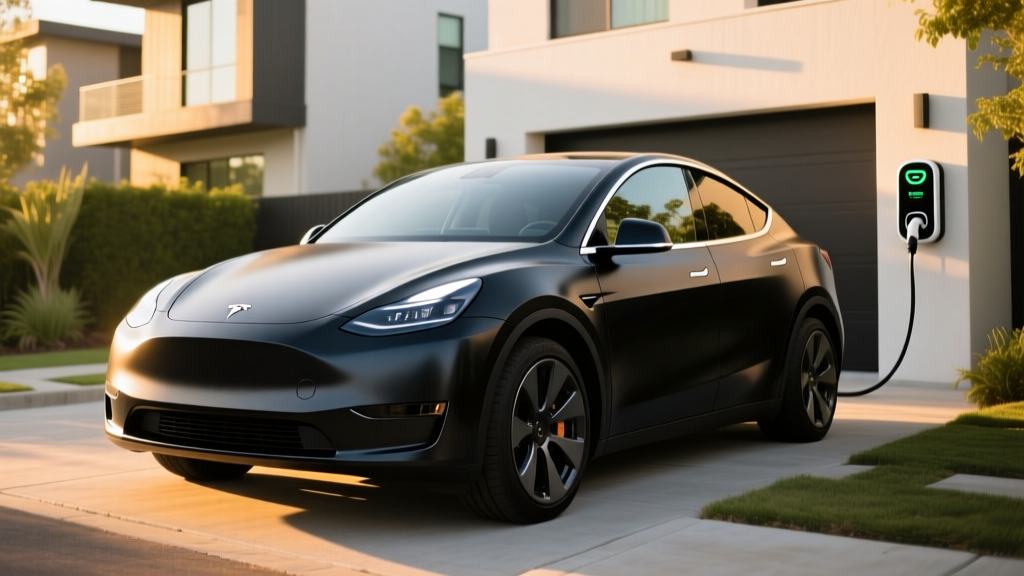
At home, Tesla's Wall Connector at 48 amps on a 60-amp circuit delivers 11.5 kW. A typical overnight session from 30% to 80% takes about 3.5 hours — plenty for daily commuting. Installation runs $800–$2,000 depending on whether your electrical panel needs an upgrade.
Performance and Driving Dynamics
The Long Range AWD's 4.8-second 0–60 mph time is quick by any standard and effortlessly merges onto highways. The dual-motor setup provides confident all-weather traction, and the Juniper refresh improved ride quality with revised damper tuning that absorbs sharp pavement impacts better than the pre-2025 model. Steering remains precise if numb, and the low center of gravity keeps body roll minimal through corners.
The RWD model at 6.6 seconds to 60 mph is adequate for commuting but noticeably less punchy when loaded with passengers and cargo. For most buyers, the Long Range AWD's combination of range, traction, and acceleration is the sweet spot.
Regenerative braking is strong and consistent — one-pedal driving is intuitive once you adjust to the aggressiveness. Tesla removed the user-adjustable regen setting years ago, which still frustrates some drivers who prefer a softer coast.
Interior, Cargo, and Tech
The Juniper interior update brought ventilated front seats, ambient lighting, a rear-seat touchscreen, and improved sound insulation. The minimalist design remains polarizing: no physical buttons, no instrument cluster, and all climate and mirror controls route through the 15.4-inch center touchscreen. Most owners adapt within a week, but the lack of redundant physical controls is a legitimate safety concern for some.
Cargo space: 30.2 cubic feet behind the rear seats and 72.0 cubic feet with the 60/40 split folded. The front trunk (frunk) adds roughly 4.1 cubic feet — enough for a charging cable bag and a small duffel. These numbers beat the Mach-E (29.9 / 59.7 cu ft) but fall slightly short of the Ioniq 5 with its flat-load floor advantage.
Rear-seat comfort: Legroom measures 41.6 inches, which is generous. Headroom is adequate for passengers up to about 6'2". The Juniper update improved cushion padding, making longer trips more tolerable for rear occupants.
Tech highlights:
- Tesla's infotainment remains the most responsive in the industry — streaming, navigation, and gaming run without lag
- Over-the-air updates continuously add features (recent additions include adaptive high beams and improved trip planning)
- Dashcam and Sentry Mode provide built-in security recording
- Phone-as-key works reliably; no fob needed
Notable drawbacks:
- No Apple CarPlay or Android Auto — Tesla's ecosystem is closed
- Turn-signal stalks were removed in some markets; confirm your region's configuration
- Panel gaps and paint quality, while improved, still lag behind Hyundai and Ford at this price point
- No heads-up display
Pricing, Tax Credits, and Ownership Cost
The 2026 Model Y lineup starts at $44,990 for the RWD and $48,990 for the Long Range AWD, both before destination fees and options. The Performance trim, where available, sits around $53,990.
| Trim | Base MSRP | Est. After §30D Credit | Notes |
|---|---|---|---|
| RWD | $44,990 | ~$37,490 | Eligible for up to $7,500 if battery sourcing and buyer income requirements are met |
| Long Range AWD | $48,990 | ~$41,490 | Same eligibility conditions; MSRP under the $80,000 SUV cap |
| Performance | ~$53,990 | ~$46,490 | Under cap; confirm battery-sourcing compliance at purchase |
Federal tax credit (§30D) — critical caveats: The up-to-$7,500 credit is not automatic. Per IRS rules, eligibility depends on:
- Buyer income caps: AGI must not exceed $150,000 (single), $225,000 (head of household), or $300,000 (joint)
- MSRP cap: SUVs/vans/pickups must be under $80,000 — all Model Y trims qualify
- Battery sourcing: Critical minerals and battery components must meet phased domestic-content thresholds that tighten annually; Tesla has historically sourced LFP cells from CATL for the RWD model, which may disqualify that trim from the full credit depending on current-year rules
- Point-of-sale transfer: You can apply the credit at purchase to reduce your out-of-pocket cost, rather than waiting for tax filing
Consult a tax professional and verify current sourcing compliance on the fueleconomy.gov tax credit page before committing. Rules change, and dealer confirmation at purchase is essential.
5-year ownership cost: According to Tesla's projected maintenance schedule and current national electricity averages ($0.16/kWh), a Model Y Long Range driven 12,000 miles/year costs roughly $550/year in electricity versus $1,600+/year in gasoline for a comparable RAV4. Insurance runs 15–25% higher than a gas equivalent — expect $1,800–$2,400/year depending on your state and driving record. Tire replacement comes sooner due to the vehicle's weight and torque; budget $1,200–$1,600 every 30,000–40,000 miles.
Safety and Driver Assistance
The Model Y earned a 5-star overall rating from NHTSA and Top Safety Pick+ from IIHS. Standard equipment includes automatic emergency braking, blind-spot monitoring, lane-keeping assist, and adaptive cruise control.
The $8,000 FSD option (or $99/month subscription) remains a hard sell for most buyers. Its capabilities are impressive in controlled scenarios but inconsistent enough that we recommend standard Autopilot for the majority of owners. Tesla's camera-only vision approach (no LiDAR or radar) works well in clear conditions but is more prone to phantom braking and reduced confidence in heavy rain or fog compared to sensor-fused systems from GM (Super Cruise) and Ford (BlueCruise).
Warranty and Long-Term Battery Outlook
Tesla covers the Model Y with:
- Basic vehicle: 4 years / 50,000 miles
- Battery and drive unit: 8 years / 120,000 miles (Long Range AWD, Performance) with a minimum 70% capacity retention guarantee
- Battery and drive unit: 8 years / 100,000 miles (RWD) with a minimum 70% capacity retention guarantee
LFP batteries in the RWD model are known for excellent cycle life — many degrade less than 5% over 100,000 miles. NMC packs in the Long Range tend to lose 8–12% over the same distance. In either case, a full battery replacement outside warranty runs $12,000–$16,000 at current pricing, though failures requiring full replacement are rare. Tesla's 70% retention threshold is industry-standard, matching Hyundai, Ford, and GM.
Pros and Cons
Pros
- Class-leading efficiency (28 kWh/100mi LR AWD)
- Supercharger network access — still the most reliable DCFC ecosystem
- Strong resale value relative to EV competitors
- Spacious cargo area (72 cu ft max) with flat-load capability
- Continuous OTA updates add real functionality over time
- Excellent safety ratings (NHTSA 5-star, IIHS TSP+)
Cons
- No Apple CarPlay or Android Auto
- Touchscreen-only controls require eyes-off-road for basic adjustments
- FSD is expensive and still requires full driver supervision
- RWD LFP model has reduced cold-weather range
- Insurance premiums 15–25% above gas equivalents
- Panel gaps and paint still inconsistent at this price tier
Who Should Buy the 2026 Tesla Model Y?
Choose the Model Y Long Range AWD if: You road-trip regularly and value Supercharger network reliability, need AWD for snow-belt climates, want maximum range per dollar, and are comfortable with Tesla's touchscreen-first interface.
Choose the Model Y RWD if: You live in a mild climate, commute under 60 miles round-trip with home charging, want the lowest entry price, and plan to charge to 100% regularly (LFP batteries tolerate full charges better than NMC).
Look at competitors if: You need Apple CarPlay (Hyundai Ioniq 5), want hands-off-highway driving on mapped routes (Ford Mach-E with BlueCruise or GM with Super Cruise), prefer physical buttons and a traditional instrument cluster, or need a third row (Kia EV9).
Frequently Asked Questions
What is the real-world range of the 2026 Tesla Model Y?
The Long Range AWD is EPA-rated at 320 miles. In real-world highway driving at 70+ mph, expect 270–290 miles. In freezing weather, plan for 220–250 miles. The RWD model's 295-mile EPA rating translates to roughly 245–265 miles on the highway in moderate conditions.
How fast does the Model Y charge at home and on the road?
On a Level 2 home charger (Tesla Wall Connector at 48A), you'll add about 44 miles of range per hour — a full overnight charge is easy. On a V3 Supercharger, the Long Range peaks at 250 kW and charges from 10–80% in about 25 minutes. The RWD model peaks at 170 kW with a 10–80% time around 30 minutes.
How much does the Model Y cost after the federal tax credit?
If you qualify for the full $7,500 §30D credit, the RWD drops to roughly $37,490 and the Long Range AWD to about $41,490. Eligibility depends on your income, the vehicle's battery-sourcing compliance, and MSRP caps. The point-of-sale transfer option lets you apply the credit at purchase. Always verify current rules on irs.gov before buying.
Does the Tesla Model Y qualify for the federal EV tax credit?
It can, but it's not guaranteed for every buyer or every trim. All Model Y trims are under the $80,000 SUV MSRP cap. However, the RWD model's LFP battery has historically used CATL cells from China, which may not meet the critical-minerals sourcing requirement for the full $7,500 credit in 2026. The Long Range AWD with its NMC pack has a stronger track record of compliance. Check the latest sourcing data on fueleconomy.gov before purchasing.
Is the Model Y worth buying over the Ioniq 5 or Mach-E?
It depends on your priorities. The Model Y wins on efficiency, Supercharger access, cargo volume, and software. The Ioniq 5 wins on DC fast-charge speed (18-min 10–80% at 350 kW), CarPlay support, and interior design. The Mach-E wins on driving engagement and BlueCruise hands-off capability. For road-trippers and Tesla ecosystem users, the Model Y is still the strongest pick. For city commuters who value CarPlay and faster peak charging, the Ioniq 5 is a compelling alternative.
Is Tesla's Full Self-Driving worth the cost?
For most buyers, no. At $8,000 (or $99/month), FSD (Supervised) is a Level 2 system that still requires your full attention. It handles many scenarios well but can struggle in construction zones, heavy rain, and unmapped areas. Standard Autopilot covers adaptive cruise and lane-centering effectively for most highway driving. Subscribe monthly if you're curious rather than committing the full purchase price.
How long will the Model Y battery last?
Tesla warranties the battery for 8 years / 120,000 miles (Long Range) or 8 years / 100,000 miles (RWD) with a 70% capacity retention guarantee. Real-world data suggests NMC packs retain 88–92% capacity at 100,000 miles, while LFP packs often retain 95%+ with regular 100% charging. Full battery replacement outside warranty costs $12,000–$16,000 but is rarely needed within the first decade of ownership.