Quick Verdict: The Benchmark Compact EV, With Caveats
The 2026 Tesla Model Y remains the sales-volume king of the EV world for good reason: strong efficiency, a mature Supercharger network, and a starting price that undercuts several rivals after incentives. But a surge of new competition — the Hyundai Ioniq 5, Ford Mustang Mach-E, and refreshed Kia EV6 — has narrowed the gap considerably. For 2026, the Model Y receives subtle updates to its interior materials and a revised Juniper-style front fascia carried over from the early-2025 refresh, but the core powertrain and battery architecture remain largely unchanged.
This review covers everything a prospective buyer needs: real-world range versus the EPA sticker, DC fast-charging behavior (including the taper above 80%), federal tax credit eligibility under current IRS §30D rules, and a critical safety feature too many owners overlook — the manual door release mechanism that could matter in a power-loss emergency.
Range, Efficiency, and the Real-World Reality Check
Real-World Expectation: ~260–285 miles on highway trips at 70–75 mph; ~210–240 miles in freezing temperatures (below 32°F) with cabin heating. The rear-wheel-drive base model drops to an EPA 295 miles, with real-world highway figures closer to 240–260 miles.
The Model Y Long Range AWD achieves an EPA-rated 117 MPGe combined (roughly 28 kWh per 100 miles), which is among the best in the compact electric SUV segment. Tesla's heat pump, standard across all trims, helps mitigate cold-weather range loss compared to resistive-heating competitors, but physics is physics — expect a 20–30% reduction in usable range during sustained sub-freezing driving.
For city-heavy commuters who can charge at home overnight, the 320-mile EPA figure is very achievable. Road-trippers should plan conservatively around 260 miles between stops, especially on mountainous or high-speed routes where aerodynamic drag dominates energy consumption.
Battery, Chemistry, and What It Means for Longevity
| Specification | Long Range AWD | Rear-Wheel Drive |
|---|---|---|
| Usable Battery Capacity | ~75 kWh (NMC) | ~60 kWh (LFP) |
| Chemistry | Nickel Manganese Cobalt (NMC) | Lithium Iron Phosphate (LFP) |
| Energy Density | Higher (more range per kg) | Lower (heavier for same kWh) |
| Cycle Life | ~1,500–2,000 cycles | ~3,000+ cycles |
| Recommended Daily Charge | 80% (to preserve longevity) | 100% OK (LFP tolerates full SoC) |
| Cold-Weather Performance | Better in extreme cold | Greater range loss in freezing temps |
The chemistry split matters for ownership. The RWD base model's LFP battery can be charged to 100% daily without degradation concerns, making it ideal for commuters with predictable routes. The Long Range's NMC pack delivers more energy density and superior cold-weather behavior but benefits from staying between 20–80% state of charge for daily use — a trade-off worth understanding before you buy.
Charging Speed: DC Fast Charge, Level 2, and the Curve Taper
| Charging Level | Power / Rate | Miles Added per Hour | Notes |
|---|---|---|---|
| Level 1 (120V household) | ~1.2 kW | ~3–4 miles/hr | Emergency only; impractical for daily use |
| Level 2 (240V home, 48A) | ~11.5 kW | ~37–44 miles/hr | Full charge overnight in ~8–9 hours |
| DC Fast Charge (V3 Supercharger) | Peak 250 kW | Up to ~1,000 mi/hr (peak) | 10–80% in ~25 minutes (Long Range) |
| DC Fast Charge (V4 Supercharger) | Peak 250 kW (Model Y limited) | Similar to V3 | V4 stalls support higher kW but Model Y caps at 250 kW |
The Model Y peaks at 250 kW on a V3 or V4 Supercharger, but that peak is sustained for only a brief window between roughly 10–30% state of charge. The charge curve tapers progressively: by 60% SoC, you're typically seeing 100–120 kW, and above 80%, speeds drop to under 50 kW. This is why Tesla (and every EV manufacturer) quotes 10–80% times rather than 0–100% — charging the final 20% can take as long as the first 70%.
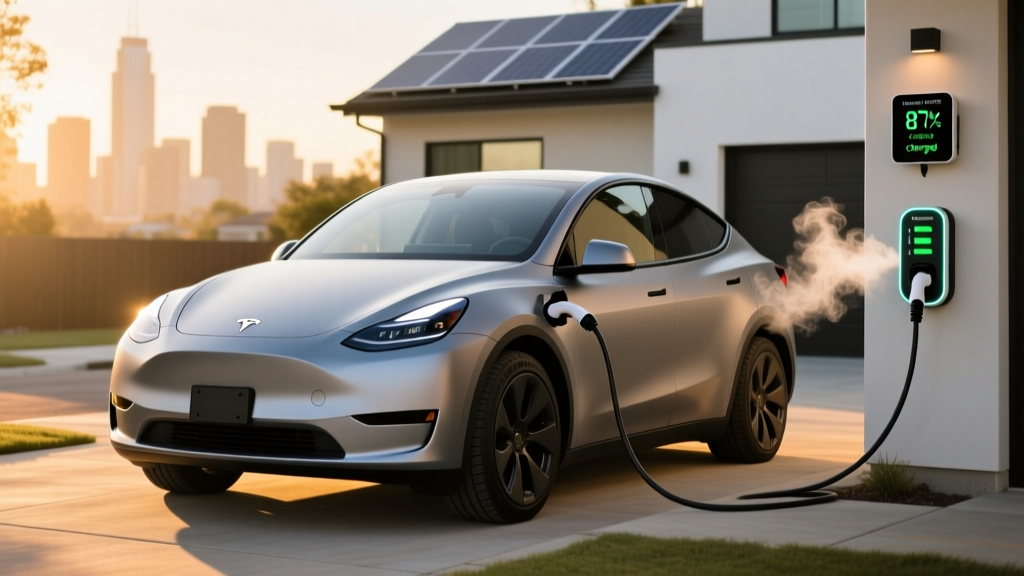
For home Level 2 charging, a Tesla Wall Connector on a 60-amp circuit (48 amps continuous) delivers roughly 11.5 kW, adding about 40 miles of range per hour. Most owners charging overnight from 20–80% will wake up to a full daily allotment in under 5 hours. Installation costs for a Level 2 home setup typically range from $500 (simple outlet near the panel) to $2,500+ if a panel upgrade or long conduit run is required.
Performance and Drivetrain
| Trim | Drivetrain | Horsepower | 0–60 mph | Top Speed |
|---|---|---|---|---|
| Rear-Wheel Drive | RWD (single motor) | ~295 hp | 6.6 seconds | 135 mph |
| Long Range AWD | Dual-motor AWD | ~384 hp | 4.8 seconds | 135 mph |
The Long Range AWD's 4.8-second 0–60 time is genuinely quick for a family crossover and makes highway merging effortless. The RWD model's 6.6 seconds is adequate for most drivers and returns slightly better efficiency. Both trims feature regenerative braking with one-pedal driving capability, though the regen strength is not adjustable in current Tesla software — you either adapt to it or you don't.
Manual Door Release: What Every Model Y Owner Must Know
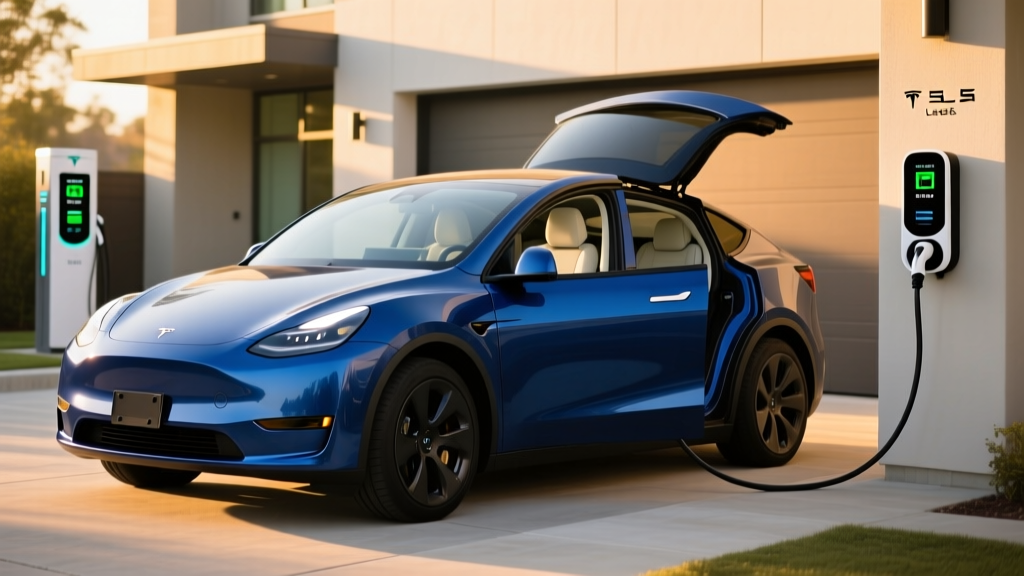
The 2026 Model Y, like all Tesla vehicles, uses electronic push-button door releases — there is no traditional mechanical handle on the interior. In a collision, power loss, or electrical fault, the electronic release may not function. This makes the manual door release a critical safety feature that every owner and passenger should locate before an emergency occurs.
Front Doors: The manual release is a small mechanical pull tab located above the window switch panel on the door armrest. Pull it toward you to mechanically disengage the latch and open the door without electrical power.
Rear Doors: The manual release is accessed by lifting the small carpet/mat flap on the lower edge of the rear door panel (near the floor). Underneath is a mechanical cable pull that releases the latch. This location is not intuitive and is rarely explained during delivery — make sure rear-seat passengers (especially children's caregivers) know where it is.
Tesla also equips the Model Y with an automatic window-drop feature on door open (the window lowers slightly to clear the seal). In a total power failure, this won't occur, so expect resistance when manually opening. This is normal and won't damage the vehicle.
Pricing, Trims, and Federal Tax Credit Eligibility
| Trim | Base MSRP | Federal §30D Credit | Effective Price (if eligible) |
|---|---|---|---|
| Rear-Wheel Drive | $44,990 | Up to $7,500 | ~$37,490 |
| Long Range AWD | $48,990 | Up to $7,500 | ~$41,490 |
Federal tax credit eligibility under IRS §30D is not automatic. To qualify for the full $7,500 credit on a 2026 Model Y, all of the following must apply:
- MSRP Cap: The vehicle's MSRP must not exceed $80,000 for SUVs (both trims qualify).
- Buyer Income Cap: Modified adjusted gross income must not exceed $150,000 (single), $225,000 (head of household), or $300,000 (joint filers).
- Battery Sourcing: A percentage of critical minerals and battery components must be sourced from the U.S. or free-trade-agreement countries. Tesla's sourcing has shifted over time — verify current-year eligibility on fueleconomy.gov before purchasing.
- Point-of-Sale Transfer: As of 2024, buyers can elect to transfer the credit to the dealer at purchase, reducing the upfront price rather than waiting for a tax refund. This is available for the Model Y.
Consult a tax professional for your specific situation. State and local incentives may stack on top but vary by jurisdiction — check AFDC's incentive database for your area.
Interior, Cargo, and Technology
The 2026 Model Y's cabin follows Tesla's minimalist ethos: a single 15.4-inch touchscreen controls virtually every function, from climate to glovebox release. The Juniper refresh added ventilated front seats, ambient lighting, and improved sound insulation over the pre-2025 model, but the fundamental layout is unchanged.
| Dimension | Measurement |
|---|---|
| Cargo Volume (rear seats up) | 30.2 cu ft |
| Cargo Volume (rear seats folded) | 72.1 cu ft |
| Front Headroom | 41.0 in |
| Rear Legroom | 38.4 in |
| Front Trunk (Frunk) | 4.1 cu ft |
The 72.1 cu ft maximum cargo space with seats folded is competitive with the Hyundai Ioniq 5 (59.3 cu ft) and significantly larger than the Ford Mustang Mach-E (59.7 cu ft). The frunk is small but useful for charging cables or a soft bag.
Standout Tech: Tesla's navigation with real-time Supercharger routing and battery preconditioning remains the gold standard for road-trip planning. The 15-camera vision system supports Autopilot (standard) and Full Self-Driving Supervised ($8,000 option or $99/month). FSD Supervised is an SAE Level 2 system — it does not make the car self-driving, and the driver must remain fully engaged with hands on the wheel and eyes on the road at all times.
Notable Drawbacks: The absence of physical climate controls or a traditional instrument cluster frustrates some buyers. Turn signals are stalk-mounted (restored in the Juniper refresh after the controversial steering-wheel buttons on early Cybertruck/Model 3 Highland). The all-glass roof can create significant cabin heat in summer — a sunshade is strongly recommended.
Pros and Cons
Pros
- Best-in-class Supercharger network reliability and coverage
- Strong efficiency (117 MPGe combined, 28 kWh/100mi)
- Class-leading cargo space (72.1 cu ft)
- Over-the-air updates continuously add features
- Competitive pricing after federal tax credit
- LFP battery option (RWD) allows daily 100% charging
Cons
- Minimalist interior not for everyone; no physical buttons
- Build quality still inconsistent vs. legacy automakers
- DC fast charge capped at 250 kW (rivals hit 350 kW)
- FSD Supervised is expensive and still Level 2 only
- Rear manual door release is poorly marked and non-intuitive
- Insurance premiums often 20–40% higher than comparable non-Tesla EVs
Warranty and Long-Term Ownership
Tesla covers the Model Y with a 4-year/50,000-mile basic vehicle warranty and an 8-year/120,000-mile battery and drive unit warranty (Long Range AWD). The RWD model's LFP battery warranty is 8 years/100,000 miles. The battery warranty guarantees retention of at least 70% of original capacity during the coverage period — a threshold consistent with most competitors.
Real-world degradation data from Tesla fleet analytics suggests most Model Y batteries retain approximately 88–92% capacity after 100,000 miles, well within the warranty floor. LFP batteries in the RWD model show even slower degradation curves but are more susceptible to range loss from cold-soak events.
Who the 2026 Model Y Suits Best
Choose the Model Y if: You value Supercharger network access for road trips, want maximum cargo versatility, prefer minimalist tech-forward interiors, and can charge at home with Level 2. The RWD trim is ideal for warm-climate commuters who want LFP longevity; the Long Range AWD is better for cold-weather states and families needing dual-motor traction.
Look at competitors if: You prefer physical buttons and a traditional instrument cluster (Hyundai Ioniq 5, Kia EV6), need 350 kW DC fast charging (Hyundai/Kia E-GMP platform), want a more luxurious interior (BMW iX, Genesis GV60), or need three-row seating (Kia EV9).
Frequently Asked Questions
What is the real-world range of the 2026 Tesla Model Y?
The Long Range AWD achieves an EPA-estimated 320 miles, but real-world highway driving at 70–75 mph typically yields 260–285 miles. In freezing temperatures, expect 210–240 miles. The RWD base model's EPA rating is 295 miles, with real-world figures around 240–260 miles on highway trips.
How fast does the Model Y charge at home and on DC fast chargers?
On a home Level 2 charger (240V, 48A), the Model Y adds roughly 37–44 miles of range per hour, achieving a full overnight charge in about 8–9 hours. On a Tesla V3 or V4 Supercharger, it peaks at 250 kW and charges from 10–80% in approximately 25 minutes, though the charge curve tapers significantly above 60% state of charge.
How much does the 2026 Model Y cost after the federal tax credit?
The RWD starts at $44,990 MSRP and the Long Range AWD at $48,990. If you meet all IRS §30D requirements (income caps, battery sourcing, MSRP under $80,000), the effective price drops to approximately $37,490 (RWD) or $41,490 (Long Range) after the $7,500 credit. The credit can be applied at point of sale to reduce your upfront cost.
Where is the manual door release on a Tesla Model Y?
For front doors, the manual release is a mechanical pull tab above the window switch panel on the door armrest. For rear doors, lift the carpet flap on the lower door panel near the floor to access a mechanical cable pull. Familiarize yourself with these locations before an emergency — they are not intuitive and are rarely highlighted during vehicle delivery.
Is the Model Y worth buying over the Hyundai Ioniq 5 or Ford Mach-E?
The Model Y wins on Supercharger network access, cargo space (72.1 vs. 59.3 cu ft), and efficiency. The Ioniq 5 charges faster (up to 350 kW on 800V architecture, 10–80% in ~18 min) and offers physical controls. The Mach-E provides a more traditional driving feel and interior layout. Your choice depends on whether network convenience and cargo volume outweigh charging speed and interior preference.
Does the 2026 Model Y qualify for the $7,500 federal EV tax credit?
It can, but eligibility is not guaranteed. You must meet income thresholds ($150K single / $300K joint), the vehicle must have qualifying battery component and critical-mineral sourcing (verify on fueleconomy.gov for the current model year), and MSRP must be under $80,000 (both trims qualify). Consult a tax professional and check IRS guidance before assuming eligibility.