Quick Verdict: The Benchmark Compact Electric SUV
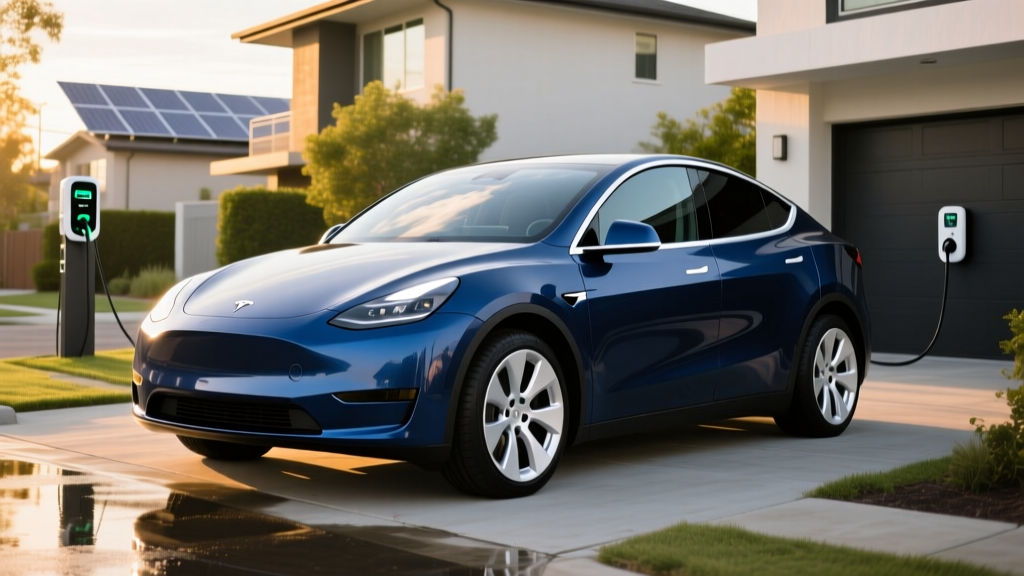
The 2026 Tesla Model Y remains the best-selling electric vehicle in the United States for good reason. It pairs a usable 320-mile EPA range with a 250 kW DC fast-charging peak, a spacious 76-cubic-foot cargo hold, and access to Tesla's Supercharger network — all starting at $44,990 before incentives. For buyers who want a daily-driver EV that handles road trips without drama, the Model Y Long Range AWD is still the segment's default answer. But rising competition from the Hyundai Ioniq 5, Ford Mustang Mach-E, and Chevrolet Equinox EV means the Model Y no longer wins by default — it wins on execution.
One ownership question that comes up constantly: how to apply for Tesla Insurance, Tesla's in-house, usage-aware coverage product available in most states. We'll cover the full application process, how the real-time safety score affects your premium, and whether it undercuts legacy insurers — after we break down the vehicle itself.
Range, Battery, and Real-World Efficiency
| EPA Range | 320 miles |
| Battery (usable) | ~75 kWh, NMC (nickel manganese cobalt) |
| Efficiency | 122 MPGe combined / 27 kWh per 100 mi |
| Peak DC Fast Charge | 250 kW (CCS via NACS adapter or native NACS) |
| 10–80% DC Time | ~27 minutes |
| Level 2 Home Charge | 11.5 kW (~44 mi/hr) |
| Drivetrain | Dual-motor AWD |
| Horsepower | 384 hp combined |
| 0–60 mph | 4.8 seconds |
| Cargo Volume | 30.2 cu ft (rear seats up) / 76.2 cu ft (folded) |
| Base MSRP | $44,990 |
| Battery Warranty | 8 years / 120,000 miles (min 70% retention) |
EPA Sticker vs. Real-World Range
EPA estimate: 320 miles. In mixed driving at 65–70 mph with climate control on, expect 270–290 miles from a full charge. On a pure highway run at 75+ mph in summer heat, that drops closer to 255–270 miles. In freezing weather (below 30°F), plan for 220–245 miles of usable range unless you precondition the battery while plugged in. The Model Y's heat pump helps mitigate cold-weather loss compared to older EVs, but physics still wins in deep winter.
The Model Y Long Range uses an NMC (nickel manganese cobalt) battery pack, which offers higher energy density than the LFP (lithium iron phosphate) chemistry found in the base RWD trim. The trade-off: Tesla recommends daily charging to 80% for NMC packs to maximize longevity, while LFP packs can be charged to 100% daily without accelerated degradation. If you need maximum daily range for a long commute, the base RWD model with its LFP pack and 100% daily charging tolerance is worth considering — though its EPA range is lower at approximately 260 miles.
Charging Speed and Infrastructure
| Charge Level | Power (kW) | Speed (miles/hr) | Typical Use Case |
|---|---|---|---|
| Level 1 (120V outlet) | ~1.4 kW | ~5 mi/hr | Emergency / overnight trickle |
| Level 2 (240V home) | 11.5 kW | ~44 mi/hr | Daily home charging |
| DC Fast (Supercharger V3) | 250 kW peak | ~1,000+ mi/hr (peak) | Road trips, 10–80% in ~27 min |
| DC Fast (Supercharger V4) | Up to 325 kW (capable) | Varies by station | Emerging infrastructure |
At a V3 Supercharger, the Model Y peaks at 250 kW but only holds that rate briefly — typically from around 10% to 25% state of charge. The charge curve then tapers progressively: by 50% SoC you're seeing roughly 150 kW, and by 80% it drops below 60 kW. This is why Tesla (and every other manufacturer) quotes 10–80% times rather than 0–100%. Charging past 80% at a DC fast charger is painfully slow and unnecessary for most road-trip legs.
For home charging, a Wall Connector on a 60-amp circuit delivers the full 11.5 kW (48 amps continuous), adding roughly 44 miles of range per hour. Most owners who charge overnight from 20% to 80% wake up to a full daily budget. Installation costs for a Level 2 home setup typically run $800–$2,000 depending on your electrical panel capacity — budget for a potential panel upgrade if you're in an older home with a 100-amp service.
Performance, Ride, and Daily Driving
The dual-motor AWD Long Range puts down 384 horsepower and hits 60 mph in 4.8 seconds — quick enough to merge onto any freeway with authority, if not quite as brutal as the Performance variant's 3.5-second sprint. The instant torque delivery means real-world acceleration feels even faster than the numbers suggest, particularly in the 0–40 mph range where most daily driving happens.
Ride quality in the refreshed Model Y is noticeably improved over pre-2025 models. Tesla retuned the suspension and added acoustic glass, reducing cabin noise and smoothing out rough pavement. It's still firmer than a Hyundai Ioniq 5 or Ford Mustang Mach-E — you'll feel expansion joints and potholes more than in those competitors — but it no longer feels harsh.
Regenerative braking remains strong and predictable. Tesla's one-pedal driving mode lets you come to a complete stop without touching the brake pedal in most situations, which reduces fatigue in stop-and-go traffic. The steering is precise and quick, though some drivers find it artificially heavy even in Comfort mode.
Interior, Cargo, and Technology
The Model Y's minimalist interior is either refreshing or maddening depending on your preferences. There are virtually no physical buttons — everything routes through the 15.4-inch center touchscreen, including climate controls, glovebox release, and mirror adjustments. The 2026 refresh adds ventilated front seats, ambient lighting, and a rear-seat touchscreen for passengers, addressing some of the most common complaints about earlier models.
Cargo space is a genuine strength: 30.2 cubic feet behind the second row and 76.2 cubic feet with the rear seats folded. The front trunk (frunk) adds 4.1 cubic feet for charging cables or a small bag. Rear-seat legroom is 41.6 inches — adequate for adults on longer trips, though the seat cushion sits a bit low, creating a knees-up posture that some passengers find tiring on drives over three hours.
Autopilot and FSD (Supervised): Every Model Y includes basic Autopilot (traffic-aware cruise control and lane centering). Full Self-Driving (Supervised) is an optional upgrade that adds automated lane changes, city-street navigation, and traffic-light recognition. It is critical to understand that FSD is an SAE Level 2 driver-assistance system — you must keep your hands on the wheel and eyes on the road at all times. It is not autonomous driving. For more on automation levels, see the NHTSA's automated vehicle guidance.
Pros
- 320-mile EPA range with proven real-world usability
- 250 kW DC fast charging with extensive Supercharger network
- Class-leading cargo capacity (76.2 cu ft)
- Over-the-air updates add features post-purchase
- Strong resale value relative to EV segment average
- Heat pump standard for cold-weather efficiency
Cons
- Minimalist interior lacks physical controls
- Firm ride compared to Ioniq 5 and Mach-E
- FSD (Supervised) is Level 2 — not self-driving despite the name
- Insurance costs above segment average
- Panel gaps and build consistency still vary unit to unit
- No Apple CarPlay or Android Auto
Pricing, Tax Credits, and Total Cost
| Trim | MSRP | Federal Credit Potential | Effective Price |
|---|---|---|---|
| Long Range RWD (LFP) | $44,990 | Up to $7,500 (§30D) | From ~$37,490* |
| Long Range AWD (NMC) | $47,990 | Up to $7,500 (§30D) | From ~$40,490* |
| Performance AWD | $52,490 | Up to $7,500 (§30D) | From ~$44,990* |
*Effective price assumes full §30D credit eligibility. Actual credit depends on battery sourcing, buyer income, and MSRP cap compliance. Verify current rules at IRS.gov §30D clean vehicle credits.
The federal EV tax credit under IRS §30D offers up to $7,500, but eligibility is not automatic. Three main hurdles apply:
- MSRP cap: The vehicle must have an MSRP at or below $55,000 for SUVs. All current Model Y trims clear this threshold.
- Buyer income cap: Modified adjusted gross income must not exceed $150,000 (single), $225,000 (head of household), or $300,000 (joint). If you exceed these, you do not qualify.
- Battery sourcing: The battery components and critical minerals must meet phased-in domestic-content and free-trade-agreement requirements that tighten annually. Tesla has worked to qualify the Model Y, but the specific credit amount (full $7,500 vs. partial $3,750) depends on current-year sourcing compliance. Tesla's checkout page displays the estimated credit, and the point-of-sale transfer option lets you apply it as an instant discount rather than waiting for a tax refund.
Always confirm eligibility with a tax professional before relying on the credit in your purchase budget. Rules have changed multiple times since 2023, and the battery-sourcing requirements are the most volatile variable.
How to Apply for Tesla Insurance
Tesla Insurance is a usage-based auto insurance product that Tesla underwrites (or partners with state-regulated insurers to offer) using real-time driving data from the vehicle itself. It's currently available in most U.S. states, though availability and pricing structure vary by jurisdiction. Here's the step-by-step process:
- Open the Tesla app on your phone after taking delivery of your Model Y (or any Tesla vehicle).
- Navigate to "Insurance" in the app menu. If Tesla Insurance is available in your state, you'll see an option to request a quote.
- Enter your details: You'll provide basic information — driver history, address, coverage preferences (liability limits, comprehensive/collision deductibles). Tesla pre-fills vehicle data automatically.
- Review your Safety Score: Tesla Insurance uses a real-time Safety Score (0–100) calculated from five factors: forward collision warning sensitivity, hard braking, aggressive turning, unsafe following, and forced Autopilot disengagements. New policyholders typically start with a default score that adjusts after roughly 100 miles of driving data.
- Select your coverage and bind the policy: Once you choose your limits and deductible, you can activate coverage immediately. Payment is handled through the Tesla app, and your insurance card is available digitally.
- Monitor your monthly premium: Unlike traditional insurers that set a fixed six-month premium, Tesla Insurance in most states recalculates your monthly rate based on your rolling Safety Score. Safe drivers with scores above 90 often see premiums 10–20% below comparable quotes from major carriers. Aggressive driving or frequent hard-braking events can push premiums higher.
Is Tesla Insurance cheaper? It depends heavily on your driving behavior and location. For careful drivers who rarely trigger hard-braking events and use Autopilot on highways, Tesla Insurance frequently undercuts major carriers like Geico or Progressive by $50–$150 per month. For drivers in high-rate states (Michigan, Florida, Louisiana) or those with recent claims, the savings may be minimal or nonexistent. Always pull comparison quotes from at least two traditional insurers before binding a Tesla policy. Check your state's insurance department for consumer protections and complaint ratios.
Key limitation: Tesla Insurance is not available in every state, and in some jurisdictions it operates through a third-party underwriter rather than Tesla directly. The Safety Score model also means your premium is genuinely variable — if your driving habits change or you lend the car to a less careful driver, your rate adjusts the following month.
How the Model Y Compares to Key Competitors
The compact electric SUV segment is crowded in 2026. Here's how the Model Y stacks up against its three most cross-shopped rivals:
- Hyundai Ioniq 5: The Ioniq 5 matches the Model Y on range (~305 mi EPA for the Long Range AWD) and undercuts on price by roughly $3,000. Its 800V architecture enables faster 10–80% charging (~18 minutes at a 350 kW charger). But it has less cargo space (27.2 cu ft rear seats up) and no front trunk. Choose the Ioniq 5 if you prioritize ride comfort and ultra-fast charging over maximum cargo volume and Supercharger access.
- Ford Mustang Mach-E: The Mach-E Extended Range AWD delivers ~312 miles EPA and a more engaging driving feel with a traditional cockpit layout. Cargo space trails the Model Y (29.7 cu ft). Ford's BlueCruise hands-free highway driving is a genuine differentiator on long trips. Choose the Mach-E if you prefer physical controls and a sportier driving experience.
- Chevrolet Equinox EV: Priced from roughly $33,000, the Equinox EV is the value play with ~315 miles of EPA range on the 3RS trim. It's slower to charge (peak ~150 kW) and less refined in ride quality, but it's the most affordable way into a 300+ mile electric SUV. Choose the Equinox EV if budget is the primary constraint.
Choose the Model Y If:
- You want maximum cargo space in a compact electric SUV
- Supercharger network reliability is a priority for road trips
- You value over-the-air feature updates and Tesla's software ecosystem
- You plan to use Tesla Insurance and are a careful driver
Look Elsewhere If:
- You prefer physical buttons and a traditional interior layout
- Ride comfort matters more than acceleration (Ioniq 5 or Mach-E)
- Budget is tight and you need the lowest possible entry price (Equinox EV)
Frequently Asked Questions
What is the real-world range of the 2026 Tesla Model Y?
The EPA rates the Long Range AWD at 320 miles. In real-world mixed driving at highway speeds, expect 270–290 miles. Cold weather below 30°F reduces that to roughly 220–245 miles. Preconditioning while plugged in recovers some of that loss.
How fast does the Model Y charge at home and on the road?
On a Level 2 home charger (240V, 60A circuit), the Model Y charges at 11.5 kW, adding about 44 miles per hour. At a V3 Supercharger, it peaks at 250 kW and charges from 10–80% in approximately 27 minutes. Expect slower rates as the battery fills past 50%.
Does the 2026 Model Y qualify for the federal EV tax credit?
The Model Y is eligible for up to $7,500 under IRS §30D, but you must meet income caps ($150K single / $300K joint), the MSRP must be at or below $55,000 (all trims qualify), and battery sourcing requirements must be met for the specific delivery date. The credit can be applied at point of sale as an instant discount. Verify current eligibility at IRS.gov.
How do I apply for Tesla Insurance?
Open the Tesla app after delivery, navigate to Insurance, request a quote, enter your coverage preferences, and review your Safety Score. You can bind a policy directly in the app. Premiums adjust monthly based on your real-time driving data. Availability varies by state.
Is Tesla Insurance cheaper than traditional auto insurance?
For safe drivers with high Safety Scores (90+), Tesla Insurance is often 10–20% cheaper than major carriers. For aggressive drivers or those in high-rate states, it can be more expensive. Always compare quotes from at least two traditional insurers before committing.
Is the Model Y worth buying over the Ioniq 5 or Mach-E?
The Model Y wins on cargo space (76.2 cu ft), Supercharger network access, and software features. The Ioniq 5 offers faster charging and a smoother ride. The Mach-E provides a more traditional interior and engaging handling. All three are strong — test-drive each before deciding.
What is the battery warranty on the 2026 Model Y?
Tesla covers the battery and drive unit for 8 years or 120,000 miles (whichever comes first) with a minimum 70% capacity retention guarantee. If the battery degrades below 70% of its original capacity within the warranty period, Tesla will repair or replace it at no cost.
What are the biggest drawbacks of the Model Y?
The all-screen interior frustrates drivers who want physical climate and volume controls. Ride quality is firmer than competitors. Insurance costs run above the EV segment average (mitigated by Tesla Insurance for safe drivers). Build quality — panel gaps, paint consistency — has improved but still varies between individual vehicles.