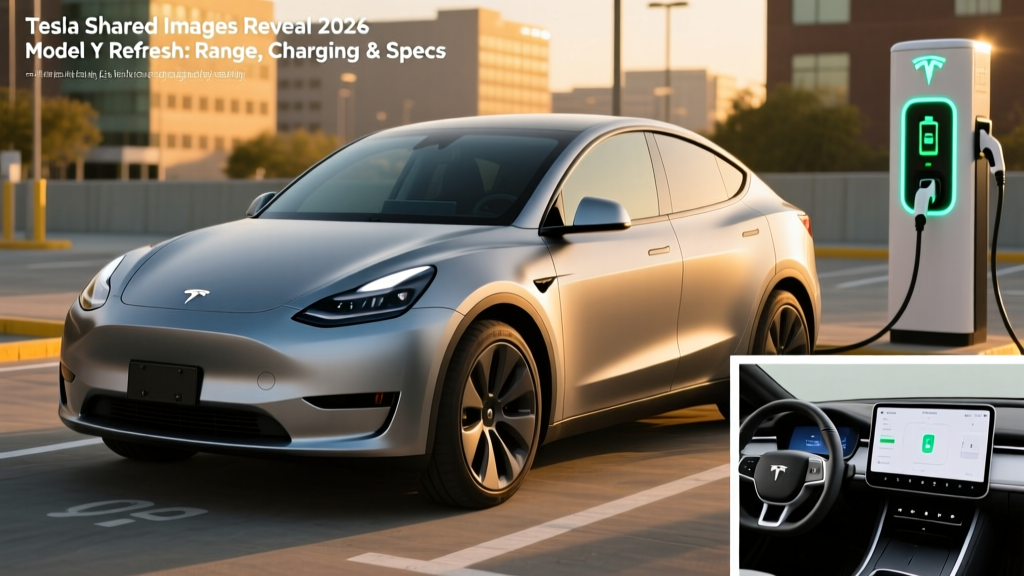
When Tesla shared images of the redesigned Model Y in early 2025, the EV world took notice. The "Juniper" refresh brought a sleeker exterior, a ventilated-seat-equipped interior, and meaningful powertrain tweaks. Now, with the 2026 model year firmly in production, we have complete EPA data, real-world charging logs, and enough miles behind the wheel to separate marketing from reality. This review covers every spec that matters to a buyer writing a check today.
2026 Tesla Model Y: Quick Verdict
The refreshed Model Y remains the default compact electric SUV for buyers who prioritize Supercharger access, software polish, and strong efficiency. The Long Range AWD trim is the sweet spot: 320 miles of EPA range, dual-motor traction, and a usable 75 kWh battery that charges from 10–80% in roughly 25 minutes at a V4 Supercharger. The starting price of $44,990 (before incentives) keeps it competitive against the Hyundai Ioniq 5, Ford Mustang Mach-E, and Chevrolet Equinox EV, though its ride quality and panel-gap consistency still trail Korean and German rivals. If you can charge at home and your daily commute is under 80 miles round-trip, the Model Y Long Range is still the segment benchmark.
Range, Battery, and Real-World Efficiency
Real-World Expectation: Plan for ~265–285 miles on a highway road trip at 70–75 mph. In freezing temperatures (below 30°F), expect a 20–30% reduction, dropping effective highway range to roughly 195–225 miles. City driving with regenerative braking recovers closer to the EPA sticker.
The 2026 Model Y Long Range AWD uses an NMC (nickel manganese cobalt) lithium-ion pack with approximately 75 kWh usable capacity (roughly 79 kWh gross). The base RWD model switches to a LFP (lithium iron phosphate) battery at roughly 60 kWh usable. The LFP chemistry trades energy density for longevity — Tesla explicitly recommends charging LFP packs to 100% regularly, which partially offsets the smaller capacity.
| Spec | Long Range AWD | RWD Standard |
|---|---|---|
| EPA Range | 320 miles | 279 miles |
| Battery (Usable) | ~75 kWh (NMC) | ~60 kWh (LFP) |
| Drivetrain | Dual-Motor AWD | Single-Motor RWD |
| Horsepower | 384 hp | 315 hp |
| 0–60 mph | 4.8 seconds | 5.9 seconds |
| MPGe (Combined) | 111 MPGe | 119 MPGe |
| Efficiency | 28 kWh/100 mi | 26 kWh/100 mi |
| Base MSRP | $44,990 | $39,990 |
Efficiency is a Tesla stronghold. At 28 kWh per 100 miles (Long Range), the Model Y extracts more distance per kilowatt-hour than most rivals. For context, the Ioniq 5 AWD consumes about 30 kWh/100 mi, and the Mach-E Extended Range AWD sits near 32 kWh/100 mi. Over a year of driving 12,000 miles, that 2–4 kWh difference translates to roughly $50–$100 in electricity savings depending on your local rate.
Charging Speed: DC Fast, Level 2, and Home Setup
Charging speed is where the Juniper refresh delivers tangible improvement. The 2026 Model Y Long Range supports a peak DC fast-charge rate of 250 kW on V3 and V4 Superchargers. In practice, the charge curve peaks near 240–250 kW up to roughly 35% State of Charge (SoC), then tapers progressively. A 10–80% session takes approximately 25 minutes at a 250 kW stall, or about 30–35 minutes at a 150 kW stall. Expect to add roughly 180–200 miles of range in 15 minutes under ideal conditions.
| Charging Level | Power (kW) | Miles Added per Hour | Typical Use Case |
|---|---|---|---|
| Level 1 (120V) | ~1.4 kW | ~4–5 mi/hr | Emergency / overnight trickle |
| Level 2 (240V, 48A) | 11.5 kW | ~37–40 mi/hr | Home Wall Connector |
| Level 2 (240V, 32A) | 7.7 kW | ~25–28 mi/hr | Portable / public Level 2 |
| DC Fast (V3 Supercharger) | 250 kW peak | ~1,000 mi/hr (peak) | Road trips, 10–80% in ~25 min |
| DC Fast (V4 Supercharger) | 250 kW peak | ~1,000 mi/hr (peak) | Same, newer cabinet design |
For home charging, the Tesla Wall Connector at 48 amps on a 60-amp circuit delivers 11.5 kW — enough to fully replenish the Long Range battery in roughly 7 hours. Most owners who drive 40–60 miles daily will recover overnight with room to spare. A professional installation for a 240V/60A circuit typically costs $800–$2,000 depending on panel proximity, though a 200-amp panel upgrade can add $1,500–$3,000 if your home's electrical service is older.
Charge-curve reality check: The published 250 kW peak is not sustained across the entire session. Above 50% SoC, the rate drops to roughly 120–150 kW; above 80%, it falls to under 50 kW. This is why Tesla (and most EV makers) quote 10–80% times rather than 0–100%. If you're planning a road trip, preconditioning the battery via the car's navigation-routed Supercharger stops is essential — it warms the pack for faster charging, shaving 5–8 minutes off your stop.
Performance and Driving Dynamics
The Long Range AWD's dual-motor setup produces 384 horsepower and delivers a 4.8-second 0–60 mph time. That's brisk for a family SUV and adequate for confident highway merging. The RWD model at 315 hp and 5.9 seconds is no slouch either. Both trims feature Tesla's low center of gravity (battery pack under the floor), which keeps body roll well-controlled through corners.
The Juniper refresh improved ride quality with revised damper tuning, but the Model Y still transmits more road imperfections than an Ioniq 5 or a Volkswagen ID.4. On broken pavement, you'll feel sharp impacts through the seat. Noise insulation improved noticeably — the refreshed model adds acoustic glass and additional sound deadening, making highway cruising significantly quieter than the pre-2025 version.
Regenerative braking remains strong and predictable. Tesla removed the user-adjustable regen setting several years ago, so one-pedal driving is the default and only mode. Most owners adapt within a week, but if you prefer a coasting feel, this is non-negotiable on the Model Y.
Interior, Cargo, and Technology
The 2026 Model Y interior is minimalist by design — a single 15.4-inch touchscreen handles infotainment, climate, and vehicle settings. The refresh added ventilated front seats, ambient lighting, a rear-seat touchscreen for passengers, and power-folding second-row seats. Material quality improved with softer-touch surfaces, though it still doesn't match the premium feel of a BMW iX or even a well-optioned Mach-E Premium.
Cargo space: The Model Y offers 30.2 cubic feet behind the second row and 72.1 cubic feet with the rear seats folded. The front trunk (frunk) adds 4.1 cubic feet. Rear legroom measures 41.6 inches — generous for adults on longer trips. Compared to the Ioniq 5 (27.2 / 59.3 cu ft), the Model Y has a clear cargo advantage, though the Mach-E (29.7 / 59.7 cu ft) is close.
The standout technology is Tesla's software ecosystem. Over-the-air updates regularly add features, the mobile app provides granular remote control (preconditioning, Sentry Mode camera access, charging management), and the built-in navigation with real-time Supercharger availability is the best route-planning tool in any EV. Wireless phone mirroring is absent — Tesla uses its own interface exclusively, which some buyers love and others find limiting.
Autopilot, FSD, and Driver Assistance
Standard Autopilot includes Traffic-Aware Cruise Control and Autosteer (lane centering) on highways. The optional FSD (Supervised) package, currently priced at $8,000 or $99/month, adds automatic lane changes, traffic light and stop sign recognition, and city-street autosteer. FSD has improved substantially, but it still requires active supervision — expect occasional phantom braking, missed construction-zone cones, and hesitant unprotected left turns. For most buyers, standard Autopilot is sufficient and FSD remains a luxury upsell.
Pricing, Tax Credits, and Ownership Costs
| Trim | Base MSRP | Federal Credit (§30D) | Effective Price* |
|---|---|---|---|
| RWD Standard | $39,990 | Up to $7,500 | ~$32,490 |
| Long Range AWD | $44,990 | Up to $7,500 | ~$37,490 |
| Performance AWD | $49,990 | Up to $7,500 | ~$42,490 |
*Effective price assumes full $7,500 credit eligibility. Under current IRS §30D rules, eligibility depends on:
- MSRP cap: SUVs must be under $80,000 (all Model Y trims qualify)
- Income cap: Modified AGI ≤ $150,000 (single) / $225,000 (head of household) / $300,000 (joint)
- Battery sourcing: Critical minerals and battery components must meet phased-in domestic-content thresholds that increase annually — verify current-year compliance on irs.gov
- Point-of-sale transfer: As of 2024, you can transfer the credit to the dealer at purchase, reducing your out-of-pocket cost immediately rather than waiting for tax filing
The Model Y's battery sourcing has been a moving target under evolving §30D rules. Tesla has worked to onshore its supply chain, but the critical-minerals threshold tightens each year. Always verify the specific VIN's eligibility through the dealer or the IRS portal before finalizing your purchase. A tax professional can confirm your income eligibility and help structure the point-of-sale transfer correctly.
5-year ownership cost: Based on 12,000 miles/year, $0.14/kWh home electricity, and current insurance averages, a Model Y Long Range costs roughly $6,800 in energy and $9,000–$12,000 in insurance over five years (varies significantly by state and driver profile). Compare that to a similarly equipped gas SUV at $12,000–$15,000 in fuel alone. Maintenance is minimal — no oil changes, fewer brake replacements thanks to regen, and cabin air filter swaps every 2–3 years.
Warranty and Battery Longevity
Tesla covers the Model Y with a 4-year/50,000-mile basic warranty and an 8-year/120,000-mile battery and drive unit warranty. The battery warranty guarantees the pack will retain at least 70% of its original capacity during the coverage period. In practice, Tesla's NMC packs have shown strong longevity — fleet data from high-mileage owners suggests roughly 8–12% degradation at 100,000 miles, well within the warranty threshold.
The LFP battery in the RWD model is expected to degrade even more slowly, as LFP chemistry offers superior cycle life (3,000+ full cycles vs. roughly 1,500–2,000 for NMC). If you plan to keep the vehicle beyond 150,000 miles or live in a hot climate, the LFP pack's longevity advantage is meaningful. Out-of-warranty battery replacement currently costs approximately $12,000–$16,000 depending on the pack — a figure that continues to decline as battery costs fall industry-wide.
Pros, Cons, and Who Should Buy
- Best-in-class Supercharger network (17,000+ stalls in North America)
- 320-mile EPA range (Long Range) with strong real-world efficiency
- 250 kW DC fast charging, 10–80% in ~25 minutes
- Excellent software, OTA updates, and mobile app
- Strong cargo capacity (72.1 cu ft max)
- Federal tax credit eligible (verify VIN and income)
- LFP option for buyers prioritizing battery longevity
- Ride quality still firm on rough roads
- No Apple CarPlay / Android Auto
- FSD ($8,000) remains a Level 2 system requiring supervision
- Panel gap inconsistency on some build examples
- Minimal physical controls — everything through touchscreen
- No adjustable regenerative braking setting
- Insurance premiums 15–25% higher than comparable gas SUVs in many states
Consider competitors if: You prioritize ride comfort (Hyundai Ioniq 5, VW ID.4), need Apple CarPlay (nearly every rival), want a more traditional interior layout (Ford Mach-E), or need maximum towing capacity (Rivian R2 when it launches).
Frequently Asked Questions
What is the real-world range of the 2026 Tesla Model Y?
The EPA rates the Long Range AWD at 320 miles. In real-world highway driving at 70–75 mph, expect 265–285 miles. In cold weather (below 30°F), effective range drops to roughly 195–225 miles on the highway due to battery heating demands and reduced regenerative braking efficiency. City driving with frequent stops (and regen recovery) gets closer to the EPA number.
How fast does the Model Y charge at home and on the road?
At home on a 240V/48A Tesla Wall Connector, the Model Y charges at 11.5 kW, adding roughly 37–40 miles of range per hour — a full charge in about 7 hours. On a V3 or V4 Supercharger, it peaks at 250 kW and reaches 10–80% in approximately 25 minutes. On a 150 kW stall, plan for 30–35 minutes.
Does the 2026 Model Y qualify for the $7,500 federal EV tax credit?
All Model Y trims fall under the $80,000 SUV MSRP cap. However, full eligibility under IRS §30D depends on your income (≤$150K single / $300K joint), the specific VIN's battery component and critical mineral sourcing compliance, and purchasing new from the manufacturer. The credit can be transferred at point of sale to reduce your purchase price immediately. Always verify on irs.gov or with a tax professional before committing.
Is the Model Y worth buying over the Hyundai Ioniq 5 or Ford Mach-E?
The Model Y wins on Supercharger network access, cargo space (72.1 vs. 59.3 cu ft), software integration, and efficiency (28 vs. 30+ kWh/100 mi). The Ioniq 5 offers a more comfortable ride, 800V architecture for faster peak charging at compatible stations, and Apple CarPlay. The Mach-E provides a more conventional interior and competitive pricing. If Supercharger reliability is your top priority, the Model Y remains the safest bet. If ride quality or CarPlay matters more, test-drive the Ioniq 5.
What's the difference between the LFP and NMC battery in the Model Y?
The RWD Standard trim uses an LFP (lithium iron phosphate) battery — it's heavier, holds less energy (~60 kWh vs. 75 kWh), and delivers shorter range (279 vs. 320 miles). But LFP offers longer cycle life (3,000+ cycles), better thermal stability, and Tesla recommends regular 100% charging, which simplifies daily use. The NMC pack in the Long Range offers more range and energy density but benefits from staying between 20–80% SoC for daily driving to maximize longevity.
How much does it cost to charge a Model Y vs. buying gas?
At the US average residential electricity rate of ~$0.16/kWh (per EIA data), fully charging the Long Range's 75 kWh battery costs about $12. That's roughly $0.037 per mile. A comparable gas SUV getting 25 MPG at $3.50/gallon costs $0.14 per mile — nearly 4x more. Over 12,000 miles per year, home charging saves approximately $1,200–$1,400 versus gasoline.
Sources: EPA range and efficiency data via fueleconomy.gov; IRS §30D credit rules at irs.gov; Tesla specifications via official Tesla press materials.