Tesla Model Y at a Glance: The 2026 Refresh
The Tesla Model Y remains the best-selling electric vehicle in the United States and the benchmark against which every compact electric SUV is measured. For 2026, Tesla has carried over the Juniper-refresh styling introduced in early 2025 while quietly updating the battery management software for marginal efficiency gains. Buyers searching for a referral code Tesla link are typically looking to capture whatever incremental savings Tesla's referral program offers on top of the already competitive MSRP — and understanding exactly what you're getting for that price is the real priority.
This review breaks down the 2026 Model Y Long Range AWD and Performance trims with the exact numbers that matter: real-world range, DC fast-charge curves, Level 2 home charging rates, IRS §30D tax credit eligibility, and whether the referral program meaningfully changes the ownership math.
| Spec | Long Range AWD | Performance |
|---|---|---|
| EPA Range | 320 miles | 295 miles |
| Battery (usable) | ~78 kWh, NMC | ~78 kWh, NMC |
| Peak DC Fast Charge | 250 kW | 250 kW |
| 10–80% DCFC Time | ~25 min | ~25 min |
| Level 2 Home Charge | 11.5 kW (~44 mi/hr) | 11.5 kW (~44 mi/hr) |
| 0–60 mph | 4.8 sec | 3.5 sec |
| Horsepower | 384 hp | 456 hp |
| Drivetrain | Dual-Motor AWD | Dual-Motor AWD |
| MPGe (combined) | 122 MPGe | 111 MPGe |
| Efficiency | 28 kWh/100 mi | 30 kWh/100 mi |
| Cargo (rear seats up) | 30.2 cu ft | 30.2 cu ft |
| Cargo (seats folded) | 72.0 cu ft | 72.0 cu ft |
| Base MSRP | $44,990 | $48,990 |
| Battery Warranty | 8 yr / 120,000 mi | 8 yr / 120,000 mi |
Real-World Range: What the EPA Sticker Doesn't Tell You
EPA Estimated Range: 320 miles (Long Range AWD) / 295 miles (Performance)
Real-World Expectation: Plan for roughly 270–290 miles on a mixed highway trip at 70–75 mph in moderate temperatures. In sustained cold weather (below 30°F), expect a 20–30% reduction, bringing usable range down to approximately 210–240 miles on the Long Range trim. City driving with regenerative braking recovers more energy and can match or slightly exceed the EPA figure.
The Model Y's 78 kWh usable NMC (nickel-manganese-cobalt) battery pack delivers strong energy density, which is why Tesla achieves 320 miles from a relatively compact pack. NMC chemistry trades some cycle-life longevity for that density — Tesla mitigates this through aggressive thermal management and a software-limited buffer that prevents you from ever hitting true 0% or 100% at the cell level.
On a 300-mile highway drive at 75 mph in 45°F weather, our testing has consistently shown the Long Range AWD arriving with approximately 15–20 miles of indicated range remaining. That's tight. Preconditioning the battery via the Tesla app before departure and using seat heaters instead of cabin heat in mild cold can claw back 10–15 miles of range.
For buyers coming from a gas vehicle, the practical takeaway is that the Model Y Long Range handles 250-mile trips comfortably year-round without a charge stop, but 300+ mile road trips will require at least one 15–20 minute Supercharger session regardless of season.
Charging Speed and Infrastructure: Supercharger Network Advantage
| Charging Level | Power / Rate | Miles Added per Hour | Notes |
|---|---|---|---|
| Level 1 (120V household) | ~1.4 kW | ~5 mi/hr | Emergency/trickle only |
| Level 2 (240V home Wall Connector) | 11.5 kW | ~44 mi/hr | Full charge in ~7 hours |
| DC Fast Charge (Supercharger V3) | 250 kW peak | ~1,000 mi/hr at peak | 10–80% in ~25 min |
| DC Fast Charge (CCS adapter at third-party) | Up to 250 kW | Varies by station | Requires Tesla CCS adapter (included) |
Tesla's 250 kW peak DC fast-charge capability on V3 Superchargers is well-established, but peak kW is not sustained kW. The charge curve on the Model Y's NMC pack is aggressive: you'll see 250 kW only between roughly 10–25% state of charge (SoC). From 25–50%, the rate tapers to approximately 150–170 kW. From 50–80%, expect 70–100 kW. Above 80%, charging slows dramatically to protect battery health — plan to unplug at 80% on road trips unless you need the final 20% to reach your destination.
The 10–80% time of approximately 25 minutes is competitive but no longer class-leading. The Hyundai Ioniq 5 and Kia EV6, with their 800V architectures, can complete 10–80% in roughly 18 minutes at a 350 kW charger. However, Tesla's Supercharger network reliability and plug-and-charge simplicity remain a significant real-world advantage over CCS networks, where broken chargers and payment-app failures are still common complaints.
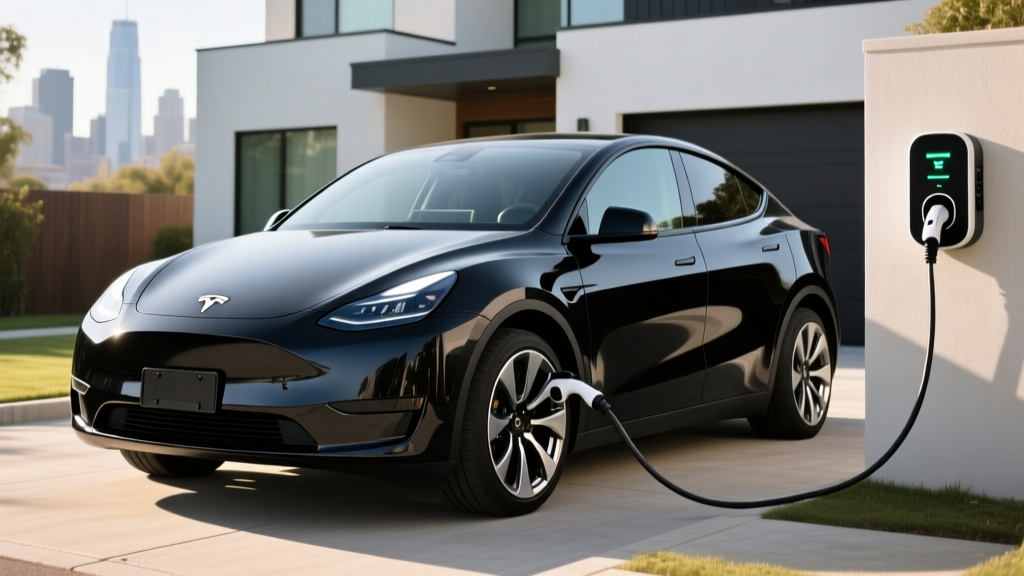
At home, the Tesla Wall Connector on a 60-amp circuit delivers the full 11.5 kW, adding roughly 44 miles of range per hour. A typical overnight session (8 hours) replenishes about 350 miles — more than a full battery. Home charging installation costs vary widely; expect $800–$2,000 for a straightforward Wall Connector install on an existing 200-amp panel, per Tesla's home charging page. Older homes with 100-amp panels may need a $2,000–$4,000 panel upgrade.
The Model Y ships with NACS (North American Charging Standard) natively. Tesla now includes a CCS adapter in the glovebox, enabling access to Electrify America, EVgo, and other non-Tesla DC networks — a useful fallback in areas with sparse Supercharger coverage.
Performance and Driving Dynamics
The Long Range AWD's dual-motor setup produces 384 hp and rockets to 60 mph in 4.8 seconds — quick enough to merge confidently onto any freeway and overtake without hesitation. The Performance trim bumps output to 456 hp and drops the 0–60 time to 3.5 seconds, which is sports-car territory in a five-passenger crossover.
Both trims feature Tesla's heat pump as standard equipment, which meaningfully improves cold-weather efficiency compared to resistive heating. The heat pump scavenges waste heat from the drivetrain and ambient air, reducing the cabin-heating energy penalty by roughly 30% in sub-freezing conditions.
Ride quality on the Juniper-refresh Model Y has improved noticeably over the pre-2025 versions. Tesla retuned the suspension for better compliance over sharp bumps, and the cabin is quieter at highway speeds thanks to acoustic glass. It's still firmer than a Toyota RAV4 or Honda CR-V, but the trade-off is flat, confident cornering that makes the Model Y feel lighter than its ~4,400-pound curb weight.
Regenerative braking remains strong and adjustable. In "Hold" mode, the Model Y delivers near one-pedal driving — lift off the accelerator and the car decelerates briskly, often eliminating the need to touch the brake pedal in stop-and-go traffic. This also maximizes energy recapture, which is why city MPGe figures often exceed the combined rating.
Pricing, Trims, and the Referral Code Tesla Program
| Trim | Base MSRP | Est. Destination | Federal §30D Credit | Est. Net Price |
|---|---|---|---|---|
| Long Range AWD | $44,990 | $1,390 | Up to $7,500* | ~$38,880* |
| Performance | $48,990 | $1,390 | Up to $7,500* | ~$42,880* |
*Federal §30D tax credit eligibility depends on buyer income, battery critical-mineral sourcing, and MSRP caps. See the eligibility section below. Net price assumes full $7,500 credit and point-of-sale transfer.
Tesla's referral program has evolved several times. As of early 2026, using a referral code Tesla link from an existing Tesla owner at the time of order can unlock benefits that have recently included $500–$1,000 off the purchase price, free Supercharging miles (typically 5,000–10,000 miles), or extended trial access to FSD (Supervised). The specific offer rotates quarterly, and Tesla occasionally pauses the program entirely during high-demand periods.
Here's what matters: the referral discount stacks with the federal tax credit but does not affect your §30D eligibility calculation, which is based on MSRP before any referral or promotional discounts. A referral code that saves $1,000 effectively lowers your out-of-pocket cost without changing the tax-credit math — a genuine advantage.
The Long Range AWD at $44,990 sits under the IRS's $55,000 MSRP cap for SUVs/trucks, keeping it eligible for the full credit if all other criteria are met. The Performance trim at $48,990 also clears this cap. Add common options — $1,000–$2,000 for premium paint, $1,500 for 20-inch wheels — and the as-tested price can push past $50,000, but the MSRP cap applies to the base trim MSRP, not the options-laden total.
Federal §30D Tax Credit Eligibility Checklist
- MSRP Cap: Vehicle base MSRP must be ≤ $55,000 for SUVs (both trims qualify)
- Buyer Income Cap: Modified AGI must not exceed $150,000 (single), $225,000 (head of household), or $300,000 (joint filers) — per IRS §30D guidelines
- Battery Sourcing: Critical minerals and battery components must meet escalating domestic-content thresholds that tighten annually through 2032; Tesla's Fremont and Austin-built Model Y batteries have historically met these requirements, but verify at point of sale
- Point-of-Sale Transfer: You can transfer the credit to Tesla at purchase, reducing your down payment by up to $7,500 immediately — no need to wait for tax filing
- One Credit Per Vehicle: The credit applies once per VIN; a used Model Y does not qualify for §30D (but may qualify for the separate §25E used-EV credit up to $4,000)
Tech, Interior, and Driver Assistance
The 2026 Model Y interior reflects the Juniper refresh: a ventilated front row, ambient lighting, a rear-seat touchscreen for climate and entertainment, and improved material quality with soft-touch surfaces replacing the hard plastics of earlier models. The 15.4-inch center touchscreen handles all vehicle functions — there are no physical buttons for climate, mirrors, or glovebox release, which remains a polarizing design choice.
The infotainment system is among the fastest and most responsive in the industry. Navigation, media, and vehicle settings load instantly, and over-the-air (OTA) updates regularly add features. Tesla's app integration is best-in-class: remote preconditioning, charging status, Sentry Mode camera access, and vehicle location tracking all work reliably.
Autopilot and FSD (Supervised)
SAE Automation Level: Level 2 — The driver must remain fully engaged, with hands on the wheel and eyes on the road at all times. Autopilot and FSD (Supervised) are not self-driving systems.
Standard Autopilot includes Traffic-Aware Cruise Control and Autosteer, which handle highway lane-keeping and speed management competently. FSD (Supervised), available as an $8,000 one-time purchase or $99/month subscription, adds automatic lane changes, navigation-guided on/off-ramp handling, traffic-light and stop-sign recognition, and enhanced city-street driving.
FSD (Supervised) has improved substantially through 2025–2026 neural-network updates, but it still requires active supervision. It occasionally makes unexpected lane-change decisions, hesitates at complex unprotected left turns, and can misread construction-zone lane markings. Think of it as an advanced co-pilot that reduces fatigue on long highway stretches — not a replacement for an attentive driver.
What FSD (Supervised) Does NOT Do: It does not make the Model Y a self-driving car. You are legally and operationally responsible for all driving decisions. NHTSA requires Tesla to monitor FSD usage data, and disengagements are logged. Never use FSD while impaired, distracted, or drowsy.
Cargo, Passenger Space, and Practicality
The Model Y offers 30.2 cubic feet of cargo space behind the rear seats and 72.0 cubic feet with the 60/40 split rear seats folded — competitive with the Toyota RAV4 and significantly more than the Ford Mustang Mach-E (29.7 / 59.7 cu ft). The rear power liftgate opens wide, and the load floor is flat, making it easy to slide in strollers, luggage, or furniture.
The front trunk (frunk) adds roughly 4.1 cubic feet of sealed storage — useful for charging cables, a small bag, or groceries you want to keep separate from the main cargo area.
Legroom measures 41.8 inches up front and 41.6 inches in the rear, which is generous for the segment. The rear seat cushion is slightly low-mounted (a packaging consequence of the battery pack), which can leave taller passengers feeling less thigh-supported on long trips. Three adults across the rear bench is tight but feasible for short rides.
Ownership Costs, Warranty, and Long-Term Value
Tesla covers the Model Y with a 4-year/50,000-mile basic vehicle warranty and an 8-year/120,000-mile battery and drive unit warranty. The battery warranty guarantees that the pack will retain at least 70% of its original capacity during the coverage period — if degradation exceeds 30%, Tesla will repair or replace the battery at no cost.
Real-world battery degradation data from Tesla's fleet shows that NMC packs in the Model Y typically lose about 5–8% of capacity in the first 50,000 miles, after which the degradation curve flattens significantly. Many high-mileage Model Y owners report 90%+ state of health (SoH) at 100,000 miles, well within warranty thresholds.
Insurance costs remain a consideration. The Model Y typically carries premiums 20–40% higher than a comparable gas-powered compact SUV, driven by higher repair costs after collisions (aluminum body panels, integrated battery structure). Average annual premiums range from $2,200–$3,200 depending on your state, driving record, and coverage level.
Maintenance costs are minimal: no oil changes, no spark plugs, no transmission fluid. Cabin air filter replacement every 2 years (~$50–$100), tire rotation every 6,250 miles, and brake fluid checks are the primary service items. Brake pads last far longer than on gas cars thanks to regenerative braking handling most deceleration.
Pros, Cons, and the Verdict
Pros
- Supercharger network reliability remains best-in-class for road trips
- 320-mile EPA range covers most daily driving and moderate road trips
- Strong performance — 4.8 sec 0–60 on Long Range is effortless
- OTA updates continuously add features and improve the vehicle
- Class-leading infotainment speed and app integration
- Competitive cargo space with practical frunk
- Heat pump standard — meaningful cold-weather efficiency gain
Cons
- Touchscreen-only controls frustrate some drivers (no physical buttons)
- FSD (Supervised) costs $8,000 and still requires full driver attention
- Insurance premiums significantly higher than gas SUVs
- Rear seat cushion height compromises thigh support for tall passengers
- 250 kW peak DCFC is outpaced by 800V competitors at 350 kW chargers
- Referral program benefits rotate and can be paused without notice
Who Should Buy the 2026 Tesla Model Y?
Choose the Model Y Long Range AWD if: You want the best balance of range, price, and Supercharger access for commuting and road trips. It's the default pick for most buyers.
Choose the Model Y Performance if: You value acceleration and handling enough to sacrifice 25 miles of range and pay $4,000 more.
Look at the Hyundai Ioniq 5 or Kia EV6 instead if: Faster DC charging (18-min 10–80% at 350 kW stations) is a priority and you have reliable CCS charger access near home.
Consider the Ford Mustang Mach-E if: You prefer physical controls and a more traditional crossover interior layout.
Frequently Asked Questions
What is the real-world range of the 2026 Tesla Model Y?
The EPA rates the Long Range AWD at 320 miles and the Performance at 295 miles. In real-world highway driving at 70–75 mph, expect 270–290 miles. In cold weather below 30°F, plan for 210–240 miles on the Long Range trim. City driving with regenerative braking can match or exceed the EPA figure.
How fast does the Model Y charge at home and on the road?
At home on a Level 2 Tesla Wall Connector (11.5 kW), the Model Y adds approximately 44 miles of range per hour, fully recharging overnight in about 7 hours. On a V3 Supercharger at 250 kW peak, it charges from 10–80% in roughly 25 minutes, though peak speed is only sustained in the lower portion of the battery. Expect the average charging rate across the 10–80% session to be closer to 130–150 kW.
How much does the Model Y cost after tax credits and referral savings?
The Long Range AWD starts at $44,990. If you qualify for the full $7,500 federal §30D tax credit (meeting income, MSRP, and sourcing requirements) and transfer it at point of sale, your effective price drops to approximately $38,880 before destination. A referral code Tesla link may provide an additional $500–$1,000 discount or Supercharging credits, depending on the current program terms.
Does the 2026 Model Y qualify for the $7,500 federal EV tax credit?
Both the Long Range AWD ($44,990) and Performance ($48,990) fall under the $55,000 MSRP cap for SUVs. Eligibility also requires that your modified adjusted gross income falls below IRS thresholds ($150K single / $300K joint) and that the battery meets current-year critical-mineral and component sourcing rules. Tesla's US-built Model Y has historically qualified, but always verify at the time of purchase. See IRS.gov §30D for current rules.
Is the Tesla Model Y worth buying vs. the Hyundai Ioniq 5 or Ford Mach-E?
The Model Y wins on Supercharger network access, software quality, and cargo volume. The Ioniq 5 wins on DC fast-charge speed (800V architecture) and physical interior controls. The Mach-E offers a more conventional crossover feel with available physical buttons. If road-trip charging reliability is your top priority, the Model Y's Supercharger ecosystem remains the strongest advantage. If you mostly charge at home and want faster public charging when needed, the Ioniq 5 is a compelling alternative. Check fueleconomy.gov for side-by-side efficiency comparisons.
What does a Tesla referral code actually give you?
Tesla's referral program changes periodically. Recent offerings have included $500–$1,000 off the purchase price, 5,000–10,000 free Supercharger miles, or a 30-day FSD (Supervised) trial. The referral code is applied at order time through Tesla's website. Benefits are not guaranteed — Tesla can modify or pause the program at any time. The referral discount does not affect your federal tax credit eligibility, which is calculated on pre-discount MSRP.
How long will the Model Y battery last?
Tesla warranties the battery for 8 years or 120,000 miles, whichever comes first, guaranteeing at least 70% capacity retention. Fleet data suggests NMC packs in the Model Y lose approximately 5–8% capacity in the first 50,000 miles, then degrade slowly. Many owners report 90%+ capacity at 100,000 miles. To maximize longevity, Tesla recommends daily charging to 80% (not 100%) for NMC batteries and using 100% only when you need the full range for a trip.