Quick Verdict: America's Best-Selling EV Still Sets the Charging Pace
The Tesla Model Y remains the benchmark compact electric SUV for buyers who prioritize charging infrastructure and software integration above all else. For the 2026 model year, the Long Range AWD variant delivers an EPA-estimated 320 miles of range, a 250 kW peak DC fast-charge rate, and access to Tesla's 6,000+ North American Supercharger network — the most reliable public charging ecosystem available. With a starting MSRP of $44,990 (and the Standard Range RWD at $31,490), the Model Y occupies a unique position: it's simultaneously a mass-market family hauler and a tech-forward commuter, though rivals like the Hyundai Ioniq 5 and Ford Mustang Mach-E have narrowed the gap in interior quality and ride comfort.
This review breaks down the recharge time for Tesla Model Y variants, real-world range expectations, ownership economics, and whether it still earns its market-leading position in 2026.
Range & Efficiency: EPA Sticker vs. Real-World Miles
| Variant | Battery (kWh usable) | Chemistry | EPA Range | MPGe (combined) | kWh/100 mi |
|---|---|---|---|---|---|
| Standard Range RWD | ~60 kWh | LFP | 260 mi | 137 MPGe | 24 |
| Long Range AWD | ~75 kWh | NMC | 320 mi | 122 MPGe | 27 |
| Performance AWD | ~75 kWh | NMC | 293 mi | 111 MPGe | 30 |
The Long Range AWD's 27 kWh/100mi efficiency is competitive but no longer class-leading. Hyundai's Ioniq 5 achieves similar range with slightly better efficiency thanks to its 800V architecture. However, Tesla's heat pump (standard on all 2026 Model Y variants) gives it a meaningful cold-weather edge over rivals that rely on resistive cabin heating.
Recharge Time for Tesla Model Y: DC Fast, Level 2, and Level 1
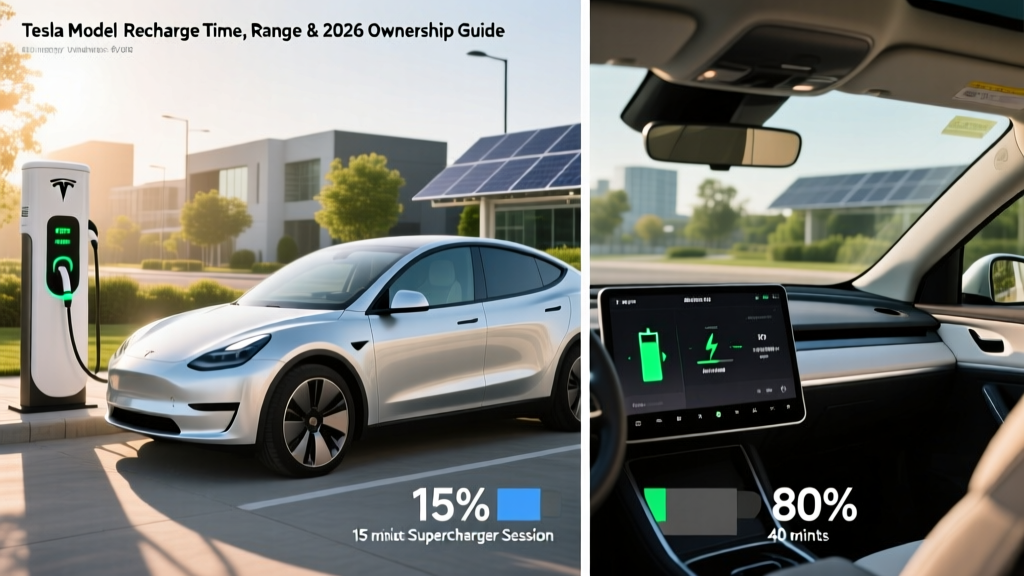
The recharge time for Tesla Model Y variants depends heavily on which charger you use and the battery chemistry involved. Here's the complete breakdown:
| Charging Method | Max Power | Miles Added per Hour | 10–80% Time | Notes |
|---|---|---|---|---|
| DC Fast Charge (V3 Supercharger) | 250 kW peak | ~1,000 mi/hr (peak) | ~22 minutes (LR AWD) | Peak only below 40% SoC; tapers sharply above 60% |
| DC Fast Charge (V4 Supercharger) | 250 kW (current) | ~1,000 mi/hr (peak) | ~22 minutes (LR AWD) | Newer stalls; same peak rate for Model Y architecture |
| Home Level 2 (Tesla Wall Connector, 48A) | 11.5 kW | ~44 mi/hr | ~7.5 hours (full) | Requires 60A circuit; NACS connector native |
| Home Level 2 (Generic J1772 w/ adapter) | 7.2–9.6 kW | ~28–37 mi/hr | ~10–9 hours (full) | Works with adapter included in 2026 models |
| Level 1 (120V outlet) | ~1.4 kW | ~3–5 mi/hr | N/A (trickle) | Emergency/top-up only; ~50 mi overnight |
Charging curve reality: The 250 kW peak rate only holds between roughly 10–40% state of charge. Above 50%, the rate drops to ~150 kW, and above 80% it falls below 60 kW. This is why Tesla (and the industry) quote 10–80% times — charging beyond 80% at a DC fast charger is painfully slow and should be reserved for destination charging at home. On a road trip, plan your stops around the 10–80% window for maximum efficiency.
The LFP Standard Range variant charges slightly slower at DC fast chargers (peak ~170 kW, 10–80% in ~25 minutes) but has a significant advantage: Tesla recommends charging LFP batteries to 100% regularly for accurate state-of-charge calibration, whereas NMC batteries last longer when daily-charged to 80%. This means the Standard Range model's usable daily range is closer to its full 260 miles, while the Long Range owner typically uses ~256 miles of daily capacity (80% of 320).
Performance, Drivetrain & Real-World Driving
| Variant | Drivetrain | Horsepower | 0–60 mph | Top Speed |
|---|---|---|---|---|
| Standard Range RWD | Rear-Wheel Drive | ~295 hp | 6.5 sec | 135 mph |
| Long Range AWD | Dual-Motor AWD | ~384 hp | 4.8 sec | 135 mph |
| Performance AWD | Dual-Motor AWD | ~456 hp | 3.5 sec | 155 mph |
The Long Range AWD strikes the best balance for most buyers. Its 4.8-second 0–60 time is genuinely quick for a family SUV, and the dual-motor all-wheel-drive system provides confident traction in rain and light snow. The Performance variant's 3.5-second sprint is supercar territory, but the 27-mile range penalty and firmer ride make it harder to justify unless you prioritize acceleration above all else.
Regenerative braking in the Model Y is aggressive and effectively enables one-pedal driving in most scenarios. The 2026 model retains Tesla's blended braking system, which seamlessly transitions between regen and friction brakes, though some drivers note the brake pedal feel remains somewhat artificial compared to the Hyundai Ioniq 5's more traditional pedal response.
Interior Space, Cargo & Technology
The 2026 Model Y continues with Tesla's minimalist interior approach — a 15.4-inch center touchscreen handles virtually all vehicle functions, climate controls, and infotainment. The updated "Juniper" refresh (introduced for the 2025 model year and carried into 2026) added ventilated front seats, ambient lighting, a rear-seat touchscreen, and improved sound insulation, addressing longstanding complaints about cabin noise and spartan trim.
| Dimension | Measurement |
|---|---|
| Front headroom | 41.0 in |
| Rear headroom | 38.4 in |
| Front legroom | 41.8 in |
| Rear legroom | 37.0 in |
| Cargo (behind 2nd row) | 30.2 cu ft |
| Cargo (seats folded) | 72.1 cu ft |
| Front trunk (frunk) | 4.1 cu ft |
Cargo volume is generous for the segment, though the sloping roofline cuts into vertical space for tall items compared to boxier competitors like the Kia EV9 or even the Ford Mustang Mach-E. The 4.1 cu ft frunk is useful for charging cables and groceries but smaller than the Ioniq 5's 2.0 cu ft frunk (the Ioniq 5's advantage is its overall hatchback design).
Standout tech: Tesla's infotainment system remains the most responsive in the industry, with native streaming apps, a built-in trip planner that accounts for charging stops, and over-the-air updates that regularly add features. The available Full Self-Driving (Supervised) package ($8,000 one-time or $99/month) provides hands-on, eyes-on highway and city street driving assistance. Note: FSD is an SAE Level 2 system — the driver must remain fully engaged and responsible at all times. It is not autonomous driving.
Pricing, Trim Levels & Federal Tax Credit
| Trim | Base MSRP | Est. After §30D Credit* | Destination |
|---|---|---|---|
| Standard Range RWD | $31,490 | ~$23,990 | $1,390 |
| Long Range AWD | $44,990 | ~$37,490 | $1,390 |
| Performance AWD | $49,990 | ~$42,490 | $1,390 |
*Federal tax credit estimates assume full eligibility. Actual credit varies.
The Model Y's pricing has become remarkably competitive, particularly the Standard Range RWD at $31,490 — undercutting many gas-powered compact SUVs once the federal credit is applied. However, qualifying for the full IRS §30D clean vehicle credit requires meeting several criteria that change periodically:
- MSRP cap: SUVs must be priced at or below $80,000 (all Model Y trims qualify)
- Buyer income limits: AGI must not exceed $150,000 (single), $225,000 (head of household), or $300,000 (joint) — based on the tax year of delivery or the prior year, whichever is lower
- Battery sourcing: A percentage of critical minerals and battery components must be sourced from the US or free-trade-agreement countries — Tesla's US-built LFP and NMC packs have largely met these thresholds for 2026, but verify at purchase
- Point-of-sale transfer: As of 2024, you can transfer the credit to the dealer for an immediate price reduction rather than waiting for tax filing — this is now the standard method at Tesla
Always confirm current eligibility on fueleconomy.gov before purchasing, as battery-sourcing compliance can shift with supply chain changes.
Warranty, Ownership Costs & Long-Term Outlook
| Coverage | Term |
|---|---|
| Basic vehicle warranty | 4 years / 50,000 miles |
| Battery & drive unit (Long Range/Performance) | 8 years / 120,000 miles |
| Battery & drive unit (Standard Range) | 8 years / 100,000 miles |
| Battery capacity retention threshold | 70% of original capacity during warranty period |
Tesla's battery warranty guarantees at least 70% capacity retention over the warranty period. Real-world data from Tesla's fleet suggests NMC packs typically retain ~85–90% capacity after 100,000 miles, while LFP packs show even slower degradation thanks to their chemistry — often retaining 90%+ at equivalent mileage. Battery replacement outside warranty currently runs $12,000–$16,000 depending on the pack, though this cost has been trending downward.
Insurance costs for the Model Y remain above the segment average. Expect $1,800–$2,600 annually for a Long Range AWD depending on your location, driving record, and coverage level. Tesla Insurance is available in many states and can sometimes undercut traditional carriers, though claims experiences vary. Get quotes from multiple providers before committing.
Maintenance costs are minimal: cabin air filter replacements (~$50–100 every 2 years), tire rotations, washer fluid, and wiper blades. There is no engine oil, transmission fluid, spark plugs, or emissions system to service. Brake pads last significantly longer than on gas vehicles thanks to regenerative braking — many owners report original pads at 80,000+ miles.
Pros & Cons: The Honest Scorecard
Pros
- Supercharger network access — the most reliable, widespread DC fast-charging infrastructure in North America
- Class-leading software, OTA updates, and trip-planning integration
- Competitive pricing, especially Standard Range RWD at $31,490
- Strong efficiency and heat pump for cold-weather driving
- Spacious cargo area with useful frunk
- LFP battery option for buyers who want 100% daily charging and slower degradation
Cons
- Minimalist interior still polarizes — no physical buttons, limited material warmth vs. Hyundai/Kia
- Ride quality improved with Juniper refresh but still firmer than some competitors
- FSD (Supervised) is expensive ($8,000) and remains Level 2 — not autonomous
- Insurance costs above segment average
- No Apple CarPlay or Android Auto — Tesla's native system is capable but closed
- Service center availability can be limited in rural areas
Who Should Buy the 2026 Tesla Model Y?
Choose the Model Y Standard Range RWD if: You have reliable home Level 2 charging, commute under 100 miles round-trip, want the lowest entry price into the Tesla ecosystem, and don't regularly take 300+ mile road trips. The LFP battery is ideal for daily 100% charging.
Choose the Model Y Long Range AWD if: You take regular road trips, live in a cold-weather climate, need dual-motor traction, and want the best balance of range (320 mi EPA), performance (4.8s 0–60), and price. This is the sweet-spot trim for most buyers.
Choose the Model Y Performance AWD if: You prioritize acceleration and handling above efficiency, don't mind a 27-mile range penalty, and enjoy sporty driving dynamics. The adaptive dampers and larger brakes justify the premium for enthusiasts.
Consider competitors if: You prefer a more traditional interior with physical controls (Hyundai Ioniq 5), need three rows (Kia EV9), want a more comfortable ride (Ford Mustang Mach-E), or prefer Apple CarPlay integration (nearly every non-Tesla EV).
Frequently Asked Questions
What is the real-world range of the Tesla Model Y?
The Long Range AWD's EPA estimate is 320 miles, but expect 270–290 miles on highway road trips at 70+ mph, and 240–270 miles in freezing temperatures. The Standard Range RWD delivers roughly 220–240 highway miles in fair weather, dropping to ~190–210 in winter. Preconditioning the battery before departure and using seat heaters instead of cabin heat can reclaim 10–15 miles in cold conditions.
How fast does the Tesla Model Y charge at home and on the road?
At a V3 or V4 Supercharger, the Long Range AWD peaks at 250 kW and charges from 10–80% in approximately 22 minutes. At home with a Tesla Wall Connector on a 60-amp circuit (11.5 kW), you'll add about 44 miles per hour — enough to fully recharge overnight. On a standard 120V outlet (Level 1), expect only 3–5 miles per hour, suitable for topping up but not primary charging.
Does the 2026 Tesla Model Y qualify for the $7,500 federal EV tax credit?
All Model Y trims fall under the $80,000 SUV MSRP cap. However, full credit eligibility depends on your adjusted gross income (must not exceed $150K single / $300K joint), battery-critical-mineral sourcing compliance, and your tax liability. The credit can be transferred to Tesla at point of sale for an instant price reduction. Verify current eligibility on IRS.gov before ordering.
Is the Tesla Model Y still worth buying vs. the Hyundai Ioniq 5 or Ford Mustang Mach-E?
The Model Y wins on charging infrastructure (Supercharger network), software integration, and cargo space. The Ioniq 5 offers 800V ultra-fast charging (10–80% in ~18 minutes at a 350 kW charger), a more distinctive interior, and Apple CarPlay. The Mach-E provides a more comfortable ride and traditional dealer service. If Supercharger access matters most to you — especially for road trips — the Model Y retains a real advantage, though that gap is narrowing as Tesla opens its network to other brands.
How long will the Tesla Model Y battery last?
Tesla warranties the Long Range and Performance battery for 8 years / 120,000 miles (Standard Range: 8 years / 100,000 miles) at a minimum of 70% capacity retention. Real-world fleet data shows NMC packs retaining 85–90% at 100,000 miles, and LFP packs often exceeding 90% at similar mileage. Many Model Y batteries are projected to last 200,000+ miles before reaching 70% capacity, though individual results vary based on charging habits, climate, and thermal management.
What does it cost to charge a Tesla Model Y at home vs. gas?
At the US average residential electricity rate of ~$0.16/kWh, fully charging the Long Range's 75 kWh battery costs roughly $12, yielding about 320 miles — or approximately $0.038 per mile. A comparable gas SUV getting 28 MPG at $3.40/gallon costs ~$0.121 per mile. That's roughly $830/year in fuel savings for 10,000 miles of driving. Supercharger pricing varies ($0.25–$0.50/kWh depending on location and time), making public charging more expensive than home but still generally cheaper than gasoline.