Quick Verdict: The Model Y Remains the Charging-Speed Benchmark
If you've typed "tesla recharge time" into a search bar at 11 p.m. while planning a road trip, you're not alone. The 2026 Tesla Model Y (Juniper refresh) continues to set the pace for how quickly a mainstream electric SUV can get back on the road. With a peak DC fast-charge rate of 250 kW on Long Range trims and access to the industry's most reliable Supercharger network, the Model Y's real advantage isn't just peak power — it's sustained charge-curve performance and plug-to-charge simplicity.
But peak numbers don't tell the whole story. Below, we break down exactly how long a Model Y takes to recharge at every level, what real-world range looks like beyond the EPA sticker, and whether the 2026 pricing and federal tax credit make it the right buy against rivals like the Hyundai Ioniq 5, Ford Mustang Mach-E, and Chevrolet Equinox EV.
Range & Efficiency: EPA Sticker vs. the Real World
EPA Estimated Range: 320 miles
Real-World Highway (70-75 mph, moderate temps): ~270–290 miles
Real-World Cold Weather (below 30°F, mixed driving): ~220–250 miles
Efficiency: 122 MPGe combined / 27 kWh per 100 miles
The 2026 Model Y Long Range AWD carries a 78.1 kWh usable battery pack using NMC (nickel manganese cobalt) chemistry, which offers higher energy density than LFP cells. The base Rear-Wheel-Drive (Standard Range) trim uses a ~60 kWh LFP (lithium iron phosphate) battery with an EPA rating of 268 miles. LFP trades some energy density for longer cycle life and the ability to regularly charge to 100% without accelerating degradation — a practical advantage for daily commuters.
On the Long Range AWD, expect the EPA's 320-mile figure to hold up well in city and suburban driving where regenerative braking recaptures energy. Highway runs at 75 mph typically yield 270–290 miles before the battery buffer kicks in. In sustained sub-freezing temperatures, plan for 220–250 miles of usable range due to cabin heating demands and increased battery resistance, even with Tesla's standard heat pump.
According to fueleconomy.gov, the Long Range AWD achieves 122 MPGe combined, translating to roughly 27 kWh consumed per 100 miles — competitive with the Ioniq 5's 117 MPGe and slightly behind the more aerodynamic Hyundai Ioniq 6.
Tesla Recharge Time: DC Fast Charging, Level 2, and Level 1
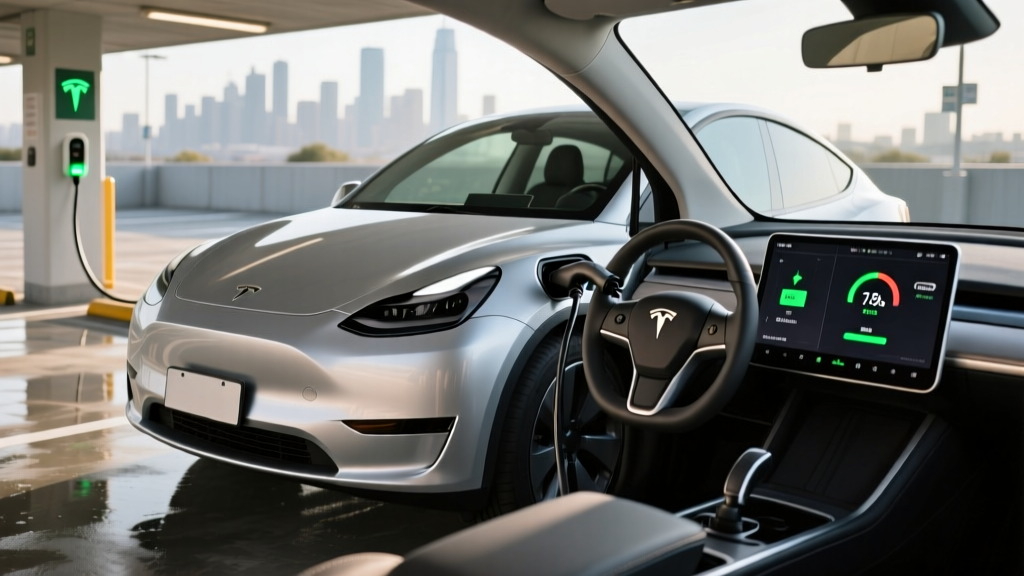
This is where the Model Y earns its reputation. Tesla's V4 Superchargers (now widely deployed across the U.S.) deliver up to 250 kW to compatible Model Y Long Range and Performance trims. The Standard Range RWD model peaks at approximately 170 kW due to its smaller LFP pack.
| Charging Method | Power (kW) | Speed (miles of range per hour) | 10–80% Time |
|---|---|---|---|
| Tesla Supercharger V4 (DC Fast) | Up to 250 kW peak | ~1,000 mi/hr at peak | ~20 minutes (Long Range AWD) |
| Supercharger V3 (DC Fast) | Up to 250 kW peak | ~900 mi/hr at peak | ~22 minutes (Long Range AWD) |
| CCS Adapter + Third-Party DC | Up to 150–250 kW (site dependent) | ~600–900 mi/hr | ~25–35 minutes (varies) |
| Home Level 2 (Tesla Wall Connector, 48A) | 11.5 kW | ~44 mi/hr | ~7.5 hours (full charge) |
| Home Level 2 (32A mobile connector) | 7.7 kW | ~30 mi/hr | ~10 hours (full charge) |
| Level 1 (120V household outlet) | ~1.4 kW | ~3–5 mi/hr | Not practical for full charge |
Charge-curve reality check: The advertised 250 kW peak is achieved only between roughly 10–25% state of charge (SoC) with a preconditioned battery. Above 50% SoC, the rate tapers to approximately 100–120 kW, and above 80% it drops further to protect battery longevity. A 10–80% session in optimal conditions takes about 20 minutes on a V4 Supercharger. A 10–90% session will take closer to 35–40 minutes — a meaningful difference on road trips when you want extra buffer.
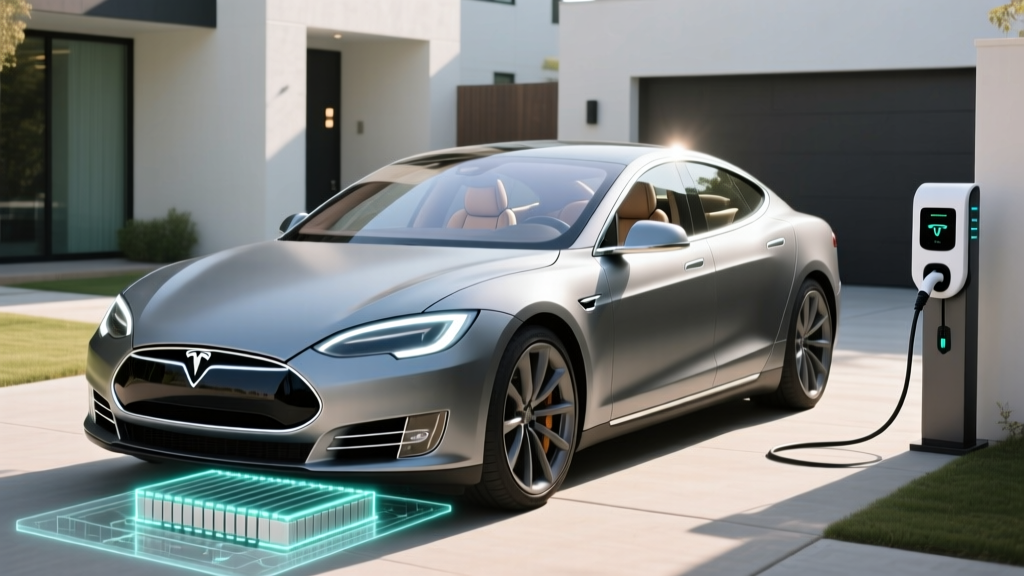
For home charging, the Tesla Wall Connector at 48 amps on a 240V/60A circuit adds roughly 44 miles of range per hour, meaning a full overnight charge is easily achievable. If your electrical panel supports only a 40A circuit (32A continuous), expect about 30 miles per hour — still sufficient for most daily driving needs.
Performance & Drivetrain
| Spec | Model Y RWD (Standard Range) | Model Y Long Range AWD | Model Y Performance |
|---|---|---|---|
| 0–60 mph | 6.6 seconds | 4.8 seconds | 3.5 seconds |
| Horsepower | ~295 hp | ~384 hp | ~456 hp |
| Drivetrain | Rear-Wheel Drive | Dual-Motor AWD | Dual-Motor AWD |
| Battery (usable) | ~60 kWh (LFP) | 78.1 kWh (NMC) | 78.1 kWh (NMC) |
| EPA Range | 268 miles | 320 miles | 293 miles |
| Top Speed | 135 mph | 125 mph | 155 mph |
| Towing Capacity | Not rated | 3,500 lbs | 3,500 lbs |
The Long Range AWD hits the sweet spot for most buyers: dual-motor all-wheel drive handles snow and rain confidently, 4.8 seconds to 60 mph is genuinely quick for a family SUV, and 320 miles of EPA range covers most road-trip legs without range stress. The Performance trim shaves over a second off the 0–60 time but sacrifices 27 miles of range due to its sportier tuning and stickier tires.
Pricing, Trim Levels & Federal Tax Credit
| Trim | Base MSRP | Est. After §30D Credit* |
|---|---|---|
| Model Y RWD (Standard Range) | $44,990 | ~$37,490 |
| Model Y Long Range AWD | $48,990 | ~$41,490 |
| Model Y Performance | $52,990 | ~$45,490 |
Federal tax credit eligibility (§30D): The Model Y qualifies for up to $7,500 under the federal EV tax credit, which can now be transferred to the dealer as a point-of-sale discount. However, eligibility depends on several factors that change periodically:
- MSRP cap: SUVs must have an MSRP at or below $80,000 — all Model Y trims qualify.
- Buyer income cap: Modified AGI must not exceed $150,000 (single), $225,000 (head of household), or $300,000 (joint filers).
- Battery sourcing: A percentage of critical minerals and battery components must be sourced from the U.S. or free-trade-agreement countries. Tesla's shifting supply chain means eligibility can vary by production batch.
- Point-of-sale transfer: Since 2024, buyers can apply the credit as an instant discount at purchase rather than waiting for a tax refund.
Always verify current eligibility on IRS.gov before purchasing, as battery-sourcing rules are updated periodically and can affect whether a specific vehicle qualifies for the full $7,500, a partial $3,750, or no credit at all.
Interior, Cargo & Technology
The Juniper-refreshed Model Y interior is a meaningful step up from the pre-2025 cabin. Ventilated front seats, ambient lighting, improved sound insulation, and a rear-seat touchscreen are now standard. The minimalist approach remains — no physical instrument cluster, everything routes through the 15.4-inch center touchscreen.
Cargo space: 30.2 cubic feet behind the second row, expanding to 72.1 cubic feet with the rear seats folded. The front trunk (frunk) adds 4.1 cubic feet. Rear legroom measures 41.6 inches — adequate for adults on longer trips.
Driver assistance: Tesla's Autopilot (SAE Level 2) comes standard and includes adaptive cruise control and lane-centering. Full Self-Driving (Supervised) remains a $8,000 option or $99/month subscription. Despite the name, FSD is still SAE Level 2 — you must remain attentive and ready to take over at all times. It is not autonomous driving.
These systems require continuous driver supervision. They do NOT make the Model Y a self-driving vehicle. You are legally and operationally responsible for the vehicle at all times. Keep hands on or near the wheel and eyes on the road.
Infotainment: Tesla's proprietary system runs natively — no Apple CarPlay or Android Auto. Navigation, media (Spotify, Apple Music, YouTube, Netflix while parked), and climate controls are all touchscreen-driven. The built-in navigation integrates Supercharger stops and battery preconditioning automatically.
Warranty & Long-Term Battery Health
Tesla provides a 4-year/50,000-mile basic vehicle limited warranty and an 8-year/120,000-mile battery and drive unit warranty for the Long Range and Performance trims (8-year/100,000-mile for the Standard Range RWD). The battery warranty guarantees retention of at least 70% of original capacity during the coverage period.
Real-world data from high-mileage Tesla owners and fleet operators suggests NMC packs in the Model Y typically retain 88–92% capacity at 100,000 miles with normal charging habits (avoiding frequent 100% charges, using LFP's advantage of regular full charges where applicable). Tesla's thermal management system — liquid cooling and heating — is a key factor in long-term cell health.
Pros, Cons & Who Should Buy the Model Y
- Best-in-class Supercharger network reliability
- Fast 10–80% DC charge time (~20 min)
- Strong real-world range (270–290 mi highway)
- Spacious cargo area (72.1 cu ft max)
- Over-the-air updates continuously add features
- Point-of-sale tax credit reduces upfront cost
- No Apple CarPlay / Android Auto
- FSD is expensive and still Level 2 only
- Firm ride quality on 20-inch wheels
- Panel gaps and paint quality still inconsistent
- Insurance premiums above segment average
- CCS adapter required for non-Tesla DC chargers
Look at competitors if: You prefer Apple CarPlay (Hyundai Ioniq 5), want a smoother ride (Ford Mustang Mach-E), or need a lower entry price with the Equinox EV.
Frequently Asked Questions
What is the real-world range of the 2026 Tesla Model Y?
The EPA rates the Long Range AWD at 320 miles. In real-world highway driving at 70–75 mph, expect 270–290 miles. In cold weather below 30°F, plan for 220–250 miles. The Standard Range RWD delivers about 268 miles EPA, with roughly 220–240 miles real-world highway.
How fast does the Tesla Model Y charge at a Supercharger?
The Long Range and Performance models peak at 250 kW on V3 and V4 Superchargers, achieving a 10–80% charge in approximately 20 minutes under optimal conditions (preconditioned battery, warm ambient temps). The Standard Range RWD peaks at ~170 kW with a 10–80% time of roughly 25 minutes.
How long does home Level 2 charging take for the Model Y?
Using a Tesla Wall Connector at 48 amps (11.5 kW), you'll add about 44 miles of range per hour, fully recharging a Long Range in roughly 7.5 hours. A 32-amp setup (7.7 kW) adds about 30 miles per hour, requiring around 10 hours for a full charge.
Does the 2026 Tesla Model Y qualify for the $7,500 federal EV tax credit?
The Model Y is eligible for up to $7,500 under IRS §30D, transferable as a point-of-sale discount. However, you must meet income caps ($150K single / $300K joint), the vehicle must meet battery-sourcing requirements, and MSRP must be under $80,000 (all trims qualify). Always check fueleconomy.gov and IRS guidance for your specific purchase date.
Is the Model Y worth buying vs. the Hyundai Ioniq 5 or Ford Mach-E?
The Model Y wins on charging infrastructure reliability and cargo space. The Ioniq 5 offers 800V architecture for faster peak charging at compatible stations and includes CarPlay. The Mach-E delivers a more comfortable ride and traditional dealership service. If Supercharger access matters to you — especially for road trips — the Model Y retains a tangible edge, though the gap is narrowing as Tesla opens its network to other brands via NACS.
What is the battery warranty on the Tesla Model Y?
Tesla covers the battery and drive unit for 8 years or 120,000 miles on Long Range and Performance trims (8 years/100,000 miles on Standard Range). The warranty guarantees at least 70% capacity retention during the coverage period.