The Tesla Model Y remains one of the best-selling electric vehicles in the United States for good reason: strong range, access to the Supercharger network, and a practical crossover footprint. But for families and rideshare drivers, one of the most searched questions is surprisingly specific — how do the Model Y rear doors function in daily use? From child-seat loading to rear-passenger comfort, the rear-door experience matters more than spec sheets suggest.
This review covers everything you need to know about the 2026 Tesla Model Y: rear-door design and rear-seat usability, alongside the full EV profile — EPA range, battery chemistry, DC fast-charging speeds, pricing, and federal tax credit eligibility under current IRS §30D rules.
Rear Doors, Rear Seat Access, and Interior Practicality
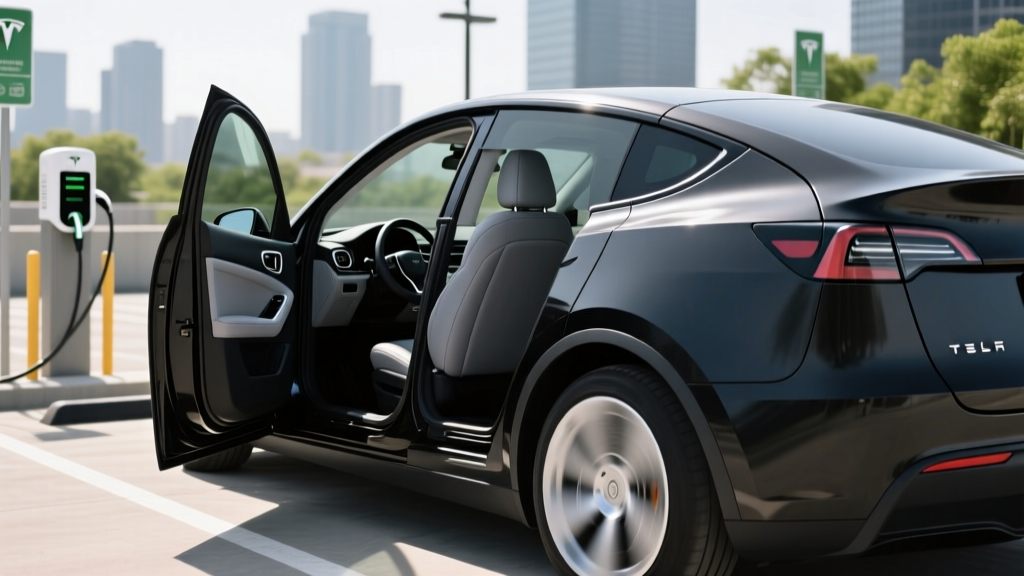
The Model Y uses a conventional front-hinged rear-door design — not sliding doors, not falcon-wing doors like the Model X. The door aperture is reasonably wide, but the roofline slopes gently toward the rear, which can require taller passengers to duck slightly when entering. The door opens to approximately 65 degrees, which is adequate for most parking-lot scenarios but tighter than some competitors like the Hyundai Ioniq 5 or Kia EV6.
For parents installing rear-facing child seats, the Model Y rear doors provide enough clearance for most infant carriers, though the sloping roofline means you'll angle the seat in rather than lower it straight down. The LATCH anchors are clearly marked and accessible. Once installed, front-seat legroom is only mildly compromised thanks to the Model Y's 113.8-inch wheelbase.
Rear-seat passengers get 38.4 inches of legroom (per Tesla's official specs), which is competitive with the Ford Mustang Mach-E (38.9 in) and slightly behind the Ioniq 5 (41.7 in). Headroom in the rear measures 37.1 inches — sufficient for most adults, though six-foot-plus passengers on long trips may notice the panoramic glass roof's lack of padding overhead. The rear bench seats three, but the center position is best suited for a child or shorter trip due to the floor hump created by the underlying battery structure.
Notable rear-door features include:
- Power-folding side mirrors that auto-fold when locked, reducing lot-side damage risk
- Child-lock controls accessible via the touchscreen rather than a physical switch on the door edge
- Rear-window tint that is factory-applied, reducing heat load for rear passengers
- No rear-door sunshades — an omission at this price point that some families will want to address with aftermarket solutions
Spec Table: 2026 Tesla Model Y Long Range AWD at a Glance
| Specification | 2026 Model Y Long Range AWD |
|---|---|
| EPA Range | 320 miles |
| Battery (usable) | ~75 kWh, NMC chemistry |
| Drivetrain | Dual-motor AWD |
| Horsepower | ~384 hp combined |
| 0–60 mph | 4.8 seconds |
| Efficiency | 122 MPGe / 28 kWh/100 mi |
| Max DC Fast Charge | 250 kW (peak) |
| 10–80% DC Charge Time | ~27 minutes |
| Level 2 Home Charge Rate | 11.5 kW (~44 mi/hr) |
| Cargo (rear seats up) | 30.2 cu ft |
| Cargo (rear seats folded) | 72.0 cu ft |
| Rear Legroom | 38.4 in |
| Base MSRP | $44,990 |
| Battery Warranty | 8 years / 120,000 miles |
Range and Efficiency: EPA vs. Real World
Real-World Expectation: Plan for ~260–290 miles on highway trips at 70–80 mph; ~220–250 miles in freezing temperatures (below 32°F) with cabin heating. City driving with regenerative braking recovers closer to the EPA sticker.
The Model Y Long Range AWD carries an NMC (nickel manganese cobalt) battery pack with approximately 75 kWh of usable capacity. Tesla's thermal management system is among the best in the industry — the heat pump is standard and significantly reduces cold-weather range loss compared to resistive heating. That said, physics is physics: any EV will lose 20–30% of its range in sustained sub-freezing driving, and the Model Y is no exception.
On a 75°F day with mixed city/highway driving at moderate speeds, owners consistently report achieving 290–310 miles before needing to charge. Push 80 mph on the interstate with A/C blasting, and expect closer to 250–260 miles of usable range before you'll want to find a Supercharger. Per fueleconomy.gov, the combined MPGe rating is 122, which translates to roughly 28 kWh consumed per 100 miles — competitive with the segment.
The Model Y RWD (base) variant uses an LFP (lithium iron phosphate) battery, which offers a different trade-off: slightly less energy density and range (~280 miles EPA), but better longevity and the ability to charge routinely to 100% without degradation concerns. If you're a daily commuter who charges at home every night, the LFP variant is arguably the smarter long-term choice.
Charging Speed: DC Fast, Level 2, and Supercharger Access
| Charging Level | Power (kW) | Speed (miles added/hr) | Notes |
|---|---|---|---|
| Level 1 (120V outlet) | ~1.4 kW | ~3–5 mi/hr | Emergency/trickle only |
| Level 2 (240V home) | 11.5 kW | ~44 mi/hr | Full charge in ~7 hours |
| DC Fast (Supercharger V3) | 250 kW peak | ~1,000+ mi/hr (peak) | 10–80% in ~27 min |
| DC Fast (Supercharger V4) | Up to 250 kW | Similar to V3 | Cable-cooled, easier plug-in |
Tesla's biggest advantage remains the Supercharger network. With over 20,000 stalls in North America, the reliability and availability of Tesla DC fast charging is unmatched by Electrify America, EVgo, or other third-party networks. The Model Y peaks at 250 kW on V3 and V4 Superchargers, though it does not sustain that rate for long — the charge curve tapers noticeably after 50% State of Charge (SoC).
Expect the 10–80% charge to take approximately 27 minutes under ideal conditions (battery preconditioned via navigation to a Supercharger). Without preconditioning — for example, if you pull into a charger without routing through the car's navigation — that time can stretch to 35+ minutes, especially in cold weather. Always navigate to your charger; the car will automatically warm the battery.
At home on a 48-amp Level 2 wall connector (hardwired, 60-amp circuit), the Model Y accepts 11.5 kW, adding roughly 44 miles of range per hour of charging. A full overnight charge from 20% to 100% takes about 7 hours. Most owners who plug in nightly never think about range — the car is always full by morning.
With the industry's shift to the NACS (North American Charging Standard) connector, the Model Y natively uses the same plug that Ford, GM, Rivian, and others have now adopted. No adapter is needed at Tesla Superchargers, and the Model Y can use CCS stations with a simple NACS-to-CCS adapter.
Performance and Driving Dynamics
The Long Range AWD Model Y delivers 384 combined horsepower from its dual-motor setup, reaching 60 mph in 4.8 seconds. That's quick by any measure and decisively quicker than most gasoline crossovers in this price range. The instant torque delivery makes highway merging and city acceleration effortless.
The Performance trim drops the 0–60 time to approximately 3.5 seconds and adds track-oriented features like larger brakes and a lowered suspension, at the cost of a slightly firmer ride and marginally reduced range.
Ride quality has improved with the recent "Juniper" refresh — the cabin is noticeably quieter, suspension tuning is more compliant over rough pavement, and the overall refinement gap between Tesla and legacy automakers has narrowed considerably. The steering remains precise and well-weighted, though some drivers find it artificially numb compared to hydraulic systems.
Regenerative braking is strong and enables one-pedal driving in most scenarios. Tesla removed the user-adjustable regen setting in recent model years, meaning you get one (strong) regen calibration. Most owners adapt within a week, but if you prefer a coasting feel, this is worth a test drive.
Pricing, Trims, and Federal Tax Credit Eligibility
| Trim | Base MSRP | Est. After §30D Credit |
|---|---|---|
| Model Y RWD (LFP) | $39,990 | ~$32,490* |
| Model Y Long Range AWD | $44,990 | ~$37,490* |
| Model Y Performance | $49,990 | ~$42,490* |
*Estimated price assumes full $7,500 federal tax credit applied at point of sale. Eligibility is not guaranteed — see requirements below.
- Vehicle MSRP must be ≤ $80,000 for SUVs (Model Y qualifies)
- Buyer AGI must not exceed $150,000 (single) / $300,000 (joint filing)
- Battery components must meet critical-mineral and sourcing thresholds (Tesla has largely met these for US-built Model Y, but confirm at purchase)
- Credit can be transferred to the dealer at point of sale as a price reduction (per IRS guidelines)
- Rules are subject to change — verify with your tax professional before purchase
The Model Y is assembled at Tesla's Fremont, California, and Austin, Texas factories. Battery sourcing has been a moving target under evolving §30D rules, but as of the current model year, most US-built Model Y vehicles qualify for the full $7,500 credit when purchased by eligible buyers. The point-of-sale transfer option means you can apply the credit directly to your purchase price rather than waiting for a tax refund — a significant cash-flow advantage.
Tech, Autopilot, and Notable Drawbacks
The Model Y's 15.4-inch center touchscreen controls nearly every vehicle function — climate, mirrors, glovebox, and even rear-seat ventilation adjustments. The infotainment system remains one of the most responsive in the industry, with native streaming apps, a strong navigation system, and over-the-air updates that regularly add features.
Tesla's Autopilot comes standard and includes adaptive cruise control, lane-centering, and automatic emergency braking. This is an SAE Level 2 driver-assistance system — meaning the driver must remain engaged, hands on the wheel, and eyes on the road at all times. Full Self-Driving (Supervised) is available as a $8,000 option or $99/month subscription and adds features like automatic lane changes, traffic-light recognition, and city-street navigation. Despite the name, FSD is also Level 2 and requires active driver supervision. It is not autonomous driving.
Notable drawbacks include:
- No traditional instrument cluster — all speed and navigation info is on the center screen, which some drivers find distracting
- No Apple CarPlay or Android Auto — Tesla's native system is capable but locks you into their ecosystem
- Rear-door opening angle could be wider for easier child-seat installation
- Build quality variance — panel gaps and paint quality have improved but still lag Toyota/Hyundai consistency
- No physical buttons for climate or volume — everything is touchscreen-based
Who Should Buy the Model Y?
- You want access to the most reliable DC fast-charging network (Superchargers)
- You need 300+ miles of real-world range for road trips
- You value over-the-air updates and a strong software experience
- You want a practical family EV with 72 cu ft of cargo space and AWD capability
- You need the widest rear-door opening for frequent child-seat swaps (consider the Ioniq 5 or EV9)
- You prefer physical buttons and Apple CarPlay (consider the Mach-E or EV6)
- You want a plush, quiet ride over sporty handling (consider the Genesis GV60)
Pros and Cons
- 320-mile EPA range with strong real-world efficiency
- Supercharger network access — best public charging reliability
- Spacious cargo area (72 cu ft seats folded)
- Quick acceleration and standard AWD on Long Range
- Strong resale value and over-the-air updates
- Qualifies for $7,500 federal credit (eligible buyers)
- Rear-door opening angle could be wider
- No Apple CarPlay/Android Auto
- All-touchscreen interface isn't for everyone
- Rear center seat is cramped for adults
- Build quality still inconsistent vs. legacy brands
- FSD subscription cost adds up over time
Frequently Asked Questions
What is the real-world range of the Tesla Model Y?
The EPA rates the Long Range AWD at 320 miles. In real-world highway driving at 70–80 mph, expect 260–290 miles. In freezing weather, plan for 220–250 miles. The RWD (LFP) variant is rated at approximately 280 miles EPA.
How fast does the Model Y charge at home and on the road?
On a 48-amp Level 2 home charger, the Model Y charges at 11.5 kW, adding about 44 miles per hour. On a V3 or V4 Supercharger, it peaks at 250 kW and charges from 10–80% in approximately 27 minutes with battery preconditioning.
Does the Tesla Model Y qualify for the federal EV tax credit?
Most US-built Model Y vehicles qualify for the full $7,500 §30D credit for eligible buyers (income ≤ $150K single / $300K joint, MSRP under $80K cap). The credit can be applied at point of sale. Always confirm current eligibility with your dealer and tax professional, as sourcing rules evolve. See IRS.gov for the latest.
Are the Model Y rear doors easy to use with child seats?
The rear doors open to about 65 degrees, which is adequate but not class-leading. Most rear-facing infant carriers fit through the opening, though the sloping roofline requires angling the seat in. The Hyundai Ioniq 5 and Kia EV9 offer wider door openings for easier installation.
Is the Model Y worth buying over competitors like the Ioniq 5 or Mach-E?
The Model Y's strongest advantage is the Supercharger network and software ecosystem. If reliable road-trip charging is your top priority, it's hard to beat. The Ioniq 5 offers a more spacious rear seat, wider rear doors, and 800V ultra-fast charging. The Mach-E provides a more traditional interior layout with physical controls and Apple CarPlay. Test-drive all three before deciding.
What is the Model Y's battery warranty?
Tesla covers the battery and drive unit for 8 years or 120,000 miles (whichever comes first) on the Long Range and Performance trims, with a minimum 70% capacity retention guarantee. The RWD variant covers 8 years or 100,000 miles.