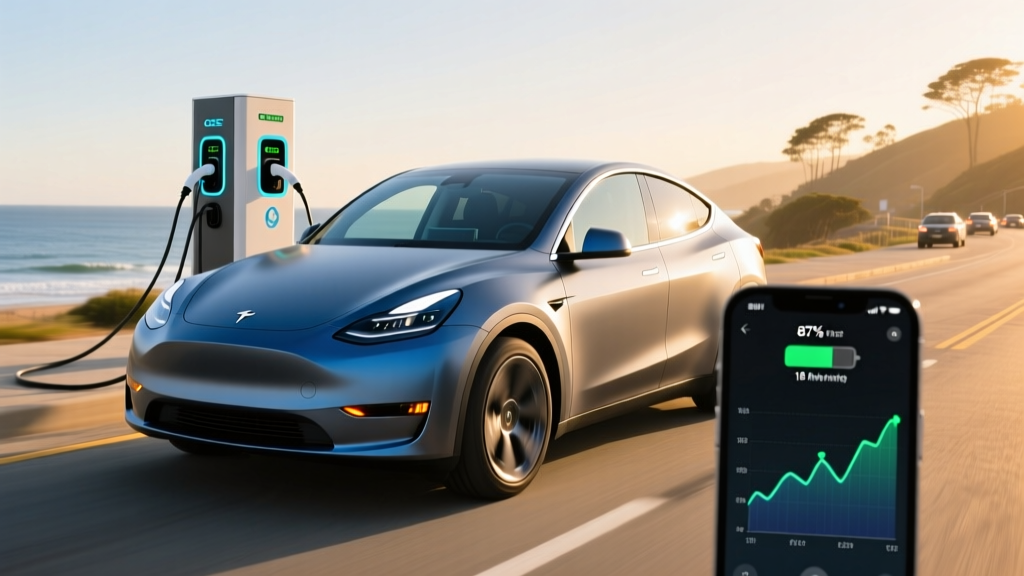
If you've searched for a picture of a Tesla, you've probably landed on the Model Y — the best-selling electric vehicle in the world for good reason. But photos only tell you so much. What matters to an EV buyer is what happens after the showroom: real-world highway range on a cold January morning, actual charging speeds when the battery is warm versus cold, the true cost after federal tax credits, and whether the Juniper-refreshed Model Y still holds its crown against a rapidly closing field of competitors.
This review goes beyond the glossy images. We break down the 2026 Tesla Model Y Long Range AWD and Performance trims with exact EPA numbers, battery chemistry specifics, charging-curve realities, and ownership economics so you can decide whether this is the right EV for your driveway — not just your Instagram feed.
2026 Tesla Model Y: Core Specifications at a Glance
| Spec | Long Range AWD | Performance (Est.) |
|---|---|---|
| EPA Range | 320 miles | 295 miles |
| Battery (usable) | ~75 kWh, LFP (cat) | ~75 kWh, NMC |
| Drivetrain | Dual-Motor AWD | Dual-Motor AWD |
| Horsepower | ~384 hp | ~456 hp |
| 0-60 mph | 4.8 sec | 3.5 sec |
| Max DC Fast Charge | 250 kW (peak) | 250 kW (peak) |
| 10-80% DC Time | ~25 min (preconditioned) | ~25 min (preconditioned) |
| Level 2 Home Charge | 11.5 kW / ~37 mi/hr | 11.5 kW / ~37 mi/hr |
| Efficiency (EPA) | 122 MPGe / 28 kWh/100mi | 111 MPGe / 30 kWh/100mi |
| Cargo (rear seats up) | 30.2 cu ft | 30.2 cu ft |
| Cargo (rear seats folded) | 72.0 cu ft | 72.0 cu ft |
| Base MSRP | $44,990 | $48,990 |
| Battery Warranty | 8 yr / 120,000 mi | 8 yr / 120,000 mi |
Sources: EPA fueleconomy.gov, Tesla Model Y design page.
Real-World Range: What the EPA Sticker Doesn't Show You
EPA sticker: 320 miles
Mixed highway (65-75 mph, moderate climate): ~275-290 miles
City / stop-and-go with regen: ~305-320 miles (near EPA or slightly above)
Cold weather (below 32°F, highway): ~220-250 miles (30-35% reduction typical for LFP)
Hot weather (above 95°F, A/C heavy): ~280-300 miles
The 2026 Model Y Long Range uses a structural battery pack with LFP (lithium iron phosphate) chemistry in the standard Long Range trim. LFP offers excellent cycle life and thermal stability — meaning the battery degrades more slowly over thousands of charge cycles — but it carries a trade-off: lower energy density and greater cold-weather range loss compared to NMC (nickel manganese cobalt) cells.
In real-world highway driving at 70-75 mph, expect roughly 275-290 miles on a full charge in temperate conditions. The Model Y's heat pump helps significantly in cold weather compared to resistive heating, but LFP cells still lose more range in sub-freezing temperatures than NMC equivalents. If you live in Minnesota or Maine and commute more than 80 miles round-trip in winter, this matters. If you're in Southern California or Texas, the LFP chemistry is almost all upside: longer lifespan, lower cost, and Tesla recommends charging LFP to 100% daily — no babying the battery at 80%.
The Performance trim uses NMC cells, which recover range better in cold weather but carry a slightly lower total capacity and a recommendation to charge to 80% for daily use, saving 100% for road trips.
Charging Speed: DC Fast Charging and Home Level 2 Reality
Charging speed is where Tesla's Supercharger network advantage meets the physics of battery chemistry. Here's what to expect:
| Charging Level | Power (kW) | Speed | Notes |
|---|---|---|---|
| Level 1 (120V household) | ~1.4 kW | ~3-4 mi/hr | Emergency/trickle only; ~90 hrs for full charge |
| Level 2 (240V, 48A Wall Connector) | 11.5 kW | ~37 mi/hr | Full charge overnight in ~7-8 hours |
| Level 2 (240V, 32A mobile connector) | 7.7 kW | ~25 mi/hr | Slower; full charge in ~10-11 hours |
| DC Fast (V3 Supercharger) | 250 kW peak | ~175 mi in 15 min | Peak only; tapers above 50% SoC |
| DC Fast (V4 Supercharger) | 250 kW (current vehicles) | ~175 mi in 15 min | Future vehicles may see higher; cable-cooled |
| DC Fast (CCS adapter, EA/others) | Up to 150-250 kW | Varies by station | Requires CCS adapter (included or ~$175) |
The charging-curve reality: The 250 kW peak on a V3 Supercharger is exactly that — a peak, not a sustained rate. A preconditioned Model Y Long Range will hit ~250 kW around 10-15% state of charge (SoC), hold above 200 kW briefly, then taper progressively. By 50% SoC, you're typically seeing 100-130 kW. By 80%, expect roughly 50-60 kW. The 10-80% session takes approximately 25 minutes when the battery is properly preconditioned (navigating to a Supercharger in the car triggers this automatically).
Cold-weather charging penalty: If you arrive at a Supercharger without preconditioning in cold weather (below 40°F), your peak charge rate may be limited to 50-90 kW until the battery warms. Always navigate to the charger using the car's built-in routing — it will precondition the pack en route, saving you 10-15 minutes on a typical session.
At home, the Tesla Wall Connector on a 60-amp circuit delivers the full 11.5 kW (48 amps continuous). That's roughly 37 miles of range per hour of charging — enough to fully replenish a depleted battery overnight. Installation typically costs $500-$2,000 depending on panel proximity and whether your home needs a panel upgrade. Always consult a licensed electrician for final installation specs.
Performance, Efficiency, and Daily Drivability
The 2026 Model Y Long Range AWD produces approximately 384 horsepower from its dual-motor setup — a permanent-magnet rear motor paired with an induction front motor for efficiency. The 0-60 mph time of 4.8 seconds is quick enough to merge confidently onto any freeway and overtake without hesitation. The Performance trim drops that to 3.5 seconds with 456 hp and track-oriented tuning.
Efficiency is where Tesla's engineering shows. At 122 MPGe combined (28 kWh per 100 miles) for the Long Range, the Model Y remains one of the most efficient electric crossovers on the market. For context, the Hyundai Ioniq 5 AWD achieves roughly 110 MPGe combined, and the Ford Mustang Mach-E Extended Range AWD sits around 101 MPGe. That efficiency advantage translates directly into lower charging costs and more range from a smaller battery.
Regenerative braking is strong and consistent. Tesla removed the user-adjustable regen setting several years ago, so one-pedal driving is the default — lift off the accelerator and the car decelerates briskly. Most owners adapt within a week and prefer it, but if you want a coasting feel, this isn't adjustable.
Interior, Cargo, and Technology
The Juniper refresh brought meaningful updates to the Model Y cabin: ventilated front seats, a rear-seat touchscreen, ambient lighting, improved sound insulation, and a slightly longer wheelbase yielding an extra inch of rear legroom (now approximately 41.6 inches front / 38.0 inches rear).
Cargo volume: 30.2 cubic feet behind the second row, expanding to 72.0 cubic feet with the 60/40 split rear seats folded. The front trunk (frunk) adds roughly 4.1 cubic feet — useful for charging cables, a laptop bag, or groceries you want to keep separate.
Infotainment: The 15.4-inch center touchscreen runs Tesla's proprietary OS — no Apple CarPlay or Android Auto. Navigation, media, climate, and vehicle controls all live on this screen, including the glovebox release. The interface is fast and intuitive for most users, but the lack of physical buttons for climate and mirrors draws legitimate criticism. Everything is a tap or swipe away, which means a glance down instead of a tactile knob turn.
Driver assistance: Basic Autopilot (traffic-aware cruise control and lane centering) is standard. Full Self-Driving (Supervised) remains a $8,000 option or $99/month subscription. FSD is a SAE Level 2 system — it does not make the car self-driving. You must remain attentive, hands on or near the wheel, and ready to intervene at any moment. Only Level 4 robotaxi services like Waymo operate without a driver in the loop.
Pricing, Tax Credits, and Ownership Economics
| Trim | Base MSRP | As-Tested (Typical) | §30D Credit Eligibility | Effective Price (Est.) |
|---|---|---|---|---|
| Long Range AWD | $44,990 | $46,490 (w/ paint, no FSD) | Up to $7,500 (see rules) | ~$37,490 – $38,990 |
| Performance | $48,990 | $50,990 (w/ paint, wheels) | Up to $7,500 (see rules) | ~$41,490 – $43,490 |
Federal tax credit rules (IRS §30D, 2026): The Model Y qualifies for up to $7,500 in federal tax credits, but eligibility is not automatic. Under current IRS rules, you must meet all of the following:
- MSRP cap: The vehicle's base MSRP must not exceed $80,000 for SUVs (Model Y qualifies).
- Buyer income cap: Modified adjusted gross income must not exceed $150,000 (single), $225,000 (head of household), or $300,000 (joint).
- Battery sourcing: A percentage of critical minerals and battery components must be sourced from the U.S. or free-trade-agreement countries. These thresholds increase yearly; Tesla's U.S.-built Model Y has generally met requirements, but verify current-year compliance at the point of sale.
- Point-of-sale transfer: You can transfer the credit to the dealer at purchase, reducing your out-of-pocket cost immediately rather than waiting for a tax refund.
Tax credit rules change and are subject to IRS interpretation. Consult a tax professional and verify eligibility at irs.gov before purchasing.
5-year ownership cost snapshot: At $0.13/kWh (national average residential electricity), charging a Model Y Long Range costs roughly $0.04 per mile. A comparable gas crossover at 25 MPG and $3.40/gallon costs $0.14 per mile. Over 60,000 miles, that's approximately $5,700 in fuel savings. Factor in lower maintenance (no oil changes, fewer brake replacements due to regen) and the total cost of ownership narrows significantly against gas competitors — even before the tax credit.
Pros and Cons: The Honest Assessment
- Class-leading efficiency (122 MPGe) stretches every kWh
- Supercharger network: 60,000+ stalls globally, best reliability in public charging
- LFP battery longevity; charge to 100% daily without degradation anxiety
- Strong cargo capacity (72 cu ft folded) and usable frunk
- OTA updates add features post-purchase
- Excellent safety ratings (NHTSA 5-star, IIHS Top Safety Pick+)
- No Apple CarPlay or Android Auto — Tesla OS only
- Minimal physical controls; everything on the touchscreen
- LFP cold-weather range loss is significant (30%+ in deep freeze)
- FSD (Supervised) is expensive and still requires full driver attention
- Insurance premiums run 15-30% higher than comparable gas crossovers
- Ride quality is firm; not as plush as Hyundai Ioniq 5 or Genesis GV60
How It Compares: Model Y vs. Key Competitors
| Attribute | Tesla Model Y LR | Hyundai Ioniq 5 AWD | Ford Mach-E ER AWD |
|---|---|---|---|
| EPA Range | 320 mi | 290 mi | 290 mi |
| Max DC Charge | 250 kW | 240 kW (350 kW capable) | 150 kW |
| 10-80% Time | ~25 min | ~18 min | ~38 min |
| Efficiency | 122 MPGe | 110 MPGe | 101 MPGe |
| Cargo (seats up) | 30.2 cu ft | 27.2 cu ft | 29.7 cu ft |
| Base MSRP (AWD) | $44,990 | $49,500 | $48,995 |
| CarPlay / Android Auto | No | Yes | Yes |
The Ioniq 5 charges faster on 350 kW-capable stations and offers CarPlay, but costs more and has less range and cargo space. The Mach-E has a more traditional interior feel but charges considerably slower. The Model Y's combination of range, efficiency, cargo, and Supercharger access remains the benchmark — if you can accept the touchscreen-only interface.
Who Should Buy the 2026 Model Y?
- Choose the Model Y Long Range if: You want maximum range and efficiency for road trips, value Supercharger reliability, commute in moderate climates, and prefer a minimalist tech-forward cabin.
- Choose the Model Y Performance if: You want sub-4-second acceleration, plan to track-day occasionally, and live in a colder climate where NMC chemistry's cold-weather advantage matters.
- Look at the Ioniq 5 instead if: You demand CarPlay/Android Auto, want the fastest DC charging available, prefer physical buttons, or value ride comfort over outright efficiency.
- Look at a PHEV instead if: You lack reliable home charging access, frequently drive in areas with sparse public charging infrastructure, or regularly tow beyond 3,500 lbs.
Frequently Asked Questions
What is the real-world range of the 2026 Tesla Model Y?
Expect approximately 275-290 miles on the highway in temperate weather, near the 320-mile EPA estimate in city driving with regenerative braking, and 220-250 miles in cold-weather highway driving below freezing. LFP chemistry is more affected by cold than NMC.
How fast does the Model Y charge at home and on the road?
On a Tesla Wall Connector (Level 2, 11.5 kW), you gain about 37 miles per hour — a full charge takes 7-8 hours. On a V3 Supercharger (DC fast), the car peaks at 250 kW and charges from 10-80% in approximately 25 minutes when preconditioned.
Does the 2026 Model Y qualify for the $7,500 federal EV tax credit?
It can, but eligibility depends on your income (under $150K single / $300K joint), the vehicle meeting current-year battery-sourcing requirements, and the MSRP staying under the $80,000 SUV cap. The credit can be transferred at point of sale to reduce your purchase price immediately. Always verify current rules at irs.gov.
Is the Model Y worth buying over the Ioniq 5 or Mach-E?
If Supercharger network access, maximum range, and efficiency are your priorities, yes — the Model Y still leads. If you prefer CarPlay, physical buttons, faster peak charging, or a plusher ride, the Ioniq 5 is a compelling alternative at a slightly higher price.
How long will the Model Y's LFP battery last?
LFP batteries are rated for 3,000-5,000+ full charge cycles before significant degradation. At 320 miles per cycle, that's theoretically 960,000+ miles — far beyond the vehicle's mechanical life. Tesla warranties the battery for 8 years or 120,000 miles, whichever comes first, guaranteeing at least 70% capacity retention. Real-world data from high-mileage Teslas shows LFP packs holding up exceptionally well.
What are the biggest drawbacks of owning a Model Y?
The touchscreen-only interface frustrates some drivers. Insurance costs run higher than average. LFP range loss in extreme cold is real and measurable. And while FSD (Supervised) is impressive, it remains a Level 2 system requiring full driver attention — it is not autonomous driving.