Quick Verdict: The Best-Selling EV Still Sets the Bar
The Tesla Model Y remains the benchmark compact electric SUV in 2026. With an EPA-estimated range up to 320 miles on the Long Range AWD trim, access to the expansive Supercharger network, and a starting price that undercuts many rivals after the federal tax credit, it's easy to see why this vehicle dominates sales charts. But the Model Y's efficiency story doesn't end at the powertrain — the tires you choose significantly affect real-world range, noise levels, and wet-weather grip. This review covers the full ownership picture: specs, charging, pricing, tax credits, and why Tesla Y tires deserve more attention than most buyers give them.
| Spec | Long Range AWD | Performance |
|---|---|---|
| EPA Range | 320 mi | 293 mi |
| Battery (usable) | ~75 kWh, NMC | ~75 kWh, NMC |
| MPGe (combined) | 122 MPGe | 111 MPGe |
| Efficiency | 28 kWh/100 mi | 30 kWh/100 mi |
| 0-60 mph | 4.8 sec | 3.5 sec |
| Horsepower | 384 hp | 456 hp |
| Drivetrain | Dual-Motor AWD | Dual-Motor AWD |
| Max DC Fast Charge | 250 kW | 250 kW |
| 10-80% DC Time | ~25 min | ~25 min |
| Level 2 Home Charge | 11.5 kW (~44 mi/hr) | 11.5 kW (~44 mi/hr) |
| Cargo (rear seats up) | 30.2 cu ft | 30.2 cu ft |
| Cargo (rear seats folded) | 72.1 cu ft | 72.1 cu ft |
| Rear Legroom | 37.4 in | 37.4 in |
| Battery Warranty | 8 yr / 120,000 mi | 8 yr / 120,000 mi |
| Base MSRP | $44,990 | $48,990 |
Real-World Range: What the EPA Sticker Doesn't Tell You
EPA Estimate: 320 miles (Long Range AWD)
Real-World Expectation: 270–295 miles on mixed highway/city driving at 70 mph; 240–265 miles in freezing temperatures (below 32°F); up to 310+ miles in moderate city driving with regen braking.
The Model Y Long Range's 320-mile EPA figure is achievable under ideal conditions — moderate temperatures, city-heavy driving with regenerative braking engaged, and speeds under 65 mph. On a 300-mile highway road trip at sustained 75–80 mph, expect roughly 270–285 miles before you need to stop. Cold weather compounds this: Tesla's heat pump helps, but battery chemistry (NMC) loses efficiency below freezing, and cabin heating draws significant energy. Plan for 20–25% range reduction in sub-32°F conditions.
This is where tire selection matters. The factory-fitted 19-inch Gemini wheels with all-season tires prioritize efficiency, contributing to that 122 MPGe combined rating. Switching to wider, stickier 21-inch Überturbine wheels with summer rubber costs you roughly 15–20 miles of range due to increased rolling resistance. Conversely, owners who prioritize year-round safety in rain and snow should know that switching to dedicated EV-optimized all-season or winter tires — like the Michelin Pilot Sport EV or Continental CrossContact LX25 — can preserve range while dramatically improving wet braking distances.
Charging Speed: DC Fast Charging and Home Level 2
| Charge Level | Power (kW) | Rate | Notes |
|---|---|---|---|
| Level 1 (120V outlet) | ~1.4 kW | ~5 mi/hr | Emergency/trickle only |
| Level 2 (240V, 48A) | 11.5 kW | ~44 mi/hr | Full charge in ~8 hours |
| DC Fast (V3 Supercharger) | Peak 250 kW | ~175 mi in 15 min | 10-80% in ~25 min |
| DC Fast (V4 Supercharger) | Peak 250 kW | Similar to V3 | Newer stations, CCS adapter native |
The Model Y peaks at 250 kW on Tesla's V3 and V4 Superchargers, but that peak is sustained only between roughly 10–30% State of Charge (SoC). Above 50%, the charge curve tapers significantly — by 80% SoC, you're pulling closer to 60–80 kW. This is why Tesla and most EV analysts quote 10-80% times (~25 minutes) rather than full-charge times. Charging from 80-100% can add another 20+ minutes due to cell-balancing at the top of the curve.
At home, a 48-amp Level 2 wall connector on a 60-amp circuit delivers 11.5 kW, adding roughly 44 miles of range per hour. A full overnight session (8 hours) replenishes the entire battery. Tesla's Wall Connector costs around $475, and professional installation on an existing 200-amp panel typically runs $500–$1,500 depending on run length and permit requirements. If your home has a 100-amp panel, expect a $1,500–$3,000 panel upgrade — a detail many buyers overlook.
The Model Y ships with a NACS (North American Charging Standard) port natively. With Ford, GM, Rivian, and most other manufacturers adopting NACS by 2025–2026, Tesla owners now share Superchargers with a growing number of non-Tesla EVs, which can increase wait times at popular corridors during peak travel.
Performance, Handling, and Why Tesla Y Tires Matter More Than You Think
The Model Y Long Range AWD delivers 384 horsepower through a dual-motor setup, reaching 0-60 mph in 4.8 seconds — brisk for a 4,400-lb crossover. The Performance trim bumps output to 456 hp and drops the sprint to 3.5 seconds, rivaling many sports sedans.
But EVs put unique demands on tires that gas-car owners rarely consider:
- Weight: The Model Y's ~4,400-lb curb weight (with battery pack low in the chassis) generates more lateral and longitudinal tire load than a similarly sized gas SUV. Tires wear 20–30% faster on EVs, especially on the driven axles.
- Instant torque: Electric motors deliver maximum torque from 0 RPM. Aggressive launches scrub tire tread faster than gradual internal-combustion torque curves.
- Noise: Without an engine masking road noise, tire choice dominates cabin acoustics. The Model Y's frameless windows and minimal sound deadening amplify this effect.
- Rolling resistance: Low-rolling-resistance (LRR) tires directly translate to more miles per kWh. The difference between an efficiency-optimized tire and a max-performance summer tire can be 3–5% of total range — that's 10–16 miles on the Long Range.
Tesla's OEM tire fitments vary by wheel size and model year. The 19-inch Gemini wheels typically ship with Hankook Kinergy GT or Continental EcoContact 6 Q tires — both tuned for low rolling resistance. The 20-inch Induction wheels get Michelin Pilot Sport 4 or Pirelli P Zero variants that trade a small amount of range for sharper dry handling. The 21-inch Überturbine wheels on the Performance trim mount Pirelli P Zero or Michelin Pilot Sport 4S rubber with acoustic foam inserts to dampen cavity resonance noise.
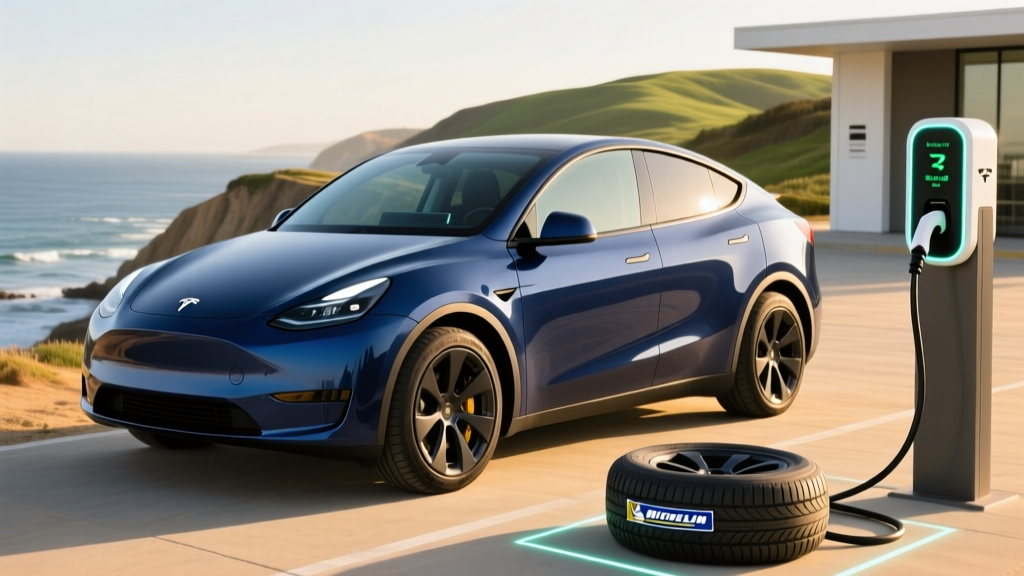
Replacement guidance: When it's time for new Tesla Y tires, prioritize EV-specific compounds. The Michelin e.Primacy, Continental EcoContact 7, and Hankook iON evo are designed for high-load, high-torque EV duty with noise-reducing foam layers. Expect to pay $220–$320 per tire mounted and balanced. Rotate every 5,000–6,000 miles to combat the uneven wear patterns EVs produce, and maintain tire pressure at the door-jamb sticker spec (typically 42 psi cold) — even a 3 psi drop can cost 1–2% range.
Pricing, Trims, and Federal Tax Credit Eligibility
| Trim | Base MSRP | As-Tested (typical options) | Est. After §30D Credit |
|---|---|---|---|
| Long Range AWD | $44,990 | $46,490 (w/ paint + FSD) | ~$37,490–$38,990 |
| Performance | $48,990 | $51,490 (w/ 21" wheels + FSD) | ~$41,490–$43,990 |
The Model Y qualifies for up to $7,500 under the IRS §30D Clean Vehicle Credit, but eligibility is not automatic. Key requirements for 2026:
- MSRP Cap: The vehicle's base MSRP must not exceed $80,000 for SUVs — the Model Y clears this easily.
- Buyer Income Limits: Modified adjusted gross income (MAGI) must be ≤$150,000 (single), ≤$225,000 (head of household), or ≤$300,000 (joint filing). Exceed these and you lose the credit entirely.
- Battery Sourcing: The $7,500 credit splits into two $3,750 halves — one for critical minerals sourcing and one for battery component manufacturing. Sourcing requirements tighten annually. Verify current-year compliance on fueleconomy.gov before purchasing.
- Point-of-Sale Transfer: Since 2024, buyers can transfer the credit to the dealer at purchase, reducing the out-of-pocket price immediately rather than waiting for a tax refund.
Tesla lists the Model Y as eligible for the full $7,500 credit on its website as of early 2026, but battery supply chains shift and IRS guidance updates periodically. Always confirm on the IRS qualified vehicles list before signing a purchase agreement. State and local incentives (California's CVRP, Colorado's state credit, utility rebates) may stack on top but vary by jurisdiction — consult your state's energy office or a tax professional.
Tech, Driver Assistance, and Interior
The Model Y's minimalist interior centers on a 15.4-inch touchscreen running Tesla's proprietary OS. There are no physical buttons for climate, mirrors, or glovebox — everything routes through the display. The interface is responsive and well-designed, but the all-touch approach draws legitimate criticism for distracting drivers during adjustments.
Autopilot and FSD (Supervised): Every Model Y ships with basic Autopilot (traffic-aware cruise control and lane centering). Full Self-Driving (Supervised) is an $8,000 option or $99/month subscription that adds automatic lane changes, traffic light/stop sign recognition, and navigate-on-autopilot. However, FSD remains an SAE Level 2 system — the driver must remain fully engaged, hands on the wheel (or demonstrating attention via the cabin camera), and ready to take over at any moment. Tesla's "Supervised" branding acknowledges this. This is not autonomous driving; Level 4 robotaxi services like Waymo operate in geofenced areas without a driver present, which is a fundamentally different capability.
Notable tech features:
- Over-the-air (OTA) software updates that add features post-purchase
- Sentry Mode (parked-camera surveillance with motion-triggered recording)
- Dog Mode (climate control with exterior display message for passersby)
- Phone-as-key with Bluetooth proximity unlock
- 15-speaker premium audio with immersive sound
- Front trunk (frunk) with 4.1 cu ft of additional storage
Drawbacks: Build quality, while improved since the Fremont factory's early years, still shows panel-gap inconsistencies compared to German and Korean rivals. The absence of Apple CarPlay and Android Auto frustrates smartphone-dependent users. Rear-seat comfort is adequate but not class-leading — the seat cushion is relatively flat and thigh support limited for taller passengers. The panoramic glass roof, while visually open, offers no shade and can make the cabin feel warm in direct summer sun despite UV/IR tinting.
Who Should Buy the Model Y — and Who Should Look Elsewhere
Pros
- Class-leading efficiency (122 MPGe combined)
- Access to 25,000+ Supercharger stations in North America
- Strong real-world range (270+ mi highway)
- Excellent cargo space (72.1 cu ft max)
- OTA updates keep software current
- Qualifies for up to $7,500 federal credit
- Low operating cost (~$0.04–$0.06/mi on home charging)
Cons
- All-touch interface can distract while driving
- No Apple CarPlay or Android Auto
- Rear seat comfort trails Hyundai Ioniq 5 and Kia EV6
- Build quality still inconsistent vs. legacy automakers
- Insurance premiums run 15–25% above segment average
- Tire replacement costs higher than gas crossovers
- Glass roof lacks a physical sunshade
Buy the Model Y if: You want maximum range per dollar, rely on road-trip charging infrastructure, value software-forward features, and live in an area with reliable home-charging access. It excels as a daily commuter and family hauler with occasional long-distance duty.
Consider alternatives if: You prioritize ride comfort and interior material quality (Hyundai Ioniq 5, Kia EV6), need the longest possible range without charging stops (Lucid Gravity, upcoming Rivian R2), want a third row (Kia EV9), or prefer physical controls and CarPlay integration (Ford Mustang Mach-E, BMW iX).
Frequently Asked Questions
What is the real-world range of the 2026 Tesla Model Y?
The Long Range AWD is EPA-rated at 320 miles. In real-world mixed driving at highway speeds (70–75 mph), expect 270–295 miles. In freezing temperatures, plan for 240–265 miles. City driving with regenerative braking can push close to the EPA figure in moderate weather.
How fast does the Model Y charge at home and on DC fast chargers?
On a 250 kW V3/V4 Supercharger, the Model Y charges from 10–80% in approximately 25 minutes, though the peak rate only sustains between 10–30% SoC before tapering. At home on a 48-amp Level 2 wall connector (11.5 kW), it adds about 44 miles per hour, reaching a full charge in roughly 8 hours.
How much does the Model Y cost after the federal tax credit?
The Long Range AWD starts at $44,990. With the full $7,500 §30D credit (subject to income, MSRP, and battery-sourcing requirements), the effective price drops to approximately $37,490. The Performance trim at $48,990 falls to roughly $41,490 after the credit. Always verify eligibility on the IRS qualified vehicle list before purchasing.
Does the Tesla Model Y qualify for the $7,500 federal EV tax credit?
As of early 2026, Tesla lists the Model Y as qualifying for the full $7,500 credit. However, eligibility depends on buyer income (MAGI ≤$300,000 joint), the vehicle's MSRP (under $80,000 for SUVs — the Y qualifies), and battery critical-mineral and component sourcing requirements that tighten annually. Confirm current status at irs.gov.
Is the Tesla Model Y worth buying over competitors like the Ioniq 5 or Mach-E?
The Model Y wins on efficiency, Supercharger network access, and cargo volume. The Hyundai Ioniq 5 offers faster 800V charging (10–80% in ~18 min on a 350 kW charger), more comfortable rear seats, and physical buttons. The Ford Mustang Mach-E provides a sportier driving feel and CarPlay. Your choice should depend on whether charging infrastructure (Tesla), charging speed (Hyundai/Kia), or interior ergonomics (Ford/Hyundai) matter most to you.
What tires does the Tesla Model Y use, and how often do they need replacing?
Factory tire fitments vary by wheel size: 19-inch Gemini wheels use all-season LRR tires (Hankook Kinergy GT or Continental EcoContact 6 Q), 20-inch Induction wheels use Michelin Pilot Sport 4 or Pirelli P Zero, and 21-inch Überturbine wheels mount Pirelli P Zero or Michelin Pilot Sport 4S with acoustic foam. Due to the Model Y's weight (~4,400 lbs) and instant torque, expect tire life of 25,000–35,000 miles with regular rotation every 5,000–6,000 miles. EV-specific replacement tires with foam inserts (Michelin e.Primacy, Hankook iON evo) run $220–$320 per tire.
What is the battery warranty on the Model Y?
Tesla covers the Model Y's battery and drive unit for 8 years or 120,000 miles (whichever comes first), with a guaranteed minimum capacity retention of 70%. If the battery degrades below 70% of its original capacity within the warranty period, Tesla will repair or replace it at no cost. Real-world data from Tesla's Impact Reports shows average degradation of approximately 12% after 150,000 miles across the fleet, suggesting most packs outlast the warranty period.