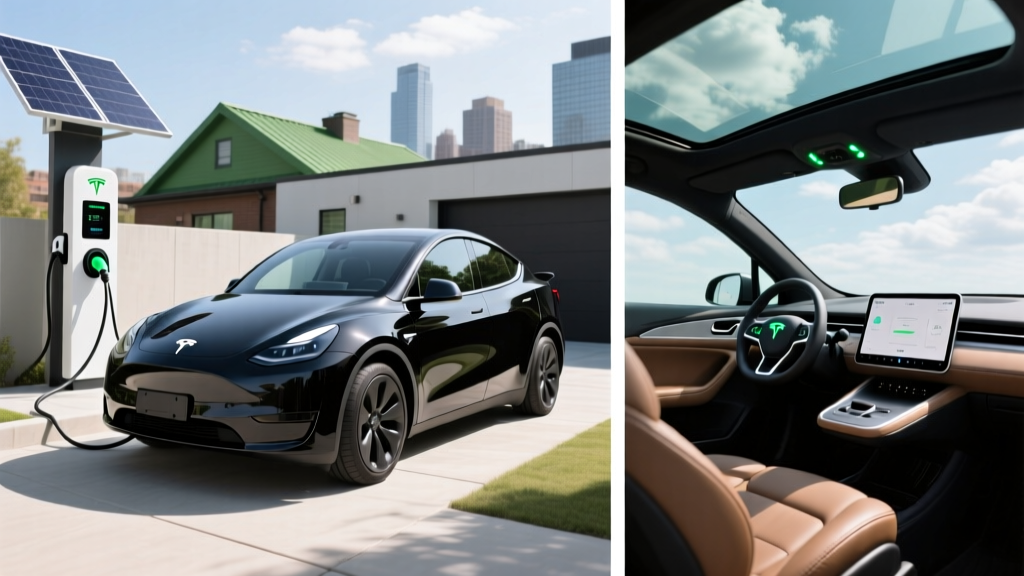
Quick Verdict: The 2026 Tesla Model Y
The 2026 Tesla Model Y Long Range remains the benchmark compact electric SUV for buyers who prioritize charging infrastructure, software polish, and efficiency. With an EPA-estimated 330 miles of range, access to the 17,000+ Supercharger network, and a starting MSRP around $44,990 (before any incentives), it occupies a defensible position even as rivals like the Hyundai Ioniq 5, Ford Mustang Mach-E, and Kia EV6 close the gap on interior quality and ride comfort. This review breaks down every number that matters — from real-world highway range to DC fast-charge taper — and addresses a question we hear often: how do facts about renewable sources of electricity change the ownership equation?
| Spec | Value |
|---|---|
| EPA Range | 330 miles |
| Battery (usable) | ~78 kWh, NMC chemistry |
| Peak DC Fast Charge | 250 kW (Supercharger V3/V4) |
| 10–80% DC Charge Time | ~27 minutes |
| Level 2 Home Charging | 11.5 kW (~44 mi/hr) |
| 0–60 mph | 4.8 seconds |
| Horsepower | 384 hp (dual motor) |
| Drivetrain | AWD (dual motor) |
| MPGe (combined) | 122 MPGe |
| Efficiency | 28 kWh/100 mi |
| Cargo (rear seats up) | 30.2 cu ft |
| Cargo (rear seats folded) | 72.1 cu ft |
| Base MSRP | $44,990 |
| Battery Warranty | 8 years / 120,000 miles |
Range & Efficiency: EPA Sticker vs. Real World
The 2026 Model Y Long Range carries an EPA-estimated 330 miles of range on its ~78 kWh usable NMC (nickel manganese cobalt) battery pack. That figure is measured under the EPA's multi-cycle test, which blends city and highway driving at moderate temperatures. Real-world results diverge based on speed, climate, and terrain.
- City / suburban (55 mph avg): 310–340 mi — regen braking recovers energy in stop-and-go traffic.
- Highway (70–75 mph): 260–290 mi — aerodynamic drag dominates at sustained speed.
- Cold weather (below 32°F): 230–270 mi — battery heating and cabin HVAC draw significant energy. Expect 20–30% range loss vs. EPA.
- Towing (with tow package): 160–200 mi — the Model Y is rated for 3,500 lbs, but towing halves effective range.
Efficiency is rated at 122 MPGe combined (28 kWh per 100 miles), per fueleconomy.gov. That puts the Model Y among the most efficient AWD electric SUVs in its class, trailing only the slightly smaller Hyundai Ioniq 5 (114 MPGe combined for the AWD variant) when comparing kWh/mile directly. Tesla's heat pump — standard on all trims — helps preserve range in cold weather by scavenging waste heat from the drivetrain rather than relying solely on resistive cabin heating.
Charging Speed: DC Fast Charge, Home Level 2, and Renewable Grid Timing
Charging speed is where the Model Y's ecosystem advantage shows. On a Tesla V3 or V4 Supercharger, the pack peaks at 250 kW, adding roughly 200 miles in 15 minutes under ideal conditions. The full 10–80% session takes approximately 27 minutes. As with all NMC packs, the charge curve tapers significantly above 80% to protect cell longevity — a session from 80–100% can add another 20+ minutes, so plan your stops around 80% unless you need the full buffer.
| Charge Level | Power (kW) | Speed (miles per hour) | Typical Use |
|---|---|---|---|
| Level 1 (120V) | ~1.4 kW | ~3–5 mi/hr | Emergency / trickle |
| Level 2 (240V, 48A) | 11.5 kW | ~44 mi/hr | Home overnight, workplace |
| DC Fast (Supercharger V3/V4) | Up to 250 kW | ~800+ mi/hr (peak) | Road trips |
| DC Fast (CCS adapter, EA/others) | Up to 250 kW | ~800+ mi/hr (peak) | Non-Tesla networks |
For home charging, a Wall Connector on a 60-amp circuit delivers the full 11.5 kW (48 amps continuous), replenishing the 78 kWh pack in roughly 7–8 hours. Most owners who drive 40–60 miles per day recover their daily usage in under two hours of Level 2 charging.
Renewable energy and charging timing: This is where facts about renewable sources intersect with EV ownership. If your utility offers time-of-use (TOU) rates, scheduling charging during midday (when solar output peaks) or overnight (when wind generation is strongest in many grids) can cut your per-kWh cost by 40–60% compared to peak evening hours. In regions like California (CAISO), Texas (ERCOT), and the Midwest (MISO), renewable penetration regularly exceeds 40–50% during these windows, meaning your EV is running on a cleaner mix. Pairing a home Level 2 charger with rooftop solar can reduce effective fuel cost to near zero after system payback — typically 7–10 years depending on local incentives and insolation.
Performance & Drivetrain
The Long Range AWD uses a dual-motor setup — a permanent-magnet motor on the rear axle and an induction motor up front — producing a combined 384 horsepower. The 0–60 mph time is 4.8 seconds, which is quick enough for confident highway merging and passing without entering sports-car territory. The Performance trim (if available for 2026) drops that to approximately 3.5 seconds with 450+ hp, at the cost of roughly 15–20 miles of EPA range and a firmer ride.
Regenerative braking is aggressive and effectively enables one-pedal driving in most conditions, though Tesla removed the user-adjustable regen setting several model years ago. The Model Y's ride quality has improved with the "Juniper" refresh — softer damping and acoustic glass reduce cabin noise, though it still trails the Ioniq 5 and EV6 for plushness over broken pavement.
Interior, Cargo & Technology
The Model Y's cabin is minimalist by design: a single 15.4-inch center touchscreen handles infotainment, climate, navigation, and vehicle settings. There is no instrument cluster — speed and navigation appear on the left third of the main screen. The 2026 Juniper refresh adds ventilated front seats, ambient lighting, power-folding second-row seats, and a rear-seat touchscreen for passengers.
Cargo space is generous: 30.2 cubic feet behind the second row and 72.1 cubic feet with seats folded, plus a small front trunk (frunk) for charging cables or a backpack. Rear legroom measures approximately 41.6 inches — adequate for adults on longer trips, though the seat cushion is relatively flat and low, which taller passengers notice on drives over two hours.
Driver assistance: Tesla's Autopilot (basic adaptive cruise + lane centering) is standard. Full Self-Driving (Supervised) remains a $8,000 add-on or $99/month subscription. FSD is an SAE Level 2 system — the driver must remain attentive, hands on or near the wheel, and legally responsible at all times. It is not self-driving. Tesla's camera-only vision stack has improved in urban scenarios, but NHTSA continues to scrutinize the system under its Standing General Order for crash reporting.
Pricing, Trims & Federal Tax Credit Eligibility
The 2026 Model Y lineup (at time of publication) includes:
- Long Range RWD: ~$42,990 MSRP — 330 mi range, single motor
- Long Range AWD: ~$44,990 MSRP — 310–320 mi range, dual motor
- Performance AWD: ~$48,990 MSRP — ~295 mi range, dual motor, track hardware
| Line Item | Amount |
|---|---|
| Base MSRP | $44,990 |
| Destination Fee | $1,390 |
| Federal §30D Credit (if eligible) | –$3,750 to –$7,500 |
| Estimated Net Price | $38,880 – $42,630 |
Federal tax credit (§30D) eligibility for 2026: Under current IRS rules, the Model Y qualifies for up to $7,500 in federal tax credit, split between a $3,750 critical-minerals component and a $3,750 battery-components component. Eligibility depends on:
- MSRP cap: Vehicle must be under $80,000 (SUVs/vans/pickups). Model Y qualifies.
- Buyer income cap: AGI must not exceed $150,000 (single), $225,000 (head of household), or $300,000 (joint).
- Battery sourcing: Critical minerals and battery components must meet escalating domestic/free-trade-partner thresholds. Tesla's shifting supply chain means the credit amount can change mid-year — always verify on the IRS qualified vehicles list before purchase.
- Point-of-sale transfer: Buyers can transfer the credit to the dealer at purchase for an immediate price reduction, rather than waiting to claim it on their tax return.
Critical caveat: Tesla's battery sourcing compliance can shift as supply chains evolve. Always check the current fueleconomy.gov qualified vehicle list in the week you plan to purchase, as the credit amount for the Model Y has fluctuated between $3,750 and $7,500 in recent quarters.
Ownership Costs & Warranty
Tesla covers the Model Y with a 4-year / 50,000-mile basic vehicle warranty and an 8-year / 120,000-mile battery and drive unit warranty. The battery warranty guarantees the pack will retain at least 70% of its original capacity during that period. Independent data from Tesla's own impact reports and third-party fleet analyses (e.g., Recurrent Auto) show NMC packs in Model Y vehicles typically retain 88–92% capacity at 100,000 miles under normal charging habits (avoiding sustained 100% SoC storage).
Insurance premiums for the Model Y run 15–30% higher than comparable gas-powered compact SUVs, according to industry averages — factor in roughly $1,800–$2,600/year depending on your state, age, and driving record. Tesla offers its own insurance product in many states, priced dynamically on real-time driving behavior via a Safety Score, which can undercut traditional carriers for careful drivers.
Electricity cost per mile averages $0.04–$0.06 at home (national average ~$0.16/kWh) versus $0.12–$0.16/mile for a 25-MPG gas SUV at $3.50/gallon. Over 15,000 miles/year, that's roughly $600–$900 in electricity versus $2,100+ in gasoline — a savings of $1,200–$1,500 annually before maintenance differences (no oil changes, reduced brake wear from regen).
Pros, Cons & Who Should Buy
- Best-in-class Supercharger network access (17,000+ stalls in North America)
- 330-mile EPA range with strong real-world highway efficiency
- Class-leading cargo volume (72.1 cu ft) for the segment
- Over-the-air updates continuously add features
- Heat pump standard for cold-climate efficiency
- Strong resale value relative to EV segment average
- Minimalist interior not to everyone's taste; no physical buttons
- Ride quality still firmer than Ioniq 5 / EV6 rivals
- FSD (Supervised) remains expensive and Level 2 only
- Insurance costs above segment average
- No Apple CarPlay or Android Auto
- Tax credit amount can fluctuate based on sourcing rules
Best for: Commuters and small families who road-trip 2–4 times per year and value charging convenience above all else. The Supercharger network remains the most reliable DC fast-charging ecosystem in North America, and the Model Y's 330-mile range means most highway trips require just one 20-minute stop per 250 miles of driving.
Consider alternatives if: You prioritize ride comfort and interior material quality (Hyundai Ioniq 5, Kia EV6), need three rows (Kia EV9), or want a more traditional cockpit layout with physical controls and Apple CarPlay (Ford Mustang Mach-E).
Frequently Asked Questions
What is the real-world range of the 2026 Tesla Model Y?
The EPA rates the Long Range AWD at 330 miles. In real-world highway driving at 70–75 mph, expect 260–290 miles. In cold weather (below freezing), plan for 230–270 miles. City driving with regenerative braking can match or slightly exceed the EPA figure.
How fast does the Model Y charge at home and on the road?
On a Tesla Supercharger (V3/V4), it peaks at 250 kW, reaching 10–80% in roughly 27 minutes. At home on a 240V / 48A Level 2 Wall Connector, it charges at 11.5 kW, adding about 44 miles of range per hour — a full charge from empty takes 7–8 hours overnight.
Does the 2026 Model Y qualify for the federal EV tax credit?
Yes, but the amount varies. Under current IRS §30D rules, it can qualify for up to $7,500 (split between critical-minerals and battery-components requirements). Eligibility depends on buyer income (AGI caps apply), the vehicle's MSRP (under $80,000 for SUVs), and battery sourcing compliance at the time of purchase. Always verify on the IRS or fueleconomy.gov qualified vehicle list before buying. The credit can be transferred at point of sale for an instant price reduction.
How do renewable energy sources affect Model Y ownership costs?
If your utility offers time-of-use rates, charging during peak solar (midday) or wind (overnight) hours can reduce your electricity cost by 40–60%. In grids with high renewable penetration (CAISO, ERCOT, MISO), these windows also mean a lower carbon footprint per mile. Pairing home solar with a Level 2 charger can bring effective fuel cost near zero after the solar system's payback period (typically 7–10 years).
Is the Model Y worth buying over the Hyundai Ioniq 5 or Ford Mach-E?
Choose the Model Y if Supercharger access, cargo space (72.1 cu ft), and software integration are your top priorities. Choose the Ioniq 5 if you value ride comfort, 800V architecture (faster peak charging on compatible CCS stations), and a more distinctive interior. Choose the Mach-E if you prefer Apple CarPlay, a traditional cockpit, and Ford dealer service access. All three are strong — the right pick depends on which trade-offs you accept.
What is the battery warranty and expected longevity?
Tesla warranties the battery for 8 years or 120,000 miles, whichever comes first, guaranteeing at least 70% capacity retention. Real-world fleet data suggests NMC packs in the Model Y retain 88–92% capacity at 100,000 miles with normal charging habits (daily limit set to 80–90%, occasional 100% for road trips).