Quick Verdict: The Benchmark Compact Electric SUV
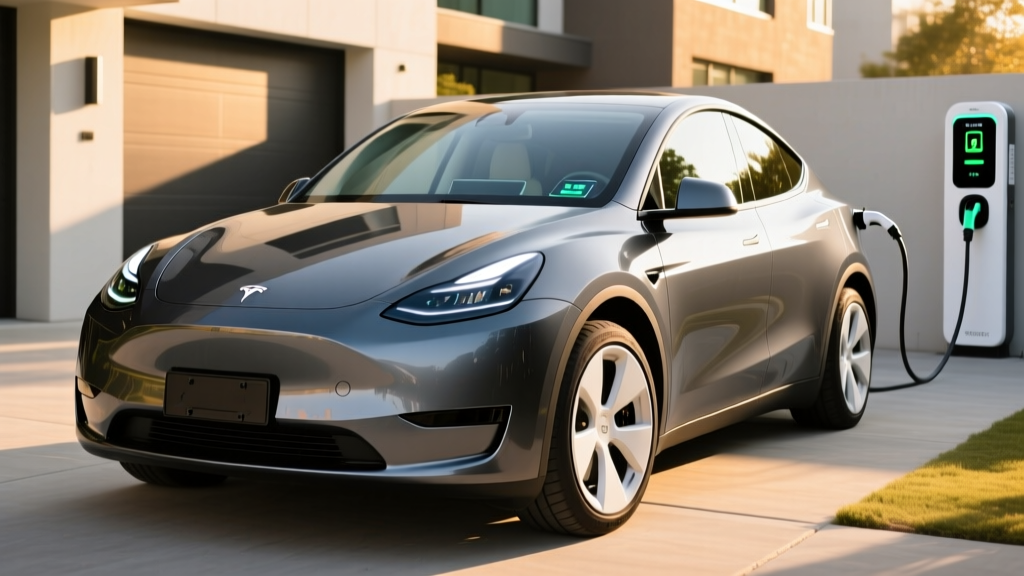
The 2026 Tesla Model Y remains the sales-volume king of the U.S. EV market for good reason: it nails the fundamentals that matter most to buyers — range, charging speed, cargo space, and software — at a price that undercuts most rivals. The refreshed "Juniper" platform brought a quieter cabin, ventilated seats, ambient lighting, and a rear touchscreen, addressing the interior-quality complaints that dogged the pre-2025 model. If you've seen a viral gif Tesla clip of the Model Y's acceleration, minimalist interior reveal, or Supercharger plug-in, you've seen the EV that more Americans actually drive than any other battery-electric vehicle.
But benchmark status doesn't mean flawless. The steering feel remains numb, the all-screen interface demands muscle memory, and the base Rear-Wheel Drive trim's LFP battery trades cold-weather range for longevity. Let's break down exactly what you're buying.
Spec Table: 2026 Tesla Model Y at a Glance
| Spec | Long Range AWD | Performance AWD | Rear-Wheel Drive |
|---|---|---|---|
| EPA Range | 320 miles | 295 miles | 275 miles |
| Battery (usable) | ~75 kWh (NMC) | ~75 kWh (NMC) | ~60 kWh (LFP) |
| Peak DC Fast Charge | 250 kW | 250 kW | 170 kW |
| 10–80% DCFC Time | ~25 min | ~25 min | ~32 min |
| Level 2 Home Charge | 11.5 kW / ~44 mi/hr | 11.5 kW / ~44 mi/hr | 11.5 kW / ~44 mi/hr |
| 0–60 mph | 4.8 sec | 3.5 sec | 6.5 sec |
| Horsepower | 384 hp | 456 hp | 295 hp |
| Drivetrain | Dual-Motor AWD | Dual-Motor AWD | RWD |
| MPGe (combined) | 111 MPGe | 104 MPGe | 119 MPGe |
| Efficiency | 30 kWh/100 mi | 32 kWh/100 mi | 28 kWh/100 mi |
| Base MSRP | $46,630 | $51,490 | $39,990 |
| Fed. Tax Credit (§30D) | Up to $7,500 | Up to $7,500 | Up to $7,500 |
| Battery Warranty | 8 yr / 120,000 mi | 8 yr / 120,000 mi | 8 yr / 100,000 mi |
Source: EPA fueleconomy.gov and Tesla press specifications, 2026 model year. Prices exclude $1,390 destination fee.
Range and Efficiency: EPA vs. the Real World
Real-World Expectation: ~270–290 miles highway at 70 mph; ~240–260 miles in freezing temps (below 32°F); ~260 miles at sustained 80 mph. City/regenerative driving can match or slightly exceed the EPA figure.
The Long Range AWD's 320-mile EPA rating is the headline number, and in mixed suburban driving at moderate temperatures, owners routinely report 290–310 actual miles on a full charge. Tesla's efficiency — 30 kWh per 100 miles — is among the best in the compact electric SUV segment, trailing only the Hyundai Ioniq 5's slightly lower consumption thanks to Tesla's heat pump and octovalve thermal management system.
The RWD trim's smaller LFP (lithium iron phosphate) battery delivers 275 EPA miles but shines in efficiency at 28 kWh/100 mi. LFP chemistry allows — and Tesla recommends — daily charging to 100%, meaning you actually access all 275 miles every day. With NMC trims, Tesla recommends an 80% daily charge limit for battery longevity, effectively giving you ~256 usable miles on the Long Range for routine commuting.
Cold weather remains the great equalizer. In sub-freezing conditions, expect 15–25% range reduction depending on whether you precondition the battery (which you should, always, via the Tesla app before departure). The heat pump standard on all 2026 trims significantly reduces cabin-heating energy draw compared to older resistive heaters, but physics still wins in deep cold.
Charging Speed: Supercharger Network and Home Setup
| Charging Level | Power | Miles Added per Hour | Best For |
|---|---|---|---|
| Level 1 (120V outlet) | ~1.4 kW | ~4–5 mi/hr | Emergency/overnight trickle |
| Level 2 (240V home) | 11.5 kW | ~44 mi/hr | Daily home charging |
| DC Fast (Supercharger V3) | Up to 250 kW (LR/P) | ~1,000 mi/hr peak | Road trips |
| DC Fast (RWD trim) | Up to 170 kW | ~700 mi/hr peak | Road trips (slower curve) |
The Model Y's charging architecture is mature and reliable, if no longer class-leading. The Long Range and Performance trims peak at 250 kW on a V3 Supercharger, reaching 10–80% in roughly 25 minutes. The RWD's LFP pack tops out at 170 kW, adding about 7 minutes to that window.
Charge curve reality check: Peak kW is not sustained kW. The Model Y holds near 250 kW only between roughly 10–30% state of charge, then tapers progressively — dropping to ~150 kW by 50%, ~100 kW by 65%, and ~60 kW by 80%. This is normal lithium-ion behavior and why we quote 10–80% times rather than peak figures alone. Above 80%, charging slows dramatically to protect cell health; plan your road-trip stops around 10–80% windows for fastest throughput.
At home, the onboard 11.5 kW charger adds about 44 miles of range per hour on a 48-amp Level 2 circuit (hardwired, 60-amp breaker). A full 10–100% home charge takes roughly 7–8 hours for the Long Range — easily overnight. Installation cost for a Tesla Wall Connector or equivalent Level 2 unit typically runs $800–$2,000 depending on panel proximity and whether your electrical panel needs a 200-amp upgrade. Always get a quote from a licensed electrician before budgeting.
The Model Y ships with a NACS (North American Charging Standard) port natively. With the industry's 2025–2026 migration to NACS, the Model Y now accesses virtually all major public DC fast-charging networks — Electrify America, EVgo, ChargePoint — without an adapter, a significant convenience advantage that has flipped from Tesla's former isolation.
Performance, Driving Dynamics, and the Juniper Refinement
The Performance trim's 3.5-second 0–60 mph time is the stuff of viral gifs — Tesla's dual-motor torque delivery is instantaneous and relentless. But the Long Range's 4.8 seconds is more than adequate for merging, passing, and everyday enthusiasm, while the RWD's 6.5 seconds, though the slowest in the lineup, still outpaces most gas-powered compact SUVs off the line.
The 2026 Juniper refresh brought meaningful improvements: acoustic glass reduces wind and road noise substantially, the retuned suspension absorbs bumps with less crashiness than the pre-refresh model, and ventilated front seats address a longstanding complaint. The cabin materials — while still minimalist — feel more premium with new ambient lighting strips and improved soft-touch surfaces.
Driving dynamics remain the Model Y's relative weakness. Steering is precise but light and devoid of feedback. Body control is competent but not sporty. If driving engagement is a priority, the BMW iX or even the Ford Mustang Mach-E GT offer more involving chassis tuning. The Model Y prioritizes efficiency, comfort, and software — and wins on those terms.
Interior, Tech, and Cargo Space
The 2026 Model Y interior is a study in screen-centric minimalism. A 15.4-inch front touchscreen handles virtually every vehicle function — climate, mirrors, glovebox, media, navigation — while a new 8-inch rear touchscreen gives back-seat passengers control over their own climate and entertainment. The absence of physical buttons is polarizing; some owners love the clean aesthetic, others find simple adjustments (like redirecting an air vent) unnecessarily fiddly.
Tesla's infotainment software remains the industry's most responsive and feature-rich, with native streaming apps, a built-in browser, Sentry Mode dashcam recording, and over-the-air updates that regularly add functionality. The navigation system routes through Superchargers automatically on road trips, preconditions the battery for optimal charge speed, and estimates arrival state-of-charge with impressive accuracy.
Cargo and passenger dimensions:
- Rear cargo (seats up): 30.2 cu ft
- Rear cargo (seats folded): 72.1 cu ft
- Front trunk (frunk): 4.1 cu ft
- Rear legroom: 41.6 inches
- Front headroom: 41.0 inches
These numbers put the Model Y at the top of the compact electric SUV segment for practicality. The flat load floor and wide hatch opening accommodate strollers, camping gear, and Costco runs with ease. The optional third row (available on Long Range) adds two small seats suitable for children, though it eliminates the rear cargo well.
Pricing, Trims, and Federal Tax Credit Eligibility
| Trim | Base MSRP | Est. §30D Credit | Effective Price (before state incentives) |
|---|---|---|---|
| Rear-Wheel Drive | $39,990 | Up to $7,500 | ~$32,490 |
| Long Range AWD | $46,630 | Up to $7,500 | ~$39,130 |
| Performance AWD | $51,490 | Up to $7,500 | ~$43,990 |
All 2026 Model Y trims fall under the IRS §30D MSRP cap of $80,000 for SUVs, making them potentially eligible for the full $7,500 federal tax credit — provided both buyer and vehicle meet all requirements:
- Buyer income caps: Modified adjusted gross income must not exceed $150,000 (single), $225,000 (head of household), or $300,000 (joint).
- Battery sourcing: A percentage of critical minerals and battery components must be sourced from the U.S. or free-trade-agreement partners. These thresholds increase annually; verify current-year compliance on Tesla's website or the IRS clean vehicle credit page before purchase.
- Point-of-sale transfer: Since 2024, buyers can transfer the credit to the dealer at purchase, receiving the $7,500 as a price reduction rather than waiting for a tax refund. This effectively lowers your drive-off price.
- Final assembly: Must occur in North America (the Model Y is assembled in Austin, TX and Fremont, CA).
Tax rules change frequently. Consult a tax professional and verify eligibility at irs.gov before relying on credit amounts in your purchase decision.
Autopilot, FSD, and Driver Assistance
Every 2026 Model Y includes Tesla's basic Autopilot — adaptive cruise control and lane-centering — as standard equipment. The optional Full Self-Driving (Supervised) package ($8,000 or $99/month) adds automatic lane changes, navigation-guided on/off-ramp handling, traffic-light and stop-sign recognition, and the controversial "city streets" capability.
FSD has improved meaningfully with Tesla's end-to-end neural network approach (v12+), but it remains a Level 2 driver-assist system, not a self-driving system. Expect occasional phantom braking, missed lane markings in construction zones, and situations requiring immediate driver takeover. It's a compelling highway companion and increasingly capable in cities, but it does not replace an attentive driver. Buyers who view FSD as a convenience feature — not an autonomy solution — will be satisfied; those expecting a chauffeur will be disappointed.
Standard safety features include automatic emergency braking, blind-spot monitoring, lane-departure warning, and 360-degree cameras. The Model Y earns top marks from NHTSA (5-star overall) and the IIHS Top Safety Pick+ designation.
Pros and Cons
Pros
- Best-in-class Supercharger network access and route planning
- 320-mile EPA range (Long Range) with excellent efficiency
- Spacious cargo area (72.1 cu ft) and practical hatchback design
- Industry-leading software, OTA updates, and infotainment
- Strong federal tax credit eligibility across all trims
- LFP option (RWD) allows daily 100% charging with minimal degradation concern
Cons
- Numb steering and unengaging driving dynamics
- All-screen interface is distracting for some drivers
- RWD trim's 170 kW DC fast-charge ceiling is slower than rivals
- FSD remains Level 2 — not autonomous — despite the name and price
- No Apple CarPlay or Android Auto support
- Third-row seat option is cramped and reduces cargo utility
Who Should Buy the 2026 Tesla Model Y?
Choose the Model Y Long Range if: You want maximum range for road trips, need dual-motor AWD for snow or rain, and value the Supercharger network for hassle-free long-distance travel. Ideal for families and frequent highway commuters.
Choose the Model Y RWD if: You primarily commute in mild climates, want the lowest entry price (potentially ~$32,500 after federal credit), prefer LFP battery longevity and daily 100% charging, and don't need AWD.
Choose the Model Y Performance if: Acceleration thrills matter, you want the sportiest suspension tuning and largest brakes, and you're willing to trade 25 miles of EPA range for a 3.5-second 0–60 time.
Look elsewhere if: You prioritize steering feedback and driving engagement (consider the BMW iX or Porsche Macan EV), need Apple CarPlay/Android Auto, or want a traditional instrument cluster and physical buttons.
Frequently Asked Questions
What is the real-world range of the 2026 Tesla Model Y?
The Long Range AWD achieves 320 miles EPA, but expect roughly 270–290 miles in real-world highway driving at 70 mph, and 240–260 miles in freezing weather. City driving with regenerative braking can match or slightly exceed the EPA figure. The RWD's LFP battery delivers 275 EPA miles and, because Tesla recommends daily 100% charging on LFP, you access all of it routinely.
How fast does the Model Y charge at home and on the road?
At home on a 48-amp Level 2 charger (240V), the Model Y charges at 11.5 kW, adding about 44 miles of range per hour — a full charge takes 7–8 hours overnight. On a Tesla V3 Supercharger, the Long Range and Performance peak at 250 kW (10–80% in ~25 minutes), while the RWD peaks at 170 kW (10–80% in ~32 minutes).
Does the 2026 Tesla Model Y qualify for the $7,500 federal tax credit?
All trims are potentially eligible for up to $7,500 under IRS §30D, subject to buyer income limits ($150K single / $300K joint), battery critical-mineral and component sourcing requirements that tighten annually, and the $80,000 SUV MSRP cap (which all Model Y trims clear). The credit can be transferred at point of sale as an immediate price reduction. Always verify current-year sourcing compliance and consult a tax professional before purchase.
Is the Model Y worth buying over the Hyundai Ioniq 5 or Ford Mustang Mach-E?
The Model Y wins on range efficiency, Supercharger convenience, software, and cargo space. The Ioniq 5 charges faster on compatible 350 kW chargers (800V architecture) and offers a more distinctive design with physical buttons. The Mach-E GT delivers sharper handling. If the Tesla Supercharger network and software ecosystem are priorities, the Model Y remains the segment default. If you value charging speed or driving feel, test-drive the Ioniq 5 and Mach-E before committing.
How long will the Model Y battery last?
Tesla warranties the battery for 8 years / 120,000 miles (Long Range, Performance) or 8 years / 100,000 miles (RWD), guaranteeing at least 70% capacity retention over that period. Real-world data from high-mileage Tesla owners suggests NMC packs typically retain 85–90% capacity at 100,000 miles with proper charging habits (avoiding frequent 100% charges and prolonged low-state-of-charge storage). LFP packs in the RWD trim show even slower degradation due to the chemistry's inherent cycle-life advantage.
Does the Model Y have Apple CarPlay or Android Auto?
No. Tesla uses its proprietary infotainment system exclusively. While it offers native Spotify, YouTube, Netflix (parked), and a web browser, there is no phone-mirroring integration. For most Tesla owners, the built-in system is sufficient; for those deeply invested in Apple or Google ecosystems, this remains a notable omission.