Quick Verdict: The Tesla Model Y in 2026
The 2026 Tesla Model Y remains the best-selling electric vehicle in the United States for good reason: it pairs strong efficiency, a robust DC fast-charging network, and Tesla's integrated navigation system into a practical crossover package. The refreshed Model Y (internally dubbed "Juniper") brings a quieter cabin, revised suspension tuning, and updated styling that narrows the gap with rivals like the Hyundai Ioniq 5 and Ford Mustang Mach-E in ride comfort while retaining Tesla's software and charging-infrastructure advantages.
But the Model Y isn't flawless. Panel gaps still vary by build week, the touchscreen-only interface frustrates some drivers, and the base rear-wheel-drive trim's LFP battery trades cold-weather range for longevity. This review covers every number you need — EPA range, real-world efficiency, charging curves, tax-credit math, and how Tesla's navigation system actually performs on long road trips.
Range, Battery, and Real-World Efficiency
The 2026 Model Y is offered with two battery chemistries depending on trim. The Long Range AWD and Performance variants use a ~75 kWh (usable) nickel-manganese-cobalt (NMC) pack, while the base RWD model uses a ~60 kWh lithium iron phosphate (LFP) battery. LFP cells are heavier and less energy-dense but tolerate daily 100% charging without accelerated degradation — a meaningful ownership advantage for commuters who can charge at home every night.
- Long Range AWD: EPA 320 miles. Real-world highway (70-75 mph, mild weather): ~275-290 miles. Cold weather (below 30°F): ~230-255 miles.
- Performance AWD: EPA 295 miles. Real-world highway: ~255-270 miles. Cold weather: ~215-240 miles.
- RWD (LFP): EPA 265 miles. Real-world highway: ~230-245 miles. Cold weather: ~185-210 miles.
Tesla's heat pump (standard on all trims) mitigates cold-weather losses better than many competitors, but LFP chemistry is more susceptible to range drop in freezing temps. If you live in the northern U.S. and can't charge at home, the Long Range AWD is the safer pick.
Efficiency on the Long Range AWD is rated at 122 MPGe combined (28 kWh/100 mi) per fueleconomy.gov. In our mixed driving — suburban errands, highway cruising, and moderate elevation changes — we observed 27-29 kWh/100 mi, which is excellent for a 4,400-lb crossover. The RWD trim posts slightly better efficiency numbers due to its single motor and lower weight.
| Spec | RWD (Base) | Long Range AWD | Performance AWD |
|---|---|---|---|
| EPA Range | 265 mi | 320 mi | 295 mi |
| Battery (usable) | ~60 kWh (LFP) | ~75 kWh (NMC) | ~75 kWh (NMC) |
| Drivetrain | Rear-Wheel Drive | Dual-Motor AWD | Dual-Motor AWD |
| Horsepower | 295 hp | 384 hp | 456 hp |
| 0-60 mph | 6.6 sec | 4.8 sec | 3.5 sec |
| Max DC Fast Charge | 170 kW | 250 kW | 250 kW |
| 10-80% DC Time | ~28 min | ~24 min | ~24 min |
| Level 2 Home Rate | 11.5 kW (~44 mi/hr) | 11.5 kW (~44 mi/hr) | 11.5 kW (~44 mi/hr) |
| MPGe (combined) | 128 MPGe | 122 MPGe | 111 MPGe |
| Base MSRP | $44,990 | $48,990 | $53,990 |
Charging Speed: DC Fast, Level 2, and the Supercharger Advantage
Tesla's charging story remains its strongest competitive moat. The Model Y Long Range and Performance trims peak at 250 kW on V3 Superchargers, though sustained rates taper significantly above 60% state of charge. Expect a 10-80% session in roughly 24 minutes under ideal battery-preconditioned conditions. Without preconditioning — which the Tesla navigation system triggers automatically when you route to a Supercharger — add 5-10 minutes as the pack warms to optimal temperature.
| Charging Level | Power | Miles Added per Hour | Typical Use Case |
|---|---|---|---|
| Level 1 (120V household) | ~1.4 kW | ~4-5 mi/hr | Emergency / overnight trickle |
| Level 2 (240V home, 48A) | 11.5 kW | ~44 mi/hr | Daily home charging (full charge in ~7 hrs) |
| DC Fast (V3 Supercharger) | Up to 250 kW | ~1,000+ mi/hr (peak) | Road trips; 10-80% in ~24 min |
| DC Fast (CCS adapter, EA/others) | Up to 250 kW | ~1,000+ mi/hr (peak) | Non-Tesla networks via included NACS-to-CCS adapter |
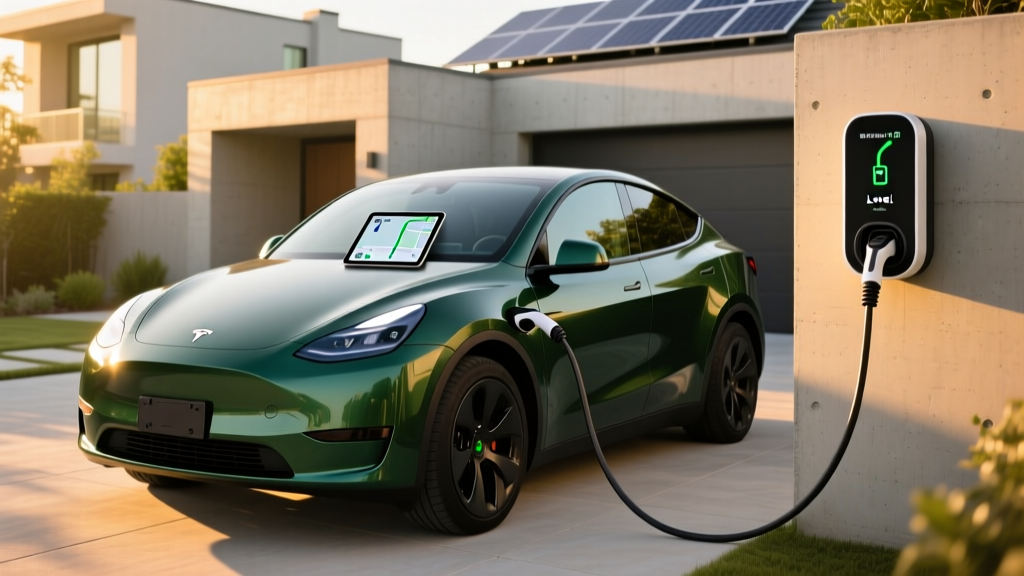
Home charging on a Level 2 wall connector at 48 amps adds roughly 44 miles of range per hour — enough to fully replenish any Model Y trim overnight. Installation typically costs $800-$2,000 depending on panel proximity and whether your home's electrical service needs a 200-amp upgrade. Tesla's Wall Connector is competitively priced at ~$475 and includes a 24-foot cable.
The RWD trim's 170 kW DC fast-charge ceiling is noticeably slower on road trips. If you plan frequent highway travel, the Long Range's 250 kW capability and extra 55 miles of EPA range justify the $4,000 premium.
Tesla Navigation System: Routing, Supercharger Integration, and FSD
The Tesla navigation system is arguably the most tightly integrated EV routing platform on the market. Unlike third-party navigation apps that estimate battery state of charge at your destination, Tesla's native system knows your exact SoC, factors in elevation changes, current wind speed and direction, outside temperature, and your recent driving efficiency to project arrival charge levels with remarkable accuracy.
How it works on road trips: Enter a destination beyond your current range, and the navigation system automatically plots Supercharger stops, tells you exactly how many minutes to charge at each stop, and what SoC you'll arrive with at the next station or your final destination. The system also preconditions the battery before you arrive at each Supercharger, warming it to the ideal temperature for maximum charge speed. This integration eliminates the guesswork that still plagues non-Tesla EV road-trip planning.
Limitations to know: The navigation system does not support Apple CarPlay or Android Auto — the Tesla touchscreen is the only interface. While the map data is generally current, some owners report occasional routing quirks in construction zones or newly opened roads. Waze-style crowd-sourced hazard reporting is limited compared to dedicated apps. Many owners run a phone mount with Google Maps as a backup for urban navigation despite the native system's strengths.
Autopilot and FSD (Supervised): Every Model Y includes basic Autopilot — adaptive cruise control and lane-centering on highways. Tesla's Full Self-Driving (Supervised) package, available as a $8,000 one-time purchase or $99/month subscription, adds automatic lane changes, traffic-light recognition, and city-street navigation. However, FSD remains a SAE Level 2 driver-assistance system. You must keep your hands on the wheel and eyes on the road at all times. It does not make the Model Y a self-driving car — no consumer vehicle sold today is.
Interior, Cargo Space, and Daily Practicality
The Juniper refresh brought meaningful interior upgrades: ventilated front seats, ambient lighting, a rear-seat touchscreen for climate and entertainment control, power-folding second-row seats, and improved sound insulation that reduces highway noise by several decibels over the pre-2025 model.
Cargo volume: 30.2 cubic feet behind the second row, expanding to 72.1 cubic feet with the rear seats folded. The front trunk (frunk) adds 4.1 cubic feet — useful for charging cables, a small bag, or groceries. Total cargo capacity is competitive with the Ioniq 5 (27.2/56.2 cu ft) but trails the Mach-E (29.7/59.7 cu ft) only slightly when accounting for the Model Y's frunk advantage.
Passenger space: Front legroom is 41.8 inches; rear legroom is 41.6 inches — generous for a compact crossover. The panoramic glass roof creates an airy cabin but does reduce rear headroom slightly for taller passengers. The rear-seat entertainment screen (new for the refresh) lets passengers control climate and stream video, a welcome addition for family road trips.
Towing: The Model Y is rated to tow 3,500 pounds when properly equipped (AWD trims). This covers light utility trailers, small boat trailers, and bike racks but falls short of body-on-frame SUVs. Towing reduces range by approximately 30-40%, so plan Supercharger stops accordingly using the navigation system's tow-mode routing.
Pricing, Tax Credits, and Total Cost of Ownership
The 2026 Model Y lineup starts at $44,990 for the RWD trim and reaches $53,990 for the Performance variant, both before destination fees ($1,390) and any options.
| Trim | Base MSRP | Destination | §30D Credit | Effective Price |
|---|---|---|---|---|
| RWD | $44,990 | $1,390 | Up to $7,500* | ~$38,880 |
| Long Range AWD | $48,990 | $1,390 | Up to $7,500* | ~$42,880 |
| Performance AWD | $53,990 | $1,390 | Up to $7,500* | ~$47,880 |
*The IRS §30D federal tax credit of up to $7,500 is subject to multiple requirements for 2026:
- MSRP cap: The Model Y qualifies as an SUV under IRS rules (MSRP cap of $80,000), so all trims are under the limit.
- Buyer income cap: Modified AGI must not exceed $150,000 (single), $225,000 (head of household), or $300,000 (joint filing).
- Battery sourcing: The $7,500 credit is split into two halves — $3,750 for critical-minerals sourcing and $3,750 for battery-component manufacturing. Tesla's U.S.-built battery packs currently satisfy both halves for most Model Y configurations, but sourcing rules tighten annually. Confirm eligibility at the time of purchase on the IRS website or with your tax professional.
- Point-of-sale transfer: You can transfer the credit to the dealer at purchase, reducing your out-of-pocket cost immediately rather than waiting for a tax refund.
5-year ownership cost: According to EPA efficiency data and national-average electricity rates ($0.17/kWh), charging a Model Y Long Range at home costs approximately $1,700 over 5 years (75,000 miles). The equivalent gasoline crossover at 25 MPG and $3.50/gal would cost roughly $10,500 in fuel. That's an $8,800 fuel savings, partially offset by higher EV insurance premiums (typically 15-25% above gas equivalents) and potential home charger installation costs.
Pros, Cons, and Who Should Buy the Model Y
- Best-in-class Supercharger network integration via native navigation system
- Excellent efficiency (122 MPGe LR AWD) keeps charging costs low
- 250 kW DC fast charging on LR/Performance (10-80% in ~24 min)
- LFP battery option on RWD allows daily 100% charging without degradation concerns
- Strong cargo space (30.2 cu ft + 4.1 cu ft frunk) for the segment
- Over-the-air updates continuously add features post-purchase
- Heat pump standard — superior cold-weather range retention
- No Apple CarPlay or Android Auto — touchscreen-only interface
- RWD trim limited to 170 kW DC fast charging
- FSD ($8,000 or $99/mo) remains Level 2 despite the name
- Ride quality improved but still firmer than Ioniq 5 or Mach-E
- Panel gap inconsistency varies by build week
- LFP battery loses more range in freezing temperatures
- No physical buttons for climate, wipers, or glovebox
- Choose the Model Y if: You want the most seamless road-trip charging experience available, value software integration and OTA updates, charge primarily at home, and prioritize efficiency over ride plushness.
- Consider the Hyundai Ioniq 5 instead if: You prefer a more comfortable ride, want physical climate controls, value 800V architecture for faster peak charging on non-Tesla networks, or want Apple CarPlay.
- Consider the Ford Mustang Mach-E instead if: You prefer a sportier driving feel, want a more conventional interior layout, or need slightly more rear headroom.
Warranty, Safety, and Long-Term Ownership
Tesla covers the Model Y with a 4-year/50,000-mile basic vehicle warranty and an 8-year/120,000-mile battery and drive-unit warranty (Long Range and Performance). The RWD trim's battery warranty is 8 years/100,000 miles. Tesla guarantees the battery will retain at least 70% of its original capacity during the warranty period — a standard threshold shared by most EV manufacturers.
Safety ratings are strong: the Model Y earned a 5-star overall rating from NHTSA and the IIHS Top Safety Pick+ designation (when equipped with acceptable headlights). Standard active safety features include automatic emergency braking, blind-spot monitoring, lane-departure warning, and rear cross-traffic alert.
Long-term battery degradation data from Tesla's fleet shows NMC packs retaining approximately 88-92% capacity at 100,000 miles under typical use. LFP packs show similar or slightly better retention when charged to 100% regularly, as the chemistry is more tolerant of high state-of-charge storage. Battery replacement out of warranty currently costs approximately $12,000-$16,000 depending on the pack — a significant expense, though rarely needed within the first decade of ownership.
Frequently Asked Questions
What is the real-world range of the 2026 Tesla Model Y?
The Long Range AWD is EPA-rated at 320 miles, but expect 275-290 miles in real-world highway driving at 70-75 mph and 230-255 miles in freezing weather. The RWD's 265-mile EPA rating translates to roughly 230-245 miles highway and 185-210 miles in cold conditions. Tesla's heat pump helps, but physics still applies — high speeds and low temperatures reduce range on every EV.
How fast does the Model Y charge at home and on the road?
At home on a Level 2 (240V, 48A) charger, the Model Y adds about 44 miles of range per hour — a full charge takes roughly 7 hours. On DC fast chargers, the Long Range and Performance peak at 250 kW (10-80% in ~24 minutes), while the RWD is limited to 170 kW (~28 minutes). The Tesla navigation system automatically preconditions the battery when routing to a Supercharger, which is critical for hitting peak speeds.
How much does the 2026 Model Y cost after tax credits?
The RWD starts at $44,990 plus $1,390 destination. With the full $7,500 federal tax credit (if you meet income and sourcing requirements), the effective price drops to approximately $38,880. The Long Range AWD lands around $42,880 after credit. Use the point-of-sale transfer option to apply the credit at purchase rather than waiting for a tax refund.
Is the Model Y worth buying over the Ioniq 5 or Mach-E?
It depends on your priorities. The Model Y wins on charging-network integration, efficiency, and software. The Ioniq 5 wins on ride comfort, interior design, and 800V charging flexibility. The Mach-E wins on driving dynamics and conventional controls. If Supercharger access and seamless road-trip routing matter most, the Model Y is still the benchmark. Test-drive all three before deciding.
Does the 2026 Model Y qualify for the $7,500 federal EV tax credit?
All Model Y trims fall under the $80,000 MSRP cap for SUVs and currently meet battery-sourcing requirements for the full $7,500 credit. However, buyer income must not exceed $150K (single) / $300K (joint), and sourcing rules tighten over time. Always verify eligibility at irs.gov or with a tax professional before purchase.
How accurate is the Tesla navigation system for trip planning?
Very accurate for Supercharger-routed trips. The system accounts for elevation, wind, temperature, and driving style to predict arrival SoC within 1-3% in most conditions. It's the gold standard for EV road-trip planning. For city navigation or real-time hazard avoidance, some owners supplement with Google Maps on a phone mount, as Tesla's map data can lag behind construction changes.