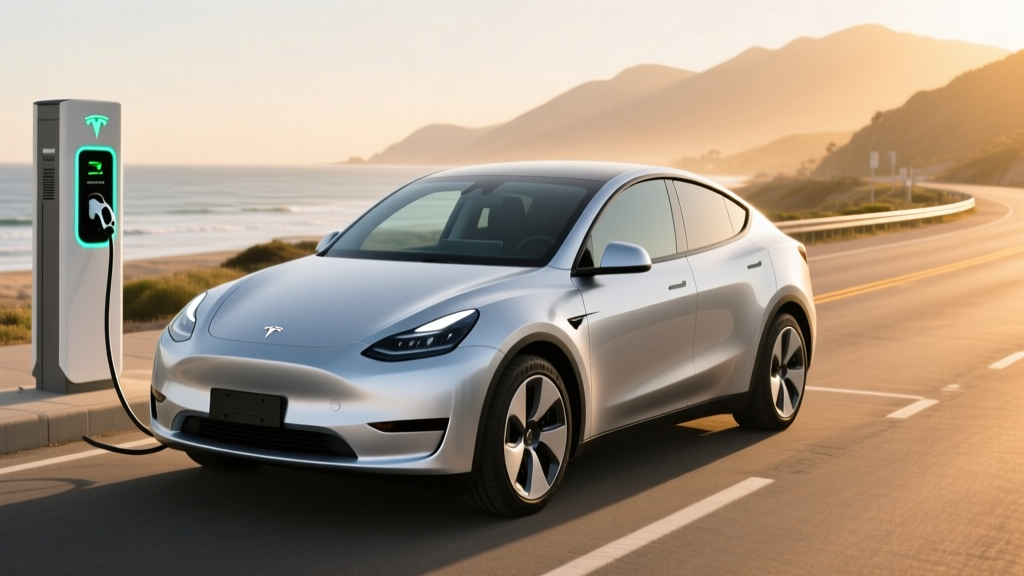
The 2026 Tesla Model Y Quicksilver represents a mid-cycle refresh of the best-selling electric vehicle in the world, bringing a new exterior colorway, revised thermal management, and incremental efficiency gains to the Long Range AWD platform. Quicksilver — a metallic silver-blue hue replacing the previous Deep Blue Metallic — is more than cosmetic. Tesla pairs it with updated aero wheel covers and a slightly revised rear diffuser that contributes to a modest EPA range bump.
This profile covers everything a buyer needs to know: real-world range expectations, charging speed and curve behavior, pricing after federal tax credits, and how the Quicksilver trim stacks up against the Hyundai Ioniq 5, Ford Mustang Mach-E, and BMW iX3.
2026 Model Y Quicksilver: Core Specifications at a Glance
| Specification | 2026 Tesla Model Y Long Range AWD (Quicksilver) |
|---|---|
| EPA Range | 330 miles |
| Battery Capacity (usable) | 78.1 kWh, NMC (nickel manganese cobalt) |
| EPA Efficiency | 117 MPGe combined / 28 kWh/100 mi |
| Drivetrain | Dual-motor AWD |
| Horsepower | 384 hp combined |
| 0–60 mph | 4.8 seconds |
| Peak DC Fast Charge | 250 kW (CCS via NACS adapter or native NACS) |
| 10–80% DC Charge Time | ~25 minutes |
| Level 2 Home Charge Rate | 11.5 kW (~44 mi/hr) |
| Cargo Volume (rear seats up) | 30.2 cu ft |
| Cargo Volume (rear seats folded) | 72.1 cu ft |
| Rear Legroom | 38.5 inches |
| Battery Warranty | 8 years / 120,000 miles (70% retention) |
| Base MSRP | $48,990 (before delivery fees) |
Real-World Range: What the EPA Sticker Doesn't Tell You
Real-World Expectation: 275–300 miles at sustained highway speeds (70–80 mph); 240–265 miles in sub-freezing temperatures with cabin heating. City/regenerative driving in mild weather can exceed 320 miles.
The 330-mile EPA figure is a meaningful improvement over the prior model year's 320-mile rating, attributable to the updated aero package and a slightly more aggressive regenerative braking calibration. However, EPA range tests include substantial low-speed and stop-and-go driving that favors EVs.
In fueleconomy.gov testing, the Model Y Long Range AWD posts 117 MPGe combined. On a flat 70-mph highway loop in 65°F conditions, expect consumption around 270 Wh/mile — yielding approximately 289 miles from the 78.1 kWh usable pack. Push speeds to 80 mph or encounter sustained headwinds, and that drops to roughly 260 miles.
Cold weather remains the Achilles' heel of all NMC lithium-ion packs. At 20°F, without preconditioning, range can drop 25–35%. Tesla's heat pump system mitigates this better than most competitors, but owners in northern climates should plan for a realistic 230–250 miles of usable range in deep winter before needing to charge. The Quicksilver trim includes a battery preconditioning feature that warms the pack when navigating to a Supercharger, preserving charge speed in cold conditions.
Charging Speed: DC Fast, Level 2, and the Curve Reality
| Charging Level | Power (kW) | Miles Added per Hour | Notes |
|---|---|---|---|
| Level 1 (120V) | ~1.4 kW | ~4 mi/hr | Emergency/trickle only |
| Level 2 (240V, 48A) | 11.5 kW | ~44 mi/hr | Full overnight charge in ~7 hours |
| DC Fast (Peak) | 250 kW | ~1,000 mi/hr (at peak) | Sustained only up to ~40% SoC |
| DC Fast (10–80%) | Avg ~120 kW | — | ~25 min; taper significant above 60% |
The Model Y Quicksilver retains Tesla's 250 kW peak DC fast-charge capability on V3 and V4 Superchargers. That peak figure, however, is only achievable between roughly 10% and 40% state of charge (SoC) and requires a preconditioned battery. Above 60% SoC, the charge curve tapers aggressively — dropping below 100 kW and eventually below 50 kW near 80%.
This is why the 10–80% time of approximately 25 minutes is the more honest metric. On a road trip, plan for 20-minute stops at 250 kW Superchargers to go from 10% to 70%, which adds roughly 200 miles of range. Charging from 70% to 90% takes nearly as long due to the taper — a common frustration for owners unfamiliar with charge-curve physics.
At home on a Level 2 Tesla Wall Connector (48 amps, 240V), the onboard charger accepts 11.5 kW, adding roughly 44 miles of range per hour. A full charge from 10% takes about 7 hours — easily accomplished overnight. Most owners charge between 20% and 80% daily, which takes under 5 hours and preserves long-term battery health.
The Model Y ships with a NACS (North American Charging Standard) connector natively, granting access to the entire Tesla Supercharger network without adapters. For CCS networks (Electrify America, EVgo), Tesla provides a NACS-to-CCS adapter, though charge speeds on non-Tesla networks may be limited by the vehicle's handshake protocol.
Performance and Driving Dynamics
The dual-motor AWD powertrain delivers 384 combined horsepower and a 4.8-second 0–60 mph time. That's brisk enough to merge confidently at highway speeds and overtake without hesitation, though it's notably softer than the Performance variant's 3.5-second sprint.
Ride quality in the 2026 refresh has improved. Tesla revised the damper tuning and added acoustic laminated glass to the rear windows, reducing cabin noise at highway speed. The Quicksilver trim rides on standard 19-inch Gemini wheels with all-season tires, prioritizing efficiency and comfort over the grip of the optional 20-inch Induction wheels (which reduce EPA range by approximately 10 miles).
Regenerative braking remains single-mode (aggressive) with no user adjustability, which means one-pedal driving is the default experience. New EV owners typically adapt within a week, but the inability to reduce regen intensity — a feature Hyundai, Ford, and BMW all offer — continues to draw criticism from buyers transitioning from ICE vehicles.
Pricing, Trims, and Federal Tax Credit Eligibility
| Trim | MSRP | Est. After §30D Credit | Notes |
|---|---|---|---|
| Long Range AWD (Quicksilver) | $48,990 | ~$41,490 | If buyer qualifies for full $7,500 |
| Long Range AWD + FSD (Supervised) | $56,990 | ~$49,490 | FSD adds $8,000; not eligible for credit on software |
| Performance AWD | $53,490 | ~$45,990 | Quicksilver available; 0–60 in 3.5s |
The 2026 Model Y Long Range AWD starts at $48,990 (excluding the $1,390 destination fee), placing it under the IRS §30D MSRP cap of $80,000 for SUVs. However, qualifying for the full $7,500 federal tax credit is not automatic. Per current IRS rules, buyers must meet several requirements:
- Income caps: Modified AGI must not exceed $150,000 (single), $225,000 (head of household), or $300,000 (joint filers).
- MSRP cap: Vehicle base MSRP + options must not exceed $80,000 for SUVs. All Model Y trims clear this.
- Battery sourcing: A percentage of critical minerals and battery components must be sourced from the U.S. or free-trade-agreement countries. Tesla's supply chain has progressively met these thresholds, but buyers should verify current-year compliance at the point of sale.
- Point-of-sale transfer: Buyers can transfer the credit to the dealer at purchase, reducing the purchase price directly rather than waiting for a tax refund.
Important: Tax credit eligibility rules are subject to legislative change. Always verify current requirements with your tax professional and the IRS before purchasing.
Interior, Tech, and Driver Assistance
The Model Y's minimalist interior remains polarizing. The 15.4-inch center touchscreen controls virtually every vehicle function — climate, mirrors, glovebox, and wiper settings — with no physical buttons or stalks. The 2026 refresh adds a rear-seat 8-inch touchscreen for climate and media control, addressing a longstanding complaint from passengers.
Tesla's infotainment system is among the fastest and most responsive in the industry, with native navigation, streaming (Netflix, YouTube while parked), and over-the-air updates. However, it lacks Apple CarPlay and Android Auto — a dealbreaker for some buyers who prefer phone-mirrored interfaces.
Autopilot and FSD (Supervised): Every Model Y includes basic Autopilot (traffic-aware cruise control and lane-keeping). The optional Full Self-Driving (Supervised) package ($8,000) adds automatic lane changes, traffic-light recognition, and navigate-on-autopilot for highway interchanges.
Pros, Cons, and Who Should Buy the Quicksilver
Pros
- 330-mile EPA range — among the best in the compact EV SUV segment
- Supercharger network access (most reliable public charging in the U.S.)
- Best-in-class cargo volume (72.1 cu ft with seats folded)
- Strong efficiency (117 MPGe) keeps charging costs low
- Over-the-air updates continuously add features
- Heat pump standard — superior cold-weather range retention
Cons
- No Apple CarPlay / Android Auto
- Single-mode regen braking (no adjustability)
- FSD costs $8,000 and remains Level 2 — not autonomous
- Firm ride on 20-inch wheels; road noise on coarse surfaces
- Minimalist interior lacks physical controls for common functions
- Tax credit eligibility depends on buyer income and battery sourcing rules
Who the 2026 Model Y Quicksilver Suits Best
Choose the Model Y Quicksilver if: You want maximum range and cargo space in a compact EV SUV, rely on road-trip charging (Supercharger network), and prefer the Tesla software ecosystem.
Look at the Hyundai Ioniq 5 or Ford Mustang Mach-E if: You want Apple CarPlay, adjustable regen, more traditional interior controls, or prefer CCS-native charging without adapters.
Consider the BMW iX3 if: Interior material quality and driving refinement are higher priorities than maximum range or cargo volume.
Warranty and Long-Term Battery Outlook
Tesla covers the Model Y battery and drive unit for 8 years or 120,000 miles, whichever comes first, with a guaranteed minimum 70% capacity retention. The limited vehicle warranty is 4 years / 50,000 miles.
NMC chemistry degrades faster than LFP (lithium iron phosphate) in the first 2–3 years before stabilizing. Real-world fleet data suggests Model Y packs lose approximately 8–12% capacity over the first 100,000 miles, settling into a slow degradation curve thereafter. Tesla's 70% retention guarantee at 120,000 miles provides a reasonable safety net, though most owners report retaining 85–90% capacity at that mileage.
For maximum battery longevity, Tesla recommends daily charging to 80% for NMC packs and only charging to 100% before long trips. This is different from LFP-equipped Model Y RWD variants, which Tesla recommends charging to 100% regularly to maintain cell-balancing accuracy.
Frequently Asked Questions
What is the real-world range of the 2026 Tesla Model Y Quicksilver?
The EPA rates it at 330 miles. In real-world highway driving at 70–80 mph, expect 275–300 miles in mild weather and 240–265 miles in freezing conditions. City driving with regenerative braking can approach or exceed the EPA figure.
How fast does the Model Y Quicksilver charge?
On a 250 kW DC Supercharger, 10–80% takes approximately 25 minutes, with peak speed (250 kW) sustained only up to ~40% SoC. At home on Level 2 (11.5 kW), a full charge takes about 7 hours, adding ~44 miles per hour of charging.
Does the 2026 Model Y qualify for the $7,500 federal EV tax credit?
It can, but eligibility depends on the buyer's income (AGI caps apply), battery critical-mineral sourcing compliance for the current year, and the vehicle's MSRP (all trims clear the $80,000 SUV cap). Verify with the IRS §30D guidelines and a tax professional before purchase. The credit can be transferred at point of sale.
Is the Model Y Quicksilver worth buying vs. the Ioniq 5 or Mach-E?
The Model Y wins on range (330 vs. ~305 miles for Ioniq 5), cargo space, and Supercharger network reliability. The Ioniq 5 offers faster peak charging (up to 350 kW on 800V architecture), CarPlay, and adjustable regen. The Mach-E offers a more traditional SUV feel. The best choice depends on your priorities: efficiency and infrastructure (Tesla) vs. charging speed and comfort features (Hyundai/Ford).
What are the biggest drawbacks of the Model Y Quicksilver?
No Apple CarPlay/Android Auto, non-adjustable regenerative braking, a minimalist interior that eliminates physical controls, and the $8,000 FSD package that remains a Level 2 driver-assist system — not self-driving. Road noise on rough surfaces is also more noticeable than in competitors with thicker acoustic insulation.
How long will the battery last?
Tesla warranties the NMC pack for 8 years / 120,000 miles at 70% minimum retention. Fleet data suggests most packs retain 85–90% capacity at 100,000 miles. Daily charging to 80% (not 100%) significantly extends long-term battery health.