Tesla Model Y PowerShare: More Than Just a Crossover
The Tesla Model Y has dominated the U.S. EV sales charts for years, but the introduction of PowerShare — Tesla's bidirectional energy ecosystem — has transformed this compact SUV from a daily commuter into a rolling home battery. If you've been searching for "Model Y PowerShare" to understand what the feature actually does, whether your home can use it, and whether the 2026 refresh is worth your money, this review breaks down every spec that matters.
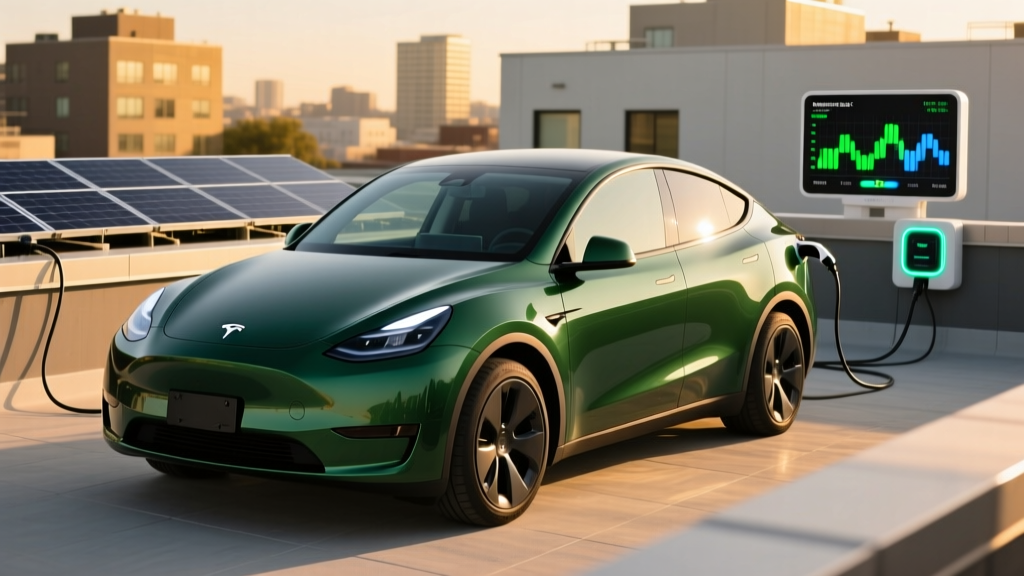
PowerShare encompasses two capabilities: V2L (Vehicle-to-Load), which lets you power devices and tools directly from the car, and V2H (Vehicle-to-Home), which can feed energy back into your home's electrical panel during an outage when paired with the Tesla Powerwall and Wall Connector. It's not a party trick — it's a genuine resilience feature that changes the ownership calculus for buyers in storm-prone or grid-unstable regions.
2026 Model Y Core Specs at a Glance
| Specification | Long Range AWD | Performance |
|---|---|---|
| EPA Range | 320 miles | 295 miles |
| Battery (usable) | ~75 kWh (NMC) | ~75 kWh (NMC) |
| Drivetrain | Dual-Motor AWD | Dual-Motor AWD |
| Horsepower | 384 hp | 456 hp |
| 0–60 mph | 4.8 sec | 3.5 sec |
| Max DC Fast Charge | 250 kW | 250 kW |
| 10–80% DC Time | ~27 min | ~27 min |
| Level 2 Charge Rate | 11.5 kW (44 mi/hr) | 11.5 kW (44 mi/hr) |
| MPGe (combined) | 122 MPGe | 111 MPGe |
| kWh/100 mi | 28 | 30 |
| Cargo (rear seats up) | 30.2 cu ft | 30.2 cu ft |
| Cargo (rear seats folded) | 72.0 cu ft | 72.0 cu ft |
| Rear Legroom | 41.6 in | 41.6 in |
| Base MSRP | $46,630 | $51,630 |
| Battery Warranty | 8 yr / 120,000 mi | 8 yr / 120,000 mi |
Real-World Range: What the EPA Number Doesn't Tell You
EPA Sticker: 320 miles (Long Range AWD)
Real-World Expectation: ~260–280 miles at sustained 70–75 mph highway speeds; ~210–240 miles in freezing temperatures (below 32°F) with cabin heat running. City/regen-heavy driving can match or slightly exceed the EPA figure at ~310–325 miles.
The Model Y Long Range's 320-mile EPA rating is competitive, but Tesla's efficiency advantage has narrowed as Hyundai, Kia, and BMW have fielded 800V architectures with heat pumps as standard. According to fueleconomy.gov, the Long Range AWD achieves 122 MPGe combined, which translates to roughly 28 kWh per 100 miles — still class-leading, though the gap over the Ioniq 5 and EV6 has closed to within 1–2 kWh/100 mi.
The NMC (nickel manganese cobalt) battery chemistry provides high energy density, which is why Tesla can pack ~75 usable kWh into a relatively compact underfloor. However, NMC cells degrade slightly faster than LFP (lithium iron phosphate) over thousands of cycles. Tesla recommends daily charging to 80% for NMC packs and 100% only for road trips — a habit that preserves long-term State of Health (SoH).
Charging Speed: Supercharger Network Advantage
| Charging Level | Power (kW) | Speed (mi/hr added) | Notes |
|---|---|---|---|
| Level 1 (120V outlet) | 1.4 kW | ~4 mi/hr | Emergency/trickle only |
| Level 2 (240V, 48A) | 11.5 kW | ~44 mi/hr | Full overnight charge in ~7 hrs |
| DC Fast (V3 Supercharger) | 250 kW peak | ~1,000 mi/hr at peak | 10–80% in ~27 min; tapers sharply above 80% |
| DC Fast (CCS adapter, 3rd-party) | Up to 150–170 kW | Varies | Electrify America, EVgo; speed depends on station |
Tesla's Supercharger network remains the most reliable DC fast-charging ecosystem in North America. The Model Y peaks at 250 kW on V3 stalls, but sustained charging averages closer to 130–150 kW across the full 10–80% session due to the battery's charge curve taper. That taper is aggressive above 60% SoC — a reality that means the advertised "15 minutes to 200 miles" headline applies only to the lowest SoC states.
For home charging, a 48-amp Wall Connector on a 60-amp circuit delivers 11.5 kW, adding roughly 44 miles per hour. Most owners wake up to a full battery every morning. If your home has a 200-amp panel, installation is straightforward; older 100-amp panels may require a $1,500–$3,000 upgrade.
What Is Model Y PowerShare and How Does It Work?
PowerShare is Tesla's branding for bidirectional energy transfer. It manifests in two ways on the 2026 Model Y:
- V2L (Vehicle-to-Load): Using a Tesla-approved adapter plugged into the charge port, you can draw up to ~2.4 kW of continuous 120V AC power — enough to run a refrigerator, power tools at a job site, camping gear, or emergency lighting. This requires no home modifications.
- V2H (Vehicle-to-Home): When paired with a Tesla Powerwall 3 and a compatible Tesla Wall Connector, the Model Y can feed energy back into your home's electrical panel during a grid outage. The car's ~75 kWh battery can power an average U.S. home (drawing ~30 kWh/day) for roughly 2–2.5 days, buying critical time during multi-day outages.
V2H is not free. You'll need a Powerwall 3 (~$9,200 before installation) and professional integration with a transfer switch or backup load panel. Total system cost for V2H capability typically runs $14,000–$18,000 installed. However, for homeowners in areas with frequent outages — Texas grid stress, California PSPS events, hurricane-prone Southeast — the combined solar + Powerwall + Model Y system replaces the need for a standalone gas generator.
It's worth noting that Ford's F-150 Lightning offers a more mature V2H system with higher continuous output (~9.6 kW through its Charge Station Pro), making it better suited for whole-home backup. The Model Y's V2L is practical but limited by its ~2.4 kW ceiling.
Pricing, Trims, and Federal Tax Credit Eligibility
| Trim | Base MSRP | Est. §30D Credit | Effective Price |
|---|---|---|---|
| Long Range AWD | $46,630 | Up to $7,500* | ~$39,130* |
| Performance | $51,630 | Up to $7,500* | ~$44,130* |
*The IRS §30D federal tax credit is not automatic. Eligibility depends on:
- Buyer income caps: AGI ≤ $150,000 (single), $225,000 (head of household), $300,000 (joint).
- MSRP cap: SUVs/vans/pickups must be ≤ $80,000 (Model Y qualifies).
- Battery sourcing: Critical minerals and battery components must meet escalating domestic-content thresholds that tighten annually. Tesla's U.S. battery manufacturing gives the Model Y an advantage, but exact eligibility varies by production batch and model year.
- Point-of-sale transfer: As of 2024, buyers can transfer the credit to the dealer for an immediate price reduction rather than waiting for a tax refund.
Always verify current-year eligibility on the IRS Clean Vehicle Provisions page or through a qualified tax professional before assuming the full $7,500. Sourcing rules have tightened significantly, and partial credits ($3,750) are possible if only one of the two requirements (critical minerals or battery components) is met.
Tech, Driver Assistance, and Interior
The 2026 Model Y's cabin is minimalist by design — a 15.4-inch center touchscreen controls virtually everything, with no instrument cluster. The "Juniper" refresh added ventilated front seats, ambient lighting, a rear-seat touchscreen, and improved sound insulation that meaningfully reduces road noise at highway speed.
Autopilot (included) provides adaptive cruise and lane centering. Full Self-Driving (Supervised), a $8,000 add-on or $99/month subscription, adds automatic lane changes, traffic light recognition, and city-street navigation.
SAE Level 2 — NOT self-driving. Both Autopilot and FSD (Supervised) require the driver to remain fully engaged, hands on or near the wheel, and eyes on the road at all times. Tesla's "Supervised" label reflects this. True driverless operation (SAE Level 4) is currently limited to geofenced robotaxi services like Waymo.
Infotainment runs Tesla's proprietary OS with built-in navigation, streaming (Netflix, YouTube while parked), and over-the-air updates. Apple CarPlay and Android Auto remain unsupported — a deliberate Tesla choice that frustrates some buyers accustomed to phone-mirroring.
Who Should Buy the Model Y with PowerShare?
Pros
- Best-in-class Supercharger network reliability
- PowerShare V2H provides genuine home backup when paired with Powerwall
- 320-mile EPA range covers most road trips without mid-charge stops
- Strong efficiency (28 kWh/100 mi) keeps charging costs low
- Spacious cargo area (72 cu ft) rivals midsize SUVs
- Over-the-air updates continuously add features
Cons
- V2L limited to ~2.4 kW (F-150 Lightning offers 9.6 kW V2H standalone)
- No Apple CarPlay / Android Auto
- NMC battery requires 80% daily charge limit for longevity
- FSD (Supervised) is expensive and still requires driver attention
- Ride quality is firm over rough pavement
- V2H requires expensive Powerwall + installation ecosystem
Best for: Tech-forward families who want a single vehicle that commutes efficiently, road-trips confidently on Superchargers, and doubles as emergency home backup. If you already own a Powerwall or plan to add solar, the PowerShare integration is seamless.
Look elsewhere if: You need heavy-duty whole-home backup without buying a Powerwall (the F-150 Lightning is better), you rely on Apple CarPlay, or you prefer a traditional instrument cluster and physical controls.
Frequently Asked Questions
What is the real-world range of the Tesla Model Y?
The Long Range AWD carries a 320-mile EPA rating. Expect ~260–280 miles on the highway at 70–75 mph, and as low as ~210–240 miles in freezing weather with heat running. City driving with regenerative braking can approach or exceed the EPA number.
How fast does the Model Y charge at home and on DC?
At home on a 48-amp Level 2 charger, the Model Y adds ~44 miles per hour (11.5 kW), fully charging overnight in ~7 hours. On a V3 Supercharger, it peaks at 250 kW and charges 10–80% in roughly 27 minutes, though the charge curve tapers significantly above 60% SoC.
Does the 2026 Model Y qualify for the $7,500 federal tax credit?
It can, but eligibility is not guaranteed. You must meet IRS income caps ($300,000 joint / $150,000 single), the MSRP must be under $80,000 (it qualifies), and the battery must meet critical-mineral and component-sourcing thresholds that change annually. Verify on IRS.gov or with a tax professional before purchase.
Can Model Y PowerShare run my whole house during an outage?
Only if paired with a Tesla Powerwall 3 and proper transfer switch installation. The Model Y's ~75 kWh battery can power an average home (~30 kWh/day) for about 2–2.5 days. Without the Powerwall ecosystem, you're limited to V2L at ~2.4 kW through the charge port adapter — enough for appliances and tools, not whole-home backup.
Is the Model Y worth buying over the Hyundai Ioniq 5 or Ford Mustang Mach-E?
The Model Y wins on Supercharger network access, efficiency, and PowerShare home integration. The Ioniq 5 offers faster 800V charging (10–80% in ~18 min on 350 kW chargers) and a more distinctive design. The Mach-E offers a more traditional interior and available CarPlay. Your choice should hinge on whether Supercharger access and PowerShare V2H matter more than charging speed or interior familiarity.
What is the battery warranty on the 2026 Model Y?
Tesla covers the battery and drive unit for 8 years or 120,000 miles (whichever comes first), with a guaranteed minimum 70% capacity retention over that period. This is competitive with the industry standard of 8 years / 100,000 miles, and Tesla's extra 20,000-mile buffer is a modest advantage.