If you've searched for Tesla Model Y power outlet options, you've likely hit a wall of conflicting forum posts and outdated videos. The 2026 Tesla Model Y (the refreshed "Juniper" generation that debuted for the 2025 model year) overhauled the cabin's power-delivery layout, adding USB-C fast-charging ports and refining 12V accessory access — but it still lacks a built-in AC household-style outlet or vehicle-to-load (V2L) capability. This review covers every power outlet and port on the 2026 Model Y, then dives into the full ownership picture: range, charging speed, pricing, and how it stacks up against rivals.
Every Power Outlet on the 2026 Tesla Model Y
Here's the complete inventory of power-delivery points inside and outside the 2026 Model Y:
| Location | Type | Output | Use Case |
|---|---|---|---|
| Front center console (rear-facing) | 2× USB-C (PD) | Up to 65W per port | Fast-charging laptops, tablets, phones |
| Rear seat console (back of front binnacle) | 2× USB-C (PD) | Up to 65W per port | Rear passenger device charging |
| Glovebox | 1× USB-A | ~12W | Dashcam / Sentry Mode USB drive |
| 12V accessory socket | 12V cigarette-lighter style | 12V / up to ~15A (180W max) | 12V fridge, tire inflator, inverter (with caveats) |
| Wireless charging pads (front) | Qi2 / MagSafe-compatible | 15W | Phone charging without cables |
What's missing: Unlike the Hyundai Ioniq 5 or Ford F-150 Lightning, the Model Y does not offer a 120V AC household outlet or a V2L (vehicle-to-load) adapter. You cannot plug in a standard AC appliance directly. To run AC devices, you'd need a 12V-to-120V inverter plugged into the 12V socket — but keep total draw well under 150W to avoid tripping the fuse, and never exceed the vehicle's DC-DC converter limits.
2026 Tesla Model Y Core Specs at a Glance
| Spec | Long Range RWD | Long Range AWD | Performance |
|---|---|---|---|
| EPA Range | 320 mi | 308 mi | 285 mi |
| Battery (usable) | ~75 kWh (NMC) | ~75 kWh (NMC) | ~75 kWh (NMC) |
| Drivetrain | Rear-Wheel Drive | Dual Motor AWD | Dual Motor AWD |
| Horsepower | 346 hp | 384 hp | ~510 hp |
| 0–60 mph | 5.6 sec | 4.6 sec | 3.5 sec |
| Top Speed | 125 mph | 125 mph | 155 mph |
| MPGe (combined) | 122 MPGe | 117 MPGe | 111 MPGe |
| Efficiency | 26 kWh/100mi | 28 kWh/100mi | 30 kWh/100mi |
| Max DC Fast Charge | 250 kW | 250 kW | 250 kW |
| 10–80% DC Time | ~25 min | ~25 min | ~25 min |
| Level 2 Home Charge | 11.5 kW (~44 mi/hr) | 11.5 kW (~44 mi/hr) | 11.5 kW (~44 mi/hr) |
| Base MSRP | $44,990 | $47,990 | $52,490 |
Sources: EPA fueleconomy.gov, Tesla.com Model Y specs.
Real-World Range: What to Actually Expect
The Juniper refresh improved the Model Y's drag coefficient and thermal management, narrowing the gap between EPA and real-world figures compared to the pre-2025 generation. However, the physics of highway driving still dominate: at 80 mph, aerodynamic drag consumes significantly more energy than at 55 mph. If your commute is mostly city driving under 45 mph, you'll likely match or slightly exceed the EPA number thanks to regenerative braking. For road trips, plan charging stops around 200–220 miles apart to keep a comfortable reserve.
The 75 kWh (usable) battery uses NMC (nickel manganese cobalt) chemistry across all trims. NMC offers higher energy density than LFP (lithium iron phosphate), enabling the Model Y's range in a compact pack. The trade-off: Tesla recommends daily charging to 80% for NMC batteries to maximize longevity, reserving 100% for road trips. If you want an LFP pack with a 100% daily-charge recommendation, the standard-range RWD variant (when available) uses LFP — but with reduced range.
Charging Speed: DC Fast, Level 2, and Level 1
| Charging Level | Power | Miles Added per Hour | Notes |
|---|---|---|---|
| Level 1 (120V household) | ~1.4 kW | ~4–5 mi/hr | Emergency/trickle only; full charge takes 50+ hours |
| Level 2 (240V home wall connector) | 11.5 kW | ~44 mi/hr | Full charge in ~7 hours; requires 60A circuit |
| DC Fast (Tesla Supercharger V3/V4) | Peak 250 kW | Up to ~1,000 mi/hr at peak | 10–80% in ~25 min; tapers significantly above 80% |
| DC Fast (CCS adapter, non-Tesla networks) | Up to 250 kW | Varies by station | Use Tesla CCS adapter (included); Electrify America, EVgo compatible |
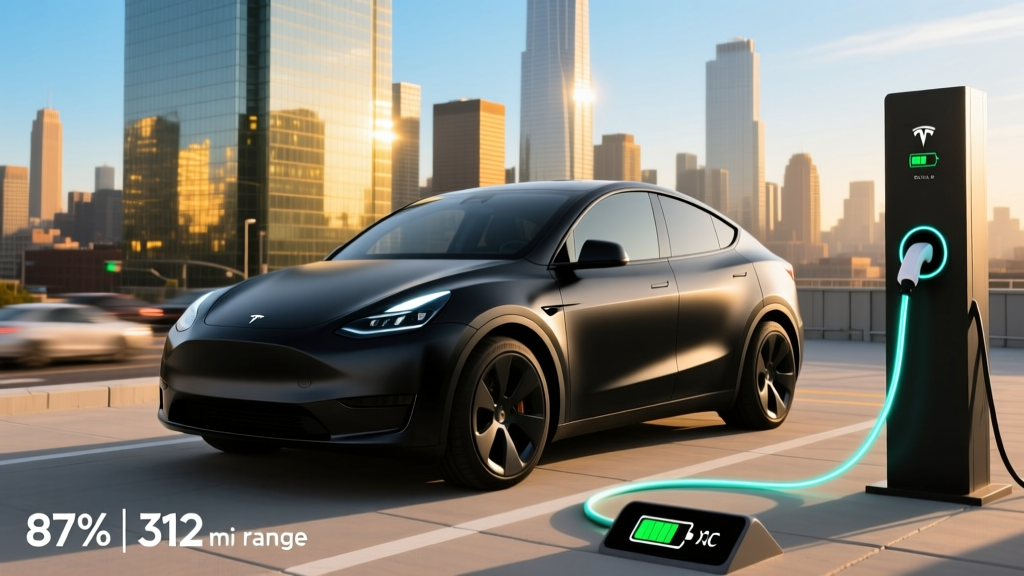
The Model Y's charge curve peaks at 250 kW from roughly 10–35% state of charge, then steps down progressively: around 170 kW through 50%, ~100 kW through 70%, and below 50 kW above 85%. This means the often-quoted "10–80% in 25 minutes" figure is realistic at a V3/V4 Supercharger with a preconditioned battery, but the last 20% (80–100%) can take an additional 25–30 minutes. For road trips, the 10–80% strategy is optimal — charge, stretch, go.
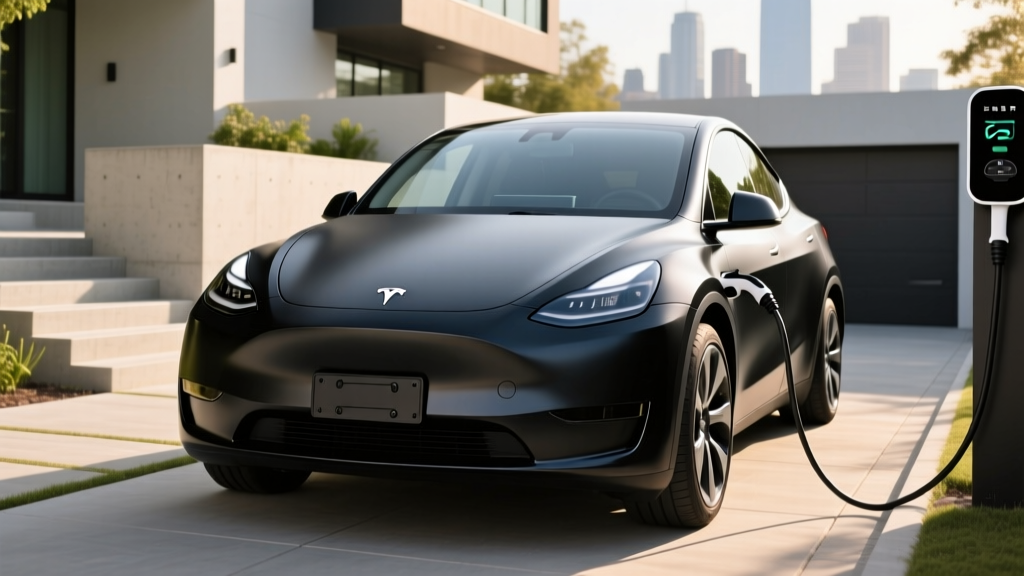
At home, Tesla's Wall Connector on a 60-amp circuit delivers 11.5 kW (48 amps continuous), adding about 44 miles of range per hour. A full overnight charge from 20% to 80% takes roughly 4.5 hours. If your home electrical panel only supports a 40-amp circuit, you'll get ~7.7 kW (30 mi/hr) — still adequate for most daily needs. Factor in $500–$1,500 for professional installation depending on your panel's proximity to the parking spot; older homes may need a $1,500–$3,000 panel upgrade to support a 60A circuit.
Pricing, Trims, and Federal Tax Credit Eligibility
| Trim | Base MSRP | Est. After §30D Credit | Destination |
|---|---|---|---|
| Long Range RWD | $44,990 | ~$37,490* | $1,390 |
| Long Range AWD | $47,990 | ~$40,490* | $1,390 |
| Performance | $52,490 | ~$44,990* | $1,390 |
*Assumes full $7,500 federal tax credit eligibility. Actual credit depends on your tax liability, income, and battery-sourcing compliance.
The IRS §30D Clean Vehicle Credit offers up to $7,500 for qualifying new EVs, but eligibility is layered:
- MSRP cap: SUVs (including Model Y) must have an MSRP at or below $80,000. All Model Y trims qualify.
- Buyer income cap: Modified adjusted gross income (MAGI) must not exceed $300,000 (married filing jointly), $225,000 (head of household), or $150,000 (single).
- Battery sourcing: The $7,500 is split into two halves — $3,750 for critical-minerals sourcing and $3,750 for battery-component manufacturing. As of 2026, vehicles with any battery components from a "foreign entity of concern" (FEOC) lose the component half. Tesla has shifted significant supply-chain sourcing to qualify for the full or partial credit, but exact eligibility can change. Always verify current status on IRS.gov's qualifying vehicle list before purchasing.
- Point-of-sale transfer: You can transfer the credit to the dealer at purchase, reducing your out-of-pocket cost immediately — even if your tax liability is lower than the credit amount.
Consult a tax professional to confirm your personal eligibility. State incentives (California, Colorado, etc.) may stack on top — check your state's energy office for current programs.
Interior Space, Cargo, and Practicality
The Juniper-refreshed Model Y improved cabin materials and acoustic glass, making it noticeably quieter than the pre-2025 generation. Space figures remain competitive for a compact electric SUV:
- Cargo volume (rear seats up): 30.2 cu ft
- Cargo volume (rear seats folded): 72.0 cu ft
- Front trunk (frunk): 4.1 cu ft
- Front legroom: 41.8 in
- Rear legroom: 41.6 in (improved ~1.0 in over pre-refresh)
- Seating: 5-passenger standard; 7-seat option available on Long Range AWD (third row is best for children only)
- Towing capacity: 3,500 lbs (AWD trims with tow package)
The rear seat gained a small touchscreen for HVAC and media control in the Juniper refresh — a welcome upgrade for rear passengers, though it replaces physical buttons entirely. Ventilated front seats and ambient lighting are now standard across trims.
Tech, Driver Assistance, and Drawbacks
The 2026 Model Y runs Tesla's latest software on a 15.4-inch front touchscreen (slightly larger than the pre-refresh 15.0-inch) and includes:
- Autopilot (standard): Adaptive cruise control + lane centering. This is SAE Level 2 — you must keep your hands on the wheel and eyes on the road at all times.
- Full Self-Driving (Supervised): Optional at $8,000 or $99/month. Adds automatic lane changes, traffic-light recognition, and city-street navigation. Despite the name, this remains SAE Level 2 — full driver supervision is required.
- Ventilated front seats (new for Juniper generation)
- Power-folding second row (button-operated)
- Acoustic glass (front and rear) — significantly reduces cabin noise
- Dashcam and Sentry Mode using the vehicle's camera suite
- No built-in 120V AC outlet or V2L — limits camping and tailgating utility vs. Ioniq 5 or F-150 Lightning
- No Apple CarPlay or Android Auto — Tesla's proprietary infotainment only
- No physical buttons for climate, mirrors, or glovebox — everything routes through the touchscreen
- Turn signal stalk removed in Juniper refresh — signals are now on the steering wheel (a learning curve, especially in roundabouts)
- Ride quality, while improved, is still firmer than the Ioniq 5 or Honda Prologue on rough pavement
Who Should Buy the 2026 Tesla Model Y?
Consider alternatives if: You need a 120V AC outlet for job-site tools or camping (look at the F-150 Lightning or Ioniq 5), you want Apple CarPlay (nearly every competitor offers it), or you prefer physical buttons and a traditional driving interface.
Pros and Cons
- 4× USB-C PD ports (65W) — charges laptops at full speed
- Class-leading Supercharger network access
- 250 kW DC fast charging; 10–80% in ~25 min
- 320-mile EPA range (Long Range RWD)
- Spacious cargo area (72 cu ft seats folded) + frunk
- Low running costs (~26 kWh/100mi)
- Strong OTA update cadence
- Qualifies for up to $7,500 federal tax credit
- No 120V AC outlet or V2L capability
- No Apple CarPlay / Android Auto
- Turn signals on steering wheel (controversial ergonomics)
- Firm ride on rough roads
- NMC battery recommends 80% daily limit (not 100%)
- FSD subscription cost adds up ($99/month)
- Insurance premiums above segment average
Frequently Asked Questions
Does the Tesla Model Y have a standard 120V power outlet?
No. The 2026 Model Y does not have a built-in 120V AC household outlet. It has a 12V DC accessory socket (inside the center console armrest), four USB-C ports, and Qi wireless charging pads. To power AC devices, you'd need an aftermarket 12V-to-120V inverter, limited to roughly 150W continuous draw.
Can I use the Tesla Model Y to power appliances during an outage?
Not natively. The Model Y does not support V2L (vehicle-to-load) or V2H (vehicle-to-home) bi-directional charging. Vehicles like the Ford F-150 Lightning (with Pro Power Onboard) or the Hyundai Ioniq 5 (with V2L adapter) offer this capability. Tesla has not announced V2L support for the Model Y as of early 2026.
What is the real-world range of the 2026 Model Y?
The Long Range RWD carries a 320-mile EPA estimate. Expect roughly 270–295 miles in real-world highway driving at moderate temperatures, and 220–255 miles in sub-freezing conditions. The Performance trim's 285-mile EPA figure translates to about 240–260 real-world highway miles.
How fast does the Model Y charge at home and on the road?
At home on a Level 2 Tesla Wall Connector (11.5 kW / 60A circuit), the Model Y adds ~44 miles of range per hour — a full overnight charge covers any daily driving. On a 250 kW DC fast charger (Supercharger V3/V4), it charges from 10–80% in approximately 25 minutes with a preconditioned battery.
Does the 2026 Model Y qualify for the $7,500 federal tax credit?
The Model Y is listed on the IRS qualifying vehicles list and falls under the $80,000 MSRP cap for SUVs. However, the full $7,500 depends on battery critical-minerals and component sourcing (which can change), as well as your personal income (MAGI must be under $150K single / $300K joint). The credit can be transferred to the dealer at point of sale. Verify current eligibility on IRS.gov before purchasing and consult a tax professional.
Is the Model Y worth buying over the Hyundai Ioniq 5 or Ford Mustang Mach-E?
The Model Y wins on Supercharger network reliability, cargo space, and efficiency. The Ioniq 5 wins on 800V ultra-fast charging (10–80% in ~18 min on 350 kW chargers), V2L capability, and a more comfortable ride. The Mach-E offers a more traditional driving feel and Apple CarPlay. If charging infrastructure access is your top priority, the Model Y's Supercharger advantage remains significant, though competitors now have access to the Supercharger network via adapter (albeit with less seamless billing and availability).
What battery chemistry does the 2026 Model Y use?
All 2026 Model Y Long Range and Performance trims use NMC (nickel manganese cobalt) lithium-ion cells with approximately 75 kWh of usable capacity. NMC offers high energy density but benefits from daily charging limited to 80% for long-term health. Tesla's battery and drive-unit warranty covers 8 years or 120,000 miles (Long Range) / 8 years or 100,000 miles (Performance), whichever comes first, against degradation below 70% capacity retention.
Always verify the latest pricing, specifications, and tax-credit eligibility on Tesla.com and fueleconomy.gov, as these can change mid-model-year.