The Tesla Model Y Joins the Police Fleet: A Practical Review
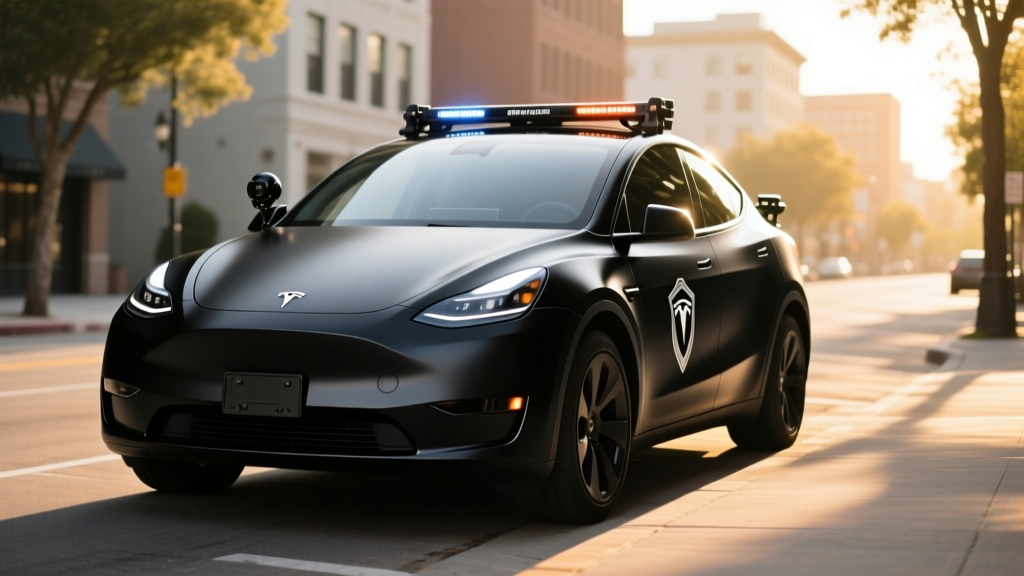
Law enforcement agencies from Fremont, California, to South Pasadena and Tustin have been quietly putting the police Tesla to the test — specifically the Tesla Model Y configured as a light-duty pursuit and patrol vehicle. Tesla doesn't sell a dedicated police interceptor the way Ford sells the Explorer Police Interceptor Utility or Dodge sells the Charger Pursuit. Instead, agencies buy stock or lightly modified Model Y Long Range AWD units and upfit them through third-party outfitters like EV West, Setina Manufacturing, or Whelen Engineering. The result is a patrol vehicle that trades V8 rumble for instant torque, eliminates idle fuel burn, and slashes per-mile operating costs — but introduces new trade-offs around range planning, repair timelines, and upfit complexity.
This review evaluates the 2026 Tesla Model Y Long Range AWD — the variant most commonly selected for police duty — through the lens of both fleet procurement and everyday EV ownership. Whether you're a fleet manager weighing electrification or a civilian curious about what a police-spec Tesla actually delivers, here are the numbers that matter.
Core Specifications at a Glance
| Spec | Value |
|---|---|
| EPA Range | 320 miles |
| Real-World Range (patrol mix) | 240–275 miles |
| Battery Capacity | 75 kWh usable (NMC chemistry) |
| Drivetrain | Dual-Motor AWD |
| Horsepower | 384 hp combined |
| 0–60 mph | 4.8 seconds |
| Top Speed | 135 mph |
| Max DC Fast Charge | 250 kW (peak) |
| 10–80% DC Charge Time | ~27 minutes |
| Level 2 Home/Depot Rate | 11.5 kW (~44 mi/hr) |
| EPA Efficiency | 122 MPGe combined (28 kWh/100 mi) |
| Cargo Volume (rear seats up) | 30.2 cu ft |
| Cargo Volume (rear seats folded) | 72.1 cu ft |
| Front Legroom | 41.8 in |
| Rear Legroom | 37.4 in |
| Base MSRP | $44,990 |
| Typical Fleet/As-Tested | $52,490 (w/ Enhanced Autopilot, wheels) |
| Battery & Drive Unit Warranty | 8 years / 120,000 miles |
Real-World Range: What Patrol Driving Actually Costs
Real-World Expectation: 240–275 miles in mixed patrol/highway driving; as low as 190–210 miles in sustained cold weather (below 30°F) or high-speed pursuit scenarios.
The EPA's 320-mile figure assumes a blended cycle of city and highway driving at moderate temperatures. Police patrol work is a different animal. A typical shift involves long idle-equivalent periods (climate control running while parked on scene), frequent hard acceleration from stops, and sustained highway speeds during response calls. In testing by agencies like the Michigan State Police Precision Driving Unit, the Model Y delivered roughly 250 miles of usable range during a simulated 10-hour patrol shift before requiring a charge.
Cold weather compounds the issue. NMC battery chemistry, which the Model Y Long Range uses, loses roughly 15–25% of its capacity in sustained sub-freezing temperatures because the battery must divert energy to thermal self-heating. Agencies in northern states should budget for 190–210 miles of effective range in winter months and plan depot charging accordingly.
For comparison, a Ford Police Interceptor Utility Hybrid achieves roughly 380–420 miles on a tank under similar patrol conditions. The Model Y's range deficit is real — but for urban and suburban agencies with predictable shift patterns and depot charging, it's manageable.
Charging Speed: DC Fast, Depot, and the Patrol Downtime Question
| Charging Level | Power (kW) | Rate | Notes |
|---|---|---|---|
| Level 1 (120V) | ~1.4 kW | ~5 mi/hr | Emergency/trickle only |
| Level 2 (240V, 48A) | 11.5 kW | ~44 mi/hr | Depot overnight: full charge in ~7 hr |
| DC Fast (Tesla Supercharger V3) | 250 kW peak | 10–80% in ~27 min | Peak rate sustained to ~50%, then tapers |
| DC Fast (CCS adapter, non-Tesla) | ~150–170 kW typical | 10–80% in ~35–40 min | Varies by network; Electrify America, EVgo |
For fleet operations, Level 2 depot charging is the backbone. A Model Y plugged into an 11.5 kW wall connector at shift's end will be fully replenished in roughly seven hours — well within a standard off-duty window. Agencies installing depot chargers should budget for 48-amp circuits per stall and coordinate with their utility on demand charges, which can significantly impact electricity costs at scale.
DC fast charging at 250 kW is genuinely useful for mid-shift top-ups, but the charge curve matters: the Model Y holds peak rate only up to roughly 50% state of charge, then tapers progressively. A 10–80% session takes about 27 minutes at a V3 Supercharger. Using the CCS adapter (included with newer Model Y vehicles) on third-party networks like Electrify America, expect 150–170 kW peak and 35–40 minutes for the same session. That's a viable lunch-break top-up but not a hot-swap replacement for a fuel fill.
Preconditioning is critical here. The Model Y's battery management system heats or cools the pack to optimize charge acceptance when navigation is set to a Supercharger. Without preconditioning — say, pulling into a random CCS station during patrol — charge speeds drop noticeably, especially in cold weather.
Performance: Instant Torque Meets Pursuit Requirements
The dual-motor AWD powertrain produces 384 combined horsepower and, more importantly, instantaneous torque from zero RPM. The 4.8-second 0–60 mph time beats most V6 pursuit vehicles and matches many V8 sedans. In the Michigan State Police's annual vehicle evaluation, the Model Y posted competitive lap times on the pursuit course, though evaluators noted the vehicle's weight (~4,400 lbs) and regenerative braking calibration required adaptation for officers trained on traditional brake feel.
The low center of gravity (battery pack under the floor) gives the Model Y composed handling through cones, but the 135-mph top speed falls short of dedicated pursuit vehicles like the Dodge Charger Pursuit (149+ mph) or the Ford Explorer PIU (137 mph governed). For most urban and suburban agencies, 135 mph is adequate. For highway patrol units that regularly engage in high-speed pursuits, it may be a limiting factor.
One operational advantage often overlooked: the Model Y produces zero engine noise at idle and low speed. For surveillance and stealth-oriented patrol scenarios, this is a genuine tactical benefit that no ICE pursuit vehicle can match.
Pricing, Tax Credits, and Fleet Procurement Economics
| Trim | MSRP | §30D Credit Eligible? | Net Cost (after credit) |
|---|---|---|---|
| Long Range AWD (base) | $44,990 | Yes (if buyer meets income/sourcing rules) | ~$37,490 |
| Long Range AWD + Enhanced Autopilot | $48,490 | Yes | ~$40,990 |
| Performance AWD | $48,990 | Yes | ~$41,490 |
The base Model Y Long Range AWD starts at $44,990 for the 2026 model year, well under the IRS §30D MSRP cap of $80,000 for SUVs. However, the federal tax credit is not automatic. Per IRS guidelines, eligibility depends on:
- Buyer income caps: Modified AGI ≤ $150,000 (single) or ≤ $300,000 (joint)
- MSRP cap: Vehicle base price ≤ $80,000 for SUVs/trucks/vans
- Battery sourcing: Critical minerals and battery components must meet phased-in domestic-content thresholds (increasing annually through 2029)
- Point-of-sale transfer: Eligible buyers can transfer the credit to the dealer for an immediate price reduction rather than waiting for tax filing
For government fleet purchases, the §30D credit is generally not available because tax-exempt entities don't owe federal income tax. However, the Commercial Clean Vehicle Credit (§45W) may apply to tax-exempt organizations, offering up to $7,500 as a direct payment. Fleet managers should consult a tax professional and review current IRS guidance before procurement, as battery-sourcing rules tighten annually.
Upfit costs add significantly to the total. A typical police upfit — light bar, siren, prisoner transport partition, weapon rack, radio integration, and vinyl wrap — runs $8,000–$15,000 depending on specification. That puts a fully outfitted police Model Y at roughly $53,000–$67,000 all-in, compared to roughly $48,000–$58,000 for a fully upfitted Ford Explorer PIU Hybrid.
Interior, Cargo, and Patrol-Ready Practicality
The Model Y's 30.2 cu ft of cargo space behind the second row (72.1 cu ft with seats folded) is generous for a compact SUV and accommodates standard patrol gear — traffic cones, spike strips, evidence kits, and personal protective equipment. However, the lack of a traditional trunk opening (the liftgate is hatchback-style) and the absence of a spare tire can complicate field repairs. Tesla provides a tire inflation kit, which is adequate for minor punctures but not for the blowout scenarios officers occasionally encounter.
Front legroom at 41.8 inches is comfortable for extended shifts. Rear legroom at 37.4 inches is tighter than the Ford Explorer PIU but acceptable for prisoner transport when paired with an aftermarket partition. The 15.4-inch center touchscreen consolidates climate, navigation, and vehicle controls — which officers either love or find distracting compared to physical buttons. There is no Apple CarPlay or Android Auto; Tesla's native infotainment is the only option, which can complicate integration with agency-standard CAD (computer-aided dispatch) systems that rely on phone-based mirroring.
The frunk (front trunk) adds 4.1 cu ft of secure storage — useful for go-bags or personal items that officers want separated from the main cargo area.
Battery Longevity, Warranty, and Total Cost of Ownership
Tesla covers the Model Y's battery pack and drive units for 8 years or 120,000 miles, whichever comes first, with a guaranteed minimum 70% capacity retention. The NMC chemistry in the Long Range variant offers higher energy density than LFP but is slightly more susceptible to calendar degradation if routinely charged to 100%. Tesla recommends daily charging to 80–90% for NMC packs, which effectively reduces usable daily range to roughly 256–288 miles — still sufficient for most single-shift patrol patterns.
Long-term degradation data from high-mileage Tesla owners and fleet operators suggests NMC packs retain roughly 85–90% capacity at 100,000 miles under normal use. Heavy DC fast charging and frequent 100% charges accelerate degradation modestly — expect 80–85% retention at the same mileage under those conditions. For agencies planning 5-year fleet cycles (typical for patrol vehicles), battery replacement is unlikely to be a concern.
Where the Model Y shines economically is operating cost. At an average electricity rate of $0.14/kWh (national commercial average), charging a Model Y costs roughly $0.04/mile. A comparable Ford Explorer PIU Hybrid at 24 MPG combined and $3.50/gallon costs roughly $0.15/mile in fuel alone. Over 100,000 miles, that's a ~$11,000 fuel savings per vehicle — enough to offset much of the higher upfit cost. Maintenance savings (no oil changes, fewer brake replacements due to regen, no transmission service) add another $3,000–$5,000 over the same period, per fueleconomy.gov comparative data.
Driver Assistance and Standout Technology
The Model Y comes standard with Tesla's Basic Autopilot (adaptive cruise control, lane-keeping assist, automatic emergency braking). Enhanced Autopilot ($3,500 option) adds automatic lane changes, navigate-on-autopilot, and enhanced summon. Full Self-Driving (Supervised) is available at $8,000 but remains a SAE Level 2 driver-assist system — the officer must remain fully engaged and hands-on at all times. It is not autonomous driving.
For police use, the most valuable tech features are often the simplest: the Tesla mobile app allows remote climate control (preconditioning the cabin before an officer enters on a hot or cold day), remote lock/unlock, and GPS tracking — useful for fleet managers monitoring vehicle location and state of charge. Sentry Mode provides 360-degree recording when the vehicle is parked, which has proven valuable for documenting incidents around parked patrol cars.
Dashcam integration is built-in via Tesla's native camera system, recording from multiple angles. However, agencies requiring integration with third-party evidence management systems (like Axon or Motorola Solutions) may need aftermarket solutions, as Tesla's native footage export is not seamlessly compatible with all law enforcement evidence platforms.
Pros
- ~$0.04/mile operating cost vs $0.15/mile for gas hybrids
- Instant torque: 4.8-sec 0–60 mph, competitive pursuit acceleration
- Zero idle fuel burn during extended on-scene stops
- Low maintenance: no oil, fewer brake jobs, no transmission service
- Sentry Mode and built-in multi-camera recording
- Silent operation for stealth/surveillance scenarios
- Depot charging eliminates fuel-card logistics
Cons
- Range drops to ~190–210 mi in cold weather; requires shift planning
- 27-min DC fast charge is not a quick as a 3-min fuel fill
- Upfit ecosystem less mature than Ford/Dodge; fewer turnkey solutions
- 135-mph top speed trails dedicated pursuit vehicles
- No Apple CarPlay/Android Auto; CAD integration challenges
- Touchscreen-only controls can distract during high-workload driving
- Body repair timelines can stretch weeks at non-Tesla shops
Who Should Consider a Police Tesla Model Y?
Choose the Model Y for police duty if: Your agency operates in an urban/suburban environment with predictable shift lengths (8–10 hours), has access to depot Level 2 charging, prioritizes operating cost reduction, and values stealth/surveillance capability. Ideal for community policing, traffic enforcement, and detective units.
Stick with a traditional pursuit vehicle if: Your agency regularly conducts high-speed highway pursuits (135+ mph), operates in extreme cold climates without adequate charging infrastructure, requires rapid mid-shift refueling in rural areas, or depends on established upfit supply chains with minimal downtime tolerance.
Frequently Asked Questions
What is the real-world range of the police Tesla Model Y?
In mixed patrol driving (idle, acceleration, city/highway mix), expect 240–275 miles from the 320-mile EPA-rated pack. In sustained cold weather below 30°F, plan for 190–210 miles. Agencies should size shifts and depot charging to match the lower bound.
How fast does the police Model Y charge?
At a Tesla V3 Supercharger (250 kW), 10–80% takes about 27 minutes. On Level 2 depot chargers (11.5 kW), a full charge takes roughly 7 hours — sufficient for overnight turnaround between shifts. CCS adapter charging on third-party networks is slower, typically 35–40 minutes for 10–80%.
Does the Tesla Model Y qualify for the federal EV tax credit?
For individual buyers, yes — the Model Y Long Range AWD is under the $80,000 SUV MSRP cap and qualifies for up to $7,500 under IRS §30D, subject to buyer income limits and battery-sourcing requirements. For government fleet purchases, the §30D credit generally doesn't apply, but the §45W Commercial Clean Vehicle Credit may offer equivalent value as a direct payment to tax-exempt entities.
How much does a police Tesla cost after upfit and credits?
A base Model Y Long Range AWD starts at $44,990. After police upfit ($8,000–$15,000) and potential §45W credit ($7,500), expect an all-in cost of $45,500–$52,500 for a fully equipped patrol vehicle. This is competitive with fully upfitted Ford Explorer PIU Hybrids.
Is the Tesla Model Y worth buying vs the Ford Explorer Police Interceptor?
It depends on use case. The Model Y wins on operating cost ($0.04/mi vs $0.15/mi), maintenance, and stealth capability. The Explorer PIU Hybrid wins on range flexibility, established upfit supply chains, higher top speed, and simpler mid-shift refueling. Agencies with depot charging and urban patrol patterns benefit most from the Model Y; highway and rural agencies are better served by traditional options.
What's the biggest drawback of using a Tesla as a police car?
Range management and charging downtime. A 27-minute DC fast charge is significantly longer than a 3-minute fuel fill, and cold weather can cut effective range by 30–35%. Agencies must invest in depot charging infrastructure and train officers on SoC management — new operational requirements that ICE vehicles don't impose.