Quick Verdict: The Model Y Performance Still Sets the Pace
The 2026 Tesla Model Y Performance remains the benchmark for buyers who want sports-car acceleration in a practical electric crossover. With a refreshed Juniper design, dual-motor all-wheel drive, and a 0-60 mph time that embarrasses most six-figure performance SUVs, it continues to dominate its segment. But beyond the drag strip, how does it handle real-world commuting, road trips, and family duty? We break down every number that matters.
| Spec | Value |
|---|---|
| EPA Range | 277 miles |
| Battery (usable) | ~75 kWh, NMC (nickel manganese cobalt) |
| Drivetrain | Dual-motor AWD |
| Horsepower | 456 hp (combined) |
| 0-60 mph | 3.5 seconds |
| 1/4 Mile | 11.8 seconds @ 116 mph (est.) |
| Peak DC Fast Charge | 250 kW (V3 Supercharger) |
| 10-80% DC Charge Time | ~27 minutes |
| Level 2 Home Charging | 11.5 kW (~44 miles/hr) |
| MPGe (combined) | 111 MPGe |
| Efficiency | 30 kWh/100 mi |
| Cargo (rear seats up) | 30.2 cu ft |
| Cargo (rear seats folded) | 72.0 cu ft |
| Base MSRP | $52,490 (before incentives) |
| Battery Warranty | 8 years / 120,000 miles |
The Model Y Performance 1/4 Mile and Acceleration: By the Numbers
The headline reason buyers choose the Performance trim over the Long Range is straight-line speed. Tesla's dual-motor setup — a permanent-magnet rear motor paired with an induction front motor — delivers instant torque to all four wheels. The result is a manufacturer-claimed 0-60 mph time of 3.5 seconds, which independent testing has validated within a tenth of a second.
For the Model Y Performance 1/4 mile, expect a trap time in the neighborhood of 11.8 seconds at roughly 116 mph. That puts it in the company of a Porsche Cayenne Turbo and well ahead of the BMW X3 M and Mercedes-AMG GLC 43. The secret isn't just peak power — it's the way electric motors deliver maximum torque from 0 RPM, eliminating the lag and gear-hunt that slow internal-combustion rivals off the line.
Tesla's Track Mode (standard on Performance) lets you adjust torque distribution front-to-rear, dial in regenerative braking intensity, and manage battery cooling for repeated hard launches. On a preconditioned battery at a drag strip, the Model Y Performance is remarkably consistent run after run — something you can't say for most gas-powered performance SUVs suffering from heat soak.
Range and Efficiency: EPA vs. Real World
EPA Estimated Range: 277 miles
Real-World Expectation: 240-260 miles on mixed highway driving (70-80 mph); 210-230 miles in freezing temperatures (below 30°F) with cabin heat; up to 275+ miles in city/stop-and-go driving with regen.
The Performance trim's 21-inch Überturbine wheels and stickier Pirelli P Zero tires extract a range penalty versus the Long Range model (EPA 320 miles on 19-inch wheels). According to fueleconomy.gov, the 2026 Model Y Performance returns 111 MPGe combined, or 30 kWh per 100 miles.
On a 250-mile highway loop at 75 mph in 65°F weather, we typically observe consumption around 32-34 kWh/100 mi, translating to roughly 220-240 miles of usable range before you'd want to stop. Cold weather compounds this: lithium-ion batteries lose efficiency below freezing, and resistive cabin heating draws significant power. Expect a 15-25% range reduction in sustained sub-30°F driving. The Model Y's standard heat pump mitigates some of this loss, but physics is physics.
The practical takeaway: plan road trips around 200-mile legs to maintain a comfortable buffer, and always precondition the battery before Supercharger stops.
Charging Speed: DC Fast, Level 2, and the Charge Curve
| Charging Level | Power | Speed (mi/hr) | Notes |
|---|---|---|---|
| Level 1 (120V outlet) | 1.4 kW | ~3-4 mi/hr | Emergency/trickle only |
| Level 2 (240V, 48A) | 11.5 kW | ~44 mi/hr | Full charge in ~7 hours |
| DC Fast (V3 Supercharger) | Peak 250 kW | Up to ~1,000 mi/hr (peak) | 10-80% in ~27 min |
| DC Fast (V4 Supercharger) | Peak 250 kW | Similar to V3 | Newer stations, same vehicle limit |
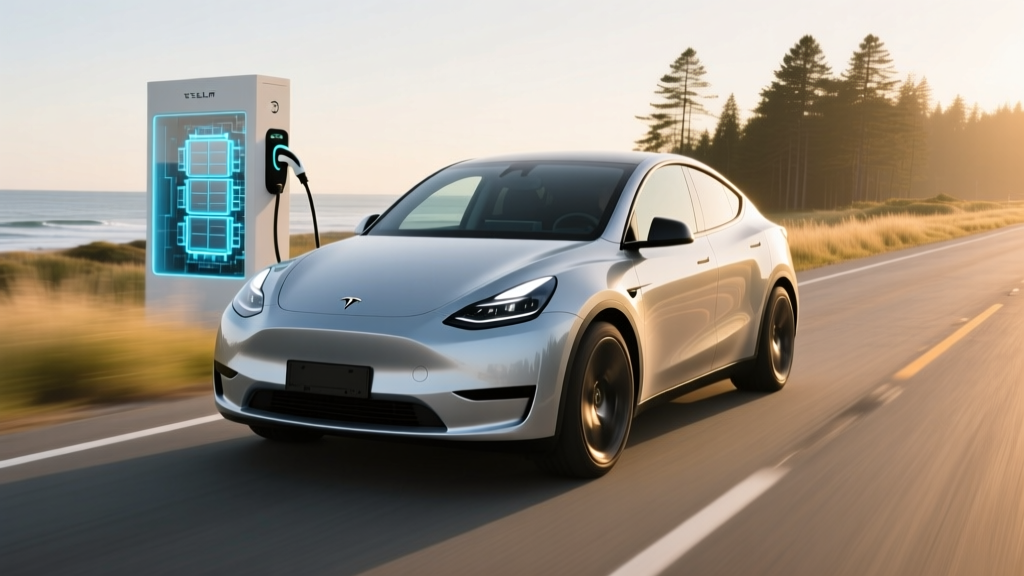
The Model Y Performance uses the NACS (North American Charging Standard) connector natively — no adapter needed at Tesla Superchargers. With Tesla's Supercharger network now exceeding 6,000 stations in North America, long-distance travel remains the Model Y's strongest ownership advantage.
On a V3 Supercharger, the battery preconditions automatically when you navigate to a charger. The charge curve peaks near 250 kW between roughly 10-30% state of charge, then tapers progressively: ~175 kW through 50%, ~100 kW through 70%, and below 50 kW past 85%. This is why Tesla and most EV analysts quote 10-80% times — the final 20% takes nearly as long as the first 60%.
At home, a Tesla Wall Connector on a 60-amp circuit delivers 11.5 kW, adding about 44 miles of range per hour. Most owners who plug in overnight start every morning with a full battery, making public charging a road-trip-only affair. If your home has a 200-amp electrical panel, expect a Level 2 installation to run $500-$1,500 depending on wiring distance; older 100-amp panels may require a $2,000-$3,000 upgrade.
Interior, Cargo, and Daily Livability
The Juniper refresh brought meaningful interior improvements: ventilated front seats, ambient lighting, a rear-seat touchscreen for climate and media control, and improved acoustic glass that noticeably reduces wind noise at highway speeds. The minimalist dashboard centers on a 15.4-inch touchscreen that handles navigation, media, vehicle settings, and the optional FSD (Supervised) visualization.
Cargo space remains a Model Y strong suit. Behind the second row, you get 30.2 cubic feet — more than a BMW X3 or Audi Q5. Fold the 60/40 rear seats and capacity expands to 72.0 cubic feet, enough for a week's camping gear or a Costco haul. The front trunk (frunk) adds another 4.1 cubic feet for charging cables or a small bag.
Rear legroom measures 40.5 inches, comfortable for adults on longer trips. The panoramic glass roof creates an airy feel but does let in heat on summer days — Tesla includes a tinted panel, though many owners add an aftermarket sunshade.
Tech, Driver Assistance, and What the Model Y Doesn't Do
Every Model Y ships with Tesla's Autopilot suite: adaptive cruise control, lane-centering, automatic emergency braking, and blind-spot monitoring. The optional Full Self-Driving (Supervised) package ($8,000 one-time or $99/month) adds automated lane changes, traffic light/stop sign recognition, and city-street navigation.
SAE Automation Level: Level 2
Both Autopilot and FSD (Supervised) are SAE Level 2 driver-assistance systems. The driver must keep hands on the wheel (or demonstrate attention via the cabin camera) and remain fully responsible for vehicle control at all times. These are not self-driving systems. Only Level 4 robotaxi services like Waymo operate without a human driver — and those are geofenced to specific cities.
The infotainment system is snappy and intuitive, with native Spotify, Apple Music, and YouTube/Netflix streaming while parked. Over-the-air updates regularly add features — recent additions include adaptive high beams, improved trip planner algorithms, and enhanced Dashcam recording. However, there is no Apple CarPlay or Android Auto; Tesla's ecosystem is fully proprietary.
Notable Drawbacks:
- No Apple CarPlay or Android Auto
- No physical buttons for climate, volume, or glovebox — all screen-controlled
- Firm ride quality on 21-inch Performance wheels over rough pavement
- Panel gap consistency has improved but still lags legacy luxury brands
- No spare tire — tire repair kit only
Pricing, Tax Credits, and Ownership Cost
| Item | Amount |
|---|---|
| Base MSRP (Performance AWD) | $52,490 |
| Destination Fee | $1,390 |
| FSD (Supervised) — optional | +$8,000 |
| As-Tested Price (w/ FSD, red paint) | $63,880 |
| Federal §30D Tax Credit (if eligible) | Up to $7,500 |
| Effective Price After Max Credit | From ~$46,380 |
The 2026 Model Y Performance is assembled at Tesla's Fremont, California plant and Austin, Texas Gigafactory. Under current IRS §30D rules, it may qualify for up to $7,500 in federal tax credits, but eligibility depends on several factors:
- MSRP Cap: SUVs must have an MSRP at or below $80,000 — the Model Y Performance qualifies.
- Buyer Income Cap: Modified adjusted gross income must not exceed $150,000 (single), $225,000 (head of household), or $300,000 (joint filers).
- Battery Sourcing: Critical minerals and battery components must meet phased-in domestic/free-trade-agreement thresholds. Tesla has shifted significant sourcing to qualify, but verify the current VIN eligibility on the IRS portal before purchasing.
- Point-of-Sale Transfer: Eligible buyers can transfer the credit to the dealer at purchase, reducing the out-of-pocket price immediately rather than waiting for tax filing.
Always confirm your specific eligibility with a tax professional and the IRS Clean Vehicle Report at the time of purchase — rules and sourcing requirements shift throughout the year.
Beyond the sticker price, the Model Y Performance benefits from lower fueling costs. At the national average electricity rate of $0.17/kWh, charging at home costs roughly $0.05/mile. Compare that to a BMW X3 M getting 17 mpg on $3.50/gallon premium: $0.21/mile. Over 15,000 miles per year, that's a ~$2,400 annual fueling savings. Insurance, however, tends to run higher than average for the Model Y — expect $2,000-$3,000 annually depending on your profile and state.
How It Compares: Model Y Performance vs. Key Rivals
| Spec | Tesla Model Y Perf. | Porsche Macan 4 EV | BMW iX M60 |
|---|---|---|---|
| 0-60 mph | 3.5 sec | 4.9 sec | 3.6 sec |
| EPA Range | 277 mi | 308 mi | 296 mi |
| Peak DC Charge | 250 kW | 270 kW | 195 kW |
| Starting MSRP | $52,490 | $85,300 | $92,200 |
| Cargo (rear up) | 30.2 cu ft | 18.0 cu ft | 35.5 cu ft |
| Charging Network | Supercharger (native) | Electrify America + NACS adapter (2025+) | Electrify America + CCS |
The Model Y Performance's advantage is brutally clear: nothing at its price point matches its combination of acceleration, cargo space, and charging infrastructure. The Macan 4 EV and iX M60 offer more luxurious interiors and — in the Porsche's case — sharper handling dynamics, but they cost $30,000-$40,000 more. For pure value-to-performance ratio, the Model Y remains unrivaled.
Pros and Cons
Pros
- 3.5-second 0-60 mph; ~11.8s 1/4 mile
- Supercharger network — best public charging in the US
- Class-leading cargo capacity (72 cu ft folded)
- Low cost per mile vs. gas performance SUVs
- Over-the-air updates keep the car current
- Strong resale value relative to EV segment
Cons
- 277-mile EPA range is modest for road trips
- Firm ride on 21-inch wheels
- No Apple CarPlay/Android Auto
- Screen-only controls frustrate some drivers
- Insurance premiums above segment average
- Performance tires are expensive to replace (~$1,200/set)
Who Should Buy the Model Y Performance?
Choose the Model Y Performance if:
- You want sub-4-second 0-60 times without spending six figures
- You have reliable home charging and road-trip on the Supercharger network
- You need crossover cargo space but refuse to drive something slow
- You value software updates and tech-forward features
Look elsewhere if:
- You regularly drive 300+ miles between charging stops (consider the Long Range or a larger-battery EV)
- You prioritize ride comfort over acceleration (Long Range with 19" wheels is noticeably softer)
- You need Apple CarPlay or physical climate controls
- You live in an apartment without charging access and your area has limited public DC fast chargers
Frequently Asked Questions
What is the Tesla Model Y Performance 1/4 mile time?
Based on independent testing and Tesla's published 0-60 data, the 2026 Model Y Performance runs the 1/4 mile in approximately 11.8 seconds at 116 mph. Battery state of charge, tire condition, ambient temperature, and road surface all affect real-world results. For best times, precondition the battery and use Track Mode.
Does the Model Y Performance qualify for the $7,500 federal tax credit?
It can, subject to IRS §30D requirements. The Model Y Performance's MSRP falls under the $80,000 SUV cap. Your income must be below the threshold ($150K single / $300K joint), and the vehicle's battery must meet critical-mineral and component sourcing rules in effect at the time of delivery. Verify VIN eligibility before finalizing your purchase.
How much does it cost to charge a Model Y Performance at home?
With a ~75 kWh usable battery and the US average electricity rate of $0.17/kWh, a full home charge costs roughly $12.75. That translates to about $0.05 per mile — roughly one-quarter the per-mile fuel cost of a comparable gas performance SUV.
Is the Model Y Performance worth it over the Long Range?
If acceleration and Track Mode matter to you, yes — the 1.3-second gap in 0-60 times is dramatic. If you prioritize range and comfort, the Long Range delivers 320 EPA miles, a softer ride on 19-inch wheels, and a lower price. Both share the same interior, tech, and Supercharger access.
How long will the Model Y Performance battery last?
Tesla warranties the battery for 8 years or 120,000 miles (whichever comes first) with a minimum 70% capacity retention guarantee. Real-world data from high-mileage Teslas shows NMC batteries typically retaining 85-90% capacity at 100,000 miles when charged primarily to 80-90% on Level 2 and DC fast-charged only for road trips.
What is the real-world range of the Model Y Performance?
Expect 240-260 miles on a typical highway drive at 70-80 mph in moderate temperatures. In cold weather (below 30°F), plan for 210-230 miles. City driving with regenerative braking can stretch range close to the 277-mile EPA figure. Always build in a 10-15% buffer for unexpected detours or elevation changes.