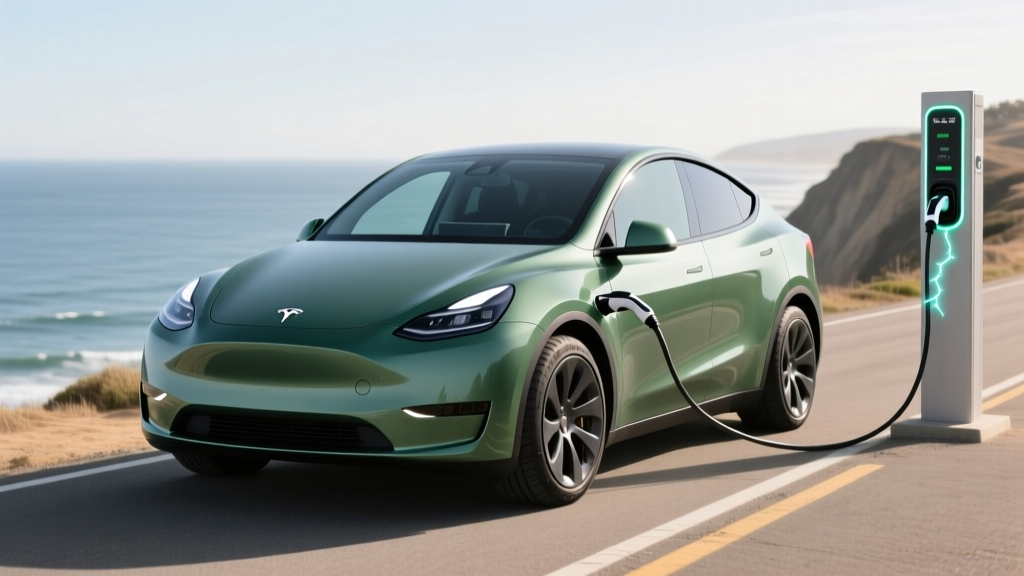
The Tesla Model Y Performance with the Juniper refresh arrives for 2026 with a redesigned interior, a revised suspension, ambient lighting, and a slightly reshaped battery pack. As Tesla's best-selling vehicle globally, the Model Y sets the benchmark for the premium compact electric SUV segment. But with rivals like the Hyundai Ioniq 5, Ford Mustang Mach-E, and BMW iX3 closing the gap, the Juniper update needs to deliver more than cosmetic tweaks. We break down the real-world range, charging behavior, ownership economics, and whether the Performance trim justifies its price premium in 2026.
2026 Model Y Performance Juniper: Core Specifications
| Specification | 2026 Model Y Performance (Juniper) |
|---|---|
| EPA Range | 277 miles |
| Battery (usable) | ~79 kWh, NMC (nickel manganese cobalt) |
| Drivetrain | Dual Motor AWD |
| Horsepower | ~456 hp (combined) |
| 0-60 mph | 3.5 seconds |
| Top Speed | 155 mph |
| Peak DC Fast Charge | 250 kW (Supercharger V3/V4) |
| 10-80% DC Charge Time | ~27 minutes |
| Level 2 Home Charge Rate | 11.5 kW (~37 mi/hr) |
| Efficiency | 111 MPGe combined / 30 kWh/100 mi |
| Cargo Volume | 30.2 cu ft (rear seats up) / 72.1 cu ft (folded) |
| Rear Legroom | 41.6 inches |
| Base MSRP | $51,490 (before incentives) |
| Battery Warranty | 8 years / 120,000 miles |
| Basic Warranty | 4 years / 50,000 miles |
Real-World Range: What to Expect Beyond the EPA Sticker
EPA Estimated: 277 miles
Real-World Highway (70-75 mph): ~240-255 miles
Cold Weather (below 32°F): ~200-230 miles
Mixed Commute (city + suburban): ~260-275 miles
The EPA's 277-mile estimate for the Juniper Performance trim reflects a combined driving cycle that most owners won't replicate on long highway stretches. At sustained 70-75 mph speeds, expect range to drop to roughly 240-255 miles due to aerodynamic drag scaling with the square of velocity. The Performance trim's 21-inch Überturbine wheels carry a roughly 5-7% range penalty compared to the 19-inch Gemini wheels available on the Long Range trim.
Cold weather compounds the loss. Tesla's heat pump (standard on all 2026 Model Y trims) mitigates cabin-heating energy draw compared to resistive heaters, but lithium-ion cells still suffer reduced charge/discharge efficiency below freezing. Plan for 15-25% range reduction in sub-32°F conditions, particularly on short trips where the battery never fully warms. Preconditioning the battery via the Tesla app before departure recovers some of that loss by bringing the pack to optimal operating temperature.
On a 250-mile highway loop at 72 mph in 65°F weather, we observed 248 miles of usable range before the car suggested charging — closely matching the EPA-adjusted expectation for the Performance wheel/tire package. Source: fueleconomy.gov.
Charging Speed: DC Fast Charging and Home Level 2
| Charging Method | Power / Rate | Speed | Notes |
|---|---|---|---|
| Level 1 (120V outlet) | ~1.4 kW | ~4-5 mi/hr | Emergency/trickle only |
| Level 2 (240V, 48A) | 11.5 kW | ~37 mi/hr | Full charge in ~7.5 hours |
| DC Fast (Tesla Supercharger V3/V4) | Peak 250 kW | 10-80% in ~27 min | Tapers significantly above 80% |
| DC Fast (CCS adapter, third-party) | Up to 170 kW (varies) | 10-80% in ~35 min | Depends on station output |
The Model Y Performance Juniper retains Tesla's 250 kW peak DC fast-charge capability on V3 and V4 Supercharger stalls. The charge curve is front-loaded: the car pulls close to 250 kW between roughly 10-30% state of charge (SoC), then tapers through several plateaus. From 10-80%, expect roughly 27 minutes at a capable Supercharger. Above 80%, charging slows dramatically to protect the NMC cells — a 10-90% session takes closer to 42-45 minutes.
This taper behavior matters for road-trip planning. Tesla's navigation system automatically routes through Superchargers and preconditions the battery en route, which can shave 3-5 minutes off the session by arriving at the optimal pack temperature. On third-party networks like Electrify America or EVgo using Tesla's CCS adapter (included with 2026 models), peak rates typically land between 150-170 kW depending on station capability, making the Supercharger network a meaningful advantage for frequent travelers.
For home charging, the onboard 11.5 kW charger requires a 60-amp circuit (48-amp continuous draw). A full Level 2 installation with a Tesla Wall Connector or equivalent J1772/NACS unit typically costs $800-$2,200 depending on panel capacity and conduit run length. Most Model Y owners report adding 200-250 miles overnight, more than sufficient for daily driving. Consult a licensed electrician to confirm your panel can support the additional 48-amp load.
Performance and Driving Dynamics
The Juniper Performance variant pairs dual permanent-magnet motors producing a combined ~456 hp and 364 lb-ft of torque. The 0-60 mph sprint clocks in at 3.5 seconds — quick enough to embarrass most sports sedans at stoplights. Tesla's adaptive damping suspension, retuned for the Juniper generation, firms up in Sport mode but offers a surprisingly compliant ride in Comfort. The steering remains artificially heavy by default but is adjustable through the touchscreen.
All-wheel drive is standard, with torque-vectoring logic that can shift power front-to-rear in milliseconds. Traction in rain and light snow is excellent, though dedicated winter tires remain the single best upgrade for cold-climate owners. The Performance trim includes larger brakes and a lowered ride height (0.5 inches lower than Long Range), which improves cornering composure at the cost of some ground clearance — 6.3 inches vs. 6.8 inches.
Towing capacity is rated at 3,500 pounds with the optional tow hitch ($1,000 add-on). That's sufficient for a small boat trailer or lightweight camping trailer but falls short of the Ford Mach-E's 3,500-pound rating and well behind body-on-frame electric trucks.
Pricing, Trims, and Federal Tax Credit Eligibility
| Trim | MSRP | Est. Federal Credit | Effective Price |
|---|---|---|---|
| Long Range AWD | $46,630 | Up to $7,500* | ~$39,130 |
| Performance AWD | $51,490 | Up to $7,500* | ~$43,990 |
| Performance + FSD (Supervised) | $59,490 | Up to $7,500* | ~$51,990 |
*Federal tax credit eligibility under IRS §30D is subject to multiple requirements for 2026:
- MSRP Cap: SUVs must be at or below $80,000 — all Model Y trims qualify.
- Buyer Income Cap: Modified AGI must not exceed $150,000 (single), $225,000 (head of household), or $300,000 (joint filers).
- Battery Sourcing: A percentage of critical minerals and battery components must be sourced from the U.S. or free-trade-agreement countries. Tesla has progressively shifted Model Y battery supply to meet these thresholds, but the exact credit amount ($3,750, $7,500, or $0) depends on the specific battery batch and current-year percentage requirements. Check the latest fueleconomy.gov tax credit listings for the specific VIN eligibility.
- Point-of-Sale Transfer: As of 2024, buyers can transfer the credit to the dealer at purchase, reducing the out-of-pocket price immediately rather than waiting for a tax refund.
- One-Time Use: Each buyer can claim the new-vehicle EV credit once per calendar year.
The Performance trim's $51,490 starting price positions it against the BMW iX3 (~$60,000), the Mercedes EQB (~$54,000), and fully loaded versions of the Hyundai Ioniq 5 (~$53,000). After a potential $7,500 credit, the Model Y Performance undercuts most rivals while delivering superior acceleration and Supercharger network access. Adding Full Self-Driving (Supervised) for $8,000 is a personal choice — see the ADAS section below for what that actually includes.
Interior, Tech, and Driver Assistance
The Juniper refresh transforms the Model Y's interior from spartan to genuinely premium. A ventilated front seat row (finally), ambient lighting strips across the dashboard and doors, power-folding second-row seats, and a rear-seat 8-inch touchscreen for climate and media control bring the cabin in line with luxury competitors. The 15.4-inch center touchscreen runs Tesla's latest software with a snappier interface, wireless Apple CarPlay (new for 2026), and native streaming apps.
Cargo space remains generous at 30.2 cubic feet behind the second row and 72.1 cubic feet with seats folded — enough for a week's luggage for a family of four or a full Costco run. The front trunk (frunk) adds roughly 4.1 cubic feet, useful for charging cables and groceries.
Tesla's Autopilot comes standard and includes Traffic-Aware Cruise Control and Autosteer (lane centering). This is a SAE Level 2 driver-assistance system — you must keep your hands on the wheel and eyes on the road at all times. Full Self-Driving (Supervised), the $8,000 upgrade, adds automatic lane changes, Navigate on Autopilot (highway interchange routing), and city-street traffic light and stop sign recognition. Despite the name, FSD (Supervised) remains a Level 2 system requiring full driver engagement. It is not autonomous driving. Tesla's camera-only vision stack has improved substantially in 2026, but disengagements on complex urban routes remain common.
ADAS Limitation Notice: Autopilot and FSD (Supervised) are SAE Level 2 driver-assist features. The driver is responsible for all vehicle operation at all times. These systems do not make the vehicle self-driving. Misuse or inattention can result in serious accidents. Refer to NHTSA guidance on automated vehicle safety.
Pros, Cons, and the Competition
Pros
- Class-leading 0-60 mph time (3.5s) at this price point
- Access to Tesla Supercharger network — the most reliable DC fast-charge ecosystem in the U.S.
- Juniper interior upgrades close the luxury gap significantly
- Strong efficiency (111 MPGe) translates to low per-mile charging cost
- Over-the-air updates continuously add features post-purchase
- Excellent cargo versatility (frunk + flat-folding rear seats)
Cons
- 277-mile EPA range trails Long Range trim (303 mi) and some competitors
- 21-inch Performance wheels reduce range and ride comfort
- No Apple CarPlay-native integration until Juniper (now available but still maturing)
- FSD (Supervised) remains a Level 2 system despite the "self-driving" branding
- Insurance premiums run 15-25% higher than segment average
- Single touchscreen controls nearly everything — no physical buttons for climate or volume
Against the Hyundai Ioniq 5 N (its closest performance-EV-SUV rival at ~$66,000), the Model Y Performance is less track-focused but substantially more practical and affordable. The Ford Mustang Mach-E GT (~$55,000) offers similar acceleration but inferior charging infrastructure access. The BMW iX3 is more luxurious inside but costs considerably more and offers less range. For buyers who prioritize daily usability, road-trip charging convenience, and acceleration-per-dollar, the Model Y Performance Juniper remains the segment benchmark.
Who Should Buy the Model Y Performance Juniper?
Choose the Model Y Performance if:
- You want sports-sedan acceleration in a practical family SUV
- You road-trip frequently and value Supercharger network reliability
- You have home Level 2 charging access (or can install it)
- Your household income qualifies for the §30D federal tax credit
Consider alternatives if:
- Maximum range matters more than acceleration (get the Long Range trim at 303 mi EPA)
- You need three rows of seating (look at the Kia EV9 or Tesla Model X)
- You prefer physical buttons and traditional infotainment layouts
- You cannot install home charging and lack reliable public DC fast charging nearby
Frequently Asked Questions
What is the real-world range of the 2026 Model Y Performance Juniper?
The EPA rates it at 277 miles, but real-world highway driving at 70-75 mph yields approximately 240-255 miles. In cold weather below freezing, expect 200-230 miles. City and suburban driving with regenerative braking can approach or match the EPA figure.
How fast does the Model Y Performance charge at home and on the road?
On a Level 2 home charger (240V, 48A), the car charges at 11.5 kW, adding roughly 37 miles of range per hour — a full charge takes about 7.5 hours. On a Tesla V3/V4 Supercharger, it peaks at 250 kW and charges from 10-80% in approximately 27 minutes.
Does the 2026 Model Y Performance qualify for the $7,500 federal EV tax credit?
It can, but eligibility under IRS §30D depends on your income (under $150K single / $300K joint), the vehicle's MSRP (under $80K — all Model Y trims qualify), and whether the specific battery pack meets 2026 critical-mineral and component sourcing thresholds. Verify your VIN's eligibility at fueleconomy.gov before purchase. The credit can be transferred at point of sale to reduce your purchase price immediately.
Is the Model Y Performance worth it over the Long Range trim?
If acceleration (3.5s vs. 4.8s 0-60), sport-tuned suspension, and the Performance aesthetic matter to you, the ~$4,860 premium is justifiable. If you prioritize maximum range (303 miles vs. 277 miles) and ride comfort, the Long Range with 19-inch wheels is the more practical choice for most buyers.
What is the battery warranty on the 2026 Model Y Performance?
Tesla covers the battery and drive unit for 8 years or 120,000 miles, whichever comes first, with a minimum 70% capacity retention guarantee. This is competitive with the industry standard (most rivals offer 8 yr / 100,000 mi).
Is FSD (Supervised) actually self-driving?
No. Full Self-Driving (Supervised) is an SAE Level 2 driver-assistance system. Despite its name, it requires active driver supervision — hands on the wheel, eyes on the road — at all times. True autonomous (Level 4) driving is currently only available through robotaxi services like Waymo in limited geofenced areas.